
On The Nation and Empire
On “The Nation” and Empire
Our magazine has refused to accept what contributor Gore Vidal once described as the “cozy unremitting war” that puts this country in a state of conflict, year after year.
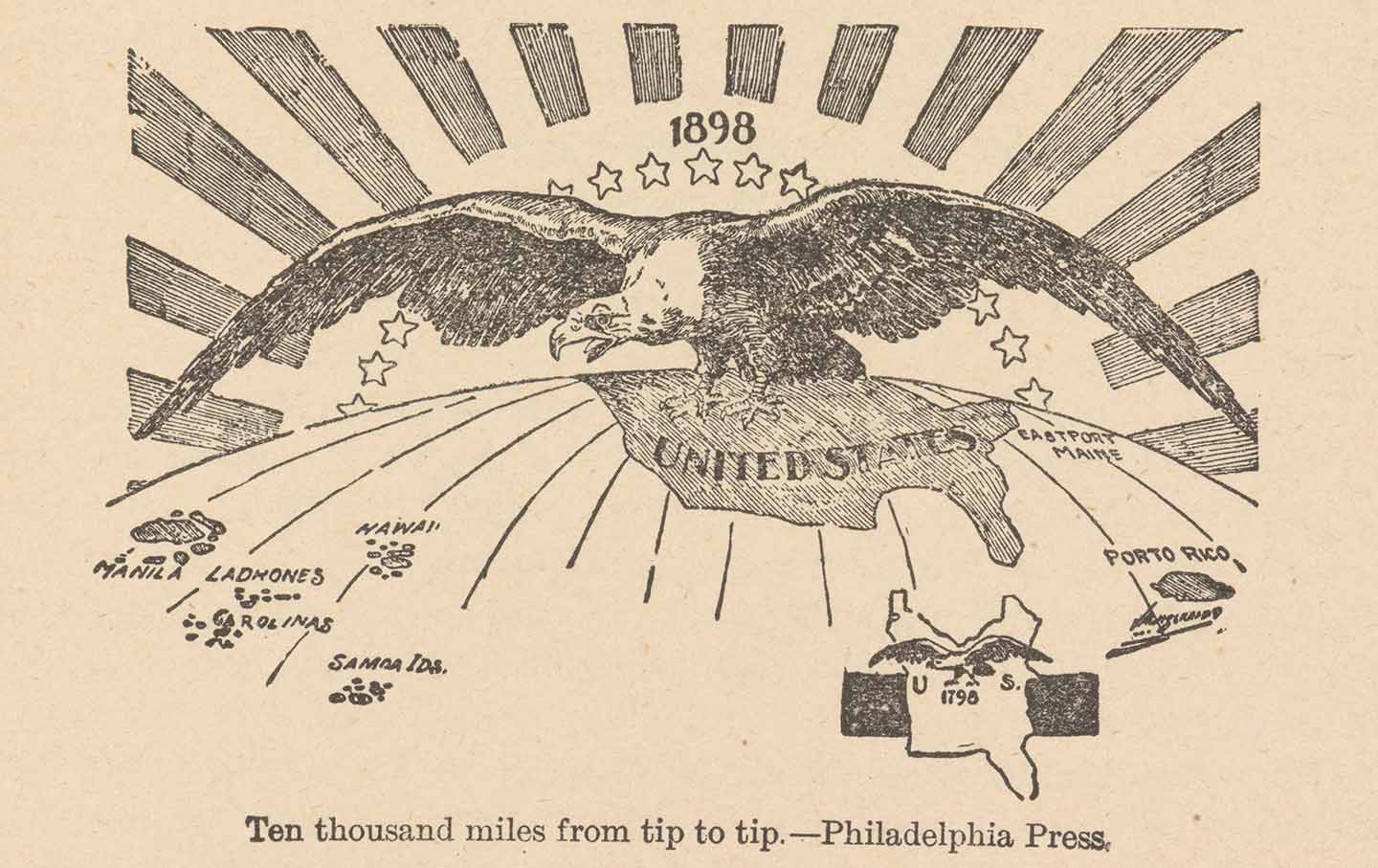
The United States was a youthful 89 years old when The Nation was founded by abolitionists at the end of the Civil War. Over the ensuing 161 years, our magazine has maintained a set of North Star values that have guided us through the darkest moments in this country’s 250-year journey. Among the steadiest of these values has been our opposition to the imperial adventures, bloated Pentagon budgets, and warped priorities that wrongheaded presidents and pliant congresses have led our country into. We have not opposed every war. But we have consistently refused to accept what our longtime contributor Gore Vidal once described as the “cozy unremitting war” that puts this country in a state of conflict, or on the verge of it, year after year, decade after decade, century after century. So it was that, as Nation editors and writers prepared this special issue marking the 250th anniversary of American independence, we were also busy opposing Donald Trump’s illegal, immoral, unnecessary, and undeclared war with Iran. The president’s ill-advised decision to pick this fight quickly spawned regional conflicts, global economic chaos, and mass opposition. But we have not opposed the war merely out of disdain for Trump’s reckless disregard for the consequences of his actions. We opposed it as the latest example of an American pattern of disregarding diplomacy in favor of a military adventurism that destroys lives, wreaks havoc abroad, and—as Secretary of State John Quincy Adams warned on July 4, 1821—so deeply involves the US in foreign intrigues that leaders abandon the pursuit of domestic tranquility and leave us with an America that is “no longer the ruler of her own spirit.”
As the United States celebrates the 250th anniversary of its founding, it is striking to note that the founders warned against many of the very harms of military adventurism that The Nation has decried throughout its history. “No nation,” James Madison warned, “could preserve its freedom in the midst of continual warfare.” Addressing the Constitutional Convention in 1787, Madison declared: “A standing military force, with an overgrown Executive will not long be safe companions to liberty. The means of defense against foreign danger, have been always the instruments of tyranny at home.” Later, in the mid-1790s, Madison argued:
War is, in fact, the true nurse of Executive aggrandizement. In war a physical force is to be created, and it is the Executive will which is to direct it. In war the public treasures are to be unlocked, and it is the Executive hand which is to dispense them. In war the honors and emoluments of office are to be multiplied, and it is the Executive patronage under which they are to be enjoyed. It is in war, finally, that laurels are to be gathered, and it is the Executive brow they are to encircle.
In those first decades of American independence from the clutches of the British Empire, Madison’s concerns were widely shared by other founders, as well as by ordinary Americans. “[America’s] glory is liberty, not dominion. Her march is the march of the mind. She has a spear and a shield, but the motto upon her shield is, Freedom, Independence, Peace,” Adams announced in a message to Congress. Indeed, he stressed:
She goes not abroad in search of monsters to destroy. She is the well-wisher to the freedom and independence of all. She is the champion and vindicator only of her own…. She well knows that by once enlisting under other banners than her own, were they even the banners of foreign independence, she would involve herself beyond the power of extrication, in all the wars of interest and intrigue…. The fundamental maxims of her policy would insensibly change from liberty to force…. She might become the dictatress of the world. She would be no longer the ruler of her own spirit.
We mark this July Fourth by recognizing that The Nation has grounded its opposition to military adventurism in many of the same values articulated by the founders. From its inception, The Nation has challenged America’s imperial misadventures and the military-industrial complex that developed to advance them. In 1893, nearly 30 years after the magazine’s founding, when European and American businessmen overthrew the queen of Hawaii and sought the annexation by the US of the island she ruled, The Nation denounced the takeover as antidemocratic and warned of what might come next:
People talk about the grand civilizing and protecting mission of the United States. We are not to shrink selfishly and timidly within our own borders, but are to go forth, as a state-errant, to redress the wrongs of other countries, to rescue the oppressed, and, incidentally, to take their land.… What they have in their minds is a remorseless trampling upon native rights, opportunities for personal enrichment.… That, in plain terms, is what the benevolent mission of the United States will come to in execution—its tender mercies proving cruel—and that is the end to which the Hawaiian beginning will surely conduct us.
That prophecy was immediately validated by the United States’ entering into war against Spain. The Nation rallied to oppose the 1898 Spanish-American War. The magazine also enthusiastically endorsed the Anti-Imperialist League, “whose object is to bring together the united efforts of men of repute throughout the country to resist what is commonly called imperialism, or the annexation of territory not contiguous to the United States.” E.L. Godkin, The Nation’s founding editor, was among the leaders of the Anti-Imperialist League, joining Mark Twain, William James, and Andrew Carnegie to “resist what is commonly called imperialism.”
When that conflict led America into its first brutal counterinsurgency war, in the Philippines, The Nation asked, “What are we doing but establishing chaos and carrying it on as a sort of business in which we are proud to excel?” The editors wrote that “Anti-Imperialism is only another name for old-fashioned Americanism.”
Under the leadership of Ernest Gruening, the managing editor from 1920 to 1922, The Nation became a lonely voice denouncing America’s use of “gunboat diplomacy” to press its agenda in Latin America and its interventions in the Dominican Republic and Haiti in the 1920s. Gruening later became a champion of Franklin Roosevelt’s still-relevant “Good Neighbor” policy, which stressed economic and political cooperation to improve relations with Central and South American nations.
After World War II, The Nation warned about the dangers of the emerging national-security state and the use of the Red Scare to justify intervention abroad and oppression at home. In 1960, The Nation reported that the US was training Cuban exiles as paramilitaries in the forests of Guatemala. The exposé, ignored by the mainstream press, was followed by the Bay of Pigs debacle, and the execrable US covert war and overt economic boycott of that island that continues to this day.
The Nation still takes pride in having been labeled a premature opponent of the Vietnam War, by predicting as early as 1945 that the French effort to revive its imperial control of the country would fail and, in a 1954 editorial by the historian Bernard Fall, warning against the US getting involved militarily.
A decade later, in 1964, after Gruening, now a senator from Alaska, cast one of the only two votes against the Gulf of Tonkin Resolution, The Nation stood in staunch opposition to the ensuing escalation. While the mainstream press recycled the government’s propaganda on the war, we exposed the lies and horrors on the ground.
This proud tradition of truth-telling dissent continued into the 21st century. After 9/11, The Nation questioned the misbegotten “War on Terror” both abroad and at home. We were one of the few publications warning early, and often alone, against George W. Bush’s “war of choice” on Iraq, the folly of the so-called “good war” in Afghanistan, and the perverse intervention in Libya.
Today, The Nation continues to expose the lies and myths, and the monstrous misadventures, of the imperial executive—from the arming of the Israeli assault on Gaza, to the kidnapping of Venezuela’s president, to the reckless war on Iran.
We regret that too many Republicans—and Democrats—continue to disregard the warnings of the founders. But we celebrate a growing trans-partisan revulsion with the reality that post–World War II America has been at war virtually nonstop, with more than 200 military interventions since 1950, including regime-change operations—both overt and covert—from Indonesia and Iran to Guatemala, Chile, Panama, Nicaragua, Honduras, and Venezuela.
Americans recognize that this country does not need an empire of over 700 military bases across the world. Nor does it require an almost 40 percent increase in an already bloated Pentagon budget—to the staggering $1.5 trillion figure that Trump has demanded.
Popular
“swipe left below to view more authors”Swipe →The historic truth from our country’s first 250 years is this: Had our leaders invested more in human needs at home rather than undeclared and unnecessary wars abroad, as Gore Vidal always argued, those wiser priorities “would have saved us debt, grief, blood.”
Now we find ourselves at a critical juncture, where Trump has brutally clarified the extent to which our global pretensions endanger the republic itself—and has revealed the essential requirement that a dramatic change in course is necessary if our freedom and our future are to be preserved for the next 250.
More from The Nation

What’s It Like Inside a Data Center? What’s It Like Inside a Data Center?
Northern Virginia is laden with structures that house data for Fortune 500 companies. I went inside just one of those monstrosities that bothers its neighbors.
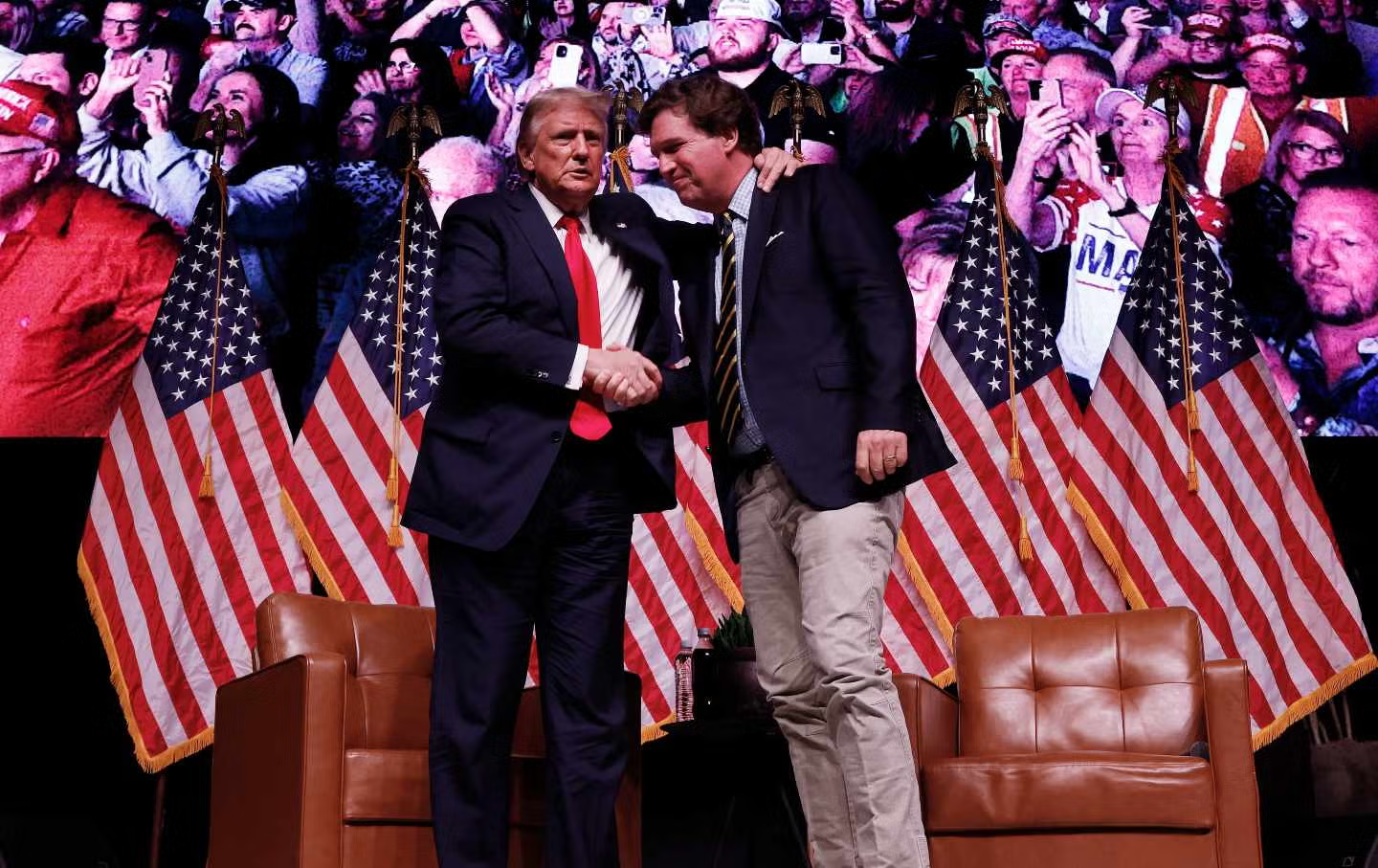
What Trump and Tucker Carlson Have in Common What Trump and Tucker Carlson Have in Common
Carlson has broken with Trump largely over the war in Iran. But on Ukraine and immigration, the two speak very much the same language.

The Jewish Case Against AI The Jewish Case Against AI
Haredi rabbis and the secular left agree: This technology is a threat to the entire social fabric.
The Fight for Educational Equality Is Also a Fight for a Just Supreme Court The Fight for Educational Equality Is Also a Fight for a Just Supreme Court
The court has severely weakened our ability to make an education system that fulfills the promise of Brown.

The Fall of “Scientific American” The Fall of “Scientific American”
When the beloved science publication got too political, its corporate owners stepped in. Now its future is uncertain.

The Bookstore Revolution in Taiwan’s Conservative Heartlands The Bookstore Revolution in Taiwan’s Conservative Heartlands
After Taiwan legalized same-sex marriage, gender-themed bookstores are working to build the social acceptance that the law alone couldn’t deliver.

