Our Back Pages / February 13, 2026

The Repeating History of US Intervention in Venezuela

A look back at The Nation’s 130 years of articles about Venezuela reveals that the more things change, the more they stay the same.
Richard Kreitner

The Nation has been covering Venezuela for a long time—since before Trump and Maduro, before Chavismo, before the drug war. Spread across three centuries, the coverage is most remarkable for the consistency of its themes: struggles between autocracy and democracy, debates over foreign intervention and national self-determination, dispatches about the corrupting role of oil in enriching the ruling class and attracting predatory foreign powers.

The Nation’s first notable story is from 1895, when a conflict over Venezuela’s border with the British territory of Guiana (now Guyana)—where gold had recently been found—provoked President Grover Cleveland to invoke the decades-old Monroe Doctrine: European powers had no right to intervene in the Western Hemisphere. Cleveland’s statement heralded a new era of US chest-thumping that culminated three years later with the Spanish-American War. Alarmed by the president’s rhetoric, The Nation ridiculed the idea that “we are going, in the name of the Monroe doctrine, to assert such ownership of the American hemisphere as will enable us to trace all the boundary lines on it to our own satisfaction in defiance of the rest of the world.”

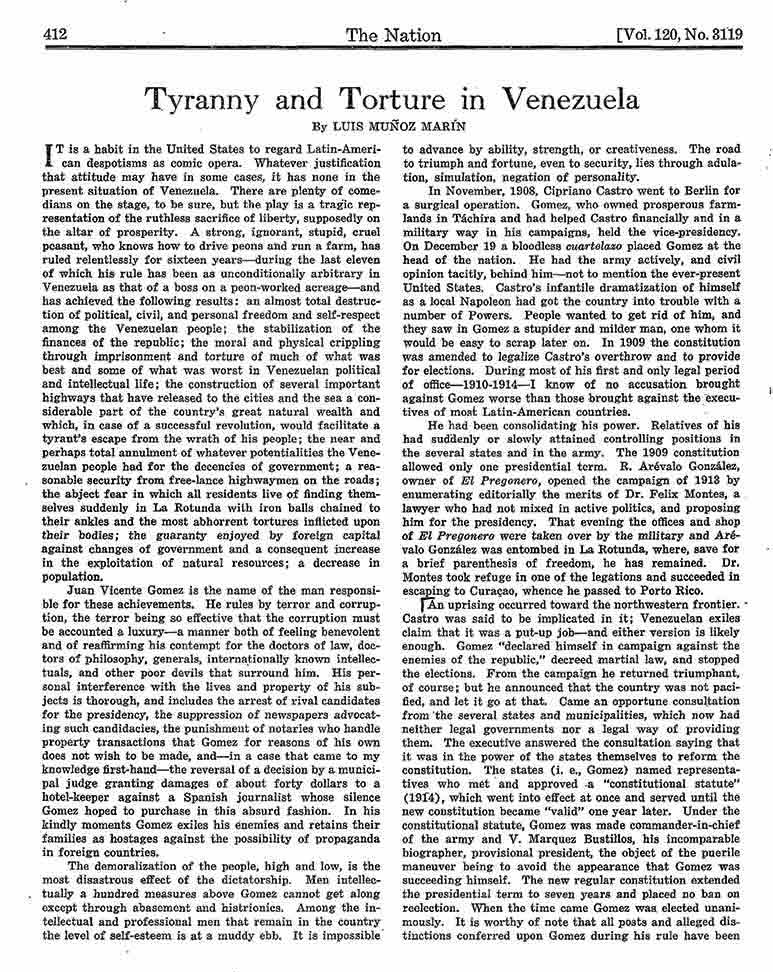
Regrettably, that is just what the US government did, repeatedly meddling in Latin America to prop up rulers who preyed on their own people and served corporate interests. From 1908 to 1935, Venezuela was ruled by Juan Vicente Gómez, a dictator who governed “by terror and corruption,” as the great Puerto Rican journalist and politician Luis Muñoz Marín wrote in these pages in 1925. Gómez invoked martial law, replaced the constitution, and tortured and imprisoned his critics. “The picture is lurid and grotesque,” Muñoz Marín concluded.

Venezuela had begun pumping oil in 1914. But the profits went not to the people but to foreign companies and local elites. “Gomez has left nothing undone to make foreign capital at home in Venezuela,” The Nation’s Mauritz A. Hallgren noted in 1928. US companies returned the favor with their unqualified support for his regime.

In 1951, with yet another dictator leading Venezuela, The Nation published “Suicide by Oil,” in which the journalist Marcelle Michelin reported, “Venezuela appears extravagantly wealthy. But the Venezuelans to whom black gold has meant a better way of life are the fortunate minority of the cities and oil camps—landowners, business men, factory hands, government employees, corporation bureaucrats. The people of the pueblos and fishing villages go on laboriously wresting what sustenance they can from earth and water.”

Again and again, in reading The Nation’s coverage, one encounters a similar story: malevolent actors, inside and outside the country, conspiring to separate the people from their land and resources—and, with them, the fulfillment of their fiercely held hopes and dreams.

Support independent journalism that does not fall in line

Even before February 28, the reasons for Donald Trump’s imploding approval rating were abundantly clear: untrammeled corruption and personal enrichment to the tune of billions of dollars during an affordability crisis, a foreign policy guided only by his own derelict sense of morality, and the deployment of a murderous campaign of occupation, detention, and deportation on American streets. 

Now an undeclared, unauthorized, unpopular, and unconstitutional war of aggression against Iran has spread like wildfire through the region and into Europe. A new “forever war”—with an ever-increasing likelihood of American troops on the ground—may very well be upon us.  

As we’ve seen over and over, this administration uses lies, misdirection, and attempts to flood the zone to justify its abuses of power at home and abroad. Just as Trump, Marco Rubio, and Pete Hegseth offer erratic and contradictory rationales for the attacks on Iran, the administration is also spreading the lie that the upcoming midterm elections are under threat from noncitizens on voter rolls. When these lies go unchecked, they become the basis for further authoritarian encroachment and war. 

In these dark times, independent journalism is uniquely able to uncover the falsehoods that threaten our republic—and civilians around the world—and shine a bright light on the truth. 

The Nation’s experienced team of writers, editors, and fact-checkers understands the scale of what we’re up against and the urgency with which we have to act. That’s why we’re publishing critical reporting and analysis of the war on Iran, ICE violence at home, new forms of voter suppression emerging in the courts, and much more. 

But this journalism is possible only with your support.

This March, The Nation needs to raise $50,000 to ensure that we have the resources for reporting and analysis that sets the record straight and empowers people of conscience to organize. Will you donate today?

Richard Kreitner

Richard Kreitner is a contributing writer and the author of Break It Up: Secession, Division, and the Secret History of America's Imperfect Union. His writings are at richardkreitner.com.

More from The Nation

Peter Thiel speaks during a news conference in Tokyo, Japan, on November18, 2019.

Welcome to the Era of the AI-Powered War Machine Welcome to the Era of the AI-Powered War Machine

How a clique of unhinged techno-optimists is putting humanity at risk.

Janet Abou-Elias and William D. Hartung

Palestinians, mainly children, wait to get hot food distributed by a charity organization as food shortages continue amid restrictions on the entry of aid.

How a Rocket in Iran Reverberates in Gaza How a Rocket in Iran Reverberates in Gaza

As Israel bombards Iran with rockets, it is sealing off borders across Gaza and the West Bank, halting the flow of food, aid, and bodies.

Hassan Herzallah

Israeli Prime Minister Benjamin Netanyahu and Finance Minister Bezalel Smotrich listen to a speech given by Indian Prime Minister Narendra Modi at the Knesset, in Jerusalem, on February 25, 2026.

How the Israeli Tail Wags the American Dog How the Israeli Tail Wags the American Dog

The US attack on Iran may be less about American security than about the priorities of Israel’s government.

Eli Clifton and Ian S. Lustick

An oil tanker in the Strait of Hormuz as viewed from the town of Al Jeer in the United Arab Emirates, on February 25, 2026.

What to Expect From a Mammoth Disruption of Global Oil and Gas Supplies What to Expect From a Mammoth Disruption of Global Oil and Gas Supplies

And why was the Trump team so unprepared for shock waves?

Stanley Reed

The Man Who Would Be the Face of the Anti-Trump West

The Man Who Would Be the Face of the Anti-Trump West The Man Who Would Be the Face of the Anti-Trump West

Mark Carney has put himself forward as one of the sharpest Western critics of Trump’s neo-imperial order. What’s less clear is what he’s offering in its stead.

Feature / Jeet Heer

The “Rules-Based Order” Is Gone. Let’s Not Bring It Back.

The “Rules-Based Order” Is Gone. Let’s Not Bring It Back. The “Rules-Based Order” Is Gone. Let’s Not Bring It Back.

Trump has destroyed a global system that mostly benefited the rich and powerful. We need to create something completely different in its wake.

Feature / Robert L. Borosage