
The Immeasurable Endurance of the Women of Gaza
Women here have become both the primary caretakers and providers, sustaining their families in the absence of husbands, fathers, and sons.
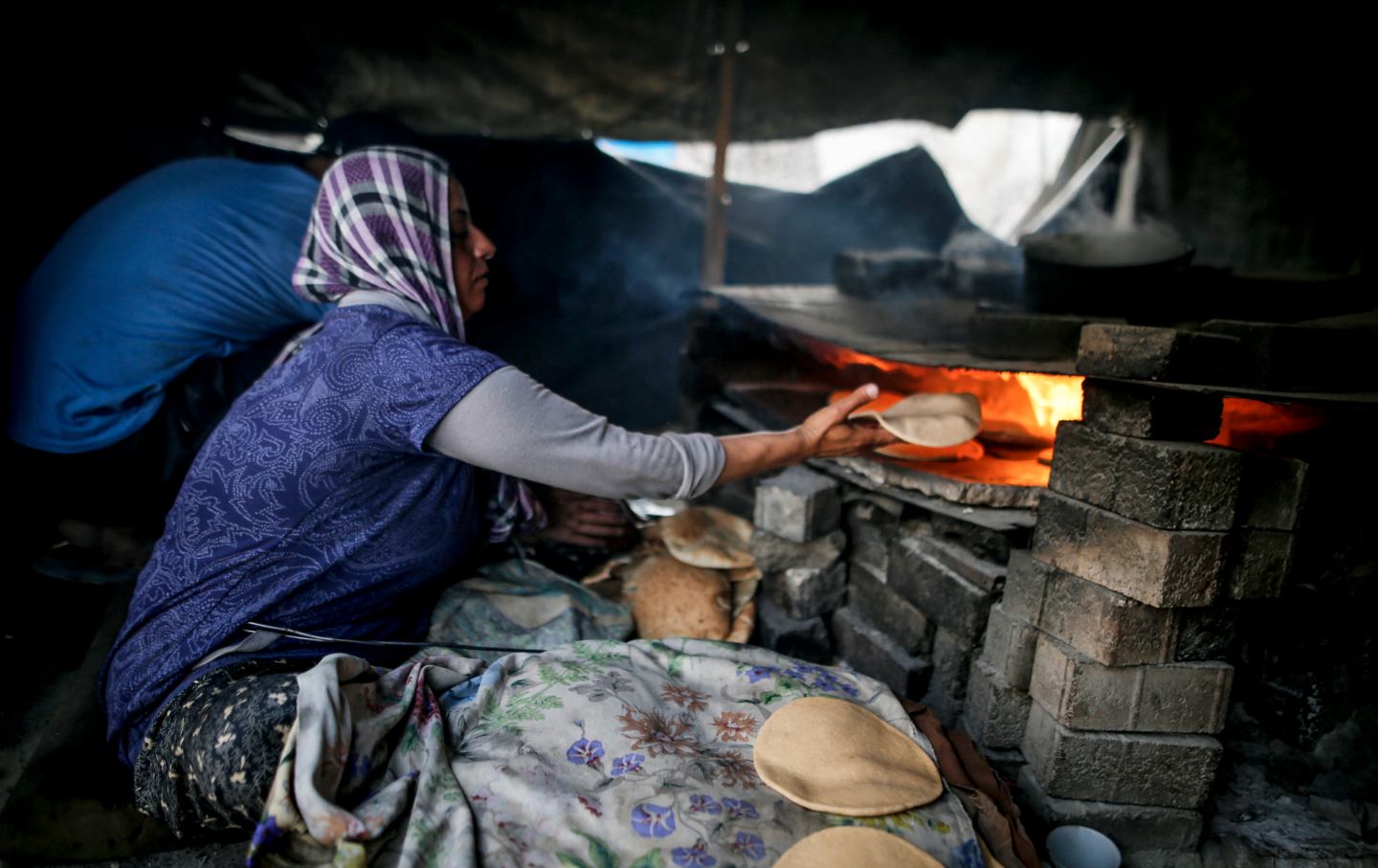
A displaced Palestinian woman bakes bread inside a damaged building at the Islamic University in Gaza City on April 18, 2026.
(Saeed Jaras / Middle East Images / AFP via Getty Images)Gaza—Women possess an invaluable strength—a resilience built on survival, not choice—and the women of Gaza have had to be especially strong. Since Israel’s genocide began in October 2023, they have endured one of the most severe humanitarian crises in modern history.
The numbers are harrowing: Over 12,400 Palestinian women have been killed in Gaza in the last two-and-a-half years, alongside more than 18,500 children. These deaths are not just statistics—they represent lives shattered, families torn apart, and an entire community living in the shadow of destruction. Yet, even in the face of such brutality, Gazan women persist. They carry their communities, serving as pillars of endurance amid the ruins of a society that has been all but erased.
Women here have become both the primary caretakers and providers, responsible for securing food, water, and shelter, caring for the injured, and sustaining their families in the absence of husbands, fathers, and sons. They are continually forced to make agonizing decisions as medical systems collapse and access to care becomes severely limited. Families are struggling to obtain treatment for injured or chronically ill children amid overwhelmed hospitals and critical shortages. Ongoing violence and restricted access to emergency services and the lack of equipment for the Civil Defense team have, in some cases, left families unable to reach or assist loved ones in time.
But in overcrowded displacement camps, in shelters exposed to the elements, and in makeshift homes that barely offer protection, they persist—not out of choice, but because there is no alternative. They are mothers who comfort children through amputations without anesthesia, daughters who bury their parents, and wives who carry the unbearable grief of losing a husband in a single air strike. Their suffering is both physical and psychological, yet they continue to care for the next generation, even as their own bodies give way to exhaustion.
Gazan women queue for hours for water while carrying infants. They search hospitals for missing sons. They remember the names of their martyrs and they pray for them, so their children are not reduced to mere numbers. They continue to teach their remaining children how to read, how to pray, how to hope even when the future seems anonymous in Gaza.
Hospitals and shelters have become sites where motherhood is repeatedly tested. Women give birth without painkillers, anesthesia, or adequate medical care, sometimes on hospital floors or in overcrowded classrooms converted into shelters. Newborns arrive into a world of malnutrition and starvation, contaminated water, and relentless bombardment. For many women, the fear does not end with childbirth but only begins.
Displacement has further stripped women of stability, privacy, and safety. Women shoulder the responsibility of keeping children safe as tents collapse under winter rain or summer heat, as sanitation breaks down, and as disease spreads. In tents and shelters, basic acts—bathing, menstruating, breastfeeding—have become daily struggles. Girls grow up too fast, learning fear before they learn freedom.
The psychological toll is staggering. Gazan women are expected to carry the weight of grief, trauma, and responsibility, while maintaining some semblance of normalcy for their children. They endure the emotional pain of burying their loved ones in silence so that others may grieve publicly. And despite it all, they persist—not out of innate resilience, but because collapse is not an option. To falter is to risk the complete erasure of a people and a culture.
Many Gazan women have played many roles at once and become both parents overnight. Others have lost entire families. Some, like pediatrician Dr. Alaa Al-Najjar, survived the unimaginable—losing nine children and her husband in a single air strike—yet continued her commitment to her work as a doctor.
Amal Ammar, the wife of journalist Yahya Sobeih, who was killed by the Israeli occupation, is now raising her children alone. Baraa, Kennan, and Sanaa are growing each day, missing their father, Yahya. Like her, the wives of journalists Ismail Al-Ghoul, Anas Al-Sharif, and Roshdi Sarraj have been forced into single motherhood by targeted killings—a reality shared by countless other women whose lives have been irreversibly altered by the genocide.
In the midst of this, some women have also taken on the perilous task of documenting the ongoing genocide. Palestinian women journalists, facing one of the most dangerous environments in the world for reporters, continue to bear witness to the suffering around them. They report from the rubble, from overcrowded shelters, and from hospitals on the verge of collapse, while carrying the grief of their own personal losses. Their role is critical—not just for their community but for the world, which has too often ignored the destruction of Gaza. These women wield cameras, microphones, and pens in place of weapons, and yet their courage has been met with violence. Many have been killed while documenting the atrocities around them, but their stories live on, ensuring that Gaza’s suffering is not erased.
One of the most courageous figures among them is Mariam Abu Daqqa, whose voice has become a symbol of determination and truth. Despite constant bombardment, she has continued to report on the realities of life under siege, documenting the horror for the world to see. But she is not alone. Women journalists across Gaza continue to work in the face of overwhelming danger, knowing that silence would only further perpetuate their suffering.
Popular
“swipe left below to view more authors”Swipe →Gazan women are not merely surviving genocide—they are holding on to a fragile thread of hope. They are the strongest because they have already given everything to keep their families alive. For them, the question remains: How much longer must they bear this burden? How much longer must they endure the unbearable while the world looks away?
As international indifference persists, the women of Gaza continue their fight—not just for their survival but for a future that seems ever more uncertain. They do so with extraordinary courage, driven not by hope but by the unrelenting will to keep their families and their people alive, in a place where every day feels like a fight for existence itself.
More from The Nation

Japan’s Far Right Is Courting Young Voters Japan’s Far Right Is Courting Young Voters
Sanseitō has attracted young voters through a robust social-media strategy, Charlie Kirk–like public speaking events, and anti-establishment messaging.
This AI Panic Is Nothing New This AI Panic Is Nothing New
In the 1940s, The Nation asked questions about the atomic bomb we’re asking of artificial intelligence today.

The Decades-Old Roots of Trump’s War on Iran The Decades-Old Roots of Trump’s War on Iran
An interview with historian Behrooz Ghamari-Tabrizi about the generations of US presidents who have tried to destroy the Iranian regime.
Emmanuel Macron’s Turbulent Exit Emmanuel Macron’s Turbulent Exit
Between a budget crisis and a cost-of-living squeeze, Macron is leaving a country feeling more insecure than ever—and ready to take to the streets.
Israel’s Election Can’t Fix What Netanyahu Broke Israel’s Election Can’t Fix What Netanyahu Broke
The fundamental problem is not the name of the prime minister, but rather the actions of the Israeli government and the urgent issues that need to be addressed.

The AfD’s Rise Isn’t Just About East Germany The AfD’s Rise Isn’t Just About East Germany
The Alternative für Deutschland has a stable national poll lead, including in the former West Germany. Its rise owes to much more than Eastern grievances.

