Impale and Cry
Christopher Nolan’s The Odyssey.
Impale and Cry: Christopher Nolan’s “The Odyssey”
In the latest rendering of the epic, there is plenty to feel guilty about even if you did not mean it.
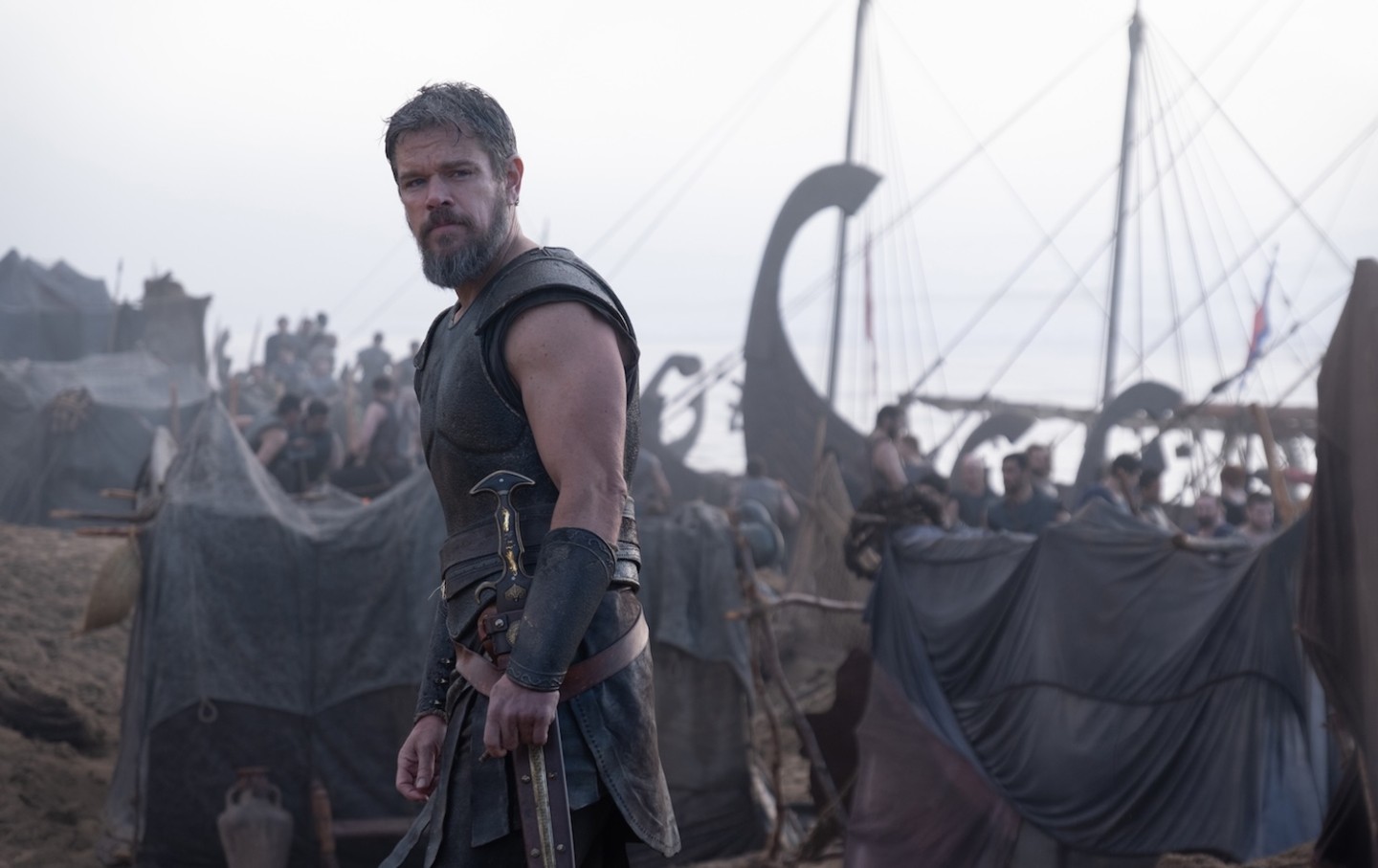
Matt Damon in The Odyssey.
(Melinda Sue Gordon / Universal Pic)An American producer, a German director, and a French screenwriter are sitting in a screening room watching dailies for a new production of The Odyssey. “Gods, I like gods, I like them very much. I know exactly how they feel. Exactly,” says the producer. “Each picture should have a definite point of view,” says the director. “I have a theory about The Odyssey,” says the producer. “I think Penelope has been unfaithful.” The screenwriter mostly keeps his mouth shut. It is a scene from Jean-Luc Godard’s Contempt, an adaptation of Alberto Moravia’s novel. Jack Palance plays Jerry the vulgar producer, and his face lights up with childish glee when he sees on screen the image of a naked woman, a mermaid tossing and turning in the sea. “Fritz, that’s wonderful for you and me but do you think the public is going to understand that?” he asks the director, who is Fritz Lang playing himself. Fritz and Paul the screenwriter (Michel Piccoli) then trade quotations. “All at once what happened as we felt is no more,” Paul says. “Our joy changed to grief as the sea closed above us.” It is unclear whether he is quoting a classic, suggesting a line for the film, or talking to himself about his marriage to Camille (Brigitte Bardot). Money is tight and the couple is unhappy. That is why Paul is working for Jerry, who will write him a check on the back of his bent-over assistant and eventually try to seduce Camille. Paul, you see, is also Odysseus. He is not absent, but he is also not himself. He has betrayed his artistic calling. He is a sellout.
I sometimes wonder if Christopher Nolan thinks of himself as a sellout or a god. The former might explain all the guilty feelings afflicting his heroes, from Bruce Wayne to Robert Oppenheimer. Was his Batman trilogy a series of nuclear detonations that wiped out non-indie middlebrow moviemaking? Or was it a Trojan Horse meant to smuggle Nolan’s cinematic genius into Hollywood before an inevitable tech-driven apocalypse would wipe out the remnants of the studio system? Nolan has now staked his claim to The Odyssey, an infinitely fertile text about a man who gets lost making his way home from war, a franchise everybody owns. You can set it anywhere from Dublin to the Deep South to outer space. You can render it as a comic picaresque, a romantic fantasy, a ballad of the aftermath of war, or combine all three and heighten the ironies. Nolan has brought it back to the Bronze Age and pursued an unmistakably personal vision. His joyless Odyssey turns out to be a box-office bonanza.
Nolan must feel bad about something. Why else all the pensive onscreen melancholy of Matt Damon as Odysseus? And why all the overcompensation in the publicity campaigns devoted to the director’s technical commitments? He uses IMAX cameras that have to be reloaded every three minutes. He does things the old-fashioned way, with minimal reliance on computers. His Polyphemus, the Cyclops, is a giant animatronic puppet. His seafaring scenes are shot in deep-water tanks at a studio in Malta or on the open seas off the coasts of the Aeolian Islands, Scotland, and Morocco. All this trivia is neat to know, and I’m not against the details, but the barrage of technical information leaves you with the impression that it is artistic camouflage. Did you hear that Nolan prints his scripts on red paper so they can’t be copied or leaked and has them hand-delivered to guarantee security?
He should hire somebody better at writing them. There are some risible lines, and most of them belong to Matt Damon’s Odysseus. “We’ve been on this beach for 10 fuckin’ years,” he says in a flashback of leaving Troy. “Let’s go home.” Sure, any soldier or sailor will curse, but the line is unpoetic. So too is Damon, when he demands to be tied to the ship’s mast saying, “I wanna hear the Sirens’ song,” like a Boston teenager in 1988 cuing up the new Aerosmith album. The script, to be fair, has fewer laugh-inducing passages than many costume dramas of late that have appropriated classics—like Chloe Zhao’s Hamnet, in which William Shakespeare spontaneously recites the “to be or not to be” soliloquy on a Thames dock to mourn his dead son—but, as in Hamnet, both the many clunkers and the few passages of eloquence zero in on the same subjects: trauma and survivor’s guilt.
Nolan’s films mount elaborate conceptual narratives that arrive at morals that are simplistic to the point of triteness. Under the disorienting dream scramble of Inception we find the story of a father who knows he ought to be back at his suburban dinner table. In Interstellar, we meet an astronaut who leaves the galaxy to save the world through the transcendent power of familial love. In the Batman films, we are left with the idea that only the very wealthy can protect the public from disaster, even if they must do so in secret and without being subject to any laws. In Oppenheimer, idealism and the best of intentions bring with them unintended consequences, such as the existence of arsenals that could destroy the world or retrospectively suspect political associations. In a Nolan film, there is plenty to feel guilty about even if you did not mean it, even if what you really wanted to do was save humanity.
Performing heroic acts of historic geopolitical significance when all you want to do is get home to the wife and kid: It can at least be said that Homer anticipated Nolan’s obsession with this eternal paternal theme. Now Odysseus joins Nolan’s menagerie of tedious brooders who also happen to be good at fighting. He impales and he cries. Having gone to war out of political obligations to do with honor, although he suspects what King Agamemnon is really after is control of “trade routes,” he returns a broken man, if one still capable of kicking serious ass.
Damon is an actor of great range and comic talents, but here he is not scheming Tom Ripley, crooked cop Colin Sullivan, or sarcastic whiz Will Hunting but a grown-up Private Ryan, bland and dutiful, until in the last act he turns into Jason Bourne and remembers how to perform a rushed series of perfunctory and conventional action sequences to slay Penelope’s suitors. Among ancient heroes, he resembles less the wily Odysseus than the pious Aeneas, the dutiful Trojan who fled his burning home with his father on his back to found Rome.
Compare Damon’s Odysseus to Kirk Douglas’s in Mario Camerini’s 1954 Ulysses. Both Damon and Douglas are unmistakable overgrown all-American boys, but Douglas shows off his comic and sexual charisma while Damon represses his. As befits the 1950s, Douglas is constantly surrounded by an international cast of pin-up models that dates the movie as much as its skimpy gowns and goofy sets. Damon’s grim characterization makes sense of some of Nolan’s elisions of Homer’s poem. He doesn’t tell his story at length to the Phaeacians because he is a man of few words, and not proud ones, the opposite of a raconteur. He doesn’t outwit Polyphemus by identifying himself as “nobody” because that would just be another dirty trick to feel guilty about. The same goes for the sex he doesn’t have with Circe and Calypso. It’s too complicated. Left out too is the shade of Achilles, who says he’d rather be the lowest tenant farmer in the land of the living than the greatest hero in the land of the dead. It doesn’t fit Nolan’s theme. He doesn’t regret slaying Hector. He just wants to be alive.
Usually the best things in any Nolan picture are incongruous performances by great actors tasked with playing villainous, or at least mildly distasteful, roles: They are the only characters with vivid personalities. Thus Heath Ledger’s Joker in The Dark Knight, Robin Williams’s serial killer in Insomnia, Joe Pantoliano’s con-artist murderer in Memento, and so on. The Odyssey is stolen in brief moments by Samantha Morton as the misandrist witch Circe, Robert Pattinson as the conniving suitor Antinous, and Jon Bernthal as Menelaus playing an Achaean chieftain and embittered husband in the manner of James Caan as Sonny Corleone. Lupita Nyong’o glows in dual roles as his insouciant wife, Helen, and her mariticidal sister, Clytemnestra. Elliot Page, dead and alive, embodies the pathos of a betrayed casualty of war. Travis Scott as Ithaca’s house bard is a nice nod to the Homeric tradition and its closest contemporary counterpart in hip-hop. James Remer as Tiresias speaking sooth to Odysseus in the realm of shades comes the closest to the classical acting we associate with the sword-and-sandal epics of Old Hollywood. Contrary to the anticipatory right-wing backlash, perhaps the best any big-budget adaptation of The Odyssey can do is showcase the styles and talents of its moment.
Yet no matter these bold standouts, they are still overshadowed by the bland (Damon, Anne Hathaway as an expository Penelope, John Leguizamo as Eumaeus the elderly swineherd) and the bad (Zendaya as a therapist Athena appearing over his shoulder whenever a bad memory comes to mind, including one of witnessing the slaughter of a Trojan girl who looked just like her; Charlize Theron playing Calypso like a sexless yoga instructor; and Tom Holland as the po-faced and impotent prince Telemachus). Zendaya, Theron, and Holland’s performances point toward the contradiction at the heart of Nolan’s reconception of the epic. He prefers a materialist interpretation to a mythological one, except when it comes to spectacle. So while we have visually stunning renderings of Odysseus confronting and escaping Scylla and Charybdis, his band tricking and fleeing Polyphemus, and Circe transforming his men into pigs and back, the dialogue keeps circling back to tiresome lessons about “Zeus’s law”—the ancient concept of “xenia” or hospitality to strangers—a golden rule repeatedly violated both by Odysseus and his antagonists. These crimes are bringing to an end what Damon calls “our age of bronze” with anachronistic self-consciousness. Nolan smuggles this theory in from Eric H. Cline’s book 1177: The Year Civilization Collapsed, which overturned the old thesis that the great Mediterranean cities of two millennia ago collapsed because of invasions by mysterious “sea people” and replaced it with the notion that they fell from within. As Penelope’s epiphany to Odysseus puts it after he recounts the war crimes he masterminded at Troy: “You are the sea people.”
The contemporary political analogies are obvious enough. The collapse of American imperial hegemony is because of a threat not from outside but from within. We have come to mistreat both strangers and the poorest among us all while waging endless wars that violate our ideals and leave our veterans maimed and traumatized. We are coming to the end of our civilization, and that is because of our own actions. To the extent that he identifies himself with this flagging neoliberal world order, Nolan is right to feel guilty. His is not an Odyssey I can ever imagine wanting, but, as they say, it might be the one we deserve: an epic of simplistic populism in which irony, comedy, and playfulness have been replaced by trauma, shame, and healing. You imagine Nolan reading any given translation of The Odyssey and you hear the voice of Jack Palance: “Fritz, that’s wonderful for you and me, but do you think the public is going to understand that?”