
Mamdani Can’t Arrest Netanyahu. But He Can Still Hold Israel Accountable.
New York City’s ties with Israel go far deeper than one man, and there are concrete things Mamdani can do to break those ties.
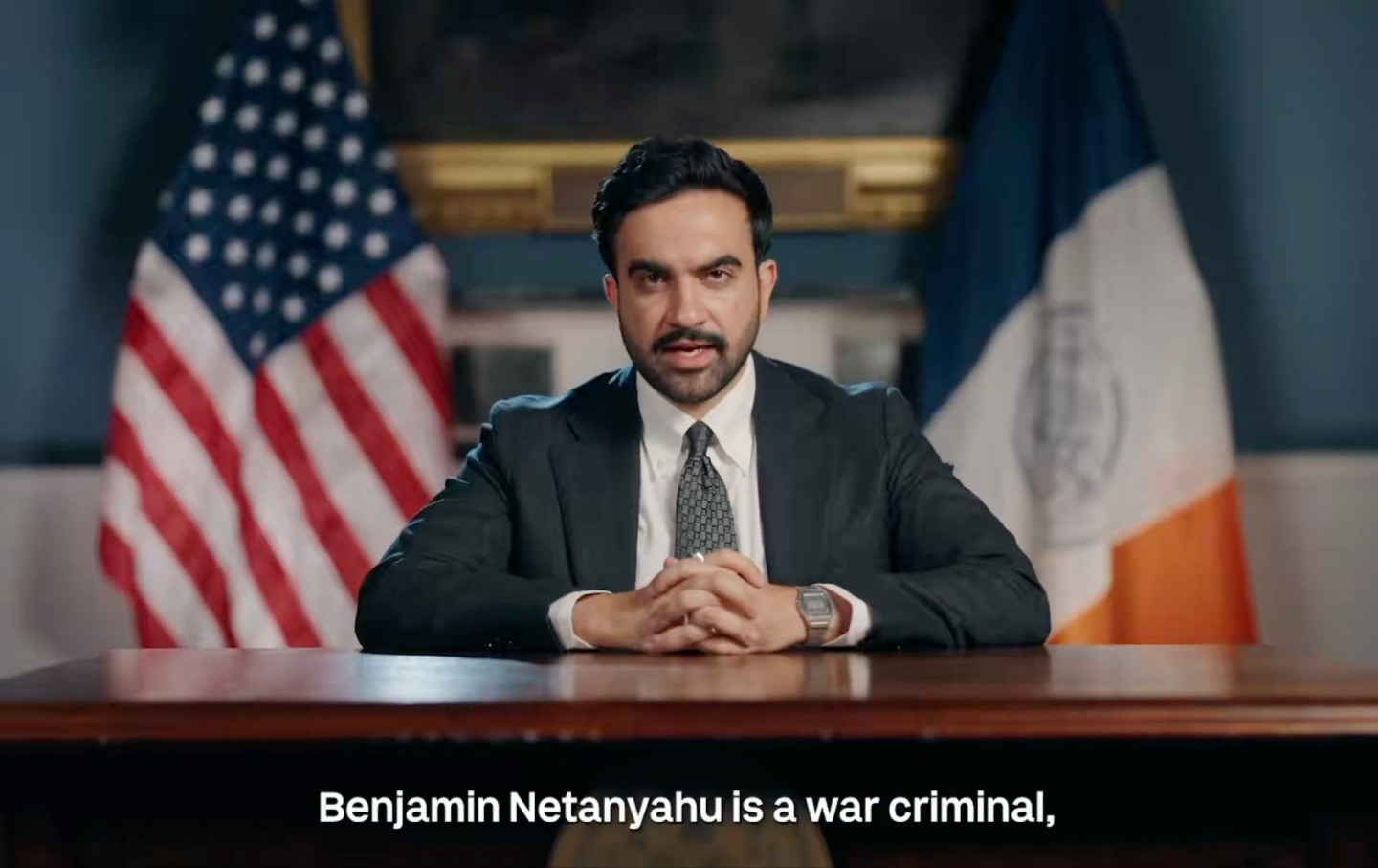
As a Palestinian-American who grew up in New York City, it is difficult to describe how uplifting—and, honestly, surreal—it feels to witness the mayor of my hometown speak about Palestinians as though our lives possess intrinsic value.
The bar is admittedly extremely low. For decades, New York politicians treated Palestinians as an inconvenience at best as they shamelessly competed to demonstrate ever greater fealty to Israel. Against that backdrop, Mayor Zohran Mamdani’s refusal to abandon Palestine represents a genuine breakthrough.
That is why it felt momentous to watch Mamdani look directly into a camera this week and declare Israeli Prime Minister Benjamin Netanyahu a genocidal war criminal who is not welcome in New York City—even if those words were followed by an acknowledgement that, despite Mamdani’s wishes, he does not have the independent authority as mayor to arrest Netanyahu for those crimes if Netanyahu ever sets foot in the city.
Of course, it was always doubtful that a New York City mayor possessed the authority to order the arrest of a sitting foreign leader, particularly one whose impunity is so deeply underwritten by Washington. Even before Mamdani took office, legal experts warned that his campaign pledge to arrest Netanyahu would run headlong into the constitutional limits of municipal power.
That does not mean the pledge was worthless. It held international law up as a standard that should be followed and helped force Netanyahu’s criminality and prospects for wider accountability into mainstream political debate. It provided a sharp contrast with Mamdani’s chief rival, former governor Andrew Cuomo, who joined Netanyahu’s legal team after the International Criminal Court issued an arrest warrant for the prime minister. And it demonstrated that ritual deference to Israel is no longer a nonnegotiable tenet of US politics. Here was the mayor of New York City, the most institutionally and demographically Zionist city outside of Tel Aviv, openly describing the Israeli prime minister in the same terms that Palestinians, human rights organizations, international legal institutions, and much of the world have used for years.
Judging from the response to Mamdani’s video this week, there is a hunger for this kind of moral clarity: At the time of writing, Mamdani’s video address had garnered over 90 million views on Twitter and 9 million likes and counting on Instagram.
And yet, as praise for the video flooded social-media feeds, the initial exhilaration gave way to a familiar unease that once again, rhetoric was eclipsing material action. Because for Palestinians there has always existed a cruel chasm between recognition and consequence—a chasm that has only grown during the Gaza genocide. For nearly three years, we have watched a growing number of governments acknowledge our suffering while continuing to facilitate it; journalists document our deaths while laundering the justifications and excuses provided by those killing us; and politicians condemn the right people and say the right things while falling short of fundamentally challenging the system that sustains the slaughter.
Mamdani’s sincerity and courage when it comes to speaking up for Palestine is not in question. Nor is his desire to hold Israel accountable. But now that he has confirmed that arresting Netanyahu is off the table, he needs to show what concrete steps he is prepared to take to end New York City’s entanglement with the political, financial, and policing infrastructure that sustains Israel’s impunity. And make no mistake: There are concrete steps Mamdani can take.
New York’s complicity in Israel’s crimes is not abstract. It is embedded in bond portfolios, procurement records, surveillance contracts, police partnerships, and the tax privileges extended to organizations helping dispossess Palestinians. These relationships fall far closer within Mamdani’s actual remit than the arrest of a foreign leader ever did.
Upon taking office, Mamdani rescinded Eric Adams’s executive orders barring city institutions from divesting from Israel and imposing on city agencies the IHRA definition of antisemitism, which falsely conflates criticism of Israel with antisemitism. That reversal reopened political space that Adams had deliberately tried to close.
But rescinding an anti-BDS order is not the same as actively pursuing divestment.
New York City’s pension funds have held hundreds of millions of dollars in Israeli assets, and Comptroller Mark Levine has promised to resume investing in Israel bonds (his predecessor, Brad Lander, had allowed the investments to lapse). City officials have previously used pension governance to pursue divestment from industries and governments they deemed beyond the pale. There is no principled reason Israel should remain uniquely insulated from the same scrutiny.
Mamdani cannot liquidate investments by executive decree: The city’s pension systems are governed by separate boards, and the comptroller exercises substantial authority over their investments. But the mayor is not powerless. Mamdani can make divestment from Israeli government bonds and companies implicated in occupation, apartheid, settlement expansion, surveillance, and genocide an explicit policy objective of his administration. He can push his pension-board appointees to propose divestment, appoint trustees who support Palestinian rights, and work with unions and pension beneficiaries to secure the votes needed to push his agenda over the line.
Mamdani could also order a comprehensive public audit of New York City contracts and institutional relationships with Israeli military and security companies. The NYPD, for example, has pursued contracts with Israeli intelligence firms and has maintained a liaison presence in Israel. Mamdani should determine which of those relationships remain active, disclose them to the public, and end those that bind the city to the architecture of Israeli occupation and genocide. He could also publicly call on New York State Attorney General Letitia James to open an independent investigation into how Netanyahu and other Israeli officials may have harmed New Yorkers.
Finally, Mamdani can use the political power of City Hall to confront the New York–based nonprofit infrastructure that helps finance Israel’s settlement project. As mayor, he cannot command the state attorney general or unilaterally revoke an organization’s tax-exempt status. But he can demand investigations into whether New York–registered organizations financing settlement expansion or settler violence have violated charitable-purpose requirements, disclosure rules, sanctions, anti-fraud laws, or other existing legal obligations. Mamdani can also do more to stop stolen-land auctions from being held across the city, and at the very least protect New Yorkers’ right to protest them.
And when Netanyahu eventually does visit New York City, as he is expected to for the UN General Assembly in September, Mamdani can ensure that his visit is devoid of the red-carpet welcome he is used to. The mayor could look back to 1995 for inspiration from then-Mayor Rudy Giuliani, who had Yasser Arafat, chairman of the Palestine Liberation Organization, ejected from a Lincoln Center UN concert while he was in town for the UN General Assembly. He could direct the New York Police Department not to assist with Netanyahu’s motorcade. And when protesters take to the streets, Mamdani should ensure that the NYPD doesn’t brutalize them.
None of these measures promise the theatrical aura of arresting Netanyahu on the tarmac. They are more bureaucratic, more difficult, and a lot less likely to produce a viral video (although Mamdani’s social-media team has proven they can make content about even the most procedural issues go viral). But these steps can directly impact the lives of Palestinians who face Israel’s genocidal onslaught every day.
What’s more, they will accomplish something that Mamdani’s focus on Netanyahu cannot: reinforce the truth that Israel’s genocidal nature is about much more than a single individual.
Popular
“swipe left below to view more authors”Swipe →Democratic lawmakers have spent years evading the demands of genuine accountability by recasting the destruction of Gaza as “Netanyahu’s war”—a sleight of hand that isolates one especially repellent perpetrator while obscuring the vast political, military, and social machinery required to carry out a genocide. In doing so, they paint Israel’s genocide, occupation, apartheid, and ethnic cleansing as mere deviations from an otherwise redeemable system, rather than expressions of that system. If Israelis could only get rid of Netanyahu, a more reasonable, liberal Israel might emerge. But Netanyahu was not alive in 1948 when Zionist militias forced over 750,000 Palestinians out of their homes at gunpoint during the Nakba. He did not invent the siege of Gaza. Nor did he birth an Israeli society in which 82 percent of Jewish Israelis support the forced expulsion of Palestinians from Gaza. If Netanyahu were somehow arrested tomorrow, Israel’s genocide would continue under the stewardship of another Israeli leader.
Reducing Israel’s crimes to one man offers the broader system that cultivated him an escape hatch. It allows Americans to imagine that accountability can be satisfied with one arrest, rather than with the dismantling of weapons pipelines, financial investments, diplomatic protections, police partnerships, and political alliances that sustain the genocide. That is why the focus must move from the spectacle of arresting Netanyahu toward the less cinematic but more consequential work of confronting complicity at its roots.
I want to be clear again: I do not doubt Mamdani’s solidarity with Palestinians. I think he wishes he could do far more and operate unconstrained by the torturous realities of governing, coalition-building, and electoral politics. Like so many people across the country, I am deeply inspired by Mamdani’s vision for New York City. He has already made life for so many New Yorkers measurably better, as is his main prerogative. At the same time, he has dramatically expanded the boundaries of what Democratic politics can look and sound like at this pivotal moment in American history.
But I am also old enough to remember another leader who rose to the highest office in the country on an enticing message of hope, only to leave us without the material change he promised. Mamdani has an opportunity to break with that legacy—to prove that hope need not remain a rhetorical posture, and that moral clarity can be translated into the patient, difficult work of dismantling the financial, political, and institutional architecture that binds his city with a genocidal apartheid state.
Supporters of Palestine have struggled against extraordinary odds to change public opinion and enter institutions of American power. Mamdani’s victory and the blueprint he has revealed for prospective leaders across the country are among the most promising outcomes of that struggle. But a transformation in cultural hegemony alone will not stop a bomb, rebuild a hospital, or return a displaced Palestinian family to its home. Merely reaching the halls of power against all odds will do nothing for Palestinians being killed, starved, and expelled every day, unless that newfound power is converted into bold, material pressure on both the individuals and institutions enabling genocide.
Mamdani may lack the jurisdiction to arrest Netanyahu, but he does not lack the power to begin disentangling New York City from the system Netanyahu represents. For the sake of all New Yorkers, and all Palestinians, he should get started right away.
More from The Nation
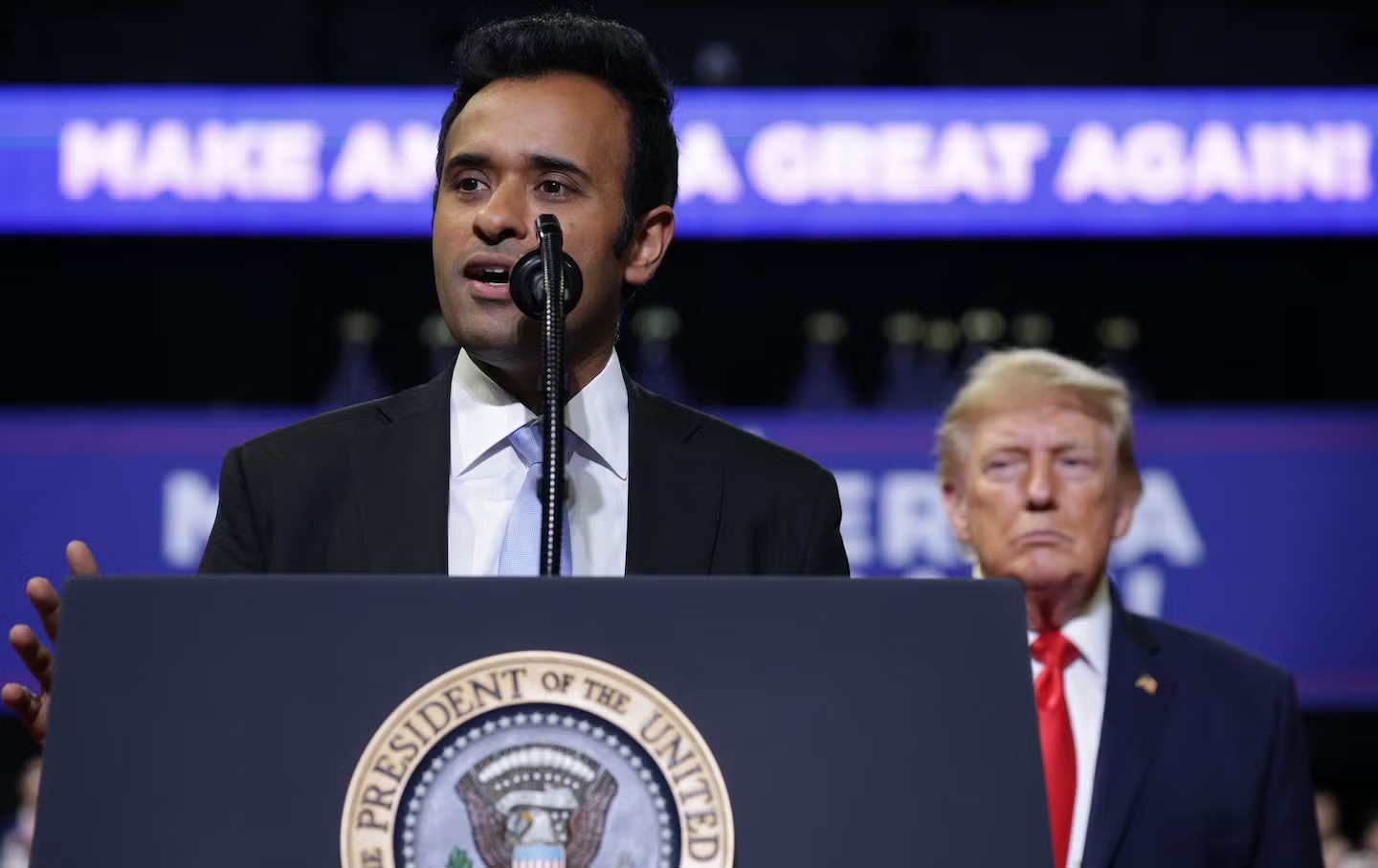
Vivek Ramaswamy’s New Attack Ad Should Be a National Scandal Vivek Ramaswamy’s New Attack Ad Should Be a National Scandal
The Ohio GOP gubernatorial candidate has accused his Democratic opponent, Amy Acton, of lying about being raped when she was 12 years old.

Dirty Business Dirty Business
Trump turns to Russian oil to lower fuel prices in the United States ahead of the midterm elections, throwing Ukraine under the bus.
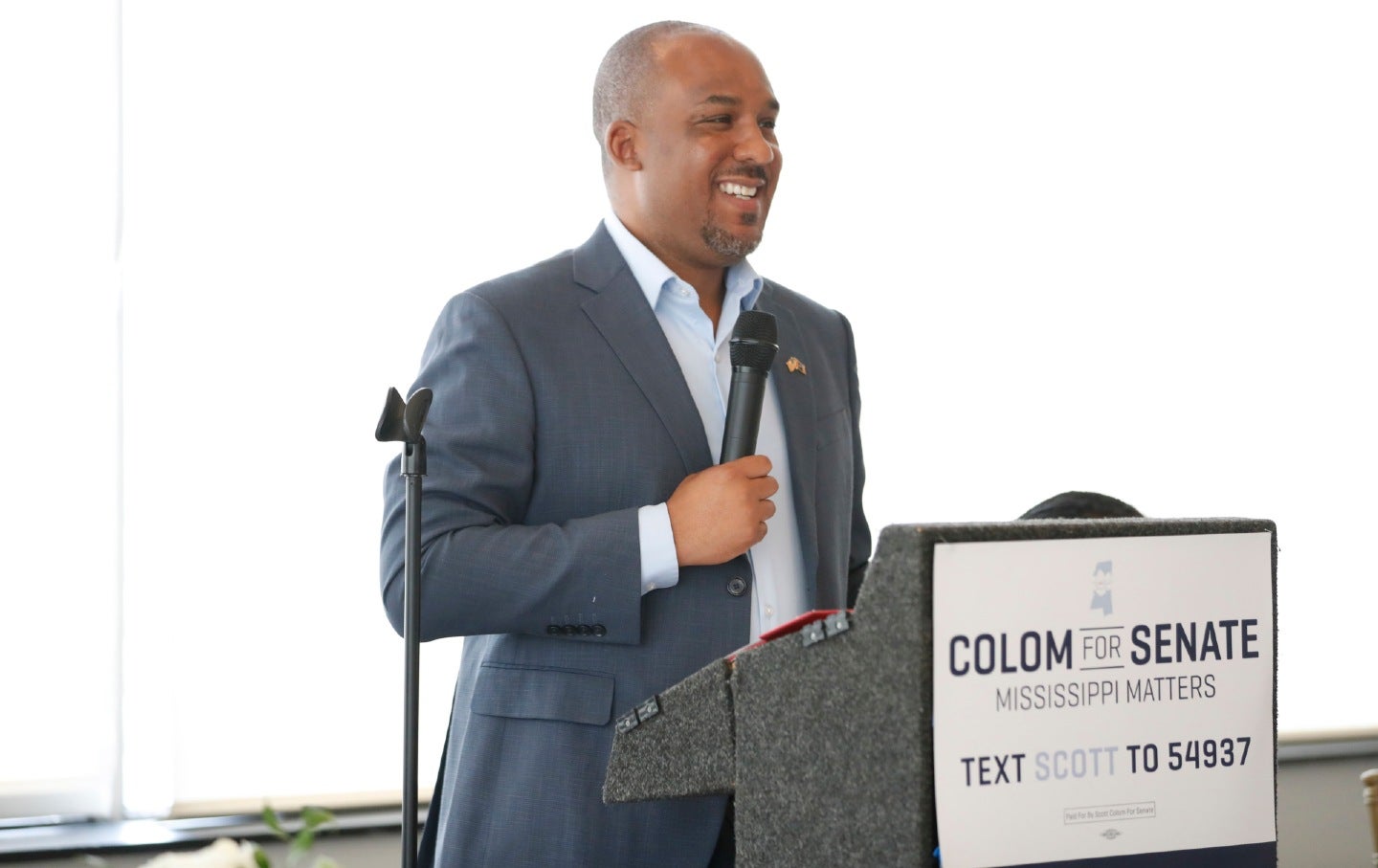
Could Mississippi Really Send a Democrat to the Senate? Could Mississippi Really Send a Democrat to the Senate?
The answer, amazingly, is yes.
Can James Carville Please Just Be Quietly Wrong Somewhere Else? Can James Carville Please Just Be Quietly Wrong Somewhere Else?
The omnipresent consultant-cum-tantrum-thrower has long outlived whatever relevance he once had, but cable producers, podcast hosts, and Democratic campaigns haven’t got the memo....

