
Lessons of the Bay of Pigs
The infamous paramilitary assault remains a cautionary Cold War history.
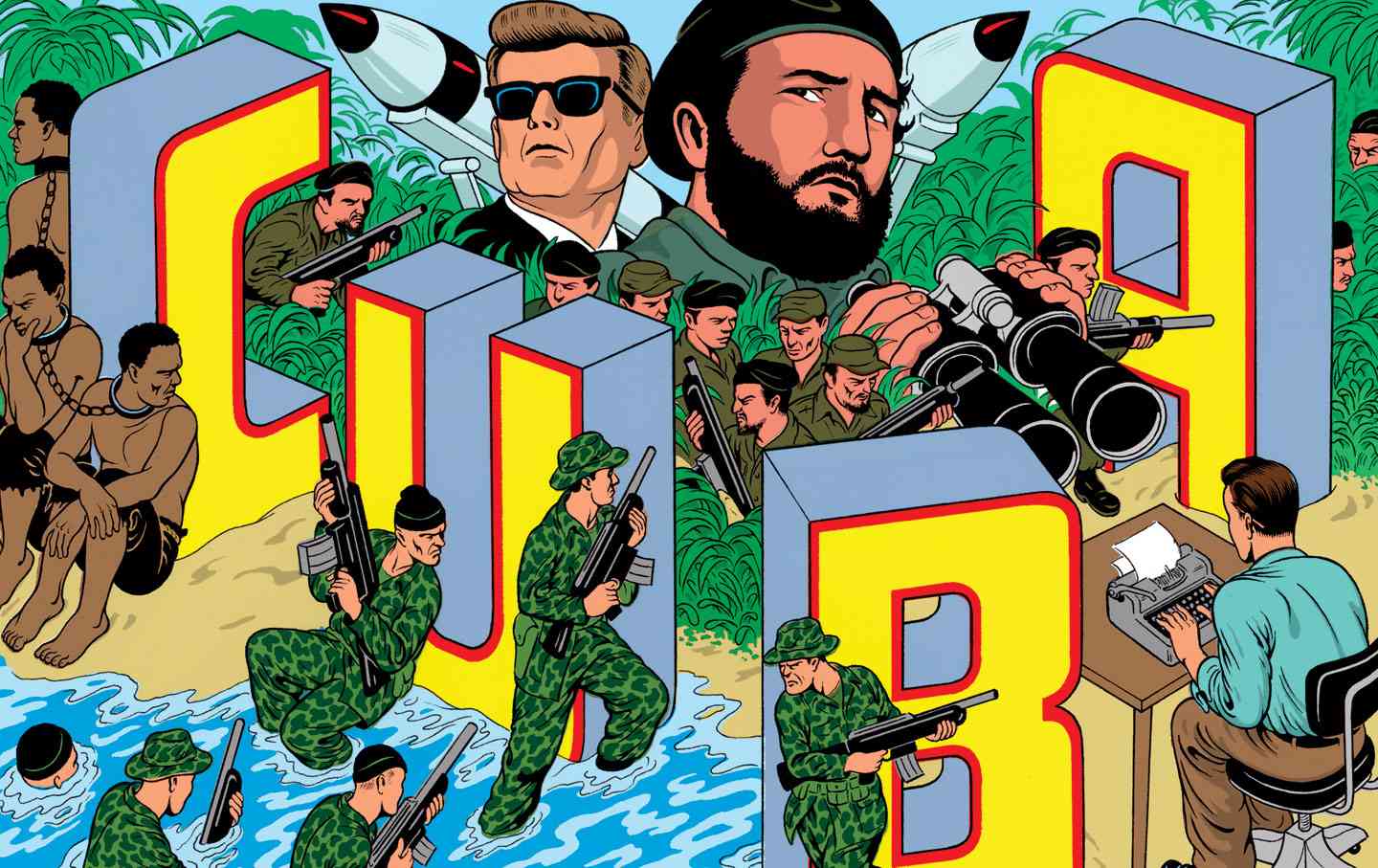
Sixty-five long years after the Kennedy White House launched a CIA-led paramilitary invasion at the Bahia de Cochinos, the specter of that failed attack haunts the current crisis in US-Cuba relations. Almost daily the Trump administration has escalated its threats to once again use military force in an attempt to overthrow the Cuban government; the White House has now issued a directive to the Pentagon to be ready. “Military planning for a possible Pentagon-led operation in Cuba is quietly ramping up, in case President Donald Trump gives an order to intervene,” USA Today reported just this week.
Trump has given every indication that he intends to assert US dominion over Cuba—a country that has stood as a symbol of Latin American independence since the 1959 revolution. The quagmire of war with Iran appears to have given the imperial president no pause. “We may stop by Cuba after we’re finished with [Iran],” Trump cavalierly stated on April 13. “Cuba is going to be next,” Trump declared just two weeks ago about his regime change intentions.
In the context of the present Cuba crisis, the 65th anniversary of the infamous Bay of Pigs debacle takes on renewed and immediate significance. The CIA-organized paramilitary effort to roll back the Castro revolution remains a cautionary history of the high costs of US intervention in Cuba—and elsewhere.
“The Perfect Failure”
The covert regime-change effort against Cuba began just 15 months after the 1959 revolution, with a March 17, 1960, authorization of President Dwight Eisenhower. The original “Program of Covert Action Against the Castro Regime” focused on creating CIA-backed teams of exile guerrillas who would be infiltrated into the mountains of Cuba to organize a counterrevolution. That effort failed miserably, as Castro’s forces quickly intercepted the infiltrators and CIA airdrops of weapons to them landed in the hands of the Cuban military, rather than the counterrevolutionaries.
At the first meeting of the CIA’s “Branch 4 Task Force,” the CIA’s director of Western Hemisphere operations predicted that the effort would fail “unless Fidel and Raúl Castro and Che Guevara could be eliminated in one package.” The regime, he argued, would only “be overthrown by the use of force.” Within months, the covert plan was reconfigured to become a paramilitary assault by a brigade of CIA trained exiles.
And the CIA did try to decapitate the Cuban leadership by enlisting the Mafia to assassinate Fidel Castro, diverting $200,000 of the invasion budget to pay for those operations. The CIA officer in charge of managing the paramilitary effort, Jacob Esterline, forcefully opposed the assassination plot. “I thought it was absolutely immoral that we involve ourselves in anything of this sort,” Esterline told me in an interview some years ago. “I thought it would be the most self-defeating thing for the operation, which was going to be difficult at best.”
Of course, the CIA-Mafia assassination plot also failed, establishing a pattern for the invasion even before it was launched. Indeed, in the words of political analyst Theodore Draper, the Bay of Pigs would go down in history as “the perfect failure.” Consider this cascade of operational disasters:
• The paramilitary assault was supposed to be a surprise, middle-of-the-night incursion. But Castro’s militia was waiting at the beach and opened fire the moment a CIA officer placed a beacon on the beach as the landing began.
• The CIA’s preliminary air strike on Castro’s air force failed to destroy all of Cuba’s planes, leaving enough of them to attack and sink the supply ships for the invasion force, on the morning of April 17, 1961.
• The CIA’s flimsy cover story for the preliminary air strike—that a Cuban air force pilot had defected and dropped bombs on Cuban planes—was exposed by the press within hours, but not before Ambassador Adlai Stevenson had presented that mendacious argument to the UN General Assembly, embarrassing the United States before the world community.
• Plausible denial of what was supposed to be a covert operation became, as the CIA itself later admitted, “a pathetic illusion.” Five months before the invasion, The Nation became the first US media outlet to report that the CIA was training an exile force in Guatemala to invade Cuba.
• The CIA-led paramilitary force was defeated within 72 hours by Castro’s much larger military and militia.
• The US goal of preventing Soviet influence in Cuba completely backfired. In the middle of the invasion, Castro declared Cuba a socialist state and sought the protection of the Soviet Union in the face of US aggression. Subsequently, Cuba signed a defense pact with the USSR, which led to Khrushchev’s decision to install nuclear missiles on the island, resulting in the October 1962 missile crisis, when the world came closest to atomic Armageddon.
Kennedy called the defeat at the Bay of Pigs “the worst experience of my life.” Only in office 12 weeks, the failed operation became a personal embarrassment in front of the entire world for his young presidency. At his first post-invasion press conference, Kennedy famously observed, “There’s an old saying that victory has a hundred fathers and defeat is an orphan,” conceding, “I am the responsible officer of the government.”
Moreover, the invasion dealt a harsh blow to US international credibility. The Kennedy administration was caught red-handed lying to the world community about its role in an unprovoked attack on a small Caribbean nation. “Acute shock and disillusion” dominated the reaction in Western Europe, as White House aide Arthur Schlesinger (who had opposed the invasion) reported back to Kennedy. It was not the failure of the operation but the decision to invade that bothered European leaders. “Why was Cuba such a threat to you?” they asked. “Why couldn’t you live with Cuba, as the USSR lives with Turkey and Finland?” US allies, as Kennedy would later acknowledge, “think we are a little demented on Cuba.”
David vs. Goliath
Hundreds of Cubans were killed or injured in the US attack, which also cost the lives of over 100 members of the exile force, Brigade 2506. But for Cuba, the outcome of the battle was a historic victory of almost biblical proportions. In the eyes of the world, particularly the Third World, Castro’s fledgling revolution had stood up to the Colossus of the North—like a David vs. Goliath. At home and abroad, Castro emerged as a nationalist leader of the anti-imperialist movement that expanded throughout the 1960s.
Popular
“swipe left below to view more authors”Swipe →In a post-invasion, secret meeting between Che Guevara and White House aide Richard Goodwin, Che “wanted to thank us for the invasion,” according to a memorandum of their conversation provided to President Kennedy. “It had been a great political victory for them, enabled them to consolidate, and transformed them from an aggrieved little country into an equal.”
That meeting remains a relevant addendum to the Bay of Pigs history. In the aftermath of what was at the time the most flagrant act of US aggression against Cuba, Fidel Castro’s government sought what Che called “a modus vivendi” with the United States. His message for President Kennedy was that Cuba was ready and willing to address Washington’s concerns through a diplomatic dialogue, with one exception: Cuba “could discuss no formula that would mean giving up the type of society to which they were dedicated.”
Sixty-five years later, that continues to be Cuba’s position as the post-Castro government of Miguel Diaz-Canel faces the most dangerous threat of US military action since the Bay of Pigs. The world has changed considerably since Cuba’s victorious defiance of US military might in April 1961. Under Trump, there is no lip service to international law or the sovereign rights of nations. There is only the unrestricted, unconstrained exercise of surgical force to crush smaller nations into submission. But the history of Playa Giron still remains immediately relevant.
“A wise man once said, ‘an error doesn’t become a mistake until you refuse to correct it,’” President Kennedy observed at his press conference after the failed Bay of Pigs invasion. “There were,” he noted, “sobering lessons” to be learned. On this dramatic anniversary of costly US aggression against Cuba, there is still time for Donald Trump to learn them.
Become a Sustaining Donor This September
Between the reemergence of right-wing red-baiting and Donald Trump’s use of the chilling National Security Presidential Memorandum–7 to criminalize left political organizing, we’re seeing McCarthyism reborn before our eyes.
This assault on democracy cannot be ignored or wished away. Resisting it requires bravery in the face of threats and repression, a steadfast commitment to the truth, and the unwavering belief that we can—and will—overcome this darkness.
We must have an independent media that sets the record straight, unearths corruption and abuses of power, and advances a politics of justice and dignity for all if we’re to win this fight.
That’s why I’m writing to you today. This September, The Nation needs to add 100 monthly donors to sustain our progressive journalism. Your contribution makes the next investigative report, the next truth-speaking column, and the next pathbreaking essay all possible.
I hope you’ll support our work with a recurring donation today. If you donate $10 or more a month, we’ll send you a brand new “Hands Off the Free Press!” sticker to recognise your commitment to our cause. Please, donate today.
Onward,
Katrina vanden Heuvel
Editor and Publisher, The Nation
More from The Nation
The Decades-Old Roots of Trump’s War on Iran The Decades-Old Roots of Trump’s War on Iran
An interview with historian Behrooz Ghamari-Tabrizi about the generations of US presidents who have tried to destroy the Iranian regime.
Emmanuel Macron’s Turbulent Exit Emmanuel Macron’s Turbulent Exit
Between a budget crisis and a cost-of-living squeeze, Macron is leaving a country feeling more insecure than ever—and ready to take to the streets.
Israel’s Election Can’t Fix What Netanyahu Broke Israel’s Election Can’t Fix What Netanyahu Broke
The fundamental problem is not the name of the prime minister, but rather the actions of the Israeli government and the urgent issues that need to be addressed.

The AfD’s Rise Isn’t Just About East Germany The AfD’s Rise Isn’t Just About East Germany
The Alternative für Deutschland has a stable national poll lead, including in the former West Germany. Its rise owes to much more than Eastern grievances.
Chinese Development Is the Betrayal Washington Cannot Forgive Chinese Development Is the Betrayal Washington Cannot Forgive
The prospects for Xi Jinping’s visit are dim because American leaders are blaming China for the failures of globalization.
Pinochet: The Verdict of History in the Letelier-Moffitt Case Pinochet: The Verdict of History in the Letelier-Moffitt Case
An act of international terrorism on the streets of Washington, DC, still reverberates 50 years later.

