
Rubio in Yerevan
A neocon in the land of Nairi.
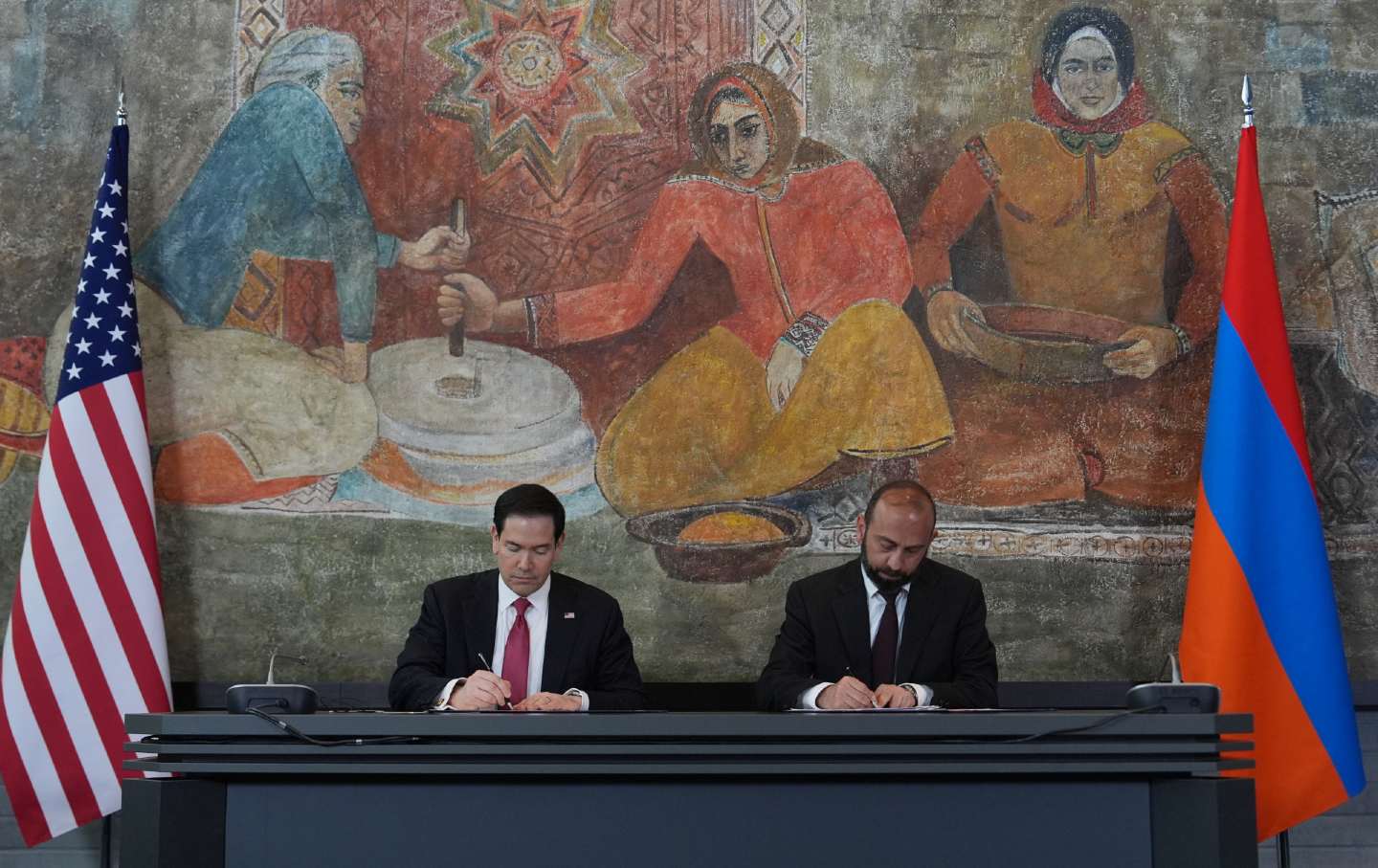
On Tuesday, neoconservative acolyte Secretary of State Marco Rubio flew into Yerevan. Rubio arrived in the Armenian capital from India, where he was doing damage control on behalf of President Trump. While in Yerevan, he signed a series of documents with Armenian Foreign Minister Ararat Mirzoyan, intended to deepen US-Armenia ties. He also endorsed the beleaguered government of Armenian Prime Minister Nikol Pashinyan, one week before the country heads to the polls in the June 7 parliamentary elections.
Although Rubio’s visit lasted just one hour, it signaled the Trump administration’s outsize ambitions for the Caucasus, just as it launched a new attack on Iran, once again, amid diplomatic negotiations. “If nothing else, Rubio’s visit to Armenia shows the Trump administration’s continued addiction to election interference abroad,” notes James Carden, a former adviser to the Obama State Department.
Meanwhile, tucked away among Yerevan’s bustling city streets, in a cozy studio apartment, two young guerilla activists—Hovhannes Ishkhanyan and Nare Navasardyan—contemplate ways to assist Armenian political prisoners. Both are self-described democratic socialists who supported the 2018 “Velvet Revolution” that swept Pashinyan to power. Since the 2020 Karabakh War, however, both have turned sharply against the Armenian PM, as have most Armenians. Ishkhanyan and Navasardyan also wear the hats of journalists and filmmakers and represent a rising independent activist scene in Yerevan. As they underscore, promises to bring true democracy to the post-Soviet republic have been betrayed. Instead, Armenians face a reality in which investigative journalists are silenced, political opponents are hounded, and the pillars of national identity are under attack.
The election on June 7 is the first since Pashinyan’s controversial recognition of Nagorno-Karabakh (Artsakh) as part of Azerbaijan in 2022, a declaration that paved the way for Baku’s ethnic cleansing of the majority-Armenian region. Rising discontent in Armenia over economic inequality and democratic decline have not helped the embattled PM. The poll numbers of the opposition forces have been rising—especially Samvel Karapetyan’s big-tent Strong Armenia party and the center-left Armenia Alliance led by former president Robert Kocharyan. Thus, with the election fast approaching, Pashinyan has become increasingly desperate to bolster his political standing.
“This issue of self-determination and democracy is not just an Armenian issue. It’s a universal issue,” maintains Ishkhanyan. “When Pashinyan betrayed Artsakh, he betrayed democracy. He betrayed the right of Artsakh to self-determination. And today we see democracy in Armenia itself being dismantled by his regime. One day is a year in Armenia. Almost every day, there are violations—legal violations, constitutional violations, voting violations, international law violations. Every day, Pashinyan’s gang, masquerading as a ‘democratic’ government, violates my rights.”
Between sips of Armenian coffee, Ishkhanyan sits back and muses: “What business does Rubio have here? Did he come to speak out for the Armenian churches in Artsakh now being demolished by Azerbaijan? Or did he come here to protect this traitor who violated, and promises to violate, the Constitution by threatening to overthrow the leader of the Armenian Apostolic Church?”
Pashinyan has publicly clashed with the Armenian Church and its spiritual head, Catholicos Karekin II, over the latter’s efforts to keep the plight of the Artsakh Armenians in the public eye. The conflict escalated to a point where Pashinyan has inexplicably declared his intention to appoint a new head of the Armenian Church, in clear violation of Armenian law. The situation, the activists stress, is strikingly similar to President Trump’s recent clash with Pope Leo XIV over the Iran War.
“By law,” Ishkhanyan notes, “Armenian clergymen have the same right to participate in politics as all other citizens. It does not mean that the church is part of the state, but it means that clergymen have the right to express opinions about politics like everybody else. So we stand for their rights. What Pashinyan is doing is unconstitutional.”
“Rubio’s presence here is blatant election interference,” chimes in Navasardyan. “But this is just the tip of the iceberg. Imagine in America having a whole network of organizations getting funding from China or Iran with no FARA [Foreign Agents Registration Act], no limitation, spreading misinformation about all the candidates opposing their preferred one. This is what we see. It’s absurd, but only accepted because Armenia is perceived as a marginal post-Soviet country that cannot stand up for itself.”
Referring to Rubio’s recent role in attempting to instigate a coup in Cuba, she adds, “Rubio is Cuban, sure, but look at what he’s doing to his own Cuba! He exemplifies US imperialism’s weaponization of ethnic diasporas against their home countries.”
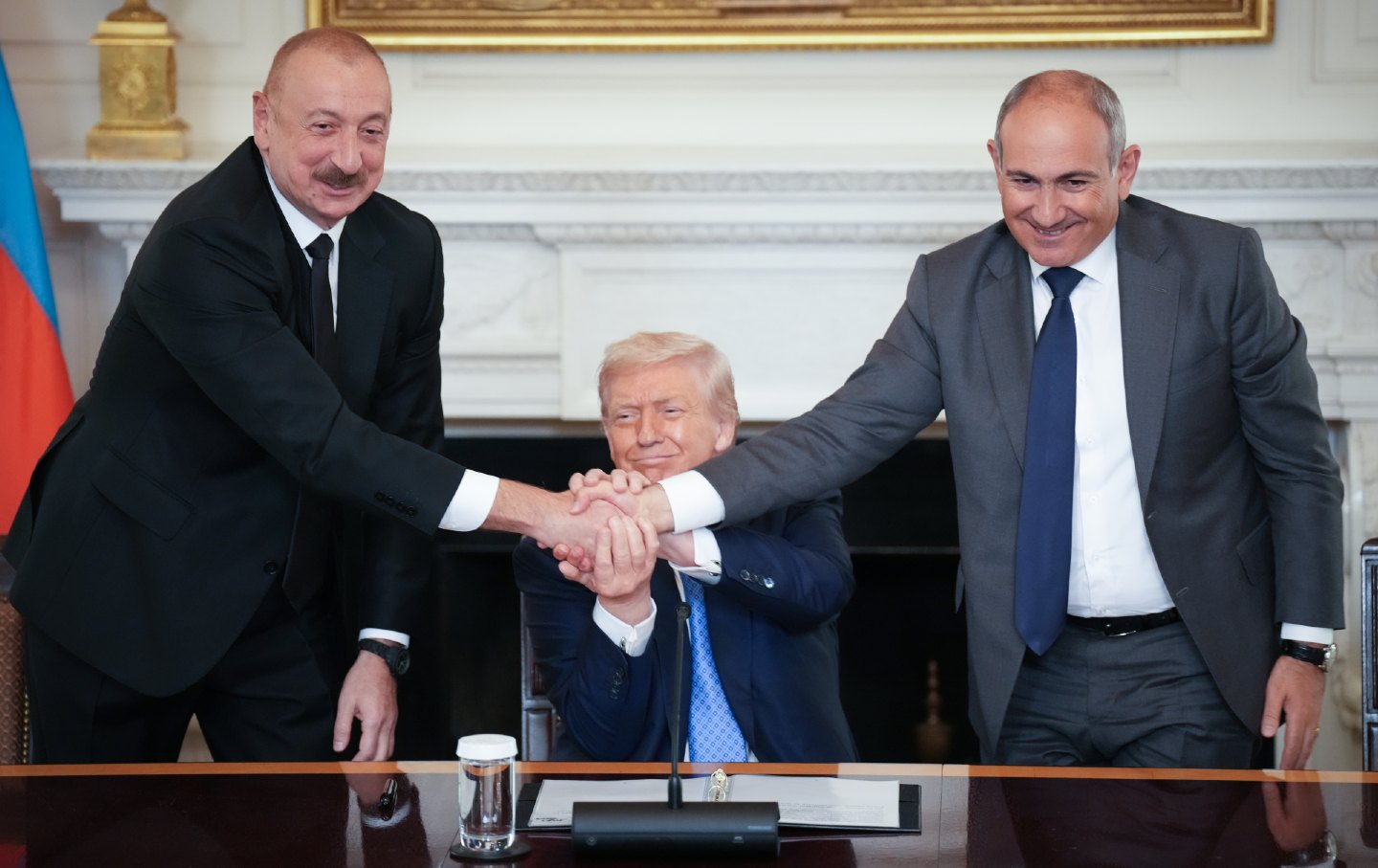
Ishkhanyan and Navasardyan underscore that Pashinyan’s de-democratization of Armenia has been conducted with the blessing of his fellow populist-in-arms, President Trump. Trump’s aim is to secure the Armenian PM’s loyalty in a bid to “checkmate” Iran and Russia in the strategic Caucasus through the Trump Route for International Peace and Prosperity (TRIPP). TRIPP envisions Armenia granting control of its southern border with Iran to private US interests for up to 99 years, while providing Azerbaijan with an unobstructed link to Turkey.
“I feel alarmed that an Armenian prime minister is giving away our lands,” stresses Ishkhanyan. “I have friends and family who live in that part of Armenia, in Agarak, in Meghri, and they are alarmed. We see what Trump is now doing with Iran. His war is a crime against humanity, a gross violation of international law. And can you imagine if America and Iran start fighting here? It’s going to be a disaster! Pashinyan is literally bringing the war against Iran to Armenia!”
Armenia prides itself for being the first nation to adopt Christianity in the year 301 CE. Yet its ancient ties with Islamic Iran are warm and long-standing, dating back to the age of Persepolis. According to recent polls, Armenians overwhelmingly sympathize with the people of Iran and overwhelmingly blame the United States and Israel for the recent war. At the Blue Mosque in Yerevan—a reminder of Armenia’s centuries-old Iranian heritage—locals recently brought toys and flowers to a makeshift memorial in honor of the Iranian schoolgirls who were killed in the US strike on Minab.
The activists further blamed Pashinyan for attacking Armenian identity itself, in moves such as removing the sacred Mount Ararat from Armenian passport stamps and even downplaying the Armenian Genocide. By contrast, both Ishkhanyan and Navasardyan were more positive on the statement commemorating the Genocide issued by New York Mayor Zohran Mamdani, calling it “refreshing.” “I like Mamdani,” noted Ishkhanyan. “His statement on the genocide can only be applauded. In fact, it is a statement that should have been issued by the Armenian prime minister!”
Popular
“swipe left below to view more authors”Swipe →On the campaign trail, Pashinyan has recently become embroiled in a series of angry arguments with Armenian voters. “Why weren’t you killed off?” he recently screamed at one war veteran, who is now a political prisoner. At the same time, despite continued threats from Azerbaijan, Pashinyan regularly claims that TRIPP has brought lasting peace to Armenia and that his opponents will bring war if they are elected. Ishkhanyan and Navasardyan are skeptical. They note that Armenia has seen more war under Pashinyan than any other post-Soviet Armenian leader.
“Pashinyan threatens us constantly with war in the case that he is not elected,” maintains Navasardyan. “So this is no ordinary election campaign, but political terror repackaged into this neoliberal promise of ‘peace’ and ‘prosperity.’ They don’t even talk about ‘democracy’ anymore. In fact, we see that in every single instance, Pashinyan chooses the interests of these larger, multinational corporations over the interests of the people here. And moreover, he chooses the financial interests of his clique over the long-term prosperity of Armenia. We have no doubt that he will continue on the same trajectory if he is re-elected. But we are ready to continue our fight in any case.”
More from The Nation
This Village Has Been Fighting Israel’s Demolition Orders for Years. It May Be on Its Last Stand. This Village Has Been Fighting Israel’s Demolition Orders for Years. It May Be on Its Last Stand.
A new order for Khan al-Ahmar’s destruction failed to attract the international attention that had protected it in the past, and residents fear they can no longer stop the bulldoz...
The Year I Taught in a Former Coal Mining Town The Year I Taught in a Former Coal Mining Town
Teaching in the South of France, I learned that equality was just a story teachers told about themselves.
Why French Students Are Revolting Why French Students Are Revolting
France’s education system is stretched to its limits, as student anger kicks off a hot fall protest season.
Revolution or No Revolution Revolution or No Revolution
Eight years after Armenia’s “Velvet Revolution,” Nikol Pashinyan’s government has deepened the country’s neoliberal trajectory while reorienting Armenia toward the West.
The GOP Sells the Mirage of a Hormuz Victory The GOP Sells the Mirage of a Hormuz Victory
The American action in the contested strait isn’t sustainable—and won’t alter the economic and political fallout from its closure.

Japan’s Far Right Is Courting Young Voters Japan’s Far Right Is Courting Young Voters
Sanseitō has attracted young voters through a robust social-media strategy, Charlie Kirk–like public speaking events, and anti-establishment messaging.

