
Has France’s Government Overplayed Its Hand?
The speed and scale of the police response is unprecedented.
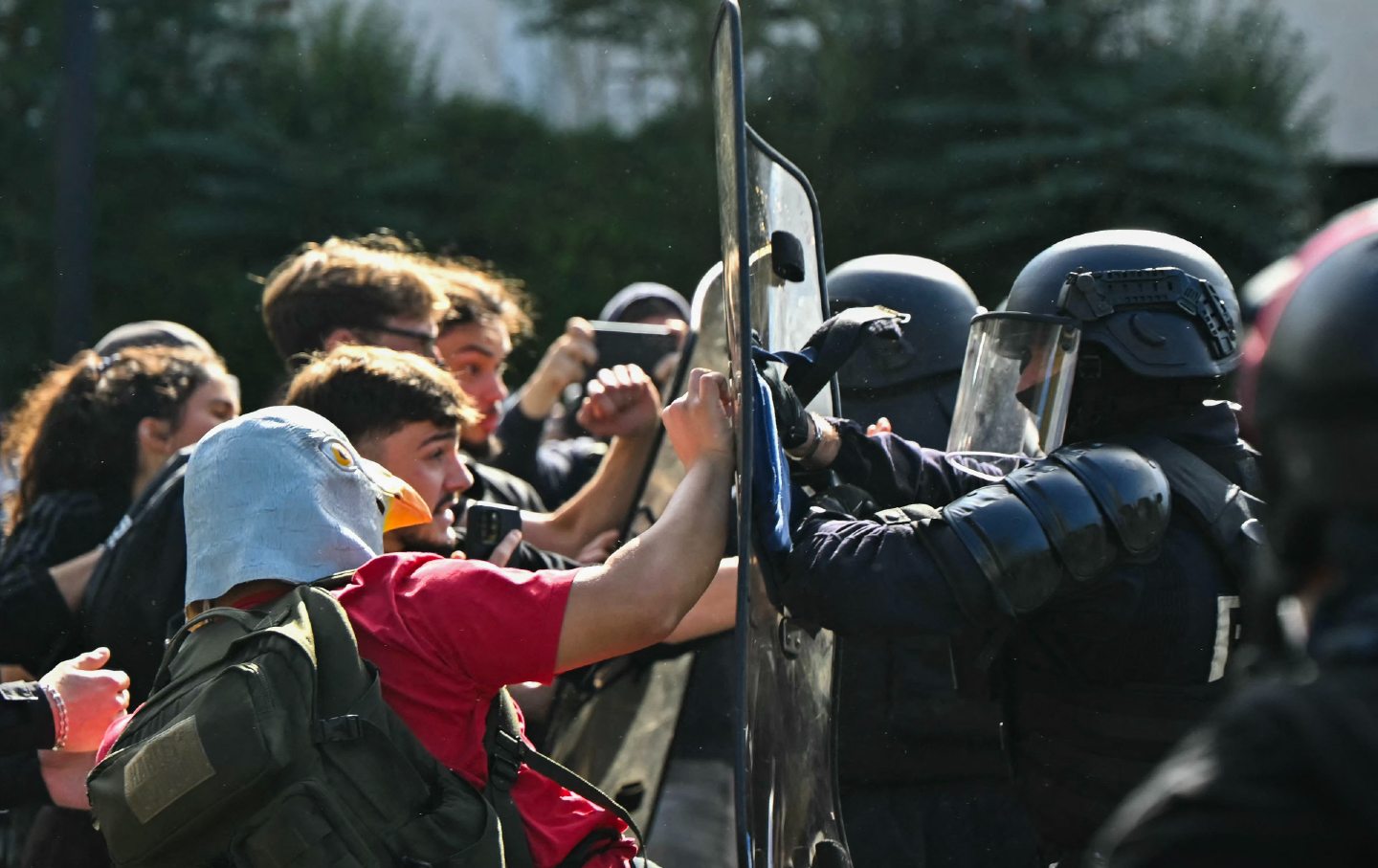
On October 2, Interior Minister Laurent Nuñez found himself beating back accusations that France’s government had reacted with insufficient vigor to the wave of student protests that has swept the country this autumn. “There are no orders for restraint,” said the minister in charge of internal security, namely the Gendarmes and CRS battalions that are called on to police demonstrations.
This time at least, Nuñez was being brutally honest. The ongoing occupations and wildcat protests, led first by high school students fed up with a fraying secondary education system, have been met by a dramatic and in many ways unprecedented deployment of state power. From the arbitrary arrest and detention of thousands of minors to the use of excessive force by riot police, the government’s primary response to the eruption has been to raise the physical and legal costs of taking to the streets.
Upward of 400,000 students, teachers, and supporters demonstrated across the country on October 6 for the day of national marches since the movement began. The figures of total arrests are now approaching 7,000 individuals, with some 87 percent estimated to be underage minors. These figures already outpace the preventive arrests seen in the beginnings of other social movements such as the 2018 “yellow vest” revolt, which had already set a high bar as far as repressive standards go.
There’s little denying that stiff policing has become a hallmark of Emmanuel Macron’s presidency. But according to Alice Cohen-Morzadec, university student and spokesperson for L’Union Étudiante, “Rarely have we seen these levels of tension with seemingly no efforts from the police to de-escalate.” In addition to the calls for more resources for the education system, student protests have increasingly turned their attention to the police response, with demonstrators at this week’s marches holding up signs and banners with slogans like “police everywhere, education nowhere” or “too young to vote, old enough to be tear-gassed.”
Speaking in Parliament on October 6, a few kilometers away from the Paris demonstration, Prime Minister Sébastien Lecornu dismissed all allegations of a heavy-handed police response. “It’s a lie to claim that there is an intentional and disproportionate use of force by the police,” the prime minister said during government questions. “It’s a dirty slander against the republican police!”
As of October 8, the oversight bureau charged with internal inquiries into the use of force has announced a total of 18 investigations since the beginning of the student mobilization. Among the most harrowing cases are adolescents who have had their jaws shattered by rubber bullets or their hands blown off by explosive stun grenades. One young protester in the outskirts of Paris testified to being dragged along a street covered with broken glass. “I couldn’t breathe, I thought I was going to die,” he told reporters at the alternative media outlet Street Press. At a medical examination, doctors found pieces of broken glass lodged in his head.
The hard response was written on the wall from the moment the student revolt started to pick up speed last week.
In a September 30 memo addressed to the police hierarchy, Interior Minister Nuñez signaled that “the proportionate use of force must never inhibit the work of reestablishing public order.” Beneath the evident contradiction in those orders—that is, between supposedly “proportionate” tactics and the disinhibited restoring of order—rights observers and legal experts read what was essentially carte blanche granted to law enforcement. Not to be outdone, Justice Minister Gérald Darmanin held an October 1 meeting with state prosecutors, posting a photo of the gathering to social media that trumpeted a “penal response of great firmness” for protesting students.
“What message is being sent to French youth by political authorities? Their message is clear: ‘We’re going to beat you, rip off your hands, and it won’t be our fault. It will be yours,’” the prominent civil liberties attorney Raphaël Kempf told The Nation.
For Lecornu’s government, saving face in the crisis depends on its ability to present the protest movement as a cover for hooliganism. “Ultraviolence is knocking on the doors of our high schools,” said the prime minister on October 6.
With exceptional examples such as the teacher who was doused in gasoline and beaten up by rioters in southern France on October 2, government ministers and right-wing media alike want to portray the student revolt as little more than a case of youth nihilism run amok. The support for the movement by the left-wing party La France Insoumise, including Saint-Denis Mayor Bally Bagayoko’s claim that “violence can be legitimate,” has also been pointed to in the efforts to dismiss the uprising as an offshoot of far-left entryism.
“Unlike previous student mobilizations, this one is being treated like an urban riot, and much of that has to do with the fact that it emerged from underprivileged neighborhoods,” Arthur Vuattoux, a sociologist who studies juvenile justice, told The Nation. That many of the protesting teens come from minority backgrounds has accelerated what Vuattoux calls their “adultification” in the eyes of the broader public: They are no longer seen as teenagers who deserve a degree of leniency but as delinquents to be disciplined.
Popular
“swipe left below to view more authors”Swipe →One common experience of the state backlash has been arbitrary arrests, with 6,629 protesters detained as of October 7. While a fraction have been held for only a few hours, a significant share of at least 5,000 have been taken into official custody, legally for up to 48 hours. That figure is to be compared with the 1,500 cases handed over to the justice system for a formal investigation and possible pursuits.
The steep drop-off between those numbers leads some legal experts to accuse the government of wantonly arresting individuals in a blatant abuse of power. For Kempf, the defense attorney who has counseled many individuals taken into custody during the student movement, these practices amount to a “violation of the rule of law and an instrumentalization of the justice system by the demands of law enforcement.”
But the most forceful use of state power has been in the recourse to violent police tactics against what is ultimately a movement led by underage minors. In an October 2 press release, Amnesty International France warned against the “disproportionate use of force by law enforcement.” The organization points to footage documenting the use of choke holds—technically phased out under official French policing protocols—the firing of tear gas canisters directly at protesters, and the widespread use of rubber bullets.
The use of force has itself been selective, reflecting the social and racial inequalities denounced since the beginning of the revolt. Cohen-Morzadec from L’Union Étudiante describes unprovoked police charges at the Sciences Po blockade, with students dragged along the ground and beaten by groups of officers. “But even this was a weaker show of force than the violence students faced in Seine-Saint-Denis,” she added. “This shows the difference in treatment between the mobilizations at prestigious Parisian schools and less privileged establishments.”
There are signs of some government backtracking in the face of criticism. Staying at arm’s length from the domestic crisis, and otherwise failing to address the student demands, President Macron has reportedly summoned key ministers to scold them for the police response. On October 7, Interior Minister Nuñez announced the temporary suspension of stun grenades; however, that order applies obly to the use of projectile-launched ordnance, as Mediapart reported, and not its hand-thrown alternative.
The government has also announced class suspensions until the end of the week, dedicating school time to so-called “internal democracy sessions” between students and officials. “This is a maneuver to break the student movement,” said Cohen-Morzadec. “The government has never cared about student representation. Our demands have been clear from the beginning.”
It is also keen to expand the state arsenal. A new anti-rioting bill, termed the “breakers-pay” law, is set to be fast-tracked for consideration by Parliament in late October. If adopted, the bill would sanction individuals accused of having participated in a violent “grouping” by making them financially liable for property damage regardless of direct individual responsibility. Critics fear that in practice this could put anyone who joins a protest at risk of sanction.
Parents are also being pressured to keep their children from exercising their political rights. In some cases, local police prefects have sent moralizing letters of disapproval to parents whose children have been taken into custody. Justice Minister Gérald Darmanin believes they should be “jointly financially liable for the abuses committed by their children.” The “breakers-pay” law would even allow authorities to deduct damages from social welfare such as housing aid and child benefits paid to parents.
With a new day of national demonstrations on October 8, and another scheduled for next Tuesday, the government has left itself few options beside escalation.
More from The Nation
This Is Not an Anniversary This Is Not an Anniversary
Does remembering the date of October 7 make it easier to name?
Are Europe and Russia Slow-Walking to World War III? Are Europe and Russia Slow-Walking to World War III?
Dangerous rhetoric has been escalating on both sides for some time now.
This Village Has Been Fighting Israel’s Demolition Orders for Years. It May Be on Its Last Stand. This Village Has Been Fighting Israel’s Demolition Orders for Years. It May Be on Its Last Stand.
A new order for Khan al-Ahmar’s destruction failed to attract the international attention that had protected it in the past, and residents fear they can no longer stop the bulldoz...
The Year I Taught in a Former Coal Mining Town The Year I Taught in a Former Coal Mining Town
Teaching in the South of France, I learned that equality was just a story teachers told about themselves.
Why French Students Are Revolting Why French Students Are Revolting
France’s education system is stretched to its limits, as student anger kicks off a hot fall protest season.
Revolution or No Revolution Revolution or No Revolution
Eight years after Armenia’s “Velvet Revolution,” Nikol Pashinyan’s government has deepened the country’s neoliberal trajectory while reorienting Armenia toward the West.

