
The Rats Terrorizing Everyone in Gaza
This is what humanitarian collapse looks like: vermin moving freely through garbage, ruined buildings, and tents—and attacking people wherever they go.
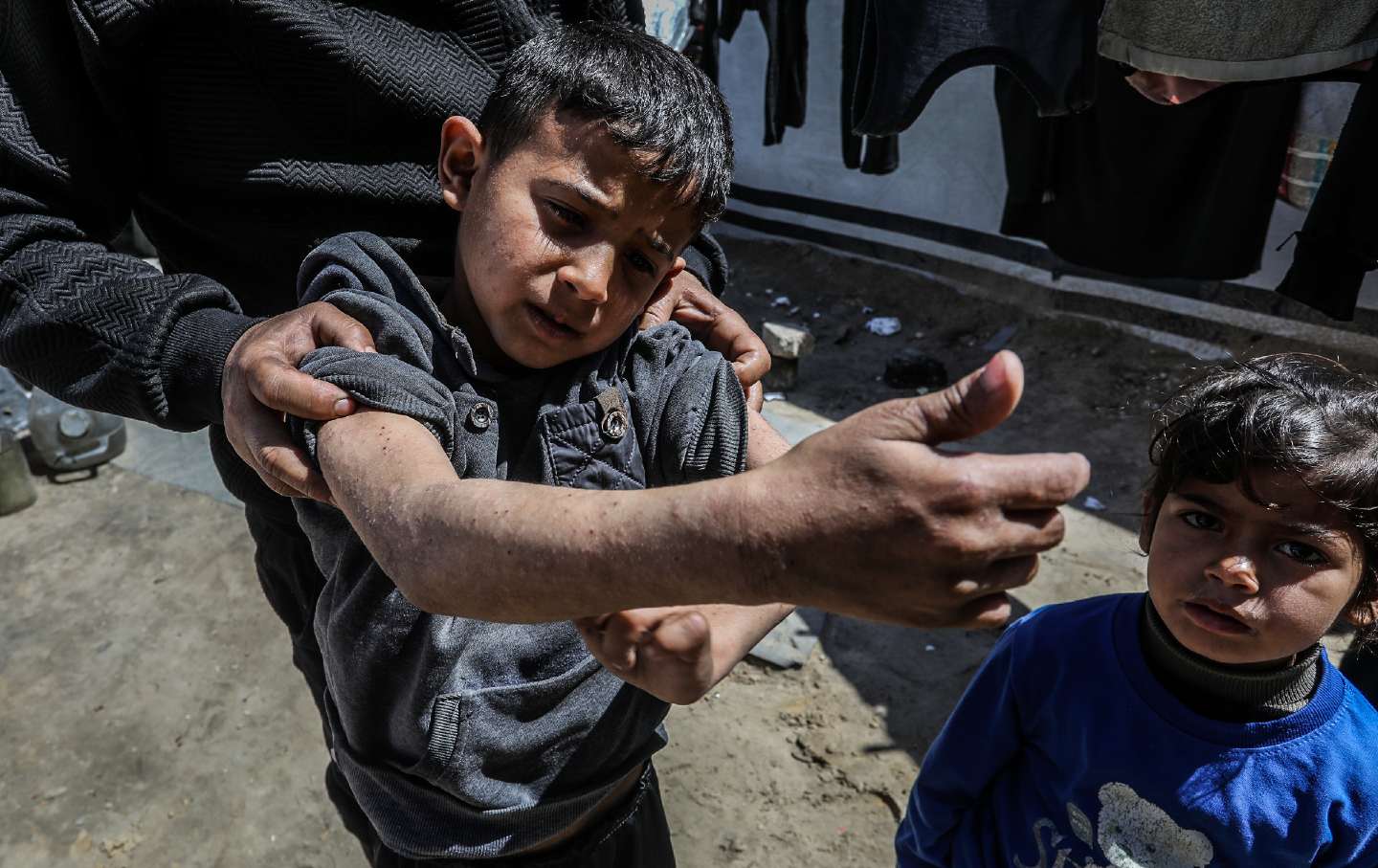
A boy in Khan Yunis displays the bites he has received from vermin on March 30, 2026.
(Abed Rahim Khatib / Anadolu via Getty Images)Gaza—Yasmeen al-Jamala still hears her infant son’s scream.
One night, her baby suddenly cried out. She switched on a flashlight and found his face covered in blood. A large weasel, big as a cat, had attacked him while he slept.
“Now I dream that something is coming for him every night,” she says.
Since that night, she checks her son repeatedly after he falls asleep. Every unfamiliar sound sends her reaching for a flashlight. Like many parents in Gaza, she says she no longer fears only what falls from the sky. She fears what emerges from the darkness after the bombing stops.
The world watches Gaza through the spectacle of bombs, tanks, and diplomacy. Yet some of the clearest evidence of the humanitarian collapse we now face comes in much smaller forms: weasels, rats, and other vermin moving freely through tents, hospitals, and ruined neighborhoods.
For many outside Gaza, rats may sound like a secondary concern when compared with bombs and bullets. But anyone who has lived through humanitarian disasters understands their significance. Rats spread disease. They contaminate food supplies. They transform misery into something even more degrading.
This is what prolonged humanitarian collapse feels like—not a single dramatic moment, but the slow accumulation of indignities that make ordinary life almost impossible.
The rats are simply the most visible warning.
According to Gaza municipality spokesperson Hosni Mhanna, more than 350,000 tons of garbage now lie uncollected across Gaza City, alongside roughly 25 million tons of rubble. The destruction of Gaza’s sewage systems and Israel’s refusal to allow the entry of adequate supplies of pesticides have created ideal conditions for rodents to multiply.
Their presence is a reminder that modern warfare does not end with explosions. It lingers in the poisoned water, the mountains of uncollected rubbish, the collapsed sewage systems and the desperate overcrowding that follows. Rodents thrive because the systems that keep human beings healthy and safe have collapsed. They run through streets where children still play because there is nowhere else for either of them to go. They climb over tents pitched beside mountains of rubbish because families have nowhere else to sleep. They enter homes whose doors no longer close because explosions have shattered the walls. They terrorize children trying to sleep in makeshift shelters.
Families have developed new nightly rituals. Before trying to sleep, they shake out blankets, inspect mattresses, and shine cell-phone flashlights into the corners of tents. Shoes are turned upside down before anyone slips them on in the morning. Food, when there is any, is hung from ropes or placed on makeshift shelves in the hope that rodents cannot reach it. Parents keep watch long after their children fall asleep, listening for the scratching sounds that signal another unwelcome visitor.
Sleep itself has become fragmented. Many people have told me that they wake repeatedly through the night, startled by movement against the tent walls or by the sound of plastic sheeting rustling. For a population already exhausted by months of bombardment, displacement and hunger, even the few hours meant for rest are no longer safe.
Almost every dawn, I watch them from my window. Rats and weasels emerge from the darkness and disappear into the ruined houses opposite our building, entering homes where families continue trying to live.
The infestation is no longer confined to tents. Before sunrise, people making their way to the dawn prayer walk cautiously through the darkness, watching the ground as much as the sky, knowing they may encounter rats before they reach the mosque.
Sondos Hamdan, who is pregnant, says she dreads the arrival of the night.
“I don’t sleep anymore,” she says. “My doctor told me not even to try to fight them. The fear alone could cause complications with my pregnancy.”
She is far from alone. Parents speak of feeling helpless as they try to protect children from dangers they cannot control. Mothers describe sleeping lightly so they can wake at the slightest sound. Fathers search for scraps of wood or metal to block gaps beneath tents, knowing the barriers rarely work. Every evening brings the same calculation: Where is the safest place to sleep tonight?
Many say the fear itself has become another form of exhaustion. Surviving the bombs no longer guarantees a peaceful night.
Inshirah Hajjaj sleeps with her feet uncovered because diabetes leaves them burning at night. One morning she opened her eyes to find blood pooling beneath her leg. During the night, a weasel had bitten two of her toes. It was the second time this had happened.
None of this happened by accident.
Garbage accumulates because there is nowhere to take it. Sewage spills because treatment plants cease functioning. Food scraps become impossible to dispose of safely. Entire families are forced into overcrowded camps where sanitation is scarce and privacy is nonexistent. Every one of these conditions creates the perfect environment for rats to flourish.
In normal times, rodents are controlled by functioning municipalities, waste collection services, sanitation workers, and public-health systems. They disappear into the background because governments and communities ensure that they do. But in war, those invisible systems disappear first.
History repeatedly demonstrates that war creates ideal conditions for epidemics. Destroy sanitation infrastructure, and infectious diseases soon follow. Limit clean water, and illnesses spread rapidly. Force hundreds of thousands into overcrowded shelters and preventable health emergencies become almost inevitable.
At Al-Shifa Hospital, emergency physician Dr. Muneer al-Shakhrit says such cases are becoming increasingly familiar. Patients arrive with bites from rodents and other animals. Those with diabetes face particular danger because they often cannot feel injuries immediately. Some require intensive care because of rat-bite fever and other infections.
For 20-year-old Amany Abu Selmi, the rodents devoured something less tangible than food. Days before her wedding, rats chewed through the clothes she had carefully prepared as a bride. Even joy, in Gaza, has become something that must survive infestation.
No society should accept that children grow up surrounded by rubble, waste, and vermin. No humanitarian response should consider such conditions anything approaching normal.
Popular
“swipe left below to view more authors”Swipe →Wars inevitably produce destruction. Yet international humanitarian principles exist precisely because civilians should not bear unlimited consequences for conflicts beyond their control. The protection of public health, access to sanitation, and the preservation of basic living conditions are not luxuries to be discussed after a ceasefire. They are essential to preventing even greater suffering while conflict continues.
The longer these conditions persist, the greater the risk becomes. Rodent infestations are not merely unpleasant. They increase the likelihood of disease transmission, contaminate food supplies, and deepen psychological trauma among populations already living under extraordinary stress. For children especially, the experience of sleeping in fear—not only of air strikes but of the creatures crawling through their tents—adds another layer of suffering that cannot easily be measured.
Rats do what rats have always done. They follow waste, destruction, and neglect. Human beings, however, have choices.
The question history will ask is not why the rats came. It is why the world accepted the conditions that invited them.
More from The Nation

Why French Students Are Revolting Why French Students Are Revolting
France’s education system is stretched to its limits, as student anger kicks off a hot fall protest season.

The GOP Sells the Mirage of a Hormuz Victory The GOP Sells the Mirage of a Hormuz Victory
The American action in the contested strait isn’t sustainable—and won’t alter the economic and political fallout from its closure.

Revolution or No Revolution Revolution or No Revolution
Eight years after Armenia’s “Velvet Revolution,” Nikol Pashinyan’s government has deepened the country’s neoliberal trajectory while reorienting Armenia toward the West.

Japan’s Far Right Is Courting Young Voters Japan’s Far Right Is Courting Young Voters
Sanseitō has attracted young voters through a robust social-media strategy, Charlie Kirk–like public speaking events, and anti-establishment messaging.
This AI Panic Is Nothing New This AI Panic Is Nothing New
In the 1940s, The Nation asked questions about the atomic bomb we’re asking of artificial intelligence today.

The Decades-Old Roots of Trump’s War on Iran The Decades-Old Roots of Trump’s War on Iran
An interview with historian Behrooz Ghamari-Tabrizi about the generations of US presidents who have tried to destroy the Iranian regime.

