
Arab Americans Have Always Been Here
The story of my people, and my country.
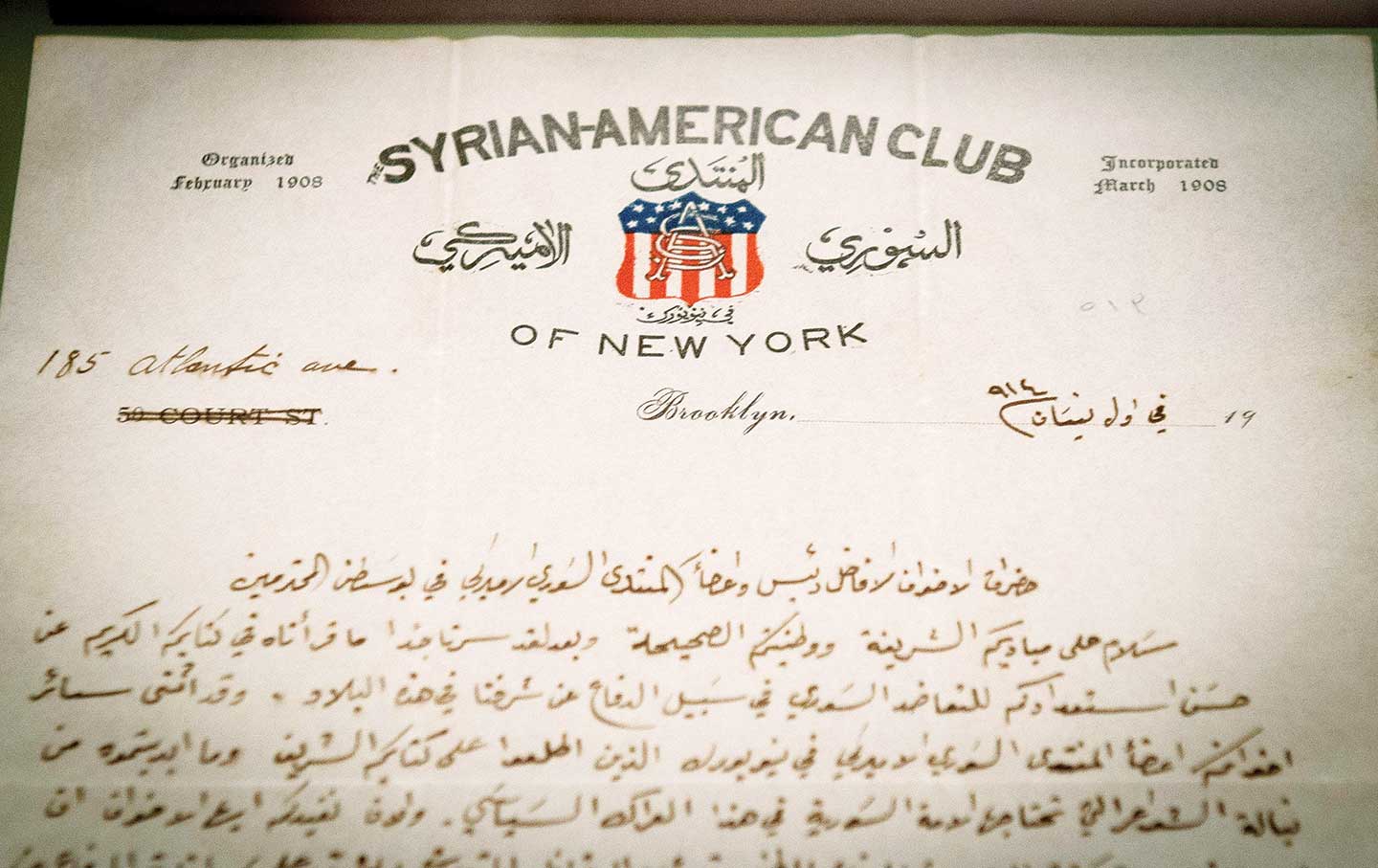
Deeproots: From the late 19th century to 1920, there were at least 100,000 Syrian immigrants who came to the United States.
(Bryan R. Smith / AFP via Getty Images)
At the 1984 Democratic National Convention, I was given the opportunity to deliver one of the speeches nominating Jesse Jackson for president of the United States. Reverend Jackson was the first presidential candidate to affirmatively include Arab Americans in his campaign, and I was the first Arab American to speak at a national party convention. In the few minutes allotted to me, I sought to convey my community’s diversity, its progress in American life, and its political concerns. I began:
I am an Arab American…. We are steelworkers of Syrian descent in Allentown and autoworkers in Detroit. We are Yemeni farmworkers in California and the Lebanese community of Brooklyn. We are the Palestinian grocers of San Francisco. We are professionals and public servants. We are immigrants and citizens, proud of being Americans and proud of our heritage.
The larger story of Arab immigration to the United States, including my own family’s story, has ebbed and flowed with this country’s 250-year history. But it wasn’t until the 1880s that larger groups of Arab immigrants began to arrive in the US. Like their Southern European counterparts, they came to find employment in the mills that populated towns in New England, the Mid-Atlantic, and the Midwest. Most of them were from the areas known today as Syria and Lebanon, but immigration records from this period simply categorized them as “Turks” from the Ottoman Empire.
250 Years of Searching for a More Perfect Union
Arabs, like other immigrant groups who came during the same period, settled in clusters in close proximity to the people they knew and built places of worship to consolidate their presence in their new neighborhoods. There were Maronite Catholic and Syrian or Greek Orthodox Christian communities throughout Connecticut, Rhode Island, Massachusetts, and New York. In the early 20th century, some of America’s first mosques were founded in Maine, Michigan, Illinois, North Dakota, and Iowa.
Emigration from the Mount Lebanon region spiked during the 1910s in the wake of the carnage of World War I and the fall of the Ottoman Empire. Not unlike the other communities from the Mediterranean (notably Italians and Greeks) who arrived in the US during the same period, a good number of these newer immigrants became peddlers and door-to-door salespeople. Because they were not from Northern Europe or may have had darker skin, they were considered foreigners, and a backlash developed against the Italians, Greeks, and “Syrians.” They were called “parasites” and were victims of violence and even lynchings. By the mid-1920s, legislation had been prepared to eliminate their visa allotments. One sponsor of the act, a Republican senator from Pennsylvania, famously referred to Arab immigrants as “trash.” As a result, for more than three decades, there was a steep reduction in the number of immigrants from the Arab world who were allowed into the US.
From the late 19th century to 1920, there were at least 100,000 Syrian immigrants. From the date when the anti-Syrian visa restrictions were put in place through 1960, the number of new immigrants from Arab countries declined sharply. During this period, a number of factors, including the absence of new immigrants and the pressures created by two world wars, the Great Depression, and the hyper-patriotism generated by those wars and McCarthyism, combined to accelerate the assimilation of the “Syrians” into American life. In the lobby of a Lebanese American clubhouse in southern Illinois, you will find a series of large, framed photographs of groups of uniformed soldiers—members of this Lebanese community—from World War I, World War II, Korea, Vietnam, and Afghanistan. They hang there as a statement of their patriotism and their pride in their adopted country.
My family was part of this unfolding story. My father’s oldest brother, Habib, came to the United States from Lebanon in 1910, when he was 14. He went door to door selling produce to earn enough to establish roots in upstate New York. His goal was to prepare the ground for the rest of the family to follow after the end of World War I.
Meanwhile, famine broke out in Lebanon. To survive, my family fled into the Bekaa Valley, where they hoped to remain until the war’s end. My grandfather died during this exile. It took the family until the early 1920s before they were in a position to join Habib in the United States. In 1921, with the exception of my father, they did. A few years later, encountering the anti-Syrian visa restrictions, my father secured a job and passage on a ship to Canada. After arriving, he illegally crossed the border into the US and reunited with his mother and siblings in 1923.
Like so many other Arab immigrants who followed, my father, his brothers, and his sisters set themselves on a path to succeed in their new homeland. They founded seven businesses between them, and their children and grandchildren launched many more or became professionals.
My father’s undocumented status led him to spend a part of his first decade in the United States in hiding to avoid deportation. He received amnesty in the 1930s and became a naturalized US citizen in 1943. His naturalization document hangs on the wall of my office beneath the presidential parchment from Barack Obama announcing my appointment to serve on the US Commission on International Religious Freedom. I call it “My American Story Wall.” At an event following my 1984 convention remarks, I observed: “I am the son of an illegal immigrant who nominated for president the great-grandson of a slave. It’s a story that could only happen in America.”
By the 1970s, despite the decades-long freeze on new immigration from Arab countries, the Arab American population had increased to almost three-quarters of a million people, mostly Syrian and Lebanese. When the 1965 Immigration Act lifted the restrictions on Arab immigration, both the numbers and the composition of Arab Americans began to change.
During the next four decades, immigration to the US from the broader Arab region increased to an average of more than 100,000 people per decade. This spike was mainly due to three factors: the tumultuous conditions that shook the Arab region in the post–World War II period, including the creation of Israel and the expulsion of hundreds of thousands of Palestinians from their homes; the civil strife in several Arab countries that followed their liberation from colonial rule; and the backlog of Syrians and Lebanese who sought reunification with their families after several decades of separation.
While most of those who came in the first two waves had been Christians from the Arab East, this third wave was more diverse, with substantial numbers from Syria, Lebanon, and Jordan, as well as sizable groups from the Gulf states and Iraq, Morocco, Somalia, Yemen, and Sudan. The most dramatic increases in Arab immigration to the US occurred during the first two decades of this century. Once again, wars and political upheaval were the major factors that drove over 1 million to immigrate during this period—with nearly half coming from Iraq, Egypt, and Jordan and roughly a third from Somalia, Syria, Lebanon, and Yemen. These recent Arab immigrants have followed similar settlement patterns and trajectories to success as their predecessors. Yemenis, for example, who arrived in the 1970s as farmworkers or dockworkers, are now a powerful bloc of small-business owners in New York and California, with their children forming an association of young Yemeni professionals. Palestinians, Egyptians, Jordanians, Iraqis, and the more recent Somali and Sudanese communities have made similar journeys.
Popular
“swipe left below to view more authors”Swipe →Likewise, while in the last century Arab American elected officials were mainly Lebanese, there are now Palestinians, Egyptians, Yemenis, Somalis, and Sudanese. More are running and winning each year.
These are the success stories we tell and celebrate, but to make the picture complete, a few additional factors must be noted.
Upheavals in the Middle East, coupled with disastrous US policies that exacerbated many of these crises, prompted many Arab Americans, including myself, to become politically active. Our goal was to help Americans better understand the Arab world and its peoples and cultures, and to press the US government to support the human and political rights of Arabs, including those of the Palestinian people.
Yet as our numbers and prominence grew, some pro-Israel groups tried to bury us. Efforts to silence our voices, tarnish our reputations, and block us from politics and the media resulted in dangerous Arab-baiting and the smearing of Arab American leaders and activists. For some, it took the form of death threats and political violence.
Here, too, my personal story tracks this larger narrative. In 1978, I was invited to join a meeting of minority-group leaders at the White House with Vice President Walter Mondale. Three days later, a White House staffer called to tell me that I wouldn’t be invited back to a follow-up meeting. It appeared that a prominent Jewish group had complained about the presence of an Arab at the first meeting. The same thing happened the next year when I was invited to join a Washington-based peace and rights coalition. Three Jewish groups said that they would have to withdraw if I was admitted. The argument was that a pro-Palestinian group would harm the credibility of the coalition in Washington.
Also beginning in the 1970s was a decades-long campaign of smears and threats. Groups like the Anti-Defamation League, the American Israel Public Affairs Committee, and the American Jewish Committee published dossiers on prominent Arab Americans, labeling us as “Arab propagandists.” These were sent to political figures and prospective employers and circulated to media outlets and venues that might invite an Arab American to speak. Some Arab Americans lost their jobs. Candidates returned campaign contributions from Arab American voters, while others simply shunned the community, believing that to be the safer course.
In 1989, David Dinkins, then running for mayor of New York, asked me to visit him at his office. Since we had worked together in Jackson’s 1988 campaign, I assumed this would be a friendly chat. Instead, Dinkins asked for my help keeping my community away from his campaign. He saw Arab Americans as a liability with Jewish donors. The first death threat I received was in 1970, when I was a teaching assistant at Temple University. The letter read: “Arab dog, you will die if you set foot on campus again.” These sorts of threats have continued since then, most of them quoting the smears propagated by more reputable organizations. My office was firebombed in 1980. A colleague whom I’d hired, Alex Odeh, was murdered when his office was bombed in 1985. In the 25 years since 9/11, three people have been convicted for threatening my life and the lives of my family and staff.
But despite the bigotry, the hate crimes, and the campaigns designed to slander and silence us, my community has continued to grow in capacity, in representation, and in voice. What is perhaps most remarkable is not the hostility we’ve endured; American history is well-stocked with such chapters. Rather, it is Arab Americans’ insistence on fully participating in civic life, never losing faith in the promise of America as a nation of immigrants. Whether speaking at the Democratic National Convention or serving in city councils, state legislatures, and the United States Congress, our work strengthens American democracy every day.
My father crossed a border illegally in 1923 because survival and family demanded it. He became a citizen 20 years later and died proud of both his Lebanese heritage and his American identity. Like so many Arab immigrants who came before him and since, he and those who followed have helped build the nation we are all fighting to preserve today.
More from The Nation
What Trump and Tucker Carlson Have in Common What Trump and Tucker Carlson Have in Common
Carlson has broken with Trump largely over the war in Iran. But on Ukraine and immigration, the two speak very much the same language.
The Jewish Case Against AI The Jewish Case Against AI
Haredi rabbis and the secular left agree: This technology is a threat to the entire social fabric.
The Fight for Educational Equality Is Also a Fight for a Just Supreme Court The Fight for Educational Equality Is Also a Fight for a Just Supreme Court
The court has severely weakened our ability to make an education system that fulfills the promise of Brown.

The Fall of “Scientific American” The Fall of “Scientific American”
When the beloved science publication got too political, its corporate owners stepped in. Now its future is uncertain.
The Bookstore Revolution in Taiwan’s Conservative Heartlands The Bookstore Revolution in Taiwan’s Conservative Heartlands
After Taiwan legalized same-sex marriage, gender-themed bookstores are working to build the social acceptance that the law alone couldn’t deliver.
Jalen Hurts Deserved Better. We All Do. Jalen Hurts Deserved Better. We All Do.
In a country that treats workers as expendable parts, Hurts’s playing through a blood clot is just the highest-profile example of the price workers pay in an oligarchy.

