
250 Years of Genocide, Theft, and Displacement
Natives have nothing to celebrate as the United States stages another sick-making festival of self-congratulation.
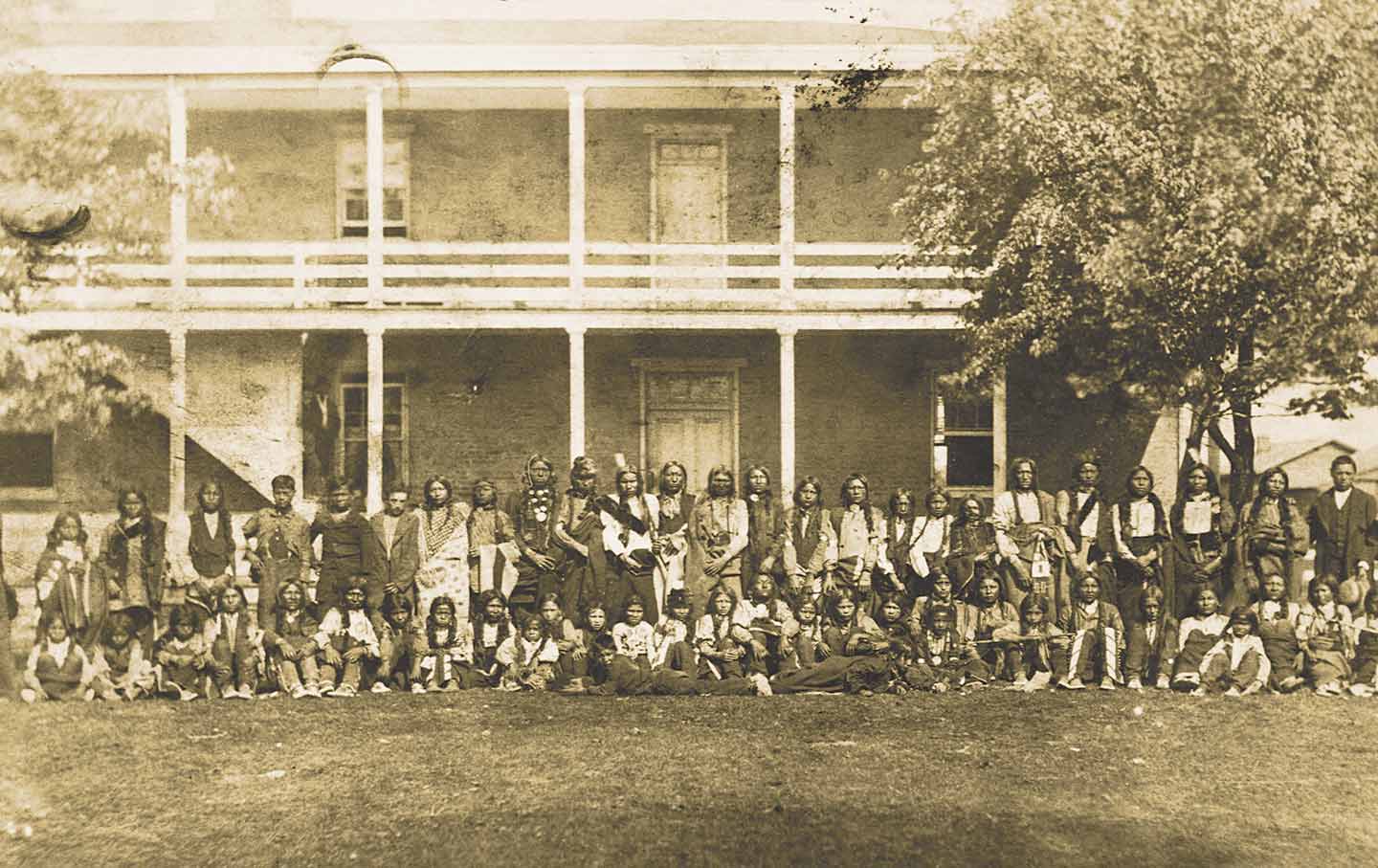
Reeducation: The boarding schools Native children were sent to, like this one in Ohio, were little more than brutal detainment camps.
(Corbis / Corbis via Getty Images)
Let’s be clear: I am not a fan of the 250th-anniversary celebration of the United States.
The official festivities to commemorate the anniversary—formalized under the Trump administration’s grift-laden Freedom 250 project—come off as little more than a red, white, and blue circle jerk. The invocation of the country’s founding as a landmark moment in the growth of democratic self-rule rings decidedly hollow in the absence of any serious reckoning with the nation’s actual past. And inevitably, that mature accounting must begin with an unstinting appraisal of the evils America has hammered on the heads of its first peoples since Christopher Columbus launched his brutal, lascivious “New World” endeavors lo these 534 years ago.
250 Years of Searching for a More Perfect Union
From an Indigenous perspective, this 250th anniversary should be a serious reflection on the traumas and damages the nation is guilty of rather than a firework-cracking celebration. The spectacle is something akin to seeing a judge wanly scold a habitual drunk driver for barreling full-speed into a parade, leaving the mangled bodies of women and children in his wake. The jurist would, in the same virtual breath, endorse the defendant’s phoned-in plea: The reason for sowing all this carnage and mayhem, the perp would explain, is that Jesus told him to.
That may sound like farcical hyperbole, but it’s pretty much the standard alibi that we Natives have heard since the first white man stumbled onto our shores. The justification for their mass murder and pillaging even has a name: Manifest Destiny. In 1872, the artist John Gast put paint to canvas to commemorate the term. He illustrated us, the Natives, running away into the darkness, fearing a huge, hovering, oncoming blond angelic figure with a horde of God-fearing white people at her back. Gast titled his iconic piece American Progress. But progress for whom? Not us.
America’s progress, according to the elected white men of Gast’s epoch, was hindered by the millions of Natives who lived freely on the land. So they declared every Native to be part of their “Indian problem”—the term the US government employed to justify policies that would eventually forcibly remove us from our homes. In all, billions of acres were stolen from this land’s first peoples for no other reason than that we weren’t Christian, we weren’t white, and we were spread out all over the continent the invaders wanted to claim for themselves.
These were certainly not live-and-let-live people who trundled to our shores from Europe. They were wašíčus—Lakota for “the greedy people.” There was never enough anything for them. There was never enough land to steal, mountains to drill into, gold to take, women to kidnap for their perverted pleasures—and then they came for our kids.
In a development all too characteristic of the selective amnesia of white Americans, people are only now coming to grips with the cruel legacy of the United States’ Indian boarding-school system. Launched via yet another sick and twisted turn of phrase—“Kill the Indian in him, and save the man”—the boarding schools were little more than brutal detainment camps. US officials, working in conjunction with the Catholic Church, would storm into our camps and homes and kidnap the children. They’d relocate them to schools that in many cases were hundreds of miles away from their families.
In these houses of horror, priests and nuns would cut the children’s hair, pierce their tongues if they were caught speaking their Indigenous languages, beat them bloody with rulers and sticks, and, in the dead of night, they would take the children into their chambers and molest them. Not just the priests; the nuns, too.
Today, investigators have uncovered dozens of mass unmarked graves where these children have been buried all over the United States and Canada, with more likely to be discovered in the coming decade.
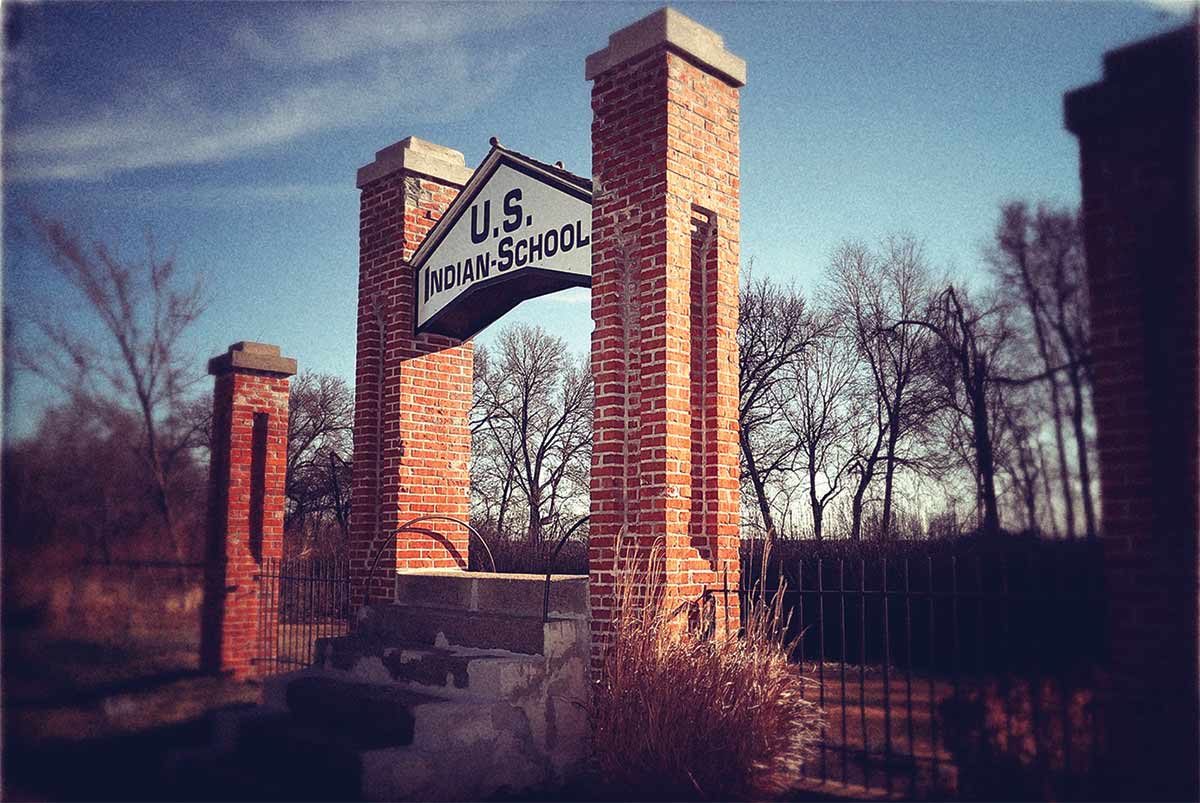
The semiquincentennial isn’t just a celebration of the nation; it’s also an encomium for the founding fathers as well as noted presidents. While white Americans revere these bogus liberators as intrepid defenders of sonorous abstractions like “freedom” and “liberty,” Natives experienced them as fiendish predators. Here’s just a partial litany of their rapacity:
President Thomas Jefferson said that the Indian justified his own extermination. President George Washington fervently believed that the surest way to kill all Natives—men, women, and children—was to annihilate every crop and resource that fed a tribe. Even President Abraham Lincoln holds the record for hanging the most Indigenous people in a single day—a fact that is often excised from classrooms and history texts.
It’s hard to celebrate a country that’s guilty of so many human-rights violations against Natives. There was the Trail of Tears, orchestrated by President Andrew Jackson, which claimed the lives of at least 10,000 Natives from exposure, starvation, and disease during their forced displacement; 4,000 of them were Cherokee—one-third of the tribe’s population was dispatched by the white government onto the Trail. There was the Wounded Knee Massacre, where, following the murder of more than 300 Lakota (200 of whom were women and children), a group of white men were paid $2 for each Lakota body dumped into a mass grave. There was the Bear River Massacre, where the United States killed an estimated 493 Shoshone people. There was the Sand Creek Massacre, where US forces murdered mostly Cheyenne and Arapaho children.
Popular
“swipe left below to view more authors”Swipe →There’s a theme here: the white lust for conquest producing mass body counts of dead Natives, especially murdered Native children. This list could be extended to include a nauseating number of mass killings at the hands of invading Europeans; the whole history of the country’s rampaging massacres of its Native population is largely unknown to white Americans. In what’s arguably the earliest and most consequential deployment of cancel culture, these vicious acts of racism and hate are deliberately airbrushed out of the country’s official narrative.
The United States is guilty of killing so many of us since America was “settled” that we Natives are still suffering the follow-on effects of the country’s founding genocide. According to the US Census Bureau, Indigenous peoples are the smallest racial minority in our own ancestral homelands. Anthropologists posit that we have inhabited this hemisphere for some 130,000 years. Human history on this land began with us, and the United States has a hard time coming to terms with that fact.
And while Natives continue to be subjected to vulgar forms of dehumanization (think Indian mascots, redface minstrelsy, tomahawk chops, and sports fans of all colors shouting, “Go back to the reservation!”), Natives serve in the military at a higher percentage than any other demographic in the United States, according to the Department of Defense.
Natives join the military for many reasons, not the least of which is that, as our elders have long taught, it is embedded in the spirit of the Native to protect the people, the land, the water, our winged relatives, and our relatives in the oceans, lakes, and seas. Others join to escape poverty and even to protect our Indigenous ways of living.
During World War II, Lewis Naranjo, a soldier and artist who was Santa Clara Pueblo, famously said from the front lines that he signed up to protect his people’s way of life. “We are doing our best to win the war to be free from danger as much as the white man,” he said at the time. “We are fighting with Uncle Sam’s army to defend the right of our people to live our own life in our own way.”
But the service of Naranjo and other Native veterans is dishonored by a 250th-anniversary flag-humping hoedown that fails to recognize the wanton savagery the United States has wrought upon Native peoples. Why would any Native be expected to celebrate white men declaring their independence from another group of white men, as they brutally denied us any semblance of freedom and liberty? Natives were not even considered American citizens until 1924. To this day, many Native nations and tribes do not have the luxury of running water or electricity.
Carlos Becenti, a citizen of the Navajo Nation (which continues to rely on the delivery of clean water by trucks in some parts), does not believe much good has come from the white invasion.
“It’s been 250 years, and the only thing this country continues to excel at producing is scared, mediocre white men,” he said.
Still, the celebrations will ring forth, echoing the white settlers’ Liberty Bell. More dogs will go missing from utter fear of the booming fireworks. Meanwhile, I will continue to wonder how anyone could expect Becenti or me to join in on the rotten jubilation.
Even today, not many non-Natives are aware that just a few paragraphs after Thomas Jefferson jotted down the famed preamble to the Declaration of Independence—“We hold these truths to be self-evident, that all men are created equal”—he went on to contradict himself by referring to us as “merciless Indian savages.”
I’d much rather be a “merciless Indian savage” than a racist white man any day. Any honest reckoning with this country’s past has to begin by honoring all of the Indigenous peoples—men, women, children—who were massacred, displaced, or left to die of disease and privation in the name of “American progress.” The shrill and duplicitous observance of the country’s latest benchmark anniversary is the handiwork of more mediocre white men too scared to face the truth.
More from The Nation

What Trump and Tucker Carlson Have in Common What Trump and Tucker Carlson Have in Common
Carlson has broken with Trump largely over the war in Iran. But on Ukraine and immigration, the two speak very much the same language.
The Jewish Case Against AI The Jewish Case Against AI
Haredi rabbis and the secular left agree: This technology is a threat to the entire social fabric.
The Fight for Educational Equality Is Also a Fight for a Just Supreme Court The Fight for Educational Equality Is Also a Fight for a Just Supreme Court
The court has severely weakened our ability to make an education system that fulfills the promise of Brown.
The Fall of “Scientific American” The Fall of “Scientific American”
When the beloved science publication got too political, its corporate owners stepped in. Now its future is uncertain.

The Bookstore Revolution in Taiwan’s Conservative Heartlands The Bookstore Revolution in Taiwan’s Conservative Heartlands
After Taiwan legalized same-sex marriage, gender-themed bookstores are working to build the social acceptance that the law alone couldn’t deliver.

Jalen Hurts Deserved Better. We All Do. Jalen Hurts Deserved Better. We All Do.
In a country that treats workers as expendable parts, Hurts’s playing through a blood clot is just the highest-profile example of the price workers pay in an oligarchy.

