
Americans Are Reaching a Financial Breaking Point
The majority of Americans are actively stressed about money. The rich have never been richer. No wonder we’re so mad.
Buying a tomato today will cost you 40 percent more than it did one year ago. There are many markers of the current unaffordability of American life, with gas prices—now at more than $4.50 a gallon thanks to Trump’s pointless war on Iran—cited most frequently. We are nickel and dimed by ever-increasing “streamflation,” so-called “convenience fees” and “shrinkflation,” whereby companies deceptively shrink product sizes while charging the same—or even more. Others examples are perhaps more consequential. Renting an apartment is 54 percent more expensive than it was in 2017, housing prices are up 60 percent since 2019, families will spend $120 more on electricity this year than they did in 2025, and credit card debt is up 63 percent since just 2021. But there’s something so startling and symbolic about a single red tomato costing 40 percent more than it did just 12 months ago. It’s as if even the simplest and most ordinary comforts of American life are quietly being put out of reach.
That bleakness is reflected in surveys about Americans’ personal finances, which reveal a creeping sense that everyday life is growing financially untenable. Sixty-seven percent of Americans say they’re actively stressed about money, according to a CBS News poll released this month. Most Americans, at 55 percent, say their finances are worsening—the highest percentage since Gallup started asking the question in 2001, and meaning that more people feel financially pessimistic today than did during the pandemic or the Great Recession of 2008. Two thirds of Americans haven’t been able to attend social engagements—decidedly unluxurious events like birthday dinners, weddings, and holiday gatherings—because of financial limitations, and most of them, 55 percent, lied to friends and family about money being the reason. One third of Americans reported skipping meals or driving less to save gas money for health care costs in a survey conducted in mid-2025—even before Trump caused the cost of gas to skyrocket even higher—while one-quarter had delayed surgery and other treatments because of cost. What’s more, one-third of the country has no savings, leaving them unable to absorb even a $400 medical emergency. How grimly fitting, then, that nearly 7 out of 10 Americans are more worried about going broke than dying.
More by Kali Holloway
As much as every policy decision Trump makes seems crafted to hasten our collective financial suffocation, this country has been choked with extreme inequality for quite some time. After an extended period of economic growth following the New Deal era and World War II, America has seen increasing income inequality since the 1970s, and today has the highest wealth inequality among G7 nations, while having some of the worst economic mobility in the developed world. The top 10 percent of the country owns almost 95 percent of all stocks, nearly half of Americans have $0 in retirement savings, and the amount of wealth held by the top .1 percent of the country is roughly equivalent to that held by the bottom 90 percent. “U.S. inequality has returned to levels not seen since the early 1900s,” writes Capital and Main, which is a funny way of reminding us that we’ve kinda always been this way. The extreme concentration of wealth in the hands of a few can be traced to the founding of a country that once tied political power explicitly to white male landownership. Meanwhile, the exclusion of Black folks, women and other marginalized groups helped establish a national ethos in which austerity and disinvestment were normalized—first just for marginalized communities but eventually, for everyone else, too. Thanks to a public education system that propagated the notion of bootstrap individualism as a civic virtue, and a culture that elevated astonishingly rare rags-to-riches stories as the achievable norm, the myth of American mobility nevertheless flourished. But studies have long shown that Americans grossly overestimate the scalability of this country’s economic ladders. Those myths were always a way to make people treat the systemic failures of free-market capitalism as their own personal shortcomings. The national delusion that everyone is a millionaire in waiting is, in some ways, what allowed the development of the billionaire class we have today.
All the while, the particularly unchecked brand of capitalism we have here in the US has worked to extract the maximum from working people while returning the barest minimum, fueling the rise of inequality that now engulfs us all. The average CEO to worker compensation was 20-to-1 in 1965. In the early 1990s, it climbed to 58-to-1. Want to know what it was in 2025? A staggering 285-to-1. At the 20 companies that employ the greatest number of low wage workers—including Walmart, Home Depot, Best Buy, Starbucks and Amazon—it was just shy of 900-to-1. At the 50 public companies with the biggest pay gaps between worker and CEO, it would take 1,000 years for the average worker to make what their CEO brings home every year.
The very rich, for their part, are bad at reading the room, and abysmal at feigning sympathy. Last year, Donald Trump called affordability concerns a “hoax”—during the holiday shopping season, no less—and recently stated that he considers Americans’ gas prices and other economic woes, “not even a little bit,” when making decisions about the war in Iran, adding, “I don’t think about Americans’ financial situation.” Treasury Secretary Scott Bessent decided to do a bit of gaslighting, insisting that while Americans “may be sounding grim,” deep down inside, “in their heart of hearts, they feel good,” and dismissed “what they’re telling the survey people.” Republican congressman Jim Jordan, meanwhile, responded to soaring gas prices with a verbal shrug, stating, “That’s life.”
“Not to make too dramatic of a connection, but elite indifference was one of the fundamental problems that led to the French Revolution,” David Lay Williams, a professor of political science at DePaul University and author of The Greatest of All Plagues: How Economic Inequality Shaped Political Thought from Plato to Marx, said to me. “What made the struggles of French peasants all the more difficult to bear [was] that their pain wasn’t being shared by the upper classes.”
Hence the fury sparked by the apocryphal quote attributed to Marie Antoinette, “Oh, they don’t have bread? Let them eat cake.”
“She didn’t actually say those words,” Williams went on. “But for the people who were suffering, she might as well have, because plenty of aristocrats weren’t suffering at all. That’s different from the American Great Depression, when the pain felt like it was being shared broadly, and there was the sense that we’re all in this together. The extreme inequality we have right now looks less like the Depression and more like prerevolutionary France.”
Billionaires have reacted to growing economic dissension with both condescension and self-pity. Kevin O’Leary, a Canadian businessman who has appeared on Shark Tank, has accused young workers of being “idiots” for “pissing away” money on daily coffees and $28 lunches, instead of bringing lunch from home or drinking water, while simultaneously claiming that the praise due to billionaires for their philanthropy and job creation has been “lost in this narrative of inequality.” Elon Musk, whose $1T fortune makes him richer than anyone alive or dead—and who recently announced he’s aiming for “10 trillion or bust”—claimed in March that there should be more gutting of federal spending because it’s mostly “entitlements.” We know that he was referring to Medicaid, Medicare and Social Security, because during the same interview he also claimed 20 million dead people and children are being used to fraudulently collect Social Security payouts. Rounding this out is Jeff Bezos, who argued against increasing taxes on billionaires by claiming that doubling his taxes is “not going to help that teacher in Queens.” He also accused politicians of “picking a villain” by criticizing poor (ha, ha) long-suffering billionaires.
These are all predictable takes from people whose riches depend on the very inequalities they show so little interest in. It did not take long for people to point out that O’Leary himself owns stakes in restaurants that charge $12 for fries and $24 for salad. Or that Medicaid, Medicare and Social Security aren’t entitlements, but programs that working people spend their lives paying into—although that’s not true for Musk, who has instead received $38 billion in corporate welfare. Or that Bezos reportedly pays a lower effective tax rate than most of his warehouse workers, one-third of whom are paid so poorly that they require help from programs like SNAP while nearly half report trouble making rent and buying food.
There’s no lunch you can skip or—to cite another boomer cliché—avocado toast you can forego that will make up that difference. And at a certain point, suggesting as much stops sounding merely out of touch, and starts to sound downright feudal. Or at least, what most of us mistake feudalism to have been. As Williams pointed out to me, the irony is that feudalism—for all its myriad horrors—had the decency not to blame the serf for being a serf. Modern capitalism’s insistence that you get what you deserve is far more insidious.
“Under feudalism, if you were rich, you knew that you shouldn’t think too highly of yourself, because you recognized that you were only rich because your parents were rich,” Williams told me. “This notion of meritocracy—and the attachment of moral attributes to people according to class—came about in the 18th century, after Europe was getting away from feudalism and working its way toward capitalism. Now, if you’re rich, it’s because you’re smart and industrious. And if you’re poor, it’s because you’re stupid and lazy.”
Popular
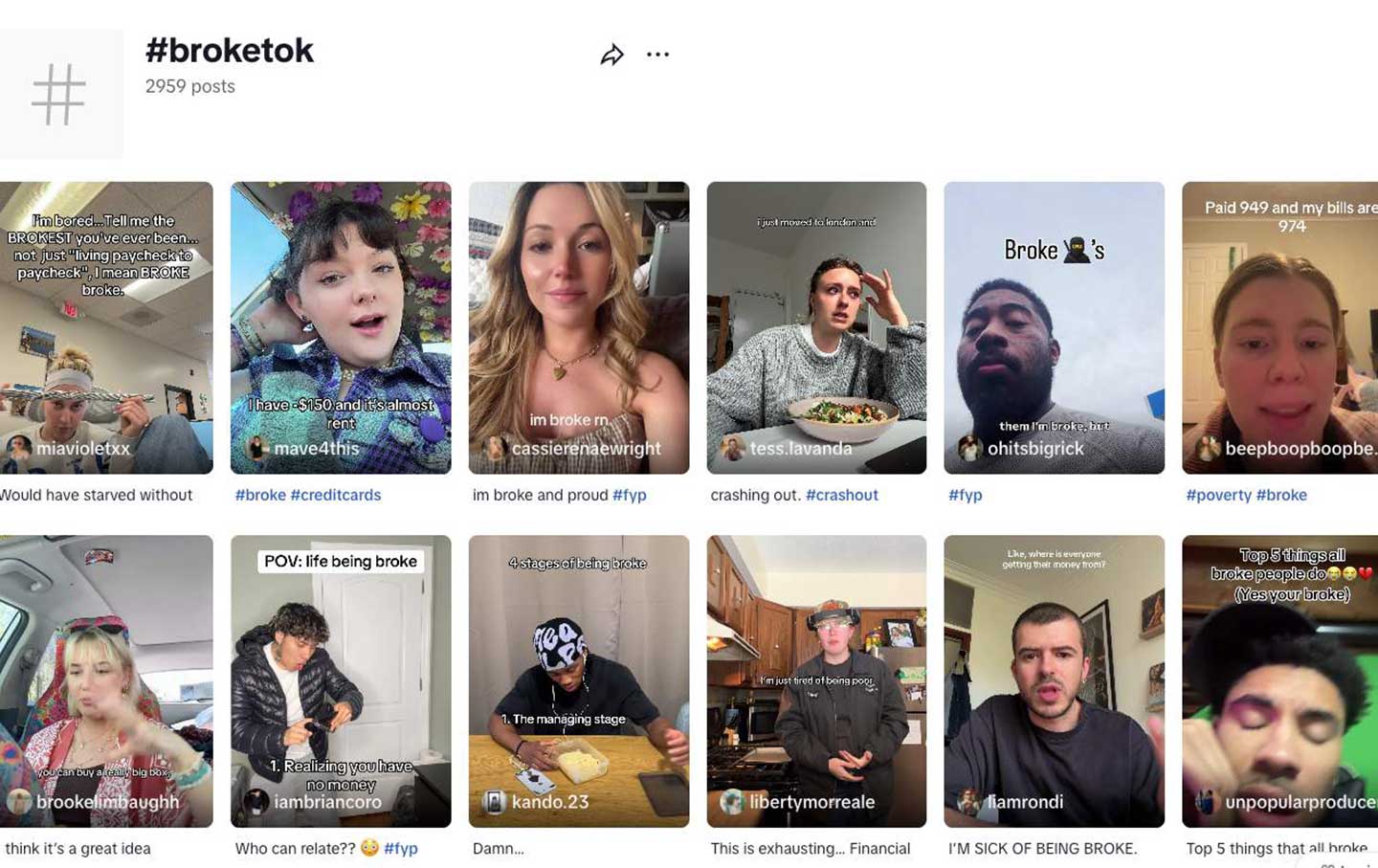
“swipe left below to view more authors”Swipe →It’s in this late-stage capitalist climate that #Broketok—in which mostly, but far from only, Gen Zers talk straight to camera about the staggering unaffordability of American life—has become a trend. In April, a video of a young woman sobbing in her car over the crushing math of her finances went viral. “I’m fucking stressed. We shouldn’t be working like this. I work my ass off and I can’t even fucking pay bills…can’t even pay my fucking rent,” she says through tears. That same month, another viral video offered the first-person perspective of a 29-year-old Kimberly-Clark warehouse worker in Ontario, California, as he used a lighter to set pallets of toilet paper on fire. “All you had to do is pay us enough to live,” he repeats, off camera, as the flames spread. “There goes your inventory.” The blaze rapidly escalated to a six-alarm fire, spreading throughout the 1.2 million square foot warehouse, requiring 175 firefighters and causing roughly $600 million in damages. None of his 20 coworkers from the nightshift were injured. He now faces seven felony arson charges. The criminal complaint cites a sample of texts and statements made by the fire-setter to infer his motive for setting the blaze. “I just cost these motherfuckers billions”; “1 percent is a fucking joke”; and “Pay us more of the value WE bring. Not corporate. Didn’t see the share holders picking up a shift.”
If videos get shared because they strike a nerve, these two seemed to strike at the shared sense of panic, hopelessness, and frustration at the heart of so much American economic insecurity. They represent two reactions, to the same condition—of hopelessness at realizing the American economic system belies the capitalist promise that hard work guarantees, at the very least, survival. Certainly, not everyone will set a warehouse on fire or even post their breakdown on TikTok, but both of those reactions are increasingly sympathetic to Americans who also feel the impossibility of the deal they’ve been given. Last year, nearly 70 percent of respondents to a Wall Street Journal survey said that the American dream—the idea that hard work pays off—isn’t true or was never true to begin with. That’s the highest percentage of disbelievers in the American dream in 15 years, and up 3 percent over just one year prior. Only a quarter said they expect their standard of living to improve. “The economic pessimism spanned across demographics,” Axios notes, “with men and women, older and younger adults, and those making more and less than $100,000 in household income.” Those videos are expressions of that same lack of faith—the end of the idea that work, sacrifice and playing by the rules will end with anything aside from exhaustion and economic precarity.
When economic insecurity is normalized and there is seemingly no recourse, people can become desperate. In America’s post-World War II economic bargain, and in the wake of violent clashes between desperate workers and corporate goons and police, unions were supposed to act as a check on capitalism, giving workers a voice—and power—at the negotiating table so their collective rage could be transformed into collective bargaining. Ultimately, they proved no match for rapacious corporate greed. America’s infrastructure for peaceful economic democracy was intentionally dismantled. (The Economic Policy Institute enumerates the spread of union-busting even in recent years, noting that “workers at Starbucks, Amazon, and Trader Joe’s have encountered multibillion-dollar corporations who are prepared to do whatever is necessary, lawful or unlawful, to crush their organizing campaigns.”) We currently live in a society where a majority, or roughly 55 percent, of homeless people have jobs. The poverty line, at $31,200 for a family of four, is based on woefully outdated economic indicators from 1963; a recent viral economics essay notes that the “price of entry” of the economy, including basic needs like childcare and healthcare, has increased exponentially, meaning we’re failing to capture how financially squeezed middle- and working-class households truly are. Occupy Wall Street took over Zuccotti Square nearly 20 years ago, and most of us are today a lot more tired of marching and absolutely fed up with waiting for things to change. When people can’t work, bargain or organize their way to a decent life, they get desperate, which can manifest in ugly ways. Extreme inequality can turn dangerous when people stop believing there are peaceful routes to improving their lives.
“It is almost universally true that violence has been necessary to ensure the redistribution of wealth at any point in time,” Walter Scheidel, Stanford historian and author of The Great Leveler: Violence and the History of Inequality from the Stone Age to the Twenty-First Century, stated to the Stanford Report back in 2017. Scheidel added, “The big equalizing moments in history may not have always had the same cause, but they shared one common root: massive and violent disruptions of the established order.”
But exactly when does extreme inequality start to threaten social stability? Researchers have found that “more unequal societies tend to have higher crime”—and more specifically, according to studies, interpersonal violent crime— “as well as lower social trust.” (Speaking of social trust, a 2026 Pew Research survey of 25 countries, found the U.S. was the only nation where more people “describe the morality and ethics of others living in the country as bad, 53 percent, than as good, 47 percent.”) Some prior studies have found that extreme wealth inequality, “by fuelling social discontent, increases sociopolitical instability,” while others have brought the correlation into doubt. But a December 2025 study finds that while inequality alone does not always spark civil unrest, in our modern world, inequality plus internet connectivity very often does, with a specific tipping point at 50 percent internet penetration. They cite examples, from 2011’s Arab Spring in Egypt and Tunisia to the recent “Gen Z uprising” in Nepal. Relative deprivation, they note, is rendered crisp and recognizable via social media.
It seems worth mentioning here that the crying girl in the car, between sobs, notes that “they always say, ‘Don’t compare yourself to others,’ but i see people going to Cochella and buying all types of shit—just pointless ‘fuck you’ money—and I’m over here, can’t even fucking pay my bills.” What else is #Broketok itself, really, but the Internet rendering inequality visible in real-time, inescapably and depressingly?
“There are probably a lot of people who think, ‘My suffering isn’t necessary. It’s only happening because we decided that some people in this economy need $800 billion—and that people like me have to work for pennies,’” Williams told me. “There’s more money in the American economy than there’s ever been in world history, but we’ve chosen to structure our economy in such a way that the top 1 percent, roughly, are getting the vast share of the rewards of this economy.”
Days after the warehouse fire video went viral, in the nearby city of Colton, California, someone painted a wall with the slogan, “Pay Us Enough to Live.” There is a reason that Luigi Mangione has become, to quote the unlikely source of Forbes magazine, “a folk hero.” And there is also a reason that so many people feel like the indifference of the rich seems to grow in direct proportion to the precariousness of life for the rest of us. As Trump is building an 90,000-square foot ballroom and a 250-foot arch flanked by gold eagles Kevin O’Leary is lecturing us all about gratitude and brown bagging your way to buying a $1 million microstudio. It’s hard to imagine there won’t be expressions of frustration beyond viral videos and graffitied walls. “If you’re not going to pay us enough to live or not to afford to live, at least pay us enough not to do this,” the fire-starter says before lighting the first pallet. Never let it be said that the people did not warn you.
Editor’s Note: This article originally misstated the planned size of President Trump’s White House ballroom. We have corrected the error.
More from The Nation
Black Freedom in an Age of White Oligarchy Black Freedom in an Age of White Oligarchy
Justin Leroy’s The Lowest Freedom points toward the limits of liberty under racial capitalism.
The School Behind the Billionaires and the Billionaire Tax The School Behind the Billionaires and the Billionaire Tax
UC Berkeley will inevitably be behind the defeat or victory of Proposition 40.
Dolly Parton Was a Proud Union Sister Dolly Parton Was a Proud Union Sister
Organized labor is celebrating the life and legacy of an artist who championed working women and carried a union card for almost 60 years.
Of Debt and Deficits and the Dollar System Of Debt and Deficits and the Dollar System
By force of preset agendas, conservatives and liberals react to debt headlines like Pavlov’s dogs.
What Happens When 8 Million People Lose Their Student Loan Repayment Plan? What Happens When 8 Million People Lose Their Student Loan Repayment Plan?
As the Biden-era SAVE plan ends, borrowers are facing unaffordable bills, lost payment records, and errors that have falsely put some into default.
David Ellison’s Delusional Stab at Self-Justification David Ellison’s Delusional Stab at Self-Justification
While the Skydance–Warner Bros. merger is in legal limbo, the CEO seeking to pull it off makes a disingenuous case for it in the court of public opinion.

