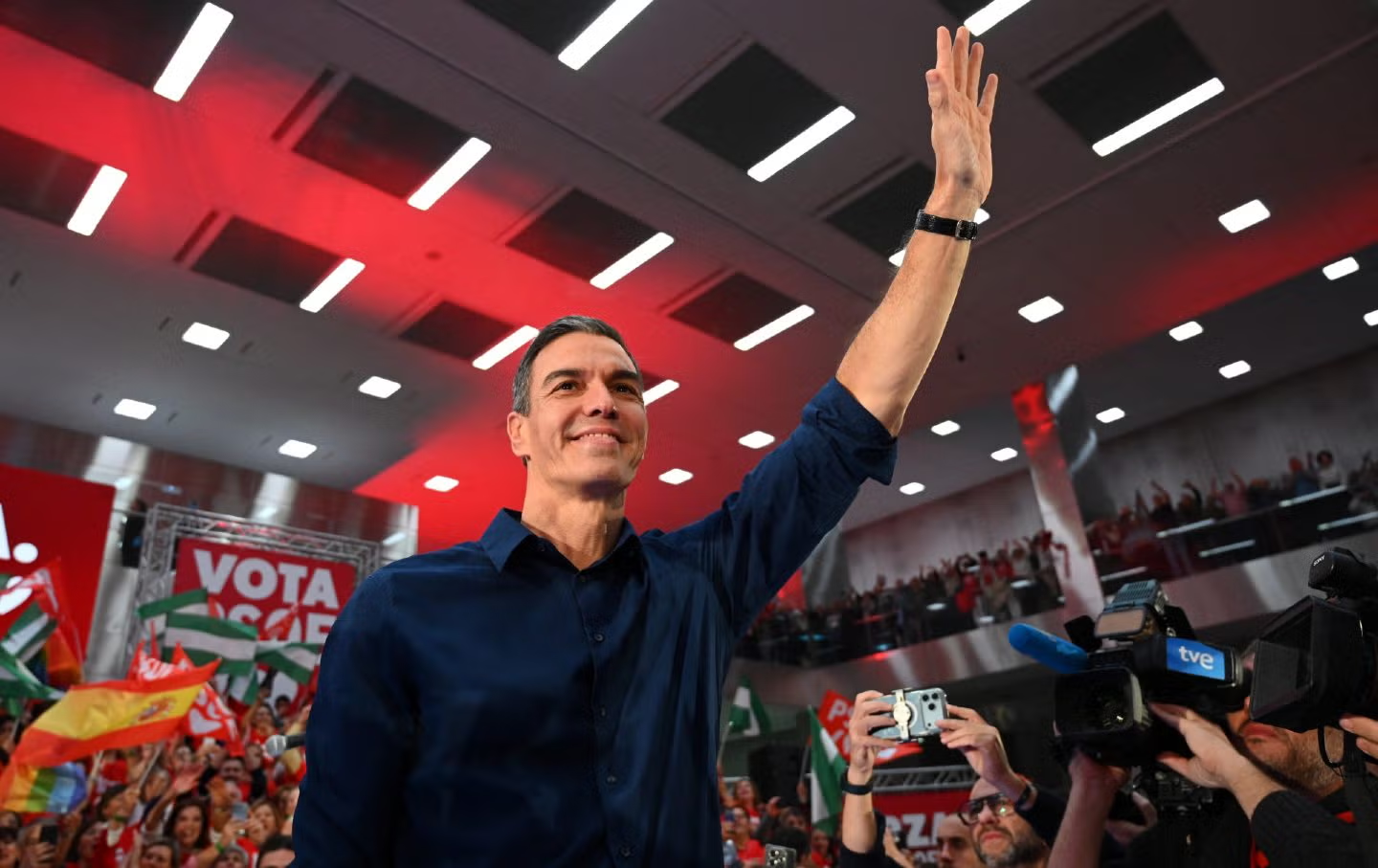
Spain’s prime minister and Spanish Socialist Party (PSOE) leader and candidate, Pedro Sanchez, waves to supporters during an election campaign rally in the Andalusian city of Cordoba on November 23, 2026.
(Jorge Guerrero / AFP via Getty Images)
On November 13, two weeks before the elections that could spell the end of Spain’s progressive government, the YouTuber and podcaster Jordi Wild—known as the “Spanish Joe Rogan”—began releasing a series of long-form video interviews with the leading candidates vying to be the country’s next prime minister after votes are cast this Sunday.
First up was Ada Colau, the 52-year-old housing activist and former mayor of Barcelona, who heads up the Frente Amplio (FA), a newly created fifteen-party progressive front. “My son watches your videos all the time and said I absolutely have to go on your show,” she told Wild. Next was Alberto Núñez Feijóo, 65, the leader of the conservative Popular Party (PP), who agreed with Wild that any leader of a European country should speak English—only to add that he hadn’t “made any effort to learn it.” Wild finished his series with sitting prime minister Pedro Sánchez, the 54-year-old leader of the Socialist Party (PSOE), who for the past eight years has steered Spain through the Covid crisis, dared to defy Trump, NATO, and Israel on defense spending and Gaza, and managed to turn Spain into the highest-performing of Europe’s largest economies.
There was one candidate Wild did not interview: Santiago Abascal, the leader of the far-right Vox party. (When Wild asked him to succinctly define each of his political opponents, Sánchez called Colau “activist” and Feijóo “conservative.” Meanwhile, Abascal, he said, “should find a new tailor because his jackets are too tight.”) Wild explained that Abascal had canceled at the last minute, but not before his team had imposed demands that were as arbitrary as they were ridiculous, including the exclusive proprietary rights over the interview.
This obsession with controlling all aspects of public appearances is standard fare for right-wing populist parties in Europe, who are quick to accuse other politicians of cowardice but wince at the possibility of a curveball. But Abascal’s attitude felt particularly bizarre for a program like Wild’s, whose followers—young, disenchanted men between the ages of 18 and 24—are catnip for the far-right. And sure enough, Abascal paid a price for his miscalculation; over the next couple of days, Vox dropped nearly two points in the polls.
In another election year, Abascal’s podcasting choices might not have mattered so much. But this year, how Vox does could determine whether one of Europe’s last progressive governments hangs on to power—or whether the Spanish far-right enters national government for the first time since the days of Franco.
As things stand, it looks like Vox will triumph, even without that podcast appearance. The final polls predict that the party will receive close to 18 percent of the vote, which will translate to some 60 representatives in the 350-seat Congress. Feijóo is projected to reach 31.5 percent—approximately 130 seats. While this is not enough for the conservative leader to govern on his own, a coalition with Vox would yield an absolute right-wing majority.
Sánchez, who for the last three years has presided over a precarious progressive coalition without a parliamentary majority, has a 25 percent chance to win the elections, but only a 10 percent chance of continuing on as prime minister. That’s because the parties to Sánchez’s left have imploded. Colau’s Frente Amplio is expected to get only around 10 seats, while Podemos, led by Irene Montero, will be lucky if it gets a single seat—a far cry from the 31 seats obtained in 2023 by Sánchez’s current coalition partner Sumar, led by labor minister Yolanda Díaz.
The elections this Sunday are seen by many as a referendum on Sánchez, who became prime minister in 2018 after ousting a conservative government via a no-confidence vote—a first in Spanish history. Until recently, he long seemed determined to serve the full four years of his term that the Constitution allows. Yet, in late September, Sánchez changed his mind as the country became awash in protest following the eviction of Maricarmen Abascal (no relation to the Vox leader), an elderly resident in Madrid who became the poster child of the housing and affordability crisis that has many Spaniards desperate—and furious. Housing prices in Spain have gone up by nearly 91 percent over the past decade, and nearly 31 percent since the beginning of 2024 alone, making the crisis especially acute for anyone looking to buy a home, renew their lease, or sign a new one. (Maricarmen was in many ways the exception that proved the rule: though she was evicted because she couldn’t pay her rent, which skyrocketed after her apartment building was bought by a corporate landlord, only 8 percent of homes in Spain are owned by businesses. The overwhelming majority are owned by fellow Spaniards, many of whom were, up until the 2008 financial crisis, incentivized to purchase second or third homes.)
These cascading problems would seem to spell doom for Sánchez. But he is a political chameleon and skilled tactician who has often been described as the continent’s ultimate comeback kid. In 2023, he was down by more than eight points when he called for snap elections. To everyone’s but Sánchez’s surprise, he cut that lead by three points during the campaign and by another four on election day, winning just enough seats to cobble a coalition together and prevent the PP and Vox from forming a governing majority.
Now, Sánchez is hoping that he can pull one more electoral rabbit out of the hat. In 2023, Sánchez mobilized voters’ fear of a far-right national government, and exploited the substance-free mediocrity of Feijóo’s campaign. He is trying to do the same in 2026, and is treating the campaign like a very high-stakes game of chess.
During his lone face-to-face debate with Feijóo on November 19, Sánchez appeared unusually measured, even meek, while an aggressive Feijóo pummeled him with false accusations and half-truths. (According to the Spanish fact-checking site Newtral, which analyzed more than one hundred statements made during the debate, Feijóo made six false and four misleading statements compared to Sánchez’s five misleading statements.) Confronted by his disappointed supporters, Sánchez later explained that his calm demeanor, allowing Feijóo to interrupt him time and again, was designed to appeal not to his base, but to the large segment of voters who are still undecided.
However, Sánchez is facing a deeper level of anger at politics in general than he did three years ago. The protests that erupted in late September were unusual in that they were highly political but not associated with any one party. Behind them was a so-called “renters’ syndicate” (sindicato de inquilinas), a national network of local collectives organized in a loose federative structure that sought to defend their members’ interests by achieving political and economic reform from outside the party system. “The most important thing is that this be understood as the beginning of a period of struggle,” their 33-year-old Madrid spokesperson, Alicia del Río, a high school counselor and union organizer, said to the digital outlet El Salto. “With the idea of generating increasing economic harm to those who stockpile housing, to those who increase the price of our groceries, to those who want to lower our pensions or take away our time off.”
Popular
“swipe left below to view more authors”Swipe →In addition to marches through central Madrid, the renters’ protests took the form of a weeks-long encampment occupying the city’s iconic Puerta del Sol plaza. The déjà-vu was unavoidable. Several of Spain’s parties to the left of Sánchez, including Podemos, emerged from a similar mass protest, the indignados, that took place fifteen years ago. Since then, its promise of political reform has run aground in a quagmire of petty infighting, top-down decision-making, party splits, and tactical errors. Sumar, the party formerly led by labor minister Díaz, is one of the indignados movement’s most recent incarnations; but now, several years after its founding, the party has lost most of its political capital. And its most intelligent and visionary young star, the 43-year-old Pablo Bustinduy, who is currently the country’s Minister of Social Rights, has declined to step into a leadership position—in no small part thanks to the extraordinary wear and tear that comes with that role. What’s left of Sumar has joined the Colau-led Frente Amplio. Podemos, meanwhile, has not. Now led by Montero (whose partner is Pablo Iglesias, the party’s cofounder), Podemos still claims the political mantle of the indignados. But while ten years ago the party seemed poised to overtake Sánchez’s Socialists, this time around it may not make it into parliament at all.
The mass protests in response to the housing crisis were also unusual because they were not necessarily directed against the sitting government. In fact, when the renters’ syndicate called for a general strike on November 11, the first in the country since 2012, Sánchez openly supported it. (Although Spain’s constitution protects the right to strike, the country’s top business lobby argued the protest was illegal because it was not related to labor rights. Feijóo, for his part, dismissed it as a “camouflaged campaign event.”)
The irony of a sitting government supporting mass protests is symptomatic of this strange moment in Spanish politics. Although Sánchez and his left-wing coalition partners nominally govern the country, they often behave as though they are in the opposition. Part of public opinion seems to operate under the same assumption. Sánchez’s parliamentary weakness—he hasn’t been able to pass a new budget in years, for example—helps explain that paradox. So, too, does the fact that the political right still holds many levers of power. Hardline conservatives control key parts of the judiciary, including the Supreme Court. The right also currently governs 14 of Spain’s 19 autonomous territories and dominates large swathes of the media. (In an attempt to correct the balance—and preemptively provide a progressive outlet should the right return to government—a new national TV channel, La Séptima, launched on November 5.)
The tactical advantage that Sánchez gained in early October by unexpectedly announcing new elections was shattered three weeks later when the country saw its second high-speed train wreck in a year, reaching a combined death toll of 115, with more than 300 injured. The causes of these accidents were, in many ways, structural: the partial liberalization of Spain’s high-speed rail has led to a 74 percent increase in passengers since 2019; meanwhile, maintenance costs have exploded, and repairs, as well as security system updates and redundancies, have lagged. The political aftermath was unavoidable: Óscar Puente, Spain’s transport minister and a Sánchez loyalist, resigned several weeks later.
During the two weeks of official campaigning, Sánchez has provided a slow drip of new policies he would pursue if reelected. He has proposed creating a public housing stock of 100,000 units and extending rent freezes, as well as €200 a year each for dental care and young adult sports vouchers. He has also proposed new taxes on the AI industry, luxury travel, and the “ultrarich.” Yet, when it comes to passing legislation and implementing policy, Sánchez’s track record, especially over the past three years, has been, at best, uneven. The progressive measures he has been able to pass during his eight years in power have resulted from pressure from his left-wing coalition partners and their constituencies in the street. With the parties to his left projected to be dramatically weakened on Sunday, that internal pressure will evaporate overnight. Sánchez’s other main vulnerability with voters includes a handful of corruption cases affecting several of his closest collaborators and party icons, and, dubiously, his wife and brother.
The parties to Sánchez’s right have seen a weak campaign and political program buoyed by the Europe-wide wave of anti-immigration sentiment. Feijóo, who tries to project moderation and centrism, has been compelled to don a populist outfit so as not to be outdone by his party’s right wing, which includes Madrid regional president Isabel Díaz-Ayuso as well as Oxford-trained aristocrat Cayetana Álvarez de Toledo. Beyond championing tax cuts and housing deregulation, Feijóo’s proposals include new anti-squatting legislation, stricter border controls, cutting back sick leave benefits. Meanwhile, Abascal, who, in recent years, has purged many of Vox’s economic conservatives in favor of Milei-style libertarians, has landed on clearer and more disciplined messaging: “National Priority, Deregulation, Remigration.”
Whatever happens on November 29, the result of Spain’s elections will echo far beyond its borders. Sánchez’s ouster would be read as an ominous sign for France, Poland, and Italy, all of which will have national elections next year that far-right parties are poised to win. If Sánchez beats the odds again, however, his victory, alongside Lula’s in Brazil and the recent wave of Democrats in the US, will signal, for many, just how useful social-democratic messaging is for stopping the advance of the far-right.
More from The Nation

The Deportation Influencers The Deportation Influencers
A growing group of US deportees is documenting their new, post-deportation lives on social media, revealing the human cost of our Kafkaesque immigration system.
The Second Life of Gaza’s Rubble The Second Life of Gaza’s Rubble
The Strip is buried under 61 million tons of rubble. Some people are finding creative ways to use it as a resource.
Critical Condition: What Are We Doing About Nuclear War? Critical Condition: What Are We Doing About Nuclear War?
Doctors are calling for verifiable, deadline-driven agreement to eliminate all nuclear weapons. The flourishing—and even the survival—of the human species is at stake.
What We Can Learn From Lula’s Seismic Win What We Can Learn From Lula’s Seismic Win
The Brazilian president looked headed for defeat. The Brazilian people had other ideas.
Pope Leo Goes to War—Against the Department of War Pope Leo Goes to War—Against the Department of War
The growing divide between Rome and Washington.

France’s Left, Divided at the Worst Possible Time France’s Left, Divided at the Worst Possible Time
Years of progressive infighting weigh on Jean-Luc Mélenchon’s presidential ambitions.