
The Year I Taught in a Former Coal Mining Town
Teaching in the South of France, I learned that equality was just a story teachers told about themselves.
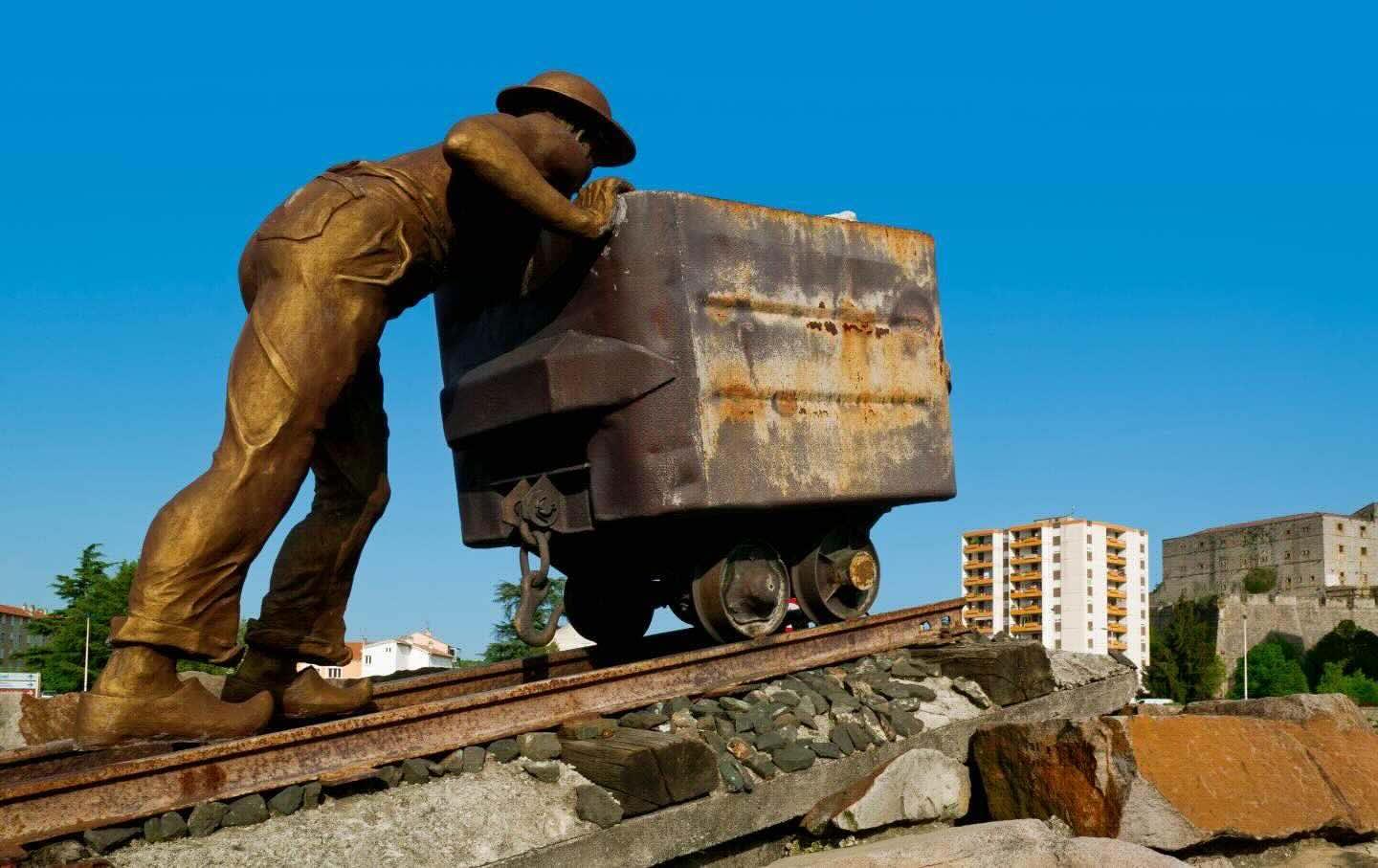
Statue of a miner by the artist Raymond Roux, to memorialize Alès’s having been a mining town during the 19th and 20th centuries.
(Getty Images)During the first year of the gilets jaunes protests, I taught English in France. By the time I arrived during that impossibly hot August in 2018, a grassroots movement against fuel taxes and economic inequality had been building, with its members eventually blocking off roundabouts and toll booths across the country and marching, every Saturday, down the large avenue at the end of my street. I would sit, lazily, with my legs sticking through the wrought-iron balustrade of my balconette and watch them go by.
It was my first year out of college, and I had taken the job in France, in part, for the time to read and write. I was assigned to one of the largest public high schools in the country, Lycée Jean-Baptise Dumas. Alès, where I taught, located in the south of the country, was a former mining town that had produced a record 3.3 million tons of coal in 1958, its workforce of 20,000 built largely on Algerian labor that France had recruited after the war. The last mine closed in 2001, but the families stayed, and many of their descendants were my students. The other teachers were French and drove in from neighboring towns like Anduze and Uzès. Due to the scarcity of housing available to foreigners, I also commuted from a neighboring city. Nîmes, where I lived, was on the edge of the Mediterranean and hosted Spanish-style bullfights in its Roman amphitheater. During my second month there, a woman was gored to death by a bull that jumped over the fence.
It was a year of experiencing firsthand something I had already learned as a French major in college: that French equality was a story France told about itself, and that the far right had been a more or less consistent underbelly of the country since at least the 1890s. France’s own Constitutional Council had ruled in 2007 that race and ethnicity could not be recorded as categories in any official state data collection, making it impossible to measure discrimination through government statistics, though private studies found that ethnic minorities in France were more than 30 percent less likely to be hired for jobs, and unemployment among people of North African origin was twice the national average. I was brought in on a seven-month government contract that prohibited other work and was designed to expire before I could declare residency. I was answerable to teachers 15 to 40 years my senior, though none of them had formal authority over me. As a teaching assistant, I was paid a poverty wage that qualified me for government housing assistance, even though I was a government employee. My position in the country was at least more honest than what France had done to my students’ families, who had been recruited to build French mines and then told, once the economic boom ended, that even if they got citizenship, they weren’t French at all.
A few weeks in, I arrived 20 minutes late to a class I was assisting with after its room was reassigned without my knowledge. The teacher held a meeting with me and two other staff members, where she threatened that if I was late again, she would bring in the French authorities to oversee my behavior and deport me if I wasn’t performing my job well. I said, in French, something like, “That sounds like it will take a long time,” to which she said it would be a several-month process. “I’m not here for very long,” I told her. “So my visa will likely expire before it’s done anyway.”
My appointment with France’s immigration office, for instance, where they would do a routine blood check for HIV and stamp my passport, was set for early December—four months after my arrival in the country. So I wasn’t worried about the French bureaucracy suddenly becoming more efficient. Plus I felt pretty certain that I hadn’t done anything to warrant deportation, and I knew that, since my contract was with the Ministry of Education and not the school, the teacher had no power to fire me. She told me I was being rude. I told her that, from my perspective, she was the one being rude. Another teacher gasped. That night, one of the teachers called me to say she was sorry I’d been singled out, and she was sure it must be stressful to be so young and arrive in a foreign country with “everything that was going on,” by which she certainly meant the gilets jaunes I watched from outside my apartment window. It was a kind thing to say, though I hadn’t thought of it like that. In any case, no one ever contacted the Ministry of Education.
When someone first learns a second language, it’s widely understood that they don’t have the same emotional associations with the words as they do in their native language. Such associations have to be built from the ground up. What this meant for me, in practice, was that I could say things in French that I never would have dared to say in English. It was very easy to be direct, because the part of my brain that processes shame or embarrassment didn’t register as I spoke. I was also direct because, in an attempt to keep up the appearance of something resembling proficiency, I would say the first sentence I could form in my head as quickly as I could. It got me into trouble with the other teachers repeatedly—although a language barrier soon became the least of our problems.
My fellow teachers never gave me the lesson plans ahead of time, although I begged for them during my first month. Instead, when I walked through the door to their classrooms, they’d ask me to explain, on the spot and in French, things like the racial dynamics in the United States that had led to the explosion of the Black Lives Matter movement. During my improvised lecture, this particularly self-serious teacher nodded and interrupted me to declare that race was a “big problem in the US.” It was apparent she thought of systemic discrimination as a uniquely American problem. After class, another teacher said to me, in the staff room, that most of the students at this school weren’t good at English. They were lazy “because—parce que—they were immigrants.”
When I asked her why she thought there was a causal relationship between being an immigrant and being lazy, she looked at me like I was dumb, like I didn’t understand her. For a moment, I thought I had misspoken—pulled the wrong word or misconjugated. I tried again, this time more directly: “You think it’s because they’re immigrants?” She did that French thing where she blew air through her pursed lips and waved a hand in exasperation. It was clear to me that she used American racism as a way to displace and avoid confronting French racism. And I was meant to be a mirror that reflected blame outward.
The school year continued much like this, and by November the mistral set in: southern France’s whipping winds, reaching speeds of up to 40 miles per hour and continuing for days on end, which were said to drive people mad. The winds made it hard to open doors, so I was always throwing my shoulder into them. Sometimes I tried to sit outside during my breaks, but most days the wind blew me right back inside. If I wasn’t giving impromptu lectures to a class, I ran small conversation groups, five to nine students at a time, sitting around a table as I tried to get the 14-to-18-year-olds to chat in English or practice dictation. Since every classroom was full, I worked with them out of a janitor’s closet. My time was split among 11 teachers, each of whom had 30 students, which meant I could go weeks without seeing the same face twice and was often, in some sense, starting over with them.
One morning, I was asked to help students with an exercise using a news clip they were watching to practice English. It was a segment from The Daily Show with Trevor Noah. The teacher and I replayed it several times while I improvised comprehension questions on the spot. We were struggling: The students were beginner speakers in English, and I was largely met with silence. During the lesson, two students began mumbling to each other, and then one jumped out of his chair and hit the other. The boys nearby stood up and started shoving each other, creating a full-on brawl that knocked over several desks. The teacher screamed at them, and another came in from down the hall and helped calm everyone down. I later learned the fight had started because one student called the other dumb for not understanding English. The fight was alarming, but the teachers—even those who had not been involved—kept bringing it up in the weeks that followed, saying it wouldn’t have happened in a “normal” school. The fight turned into a symbolic story, offering proof of what the teachers had long suspected about their immigrant students.
When I wasn’t working, I spent a lot of time alone. Not that I never went out: Most Fridays and Saturdays were spent with friends or at small house parties. But I worked 15-hour weeks, a little more since I tutored on the side for extra cash. I passed the weekday evenings on my IKEA bed frame, the French windows slamming open and shut with the wind. I taught myself to sew, kept a journal, and read a lot of Patrick Modiano, the French novelist who won the 2014 Nobel Prize in Literature. “One has to be from somewhere,” an uncle tells one of Modiano’s narrators, whose Jewishness makes his belonging in postwar France feel unstable. All through my teaching, I was told repeatedly that my immigrant students weren’t French, that I wasn’t French. No one seemed to consider that we might not want to be.
My conditions might have been better than those of my students, but I felt like a foreigner, in part because I was repeatedly made to feel like one. This hostility created the sense that my life there wasn’t real, that I was only an export of the late empire and ought to just return to the United States. I knew I was interchangeable, that the school could have had any number of other foreign citizens teaching its students in my place, and that it wouldn’t have made much difference to them if I had happened to be assigned elsewhere.
Popular
“swipe left below to view more authors”Swipe →In November, I was asked to teach the students about American Christmas traditions. When I gave these lessons, the students complained that I was violating la laïcité, France’s constitutional separation of religion from public institutions. When they left the janitor’s closet, I put my head on the table. In retrospect, it was so obvious that I had betrayed them. I wasn’t capable of seeing even that ahead of time, let alone telling the teachers I wouldn’t do it. I knew la laïcité was similar to my own country’s supposed separation of church and state, but in France it was also the same principle used to ban the wearing of hijabs, which were worn by some of my students.
I took their concerns to the teachers, but the teachers shrugged them off, saying that American holiday traditions were cultural, not religious. I didn’t think it was worth telling them about the evangelical voting bloc in the United States. I made a point, for the rest of the year, to prepare my own lessons, or to have a few on the back burner just in case. I treated the teachers with more skepticism than the dose I’d arrived with.
During my last few weeks at the school, the teachers began to suggest that I should stay through June, when the students took their exams. I told them I couldn’t because my visa would end before that, so not only would I not get paid for my time but I was also legally required to leave the country. Several of them insisted I should stay anyway to help, because surely I would want to make sure the students passed after all the effort I had put into teaching them English. They didn’t care to hear about how my visa worked in practice, just as many of them never seemed to think about the reality of their students’ lives, their existence in that uncomfortable state of semi-Frenchness. Although I hadn’t thought this aspect of the year would go any other way, that understanding only made my work feel all the more hollow.
The weather was warming up, and the doors I usually had to throw my shoulder into to open began to bake in the spring heat. On one beautiful day in particular, the courtyard was crowded with students as I sat on a bench and opened my journal. I flipped through it and read some of the entries at random; there were many to choose from, as I’d often written in it during the short breaks between classes. The journal documented a spring that had passed more easily than the fall. It also described a fear that, even as I got better at my job, I wasn’t quite able to help these students—their problems were far bigger than anything I could resolve. Not only that, but as I continued in French, I was losing my ability to think in English, and although I didn’t hear my thoughts in English first, I nonetheless spoke using the fragmented phrases I’d memorized, piecing them together to form coherent sentences. I had started to think of English this way: as just a string of grammatically correct clauses, with as many vocabulary words memorized as possible.
I felt defeated. Years of study and that, in the end, was all there was to fluency. I’d been hoping, I suppose, for something more poetic: that helping students learn English would crack something open about my native language. Instead, by the time I got on my flight home, I felt out of place in both languages, and it was more than a year before I stopped compulsively translating my thoughts between French and English. That summer, Nîmes became the hottest major city ever recorded in France—a record 44.4° Celsius (or 111.2° Fahrenheit), the temperatures driven by hot air rising from North Africa—and 50 wildfires broke out across the region. I learned about these fires, in English, from across the Atlantic.
More from The Nation
Why French Students Are Revolting Why French Students Are Revolting
France’s education system is stretched to its limits, as student anger kicks off a hot fall protest season.

Revolution or No Revolution Revolution or No Revolution
Eight years after Armenia’s “Velvet Revolution,” Nikol Pashinyan’s government has deepened the country’s neoliberal trajectory while reorienting Armenia toward the West.

The GOP Sells the Mirage of a Hormuz Victory The GOP Sells the Mirage of a Hormuz Victory
The American action in the contested strait isn’t sustainable—and won’t alter the economic and political fallout from its closure.

Japan’s Far Right Is Courting Young Voters Japan’s Far Right Is Courting Young Voters
Sanseitō has attracted young voters through a robust social-media strategy, Charlie Kirk–like public speaking events, and anti-establishment messaging.

This AI Panic Is Nothing New This AI Panic Is Nothing New
In the 1940s, The Nation asked questions about the atomic bomb we’re asking of artificial intelligence today.
The Decades-Old Roots of Trump’s War on Iran The Decades-Old Roots of Trump’s War on Iran
An interview with historian Behrooz Ghamari-Tabrizi about the generations of US presidents who have tried to destroy the Iranian regime.

