
It’s Jordan Bardella’s Party Now
With Marine Le Pen facing a critical court ruling on July 7, leadership of the French far right is passing to her 30-year-old lieutenant.
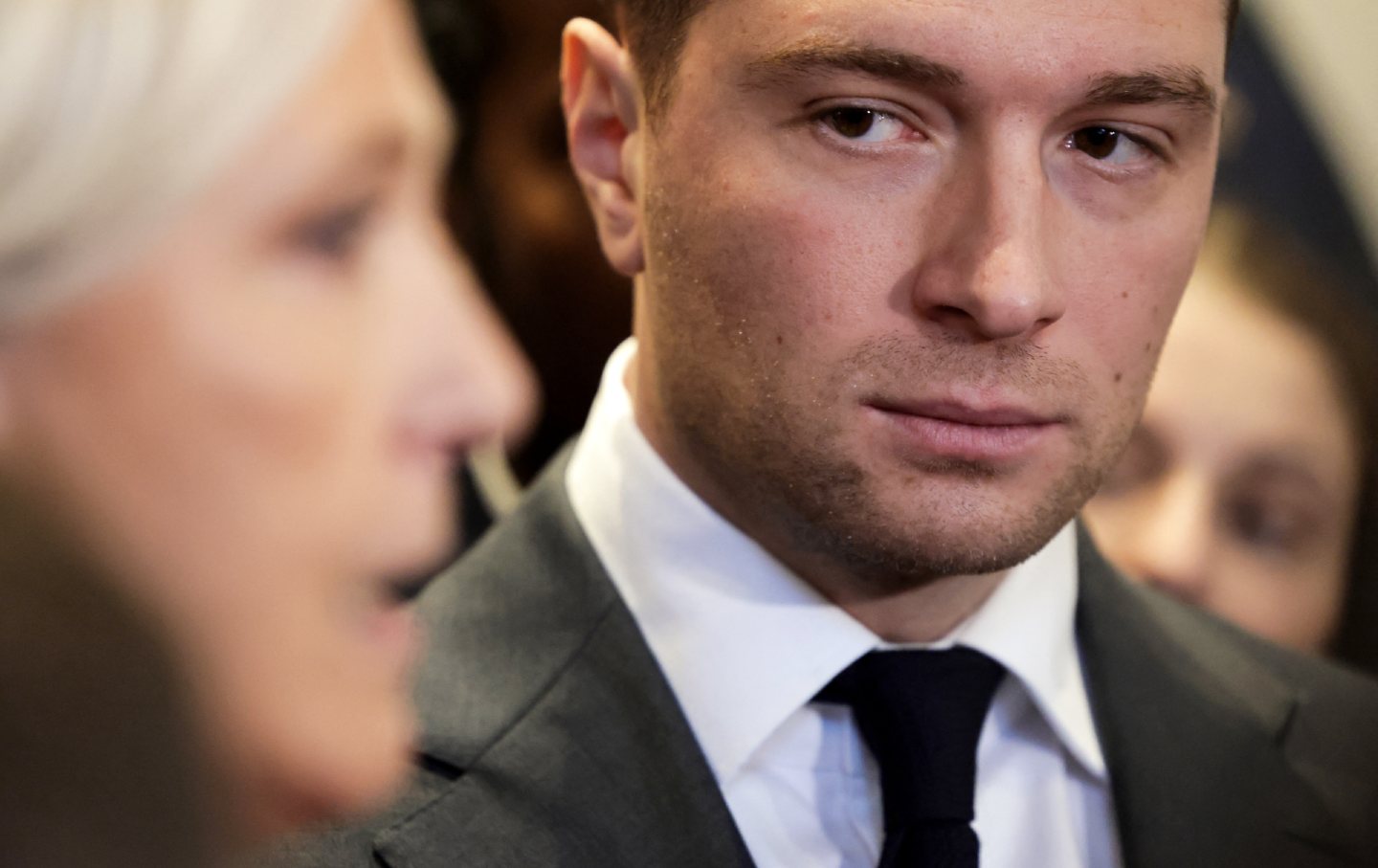
The far right’s standard-bearer for the 2027 presidential election in France will be made definitively clear on July 7, the day the Paris court of appeal is scheduled to deliver its ruling on a corruption case that could derail Marine Le Pen’s political career. In March 2025, a first ruling found Le Pen responsible for a sprawling embezzlement scandal tracing back to the late 2000s and early 2010s that saw the ex–Front National, renamed the Rassemblement National (RN) in 2018, siphoning off millions of euros of public funds from the European Parliament.
That bombshell decision, which implicated several other far-right apparatchiks, was most notable for barring Le Pen from seeking office for five years. A three-time presidential contender, Le Pen has already been forced to resign from her position in a local departmental council, although she is allowed to serve out her current term as an MP. If the verdict stands, the 2027 election could well be the first time since 1981 that the words “Le Pen” do not appear on a French presidential ballot. Marine took over the far-right force from her father, Jean-Marie Le Pen, before the 2012 presidential election and has been its unquestioned leader ever since.
But if the sky was supposed to fall for the Rassemblement National, it hasn’t. Though the RN’s initial reaction to the March 2025 verdict was to cry abuse, its attempt to build a MAGA-like stop-the-steal movement has petered out. Polls consistently show broad indifference to the RN’s accusations of judicial treachery, and tacit approval of the initial ruling, with barely a third of the public seeing the decision as a politically motivated ruling taken against the longtime far-right leader.
Over a year later, the party has downplayed its scorched-earth strategy. “Judges are falling back on practices that we thought were the exclusive purview of authoritarian regimes,” Le Pen said shortly after the initial verdict, decrying a “political decision.” The tone was markedly different in the appeal, with the defense reportedly hoping at best for a reduction of the ineligibility sentence to two years—thereby ending in March 2027, a month before the race. “My client’s life work is in your hands,” Le Pen’s counsel pleaded at the close of the appeal this February.
What’s no doubt cushioning the blow is the fact that the Rassemblement National is entering the 2027 election cycle in a position of unmatched strength. With a steady clip of opinion studies showing the party in the top spot for the first-round vote, it’s now taken as a fait accompli that the RN will make it to the run-off, where it remains competitive against just about any hypothetical contender.
The party has delayed announcing its official candidate until after the appeal, but it’s also no secret that Jordan Bardella, the RN’s 30-year-old official president, will take over from his mentor if the court of appeal upholds her ineligibility. “I hope that Marine will be able to be our candidate because she is innocent in this case,” Bardella told BFMTV on June 14. “We’ll campaign together hand in hand until the appeal. And after the appeal, we’ll keep campaigning together hand in hand.”
In fact, Bardella has long been groomed as a successor by Le Pen herself, who brought the young militant under her wing from the mid-2010s. He had obvious advantages: With Franco-Algerian and Italian roots, Bardella likes to sell himself as a child of the working-class and diverse northern suburbs of Paris that are a perennial bugbear in the right-wing press. His meteoric rise in the party was capped off with his selection as the RN’s leader in 2022, since which it has continued to notch up important victories, including emerging as the single largest parliamentary caucus after the summer 2024 snap elections.
One lingering hope is that Bardella just won’t have the stature when he’s thrust in the limelight of a presidential campaign. Before winning a seat in the European Union parliament in 2019, his only experience in office was as a regional councillor in the capital region. In the age of half-baked PR takes and punditry, Bardella’s strengths are often chalked up to his social-media savvy and appeal among younger voters. But he just as often comes off as stiff in more official settings. He speaks with the indelible mark of someone who has undergone years of media training, which can only do so much to cover up a lack of genuine intellectual and historical depth.
This would be greater cause for relief were the strength of the far right, and its rapid “normalization” in French politics, merely a matter of personnel. More importantly, the 30-year-old’s rise to centrality in the Rassemblement National has run parallel to several important shifts in party strategy—changes that are more a factor of its maturation as a political force than the work of any one figure.
Under Bardella’s watch, the Rassemblement National has aimed to transform itself into a big-tent conservative force, breaking from the “neither left nor right” appeal that Le Pen tried to cultivate in the 2010s. Sympathetic to calls for a “union” of right-wing parties, Bardella made overtures to traditional conservatives in tight run-off races in local elections held this spring, a position that was reportedly poorly received by Le Pen.
Most tellingly, Bardella’s leadership has had the party pursuing a rapprochement with corporate interests, long the stomping ground of the right-wing Républicains—and since 2017 largely beholden to the centrist president Emmanuel Macron. Ditching much of Le Pen’s lip service to the French “social state”—at least as it applies to “full-blooded” citizens—Bardella advocates drastic cuts to welfare largesse and state employment rolls. Presenting himself as a champion of fiscal discipline, Bardella is, on paper at least, in favor of an aggressive politics of belt-tightening in a country broaching an annual deficit-to-GDP ratio of nearly 5 percent.
Another advantage Bardella has over Le Pen is his greater exposure to the wider European scene, at a critical juncture in the history of the continental far right. Gone are the days of hurling invective at Brussels from the sidelines. The nationalist outsiders of yesterday are rapidly becoming today’s insiders, with actual leverage over policymaking.
Popular
“swipe left below to view more authors”Swipe →This spring, for example, the far-right caucuses in the EU parliament—including the Patriots for Europe group, of which Bardella is chairman—joined forces with the mainline conservatives of the European People’s Party to tighten the bloc’s asylum system, greenlighting the detention of undocumented migrants in “return hubs” outside of the EU. Speaking on a mid-June visit to Poland, Bardella claimed that his goal regarding Europe was to “change everything without destroying anything.” With the pledge to axe France’s contribution to the EU budget, lines like that are designed to assuage lingering frustration with the RN’s abandonment of a “Frexit” plank. But when push comes to shove, his model likely is a figure along the lines of Giorgia Meloni, Italy’s far-right premier who has successfully ingratiated herself with EU leadership.
These shifts are not without their points of friction for purists, or the base of militants and elected officials loyal above all to Le Pen. In recent weeks, Bardella has raised eyebrows among cadres by sketching out a pension system plan that would ditch altogether the principle of a baseline retirement age—increased from 62 to 64 in Macron’s hotly contested 2023 reform and a hot-button issue ever since. That’s music to the ears of corporate interests and deficit hawks, but a warning sign for sectors of the RN sentimentally attached to Le Pen’s pseudo-populism.
Still, much of the alleged opposition between Bardella and Le Pen is pure editorialization. Whoever’s leading things, the party is now in the stage where it needs to reassure big business and build bridges with traditional conservatives. Expect it to again air cries of martyrdom if Le Pen’s conviction is upheld. But that most of all rings insincere from a force that has never been so close to power.
More from The Nation
Japan’s Far Right Is Courting Young Voters Japan’s Far Right Is Courting Young Voters
Sanseitō has attracted young voters through a robust social-media strategy, Charlie Kirk–like public speaking events, and anti-establishment messaging.
This AI Panic Is Nothing New This AI Panic Is Nothing New
In the 1940s, The Nation asked questions about the atomic bomb we’re asking of artificial intelligence today.

The Decades-Old Roots of Trump’s War on Iran The Decades-Old Roots of Trump’s War on Iran
An interview with historian Behrooz Ghamari-Tabrizi about the generations of US presidents who have tried to destroy the Iranian regime.
Emmanuel Macron’s Turbulent Exit Emmanuel Macron’s Turbulent Exit
Between a budget crisis and a cost-of-living squeeze, Macron is leaving a country feeling more insecure than ever—and ready to take to the streets.
Israel’s Election Can’t Fix What Netanyahu Broke Israel’s Election Can’t Fix What Netanyahu Broke
The fundamental problem is not the name of the prime minister, but rather the actions of the Israeli government and the urgent issues that need to be addressed.
The AfD’s Rise Isn’t Just About East Germany The AfD’s Rise Isn’t Just About East Germany
The Alternative für Deutschland has a stable national poll lead, including in the former West Germany. Its rise owes to much more than Eastern grievances.

