
The Impossible Geography of Survival in Gaza
Israel has created “green zones” and “red zones” to distinguish between safe and dangerous areas. There’s little difference.
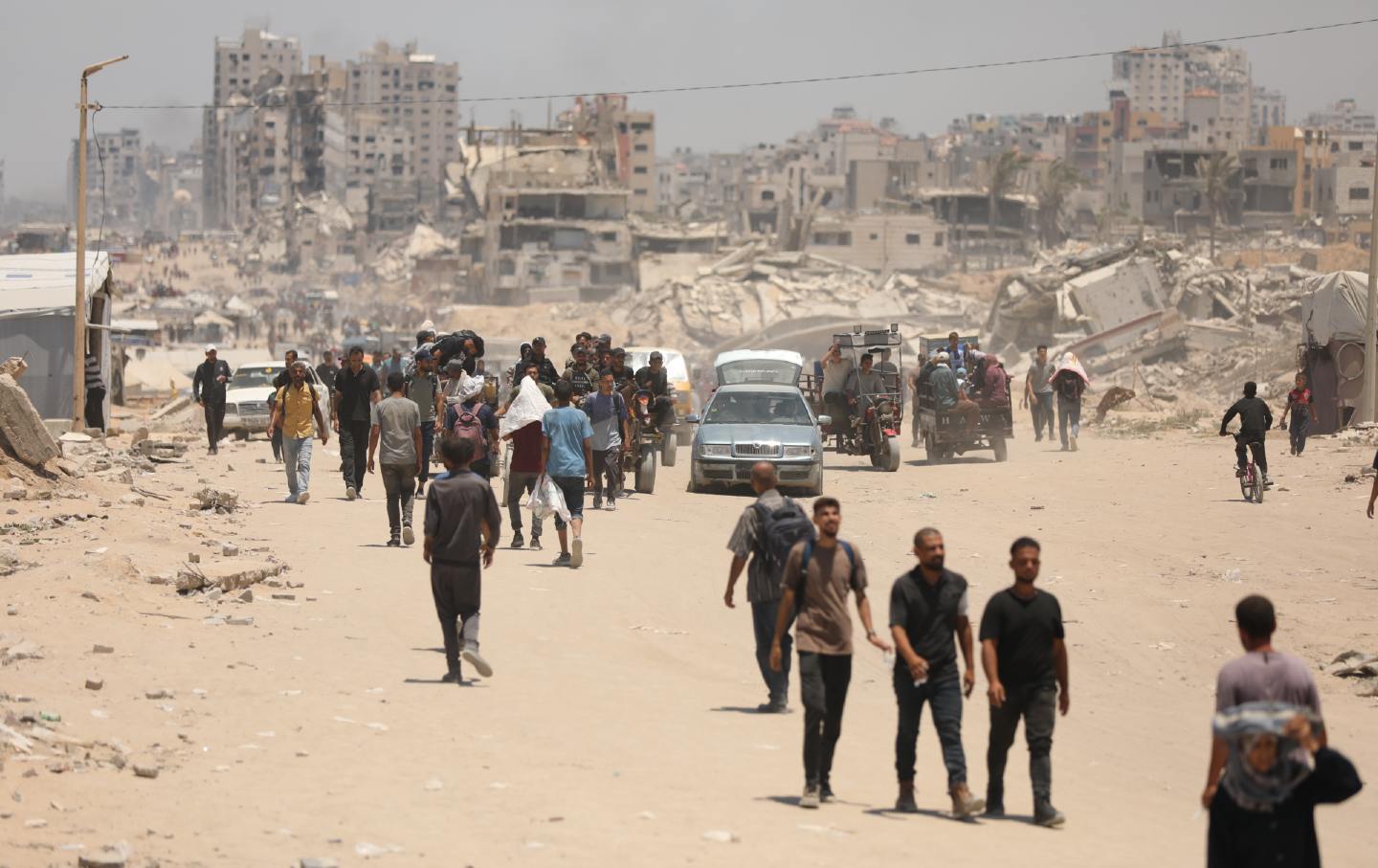
Palestinians walk toward the aid distribution point in the Netzarim Corridor under the shadow of widespread destruction in Gaza, Gaza on June 28, 2025.
(Dawoud Abo Alkas / Anadolu via Getty Images)The blankets are always packed. The mattresses rolled tight. Every possession that matters to Walid Abu Mustafa’s family of 11 sits ready for flight on his three-wheeled tuk-tuk, because in Gaza today the difference between life and death can be measured in footsteps across a single street.
Abu Mustafa spends his days sprawled on that tuk-tuk with some of his children, parked on a narrow side street in the enclave’s southern city of Khan Younis. Meters away, his wife and the rest of their family huddle at the entrance of a storage space beneath a bombed-out residential building. It’s been nearly a month since they fled their hometown of Abasan, and, with nowhere else to go, this street corner has become the center of their world—a world defined by an invisible line that runs down the middle of the adjacent main road.
On one side of that line lies what the Israeli military calls a “red zone”—an area either marked for evacuation or designated as an active combat zone where death arrives without warning. On the other side sits the “green zone,” a supposedly safe domain where families like Abu Mustafa’s cling to whatever safety they can find. The 48-year-old father keeps his eyes fixed on that dividing line, knowing that Israeli tanks could cross it at any moment, giving him seconds to load his family onto the tuk-tuk and flee deeper into an ever-shrinking Gaza.
“Between us and death is one street,” he says, bouncing his youngest son Abdullah, 6, on his knee. “Just one street.”
This is the new geography of survival in Gaza, where 1.9 million people—90 percent of the population—have been displaced into a shifting maze of military zones that offer the illusion of safety while delivering the reality of constant terror. Since the war began, Israeli forces have declared roughly 70 percent of Gaza red zones, creating a complex map of supposed sanctuary that changes without warning and offers no real protection.
The Cruel Mathematics of Displacement
Abdullah Qanan understands the absurdity better than most. Standing at the exact point where his neighborhood is bisected into different designations, he places his right foot in the “safe” zone and his left foot in the “danger” zone, a physical manifestation of Gaza’s impossible reality.
“I’ve never seen anything stranger in my life,” says Qanan, a 24-year-old business administration student at Al-Aqsa University, balancing a tray of 13 bread loaves on his head—bread made from pasta soaked in water because flour ran out weeks ago. “The occupation puts just one meter between you and death. Cross it and you’re in a death zone; step back and you’re supposedly safe.”
He laughs bitterly at the notion’s absurdity. “Do they think an artillery shell will distinguish between two adjacent houses, one supposedly safe and the other in a danger zone? Of course that’s impossible. This talk about different zones is just a joke, mocking our souls and fooling the world into thinking Israel doesn’t deliberately target civilians.”
But Qanan’s family, like thousands of others, has no choice but to play by these rules. They live in what he calls “contact zones”—areas that exist in the thin space between designated safety and certain death. Here, families pack and unpack their belongings daily, listening to the sound of drones overhead and the thunder of artillery in the distance, calculating and recalculating their odds of survival.
The Israeli military continues to reinforce these classifications through regular communications to Gaza residents, almost always confirming that red zones remain unchanged and prohibiting Palestinian from returning to them, describing evacuated areas as “dangerous combat zones where forces operate very intensively.” But areas designated as “safe,” including the al-Mawasi coastal strip where thousands have been directed to shelter, have been bombed repeatedly by Israeli forces.
Just a few days back, on June 30, at least 95 people were killed in Gaza, when Israeli missiles targeted a cafe, aid distribution post, and a school yard. These were all located in safe zones to which civilians had been encouraged to flee by Israeli orders.
No Safe Harbor
Abu Mustafa lived in al-Mawasi from late 2023, after fleeing the family’s home in Abasan, through mid-2024. It was, he says, like “a big grave.” The coastal area, promoted by Israeli authorities as a “humanitarian zone,” quickly became a sprawling tent city where families fought over space, water, and dignity. Disease spread through the overcrowded camps, and the constant threat of bombardment made sleep impossible.
Popular
“swipe left below to view more authors”Swipe →“Life among tents makes you feel like you’re buried alive,” Abu Mustafa explains. “The daily details of life there are unbearable for humans. That’s why we choose to [come] here,” he said, referring to Khan Younis, “even though we’re living on the devil’s palm, ready to be surprised by bombardment or forced to flee at any moment.”
His wife and nine children—five daughters and four sons—pray each day that they won’t have to return to al-Mawasi, despite the increasing danger of their current location. They’ve watched as Israel has systematically expanded evacuation zones, tightening them like a noose around the remaining space where Palestinians are permitted to exist.
“We’re not in a safe place,” Abu Mustafa acknowledges. “We’re living on the edge of death in an extremely dangerous contact zone. The area classified as safe still witnesses continuous bombardment and unstoppable killing of innocent civilians. But at least here, among buildings and roads, we feel some semblance of life.”
Mohammed Riyan, 43, made a different calculation. After a terrifying experience in early 2024 when Israeli tanks surrounded his family without warning, he decided to split his household. His wife and four children now live in a rented plot in al-Mawasi, sheltering in a tent, while he remains in their damaged house in Khan Younis, ready for quick escape if bombardment intensifies.
Looking at photos of his children on his phone—Nidal, 23; Basma, 20; Anas, 18; and 14-year-old Rama—Riyan shakes his head. “There’s no such thing as evacuation zones and safe zones. It’s all danger and death,” he says. “These are the most precious things I own, and I will protect them. The distinction between different zones isn’t realistic—the occupation usually expands evacuation orders…and areas not evacuated today become red zones tomorrow.”
The Architecture of Erasure
Palestinian human rights lawyer Yasser Abdel Ghafour sees these individual stories as part of a systematic campaign of displacement that constitutes another crime in the “genocidal war waged against Gazans.”
“The entire Strip is currently violated,” he explains. “The idea of a difference between evacuated and safe areas is refuted by the reality of continuous targeting through Israeli bombardment of all places.”
Abdel Ghafour, who serves as deputy director of field research at the Palestinian Centre for Human Rights, traces the evolution of displacement from the war’s second day, when Israel issued its first isolated orders, to the dramatic escalation of October 13, 2023, when Israeli forces issued evacuation orders for two entire governorates—northern Gaza and Gaza City—directing residents southward. Since then, evacuation orders have expanded to cover most of Gaza, squeezing the population into roughly 15 to 20 percent of the territory’s original 365 square kilometers.
“The goal is to erase Palestinians as an ethnic nationality existing on this land,” Abdel Ghafour says. In addition to killing more than 55,000 people during 20 months of relentless bombing, while starving and displacing those who have survived the shelling, Israeli officials have more recently openly entertained the idea of depopulating the strip. On Tuesday, Israeli Defense Minister Israel Katz announced plans to cram some 600,000 Palestinians into a tightly controlled “camp” on the rubble of Rafah.
“The painful reality is that the idea of displacing Gaza’s residents outside the territory remains strong with the Israeli occupation,” Abdel Ghafour notes. “They bet that hundreds of thousands, if given the opportunity to leave, would exit. Even from a human rights perspective, this wouldn’t be voluntary displacement but forced displacement. The occupation has completely eliminated opportunities for life and living in Gaza, now and in the future.”
Back on his street corner, Abu Mustafa adjusts the blankets on his tuk-tuk and scans the horizon for signs of approaching danger. The sound of explosions echoes from the evacuated zones nearby, sending pillars of smoke into the sky. His children cluster closer to him, and he pulls them tight. “Our survival,” he says, “depends on impossible calculations—how long to stay, when to flee, where safety might exist, if anywhere, in a place where safety has been systematically eliminated.”
Become a Sustaining Donor This September
Between the reemergence of right-wing red-baiting and Donald Trump’s use of the chilling National Security Presidential Memorandum–7 to criminalize left political organizing, we’re seeing McCarthyism reborn before our eyes.
This assault on democracy cannot be ignored or wished away. Resisting it requires bravery in the face of threats and repression, a steadfast commitment to the truth, and the unwavering belief that we can—and will—overcome this darkness.
We must have an independent media that sets the record straight, unearths corruption and abuses of power, and advances a politics of justice and dignity for all if we’re to win this fight.
That’s why I’m writing to you today. This September, The Nation needs to add 100 monthly donors to sustain our progressive journalism. Your contribution makes the next investigative report, the next truth-speaking column, and the next pathbreaking essay all possible.
I hope you’ll support our work with a recurring donation today. If you donate $10 or more a month, we’ll send you a brand new “Hands Off the Free Press!” sticker to recognise your commitment to our cause. Please, donate today.
Onward,
Katrina vanden Heuvel
Editor and Publisher, The Nation
More from The Nation
Israel’s Election Can’t Fix What Netanyahu Broke Israel’s Election Can’t Fix What Netanyahu Broke
The fundamental problem is not the name of the prime minister, but rather the actions of the Israeli government and the urgent issues that need to be addressed.

The AfD’s Rise Isn’t Just About East Germany The AfD’s Rise Isn’t Just About East Germany
The Alternative für Deutschland has a stable national poll lead, including in the former West Germany. Its rise owes to much more than Eastern grievances.

Chinese Development Is the Betrayal Washington Cannot Forgive Chinese Development Is the Betrayal Washington Cannot Forgive
The prospects for Xi Jinping’s visit are dim because American leaders are blaming China for the failures of globalization.
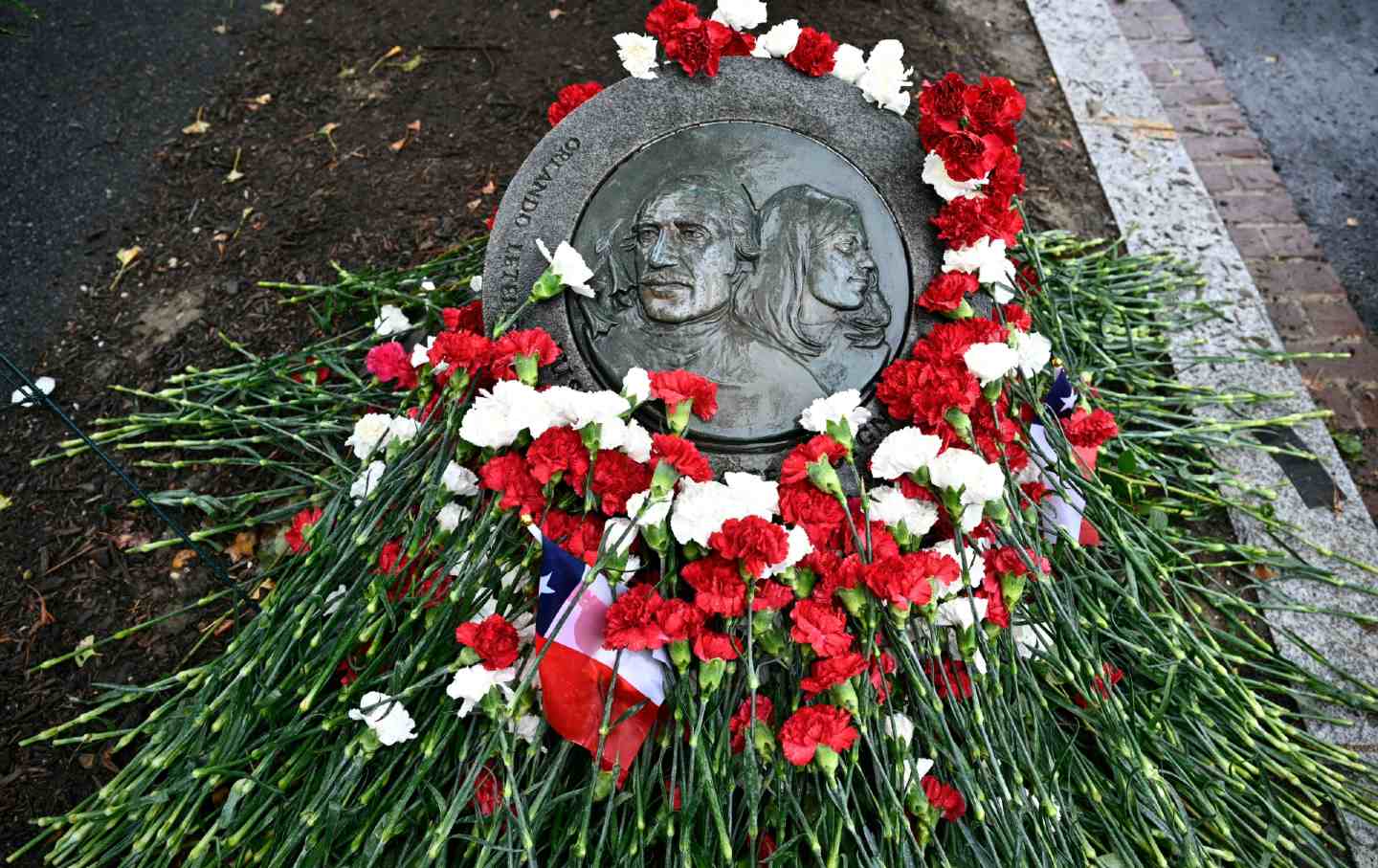
Pinochet: The Verdict of History in the Letelier-Moffitt Case Pinochet: The Verdict of History in the Letelier-Moffitt Case
An act of international terrorism on the streets of Washington, DC, still reverberates 50 years later.
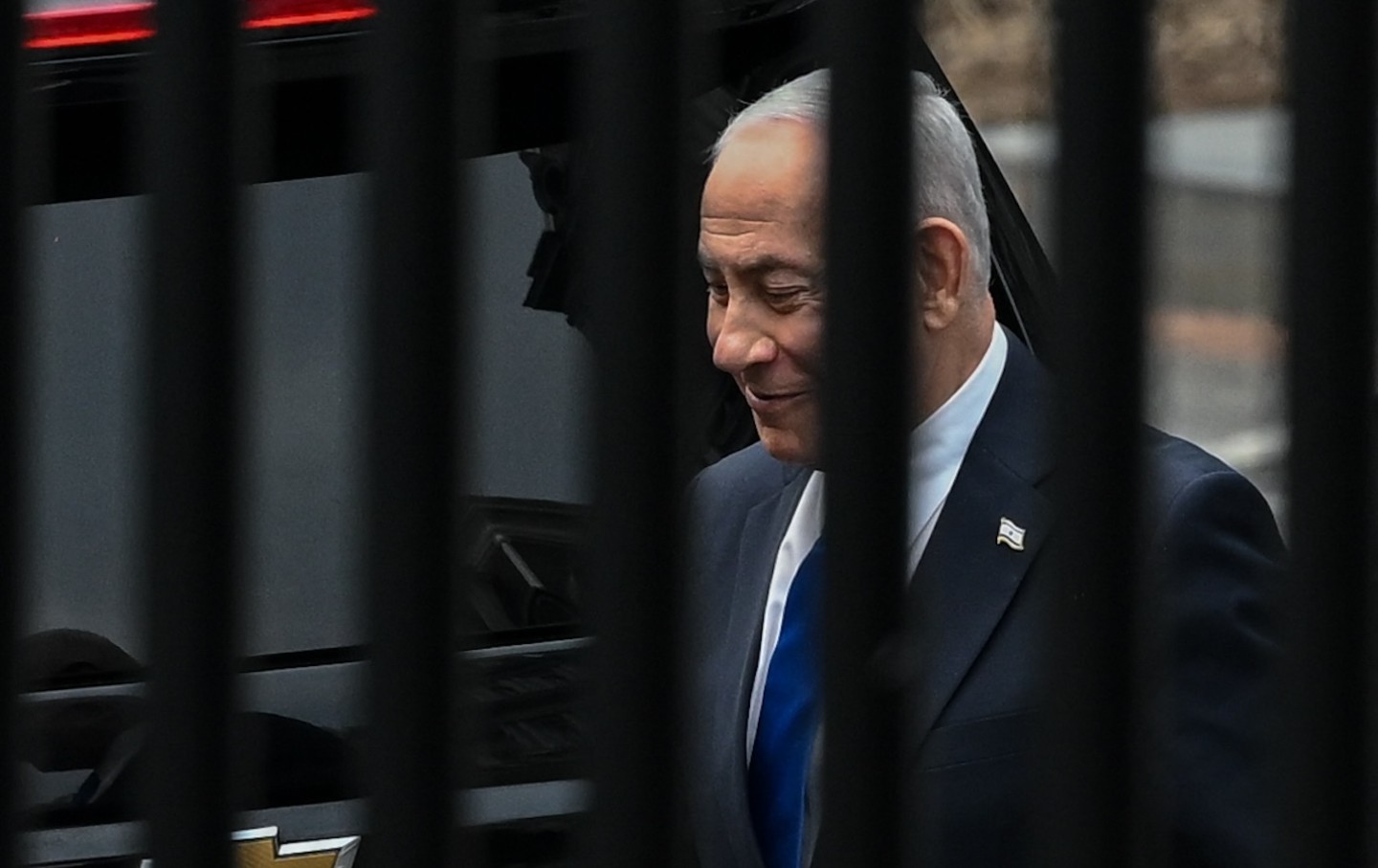
How to Arrest Benjamin Netanyahu How to Arrest Benjamin Netanyahu
Make no mistake: The United States can seize Netanyahu for crimes under US law and prosecute him in US courts when he is in New York City this week.
In the Age of AI, Nuclear Weapons Abolition Is a Renewed Imperative In the Age of AI, Nuclear Weapons Abolition Is a Renewed Imperative
As long as we have nuclear weapons, the job of ending humanity will continue to be as easy as the push of a button—or an AI agent hacking into a nuclear command-and-control system...

