
At This Year’s World Cup, Make Way for Autocrats
Sovereign wealth, private equity money, and a network of oily alliances between FIFA and the world’s most reprehensible regimes have transformed the sport forever.
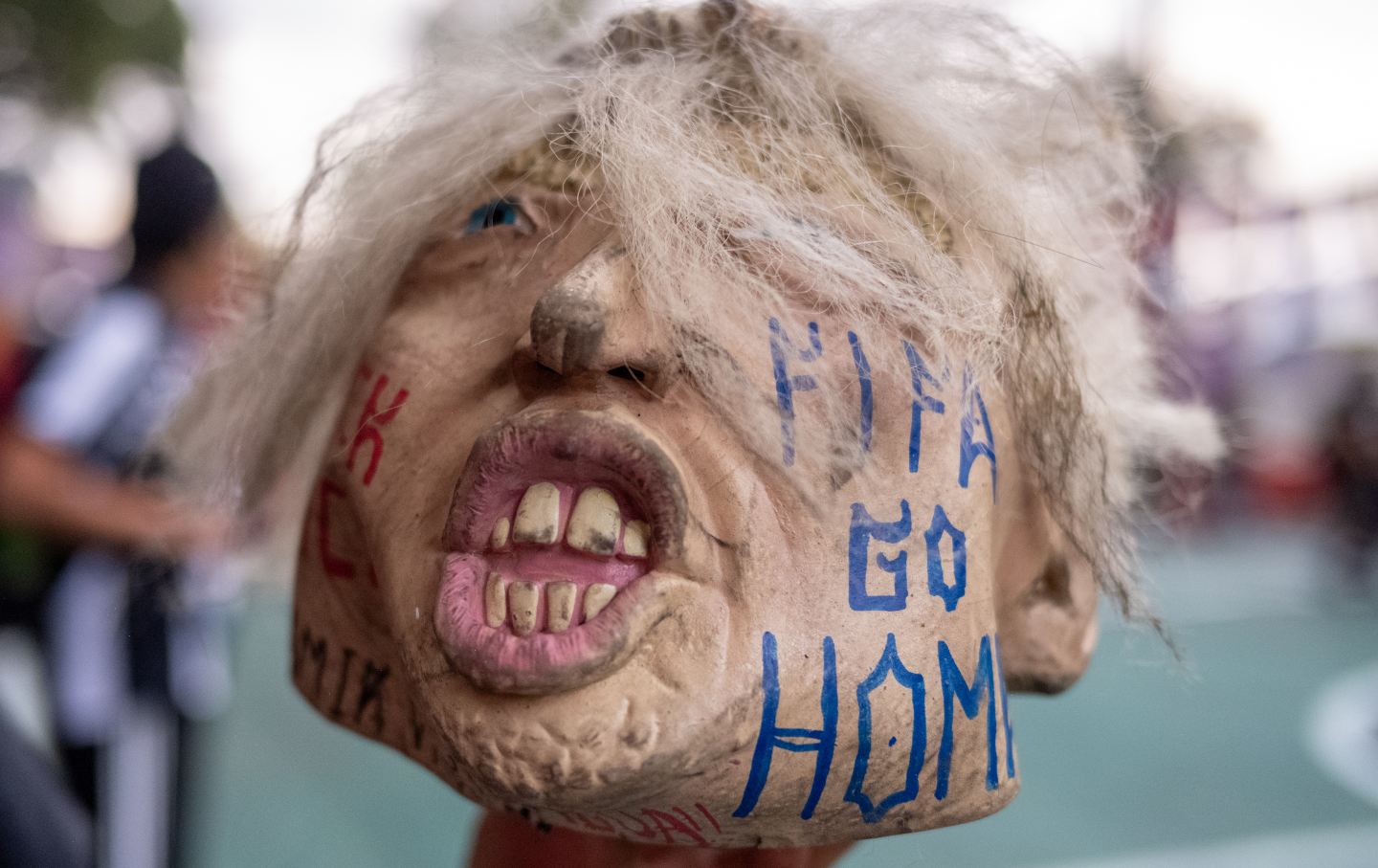
A member of the Otomi indigenous community in Mexico City holds a U.S. President Donald Trump latex mask during the “Anti-World Cup” rally on June 6, 2026, in Mexico City, Mexico.
(Marco Gonzalez / Eyepix Group / NurPhoto via AP)The noise makes the first impression: a misting chorus rising off the stands. Transmitted through the TV screen, the lyrics—precise and witty on the ground—are flattened into a series of up-tempo chants about nothing: ohhhhh-ahhhh-ehhhhh, wahh-ehhh, wahh-ahhh-ehh-ehhhh, heh-ho, heh-ho, heh-ho. Quick raps of applause swarm from bay to bay, where they swell and dip like free kicks dolphining over the practice wall. The voice of the ground announcer, soft-edged but insistent, offers constant intrusion, a paternalistic music cottoning weakly into the night. Faces in the stands are indistinct, the crowd a single beery humanity punctuated by inverted exclamation marks finishing in smudges of pink, beige, brown, black. Players termite across the grass, tertiary characters in a drama of someone else’s making. The camera lurches and narrows on a single figure, impassive and suited, taking in the scene from the grandstand. The seats here are padded, the drinking minimal, the singing nonexistent; the occasional word—whether of explanation or counsel, we do not know—is exchanged between the figure and his equally stony entourage. Though the camera lingers on him, the figure does not smile, barely reacting to goals, saves, sliding tackles, or ooh-y through balls. Whenever the lens finds him again, he will remain resolutely seated and blank. Who is this man who matters so much to a spectacle that interests him so little? It’s the autocrat.
Unlike in American sports, where team owners are encouraged to seek the limelight and successful seasons often end with the spectacle of a rich suit, rather than a player, lifting the trophy, the presence of the powerful in the stands used to be a dutiful footnote of soccer on TV. Even in the bad old days of Sepp Blatter—a man whose corruption now seems positively artisanal next to the industrial-grade stuff being produced by Gianni Infantino—power’s manifestations in the stands felt benign, almost endearing: One thinks of Jacques Chirac open-mouthing with joy at the Stade de France in 1998, an unbald Prince William doing the lawnmower celebration at Villa Park, or Angela Merkel hugging Manuel Neuer after Germany’s victory in the 2014 World Cup final. At the dawn of European football’s hyper-financialization around the turn of the century, club owners still had a kind of shambling, screwball quality to them: These were men who made their fortunes off ready-mix concrete, tracksuits, and witness tampering, honest lines of business that kept them close to the little people in the stands.
Whatever shreds of approachability once kept the soccer powers tethered to the fans have now been comprehensively chopped. Since the early 2000s, sovereign wealth, private equity money, and a network of oily alliances between FIFA and the world’s most reprehensible regimes have transformed the sport, generating various distortions that have been the subject of vigorous media coverage and near-constant public contestation. Amid the thrash of these political accommodations and floods of money, the footballing autocrat—the fund-appointed club chairman, the oil-and-gas oligopolist who’s just bought the club, the would-be dictator stewing in his seat—has suddenly become ubiquitous, an inescapable presence on our screens and feeds.
Despite all the fussing over soccer’s deepening entanglements with financial and political tyranny, this figure’s style of spectatorship remains curiously under-examined. Joy, sorrow, frustration, anger, relief: The autocrats know none of the emotions experienced by the regular fan. Resistance—to feeling, to fan sentiment, to timeworn notions of who and what sport is for—is part of their power. Increasingly, it’s to men like these that the cameras turn, and it’s according to their design that soccer is being remade.
The autocrats’ rise to prominence is another consequence of the permanent tilting of the scales in favor of the rich and a society-wide fetishization of owners and ownership (Thomas Piketty’s r > g and all that), along with a general shift in attention among soccer fans from matters on the pitch to problems off it. Is soccer’s main character now the player or the owner? It’s not so easy to say. This migration of attention has produced a strange and permanently curdled reality in which fans’ delight in and anguish over the teams and players they follow mixes with unvarying contempt for the figures controlling things behind the scenes. The contemporary crisis of trust can be felt in every fuming fan post on Reddit or Twitter about sportswashing, bent refereeing, and the extortionate price of World Cup tickets. “Game’s gone.”
The match-day presence of the autocrats who now control soccer at club and international level could, in theory, offer an opportunity to bridge the widening gulf that separates the sport’s elites from its masses. Instead, it’s worked in the opposite direction, and the autocratic style of spectatorship now functions as a visual shorthand for the stratifications on which global football increasingly runs.
Gen. Jorge Videla, Argentina’s former military dictator, was probably soccer’s first great spectator-autocrat. Videla was said to have never been to a live football match in his life until 1978; at that year’s World Cup, which Argentina hosted, he attended seven. Two years before the tournament, Videla and his generals had staged a coup d’état and begun the years-long “dirty war” that would eventually see 30,000 “state enemies”—many of them members of the left—killed or disappeared; the general announced at the Mundial’s opening ceremony, against the backdrop of a liberated flock of doves, that the tournament would be played under the sign of peace.
Footage of Videla at the matches is rare, but photos memorialize him as an incomparably saurian presence: rope-thin, dressed always in a double-breasted suit with tie, hair slicked into a martial part. Only at the ceremony following Argentina’s victory in the final, in which Videla handed Argentinian captain Daniel Passarella the trophy, did the dictator offer the slightest hint of a smile. Calculating, emotionless, uninterested in football but intent on exploiting its pageantry for purely personal political gain, Videla invented soccer authoritarianism as an aesthetic category, establishing the autocratic style’s guiding gestures and hypocrisies. Unsurprisingly, few have seen it fit to deviate from the master’s template in the years since.
Every autocrat who’s come in Videla’s wake has added his own touches and flourishes to the style guide. Roman Abramovich spent almost 20 years in the stands at Stamford Bridge wearing the look of a man about to apologize for farting. In his more expressive moments, which were infrequent, he was a master of the bewildered and toothless grin, usually offered up in tandem with an awkwardly lusty volley of applause in the wake of some Frank Lampard goal from distance, a shinned or groined conversion from Diego Costa, or a quiet cucking by John Terry at the back.
Nasser Al-Khelaifi, Qatar Sports Investment’s man in Paris and a near-constant presence in the stands at PSG’s home games, extends and refines Abramovich’s aloofness by bringing an obsessive uniformity to his public appearances. In more than a decade at the Parc des Princes, Al-Khelaifi’s hair (a thick, partless pelt of rigid black quills), clothing (dark suit, white shirt, dark tie), and emotional range (zero) have remained unchanged. The only glimmer of a soul behind this armature has been the unnerving half-smile perpetually plastered on the big man’s lips—dissatisfied and uncommitted capital in facial form, forever in search of an exit. A Champions League title, Zlatan’s 38-goal season, Unai Emery’s exitrendition of “ALLEZ ALLEZ ALLEZ PSG”: Al-Khelaifi has watched them all with the same Xi Jinping–esque smirk.
This is the smirk, ultimately, of power, a pitying thing born of existence on a plane—and at an income bracket—above the thrashers on the pitch and in the stands. In the ranks of the sporting autocrats, few deploy it better than Vladimir Putin. All of Putin’s work at the 2018 World Cup, in particular his decision to give prime seats in the presidential box to Dmitry Medvedev and Aleksandr Lukashenko for the opening match, pushed soccer as an autocratic aesthetic project forward, but his real triumph came in the dressing room of the victorious French team after the final.
As shirtless French players, pointing in his direction, danced on a table and sang, “Putin, eh eh eh, Putin, eh eh eh,” Putin stayed perfectly still, a wan smile fixed on his face, and applauded politely: a masterclass in autocratic restraint that also seemed vaguely mocking and somehow even racist, since most of the Bleus serenading him were black and it was plain that Putin did not share their happiness. Only a sporting autocrat could invest the act of clapping with such rich menace. In the condescension of every Putinesque round of applause there lies the promise of a sport that does not want or need to be liked, a sport that functions as pure coercion. At either side of Russia’s dictator, Infantino and Emmanuel Macron laughed and danced in time with the players’ songs like a pair of labradors.
Popular
“swipe left below to view more authors”Swipe →Infantino often tries to conduct himself in the autocratic style at these events, but he is too weak, too eager to please, too in thrall to his own potential as a comedian (“Today I feel gay,” he deadpanned in defense of the Qatari hosts in 2022), and fundamentally too self-loathing to channel the true gravitas and indifference of the autocrat. In the drama of soccer’s authoritarian awakening, the FIFA boss plays a bit part at best, and this summer he’ll perform his most consequential enabling role yet.
The current World Cup, of course, will center the spectacle of Donald Trump, clapping and pointing and tilting his head to one side to say “thank you” as Infantino and various other sycophants penguin about for his entertainment. Trump is a man who manages to look thoroughly bored at any sporting event he attends while remaining committed to the cause of ruining as much live sport as humanly possible with his physical presence. (If he looks bored, it’s probably because the only things he enjoys watching are Fox News and musical theater; a near-post finish from Kylian Mbappé will never match the magic of Grizabella’s solo in Cats.) Such is his addiction to inflicting himself on the big sporting stage that we know exactly how he’ll look and act at every World Cup match he attends. We can already see, up there in the stands, all the signs of a man living the worst day of his life: the bulldog jaw, the shoulders rolled forward as if they don’t fit him properly, the glazed and drowsy expression, the red tie so long it keeps his calves company.
Watching a figure like Trump in action helps clarify what, exactly, soccer wants from the autocrats. Money, access to power, influence: yes, all of this is important. But what matters more for soccer’s authorities, especially as live-match attendance transforms into a lifestyle indulgence for the frequent-flyer class, is the type of public the sport attracts. In this sense the real value of the autocrats may be as models of in-ground comportment; style, ultimately, is their great contribution. Rich, connected, docile, and unlikely to question the status quo: These are the fans FIFA and the leagues want, even as sanitization risks killing the sport. A stadium filled with 60,000 aspiring Trumps, Abramoviches, Putins, and Al-Khelaifis would constitute officialdom’s ideal public, a perfectly vacant crowd. The sporting autocrats are not aberrations in the history of football, but a portent of soccer’s grim and tranquilizing future.
Become a Sustaining Donor This September
Between the reemergence of right-wing red-baiting and Donald Trump’s use of the chilling National Security Presidential Memorandum–7 to criminalize left political organizing, we’re seeing McCarthyism reborn before our eyes.
This assault on democracy cannot be ignored or wished away. Resisting it requires bravery in the face of threats and repression, a steadfast commitment to the truth, and the unwavering belief that we can—and will—overcome this darkness.
We must have an independent media that sets the record straight, unearths corruption and abuses of power, and advances a politics of justice and dignity for all if we’re to win this fight.
That’s why I’m writing to you today. This September, The Nation needs to add 100 monthly donors to sustain our progressive journalism. Your contribution makes the next investigative report, the next truth-speaking column, and the next pathbreaking essay all possible.
I hope you’ll support our work with a recurring donation today. If you donate $10 or more a month, we’ll send you a brand new “Hands Off the Free Press!” sticker to recognise your commitment to our cause. Please, donate today.
Onward,
Katrina vanden Heuvel
Editor and Publisher, The Nation
More from The Nation
Gloria Steinem: A View From 1990s Moscow Gloria Steinem: A View From 1990s Moscow
“Keep women’s solidarity in mind: Don’t forget how we empower each other through mutual support,” she reminded us.

Accountability for the Gaza Genocide Can’t Focus on Netanyahu Alone Accountability for the Gaza Genocide Can’t Focus on Netanyahu Alone
Getting rid of one bad leader won’t bring justice.
How the AfD Benefits Politically From the Ukraine War’s Backlash How the AfD Benefits Politically From the Ukraine War’s Backlash
No election result is monocausal, and there are clearly many factors that have converged to make the AfD Germany’s most popular party.
Cuba: The “Pandora’s Box” of US Humanitarian Assistance Cuba: The “Pandora’s Box” of US Humanitarian Assistance
As the US strangles Cuba economically, Marco Rubio is running a $100 million “hearts and minds” program on the island.
The Palestine of Soraya Antonius and Annemarie Jacir The Palestine of Soraya Antonius and Annemarie Jacir
In The Lord and in Palestine ’36, the story of Mandatory Palestine comes into focus.
Let Them Eat Spreadsheets Let Them Eat Spreadsheets
How the EU is contributing to the rise of Europe’s far right.

