Irin Carmon on How the United States Has Made Pregnancy Unbearable
An interview with the author of a new book documenting the brutalities of childbirth in the post-Dobbs era.

As I finished reading a new book about the perils of pregnancy in the United States, ProPublica published a story identifying another victim of our broken healthcare system: Tierra Walker. The 37-year-old Texas mother had asked her doctor, “Wouldn’t you think it would be better for me to not have the baby?” after her early pregnancy symptoms included “unexplained seizures” and “soaring blood pressure,” ProPublica reported. But no one would help her. She was suffering from preeclampsia—a condition involving high blood pressure and a hazardous buildup of protein in the uterus—and instead of heeding her concerns, her physicians let her die.
I asked the author of the book I had been reading, Irin Carmon, what went through her mind as she learned about this latest death. Carmon—coauthor of the New York Times bestseller Notorious RBG and a longtime journalist covering gender, law, and politics, currently at New York magazine—said that Walker had done everything she was supposed to do. “She advocated for her own care, she showed up, she asked questions, she followed doctor’s orders, she understood what she needed, and she asked for it.” But, she added, “there is also a Catch- 22, particularly for Black women [like Walker], and there’s research that shows this: In advocating for yourself, you might be retaliated against. So doing all the things that you are supposed to do will not save you.”
This was also what happened to one of the five women Carmon profiles in Unbearable, Christine Fields. The 30-year-old Black mother also did everything she was supposed to do. She did her research and wrote a birth plan, trying to learn from the death of Sha-Asia Semple, who was from her Brooklyn neighborhood and died in childbirth at Woodhull Medical Center, six months before Fields would give birth to her daughter. Before her next delivery, in November 2023, Fields updated her birth plan and posted on Facebook about it, saying, “These hospitals don’t care about us enough and you HAVE THE RIGHT to determine what care you’d like for your child…. We gotta let them know we are KNOWLEDGEABLE!”
Tragically, Fields bled to death after Woodhull staff failed to closely monitor a severe complication from an emergency C-section. But Maggie Boyd, a mid-30s white woman who suffered the same surgical complication—under the care of the same doctor three-and-a-half years before Christine’s death, Carmon learned—lived. I spoke to Carmon on Friday about Fields’s and Boyd’s stories, as well as those of the other women in her book; what is actually at the root of the post-Dobbs maternal health care crisis; and why our stories are crucial as we fight to make health care more equitable and responsive during pregnancy and childbirth. The conversation has been edited for length and clarity.
—Regina Mahone
Regina Mahone: Can you tell me about the idea for this book and how it came to be?
Irin Carmon: I’ve been reporting on abortion for 15 years at this point. When it became clear that Roe v. Wade would be overturned, I was approached about whether I wanted to write a book about abortion. I knew abortion was going to continue to be at the center of my work for a long time. But I also thought that there were a lot of people writing amazing books about abortion, and I wasn’t sure that I had one in me. I think what clinched the kind of book that I had to write was when I got a chance to read the leaked draft of the Dobbs decision. Nothing in that opinion takes into account the different dimensions of harm that are inflicted on people—nothing about the physical, the emotional, the economic harms or sacrifices that are involved in a pregnancy. Even if you welcome a pregnancy, these are significant.
I was enraged and wrote an essay called “I, Too, Have a Human Form,” in which I explored what happens to your body in pregnancy. But it felt like just the beginning of the story, because I had only talked about biology. We know that this country makes so many choices every day that lead to these kinds of grievous statistics.
RM: You also include your own personal experiences with pregnancy and giving birth in New York City. Can you talk more about what it was like as a journalist covering pregnancy in America at the same time that you were experiencing pregnancy in America?
IC: I start the book telling the story of going to get an ultrasound in New York City. I was 33 weeks pregnant; the Dobbs decision had just been finalized, and so half the country was living under these inhumane abortion bans. I saw an image on the ultrasound that I was excited about, and I said to my husband, “Wow, she’s really starting to look like a person now.” It clearly enraged or upset the ultrasound tech, because she looked at the image, spoke over me, and said, “You were a person from day one.” Now, in the scheme of harms that I write about in the book, it is not significant. But it is significant to me that it is inescapable to have other people’s ideology and judgment foisted on you when you are pregnant. And that was just a symptom of the broader systemic disrespect for somebody when they become pregnant. That moment helped tie together how I wasn’t sitting off to the side from the things that I was writing about.
RM: One thing that feels difficult when writing about pregnancy after Dobbs is that so many of the assumptions we see being made about what’s happening is that this is all because of Dobbs. But the groundwork for what is happening was laid over a hundred years ago. Can you talk about that background?
IC: One of the reasons I wanted to write about New York City is because I wanted to show that Dobbs did not invent our profound catastrophe in maternal healthcare or in access to reproductive care in general. In New York, we have at least on paper amazing protections and significant access compared to other places. But we also have a profoundly broken system in which economic and racial inequality are enacted in how you’re treated when you’re pregnant. I wanted to get to the root of that, and so I tell the story of how, for millennia, the dominant form of pregnancy care, whether you wanted to be pregnant or not, was midwifery. They did the best they could with the tools that they had, which was pretty good. And it seems significant to me in thinking about how abortion care got separated out in the contemporary moment, even though in a medical sense, these are all stories that show us that you can’t separate abortion out from actually good medical healthcare.
When American doctors took over reproductive medicine basically by force, it was by cracking down on midwives. And one of the ways that they did that was by pointing out that midwives were helping women access abortion. They pointed out that American women were choosing to have fewer children and that a wave of immigration was going to, according to them, flood the country with “aliens.” The original “great replacement” theory was used to control reproductive medicine, to put midwives out of business, and to offer a different model of reproductive care that was much more top-down, and that put much more control in the hands of white male doctors who promised it would be safer, which is not substantiated by the data, particularly in the Black community. Many of the huge advances when it came to maternal mortality and morbidity had more to do with handwashing and antibiotics than they did with doctors taking over for midwives. [It’s also important to know] that these medicine men of the 19th century learned what they did know by the forcible experimentation on enslaved Black women. I write about J. Marion Sims, the so-called Father of Gynecology, whose statue still stands in front of the Alabama State Capitol. Without understanding the deep racist roots of American reproductive medicine, we find ourselves surprised again and again that this keeps happening.
RM: Your investigation into Woodhull is particularly interesting as it relates to this history. Today public hospitals like Woodhull have come to rely on midwives. Woodhull has prided itself on its C-section rates that are lower than the city rate, but it has also seen these tragic cases like Christine Fields and Sha-Asia Semple. Officials at Woodhull told you that the midwives can’t control the anesthesiologists, one of whom was fired because of his lethal mistakes in Sha-Asia’s case. This all raises the question for me of whether reform of these systems is possible if even midwives who have been brought back into the fold are being set up to fail.
IC: I certainly think that just saying we need midwives and doulas is not enough. We do know that midwifery has proven outcomes. There have been randomized control studies where patients on Medicaid are assigned a midwife and they have lower rates of maternal morbidity, they have fewer interventions that can lead to maternal morbidity, and they do better overall. There’s other research that shows that midwifery results in patients feeling like they were listened to more. But only about 10 percent or 12 percent of births in America are with midwives. We know that there’s research that people have better outcomes when they have doulas, people who are another set of eyes and ears and an advocate for them in the birthing room. But neither [midwives nor doulas] are enough if…the system that’s around them when somebody needs more advanced care than a midwife can provide [is broken]. Somebody who is experiencing a medical emergency needs to know that if something is beyond what their midwife can provide—that they’re not checking at the door their right to be treated in a dignified and respectful way or to be monitored after a C-section, because it is major surgery, and not be neglected and left to die the way Christine Fields was.
So I think it is really important that we’re talking about midwives and doulas, but they’re operating within a system in which [there are tremendous staffing issues]. There’s enormous turnover and burnout in the healthcare industry, and the way that it’s playing out is that Black women in particular are being mistreated by this system.
I wrote about Dr. Yashica Robinson in Alabama because she is an obstetrician-gynecologist and a former abortion provider who also attends births and provides a full spectrum of care. [Robinson] wants to partner with midwives to provide respectful care to patients, especially Black women who are being left behind by the system and who are being mistreated in hospitals, where she herself is working, because she can’t do everything. But even somebody with the power and authority of an obstetrician, especially somebody who is a Black woman in the South, is being treated with hostility and resistance by the state.
I think we have to be clear-eyed, whether it’s the state of Alabama fighting options in birth when there are so few there, or here in New York City where we tolerate enormous inequalities in hospitals. I think it’s a terrible choice because there’s research that shows that part of the huge inequality and maternal mortality that Black women experience can be attributed to which hospital they end up at…. Somebody was saying to me the other day that at one of the [wealthier] hospitals, the Medicaid clinic is in the basement, literally. So [better treatment] is not a guarantee just by going to a wealthier hospital.
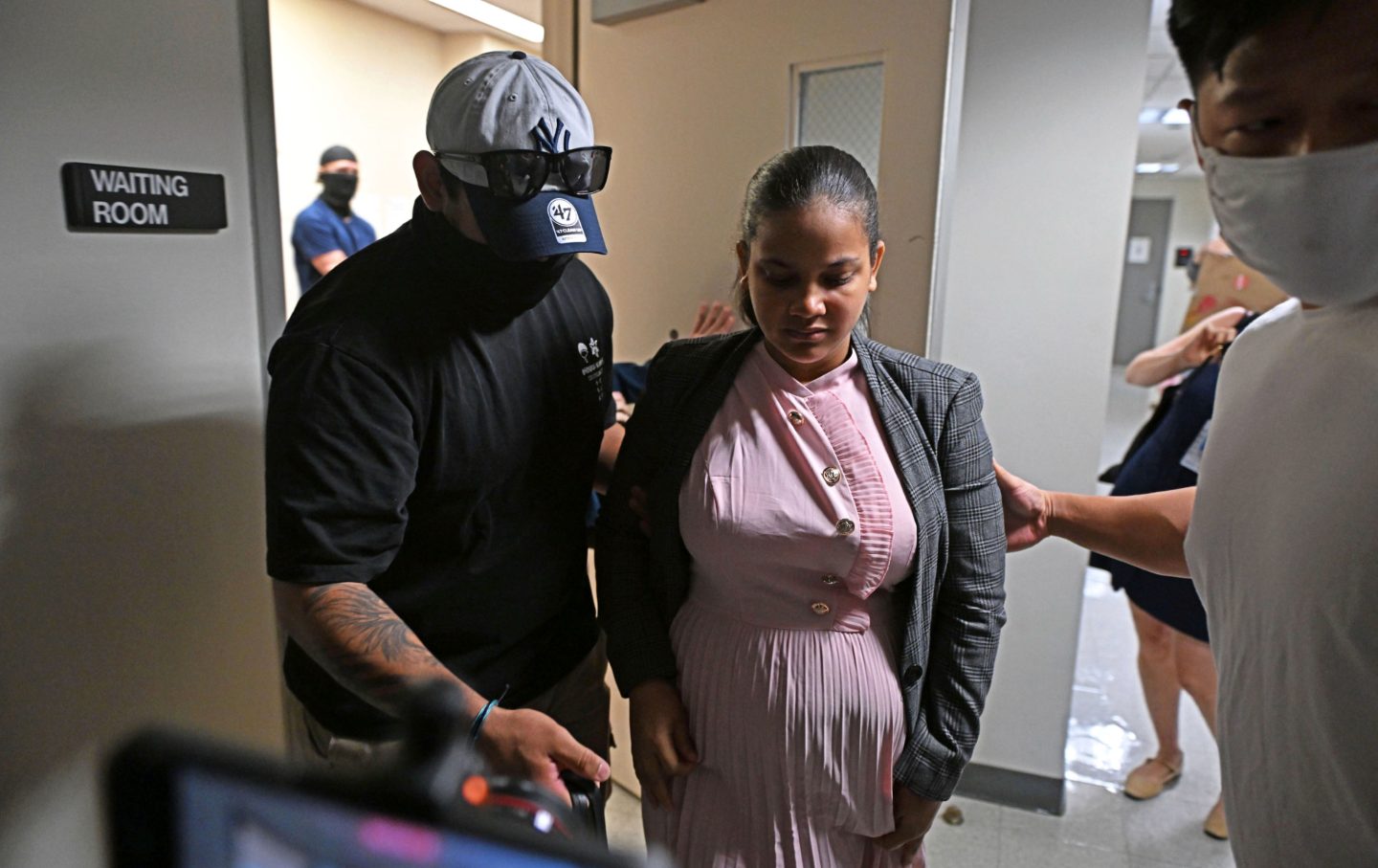
RM: It was really striking the contrast between the experiences of Christine Fields’s partner, Jose, and Maggie Boyd’s partner, Matt. Both demanded treatment from Woodhull staff—but in different years and at different times after their surgeries—after they saw their partners were getting worse. But when Jose, who is Latino, cried out for help, he was met with security officers. Matt, who is white, was eventually listened to. Maggie Boyd survived and Christine Fields did not.
IC: The statistic that really got me—or I guess it was an observation in a very large study—was about what correlated to being mistreated in birth. It noted that a Black woman with a college degree is more likely to die for pregnancy-related reasons than a white woman without a college degree. There’s also research showing that the race of your partner can correlate to mistreatment. Simply having a Black partner, regardless of the race of the birthing person, makes you more likely to be mistreated. And when you read that, it just takes your breath away, the layers in which these inequalities play out.
This was another reason why I semi-reluctantly had to be part of the story, because I met Maggie Boyd by chance at a preschool picnic. She told me she almost died giving birth. Sometimes people say that and they’re just being hyperbolic, but she literally almost died in birth; she needed a full body blood transfusion. And after telling her, “Oh my God, I’m so sorry,” I asked her, “Where did this happen?” And she said, “Have you heard of Woodhull?” I was at that moment fighting Woodhull to try to get inside to interview people. Two months later, Christine Fields was dead at Woodhull after [the public] had been assured that they were doing better after Sha-Asia Semple’s death. It was so deeply upsetting to continue to have this happen.
I write about Jose, the surviving fiancé of Christine Fields, who has become a maternal health advocate. After the book was already to press, he became a doula through a program called Dads to Doulas that is specifically focusing on helping men of color be partners in safe pregnancy care and navigating this system. There have been, just in the course of the book, three Black women who died at Woodhull in completely inexcusable and preventable ways. The third time that it happens in the book, it was just about a year after Christine Fields had been killed, and Jose said to me, “They’re talking about Woodhull closing down. I don’t want Woodhull to close down because we deserve to have a good hospital in our community.” I think we have to recognize that it is putting a huge burden on midwives without giving them the resources or the support to say, “OK, this is what we can do to solve the maternal health crisis.”
RM: In your book, you explain that legal advocate Lynn Paltrow told you in 2014 that “personhood [often considered the right’s ultimate endgame] is already here.” That really shook me. But of course it’s already here, especially now in states with total or near-total abortion bans, like Georgia, where they kept a brain-dead woman on mechanical support to gestate her pregnancy.
IC: Yeah, I mean, when we talked about what was happening before [Roe was overturned], this is such a prime example in which people found themselves shocked by Dobbs. But the groundwork had been laid on the backs of marginalized women long before Dobbs.
The reason that Lynn recognized that personhood was already here [in 2014] is because she and what is now Pregnancy Justice were representing pregnant people who had been arrested under chemical endangerment laws. I know The Nation has reported on these chemical endangerment laws that were passed in the name of protecting children whose parents took them to meth labs but that almost immediately were being used to prosecute pregnant people at a time where abortion was still legal throughout the United States. And when advocates, including Pregnancy Justice, took this to the Alabama State Supreme Court to say that this is not constitutional to say that an embryo or a fetus is the same as a child under a child abuse law, the Alabama State Supreme Court…[said] that no, in fact, chemical endangerment of a child does mean that a pregnant person can get prosecuted for being a substance user or possibly being addicted during their pregnancy because it is the same as a child. [Paltrow told me that] aside from a few brave advocates, there really wasn’t very much outrage about this, just like there hadn’t been outrage during the so-called crack baby epidemic that villainized Black women and falsely claimed that they were going to give birth to a generation of superpredators. I also profiled Dorothy Roberts, who was warning about this at the time and saying that what was being tested on Black women would be enacted more widely if it was just allowed to continue. And that’s how you have an outcome where Alabama leads the nation in arresting pregnant people for outcomes related to their pregnancy, mostly substance use.
Popular
“swipe left below to view more authors”Swipe →Everybody was so surprised when the same legal precedent in Alabama was used to ban IVF, which is predominantly accessible to well-off white people. But it’s right there in black and white…. And it was only politics, not medicine or law, that undid that result.
People have been warning from the start that [the personhood movement] would also come for IVF and birth control. It wasn’t really taken seriously until it actually happened, but it only happened because when it was being enacted on people disfavored by American society—people who use drugs, poor people, people of color, people on public health insurance—frankly, nobody cared, or very few people cared.
RM: I think a lot about what it takes for people to become pregnant or stay pregnant at a time like this. It’s a tremendous privilege for those of us who are able to access contraception or abortion to make a deliberate choice. But there are also people who might hear these stories and feel fear about wanting to be pregnant, stay pregnant, or become a parent. What do you say to those people?
IC: I think that there are a lot of people who have very good reasons that they don’t have to share with anyone else about why they don’t want to be parents, and I support them profoundly. And I know many people who are ambivalent for all the reasons that you describe, where they think they may want this but that they justifiably fear the kinds of harms of the system.
I remember saying to my husband, after Trump won in 2016, we’re never having children now. And I obviously changed my mind. I thought about why, and I was thinking about the fact that my dad was born at a time where his parents’ entire families had been wiped out by the Holocaust. The same with my father-in-law; his parents were refugees from Germany who also had entire branches of their family murdered. What might it mean to take that kind of leap of faith to bring another life into the world under circumstances that are not what you want for your kids or for yourself? For me, I’m glad I changed my mind, and I want everybody to have a choice—a real choice, not just a choice on paper, about whether to refuse to have a child or whether to have a child in circumstances that need to get a lot better. But I also think these systems only start to improve when people make demands of them. Boycotting is one route, but so is putting enormous pressure on them, exposing them, having these conversations.
And I would also say some of us have been blessed with positive experiences. It’s hard to talk about them in the context of these tragedies, but—and this is something that I’ve heard from Black midwives and doulas—we have to tell these stories of harm, and we also need to talk about the stories of joy and support, because they do exist.