
ICE’s Detention of Pregnant People Continues a Disgraceful American Tradition
We are seeing yet another example of state-sanctioned violence against the reproductive futures of those deemed outside the national body.
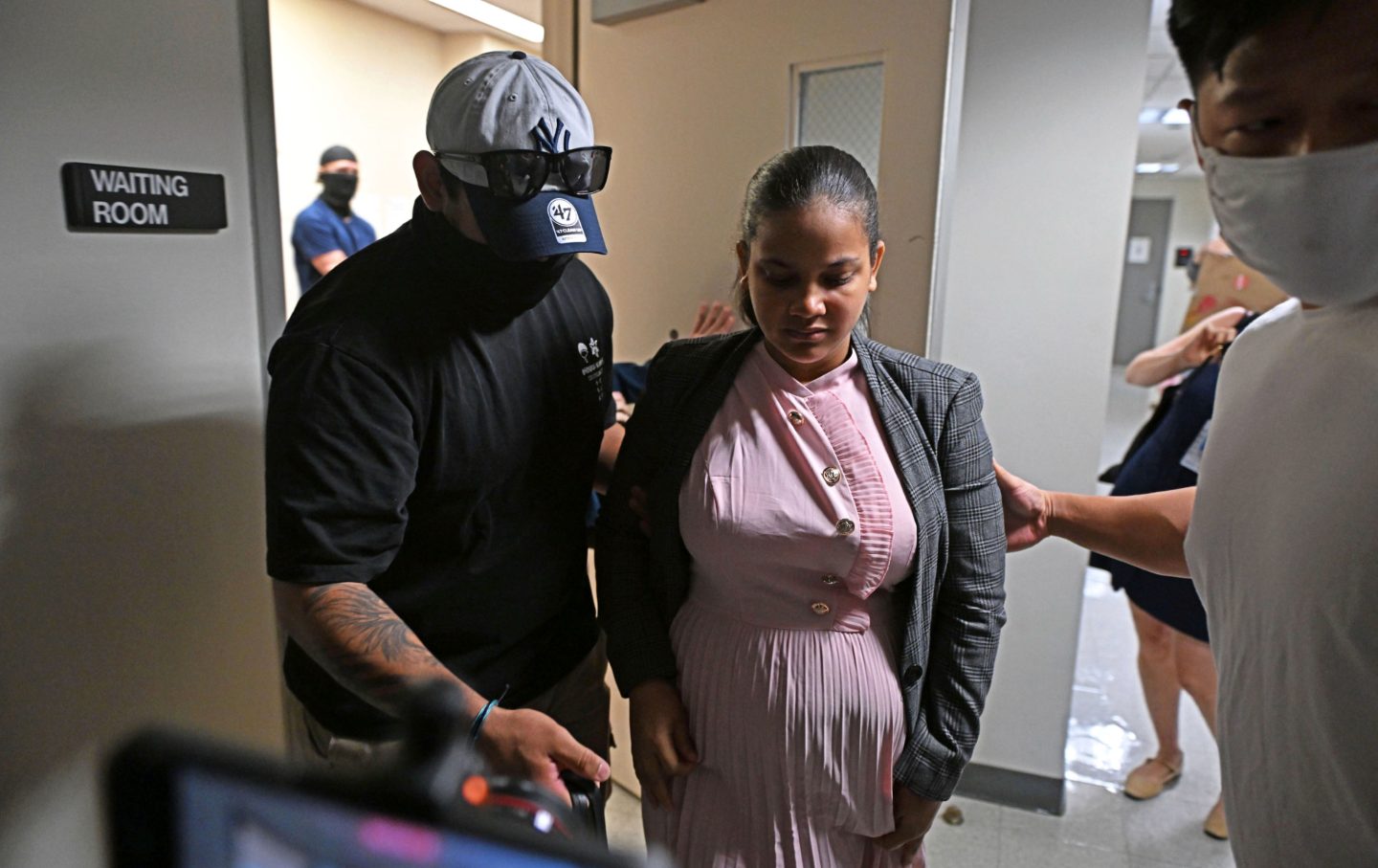
Federal agents detain a nine-months-pregnant woman after exiting a court hearing in immigration court at the Jacob K. Javits Federal Building in New York, on September 11, 2025.
(Andrea Renault / STAR MAX/ IPx via AP)When Cecil Elvir-Quinonez was pulled over for speeding on New Year’s Eve, the 25-year-old mother was thinking of her two children in her back seat—a 5-year-old son and a 5-month-old infant she was still breastfeeding. Weeks later, she was still thinking about them—only now, having been arrested and transferred to ICE custody, she was languishing in a privately run detention center in Louisiana, far from her Florida home, and facing deportation to Honduras, a country she had not seen since she was a child. She had also just learned that she was pregnant. In correspondence with The 19th, Elvir-Quinonez wrote that she had received no medical attention despite experiencing persistent bleeding and cramping, and being forced to skip meals due to the unhygienic conditions of the facility.
Her story is not an isolated one. A monthlong investigation by the office of Georgia Senator Jon Ossoff, which was released last year, found 41 allegations of physical or sexual abuse and 32 reports of mistreatment of children and pregnant women. And in October, the ACLU documented a series of disturbing allegations from multiple women and pregnant people held at two privately owned ICE detention centers—the South Louisiana Processing Center (Basile) and the Stewart Detention Center in Georgia.
According to the ACLU, three pregnant women reported ICE agents using restraints, such as shackling, even as the women were having a miscarriage; one pregnant woman said she had been held in solitary confinement for days; two women reported medical interventions without informed consent or appropriate translation services; and almost all women interviewed talked about inadequate or denial of prenatal care, medical neglect from health professionals, and limited nutrition and medications, including prenatal vitamins.
The detention and inhumane treatment of migrant women and pregnant people by the US immigration authorities is part of a continuous history of state-sanctioned violence used to regulate the reproductive futures of those deemed outside the national body, turning the “border” into a site of direct domination over the migrant body.
Since 2021, the detention of pregnant, postpartum, and nursing individuals has been governed by ICE Directive 11032.4, which, in theory, requires specific humanitarian standards to be met if detention is deemed necessary, including providing appropriate medical and mental healthcare, regular medical evaluations, prohibiting restraint use, and obtaining informed consent before any medical examination and treatment.
This directive came after legal and medical advocates like ACLU and Physicians for Human Rights, raised concerns about the conditions of ICE facilities and the growing number of pregnant people in ICE detention centers. Between October 2017 and August 2018, 1,655 pregnant women were detained by ICE, a 215 percent increase from the preceding period.
While Congress initially required the Department of Homeland Security (DHS) to publish data every six months on the total number of pregnant, postpartum, and nursing individuals in custody, that requirement has now lapsed. As of 2026, the precise number of pregnant and postpartum individuals detained in ICE facilities is unknown. The last publicly available data in 2018 showed that the rate of detaining pregnant migrants increased by 52 percent compared to 2016.
The very limited data we have comes from a patchwork of investigative journalism, congressional reports, and lawsuits. For instance, the Los Angeles Times noted that, according to DHS spokesperson Tricia McLaughlin, pregnant women make up 0.133 percent of all unauthorized immigrants in custody. This percentage translates to more than 9,000 pregnant individuals if using the NBC News tracker on immigration enforcement. According to a recent article from The Intercept, immigration experts note that the Trump administration’s commitment to expand deportation efforts and reduce data transparency is contributing to an uptick in pregnant women in immigration detention.
The increase in pregnant people detained does not come as a surprise if we look at the history of immigration laws and practices. Immigration politics is reproductive politics—and controlling and regulating sex, gender, and reproduction through federal and state immigration and immigration-related laws is not a novel practice in the United States. After the Civil War, Congress passed the first federal restrictive immigration law known as the Page Act of 1875, which prohibited the entry of Chinese women who were suspected of polygamy and prostitution to the US.
In her 2005 Columbia Law Review article on the Page Act, Kerry Abrams argues that the objective of the federal statute was to preserve American “traditional” values of family and cultural and racial hegemony. By using the “moral standing” of women to regulate immigration, the federal government also paved the way for subsequent anti-immigration laws, including the Chinese Exclusion Act of 1882.
The influence of marriage norms remains significant in today’s immigration policies and regulations. For example, whether an immigrant’s marriage is considered fraudulent depends on underlying cultural ideas about what a “real” or “proper” marriage is, and who it involves. Furthermore, the threat by President Trump to end birthright citizenship is another example of how policies around immigration are tied to reproduction, both dictating who can become a citizen and on what terms.
The US also has a long history of coercive sterilization, targeting people of color and immigrants. The 1927 Supreme Court decision Buck v. Bell, which held that forced sterilization based on mental illness, disability, poverty, or race was constitutional, paved the legal pathway for the eugenics movement to deprive many people of reproductive autonomy. Shortly after Buck, women of Mexican descent in California were disproportionally targeted in sterilization practices implemented by the state.
Decades later, the case of Madrigal v. Quilligan highlighted the coercive sterilization of Mexican American women. Organizations such as Planned Parenthood, as well as hospitals, practiced coerced sterilization and the testing of birth control pills on Puerto Rican women without their consent as a justification to solve their “poverty problem.” This practice continues today behind the walls of ICE detention centers. In 2020, a detailed report documenting coerced hysterectomies in a private ICE detention center in Georgia reintroduced the legacy of the eugenics movement to the mainstream media.
The denigration of immigrant women is also explicit when tied to birthright citizenship. In 2007 and ’11—under the Bush and later the Obama administrations—several bills were introduced to end birthright citizenship, albeit to no avail. During the second Trump administration, ads included clips of immigrants of color being chased by ICE agents, and pregnant immigrant women crossing the Rio Grande. The image of women crossing the border to have children in the US is a familiar trope used by the media to capitalize on the stereotype that immigrant women, especially women of color, intentionally come to the US to give birth to “anchor babies.” By framing immigrant women as less than human, immigration opponents invoke fears that people come to the US to “claim government benefits” and “steal jobs.” This racism is used to justify exclusionary policies.
For example, the Personal Responsibility and Work Opportunity Reconciliation Act of 1996 (PRWORA) bifurcated immigrants into “qualified” or “nonqualified” categories for services like Medicaid, Temporary Assistance to Needy Families, the Supplemental Nutrition Assistance Program, and Social Security Income.
The restriction to services, including healthcare services—which was maintained even under the Affordable Care Act—has negatively impacted the health of immigrant women and their children. Laws restricting public welfare and health insurance are associated with a higher risk of low birthweight, preterm birth, perinatal mortality, and congenital malformation among infants born to immigrant women.
Popular
“swipe left below to view more authors”Swipe →Equally disturbing are accounts of sexual abuse among women and gender minorities. In September 2025, a complaint filed by ACLU of Louisiana and other human rights groups detailed the experiences of one woman and three transgender individuals detained in ICE centers who were subjected to months of constant sexual abuse, forced labor, and denial of medical care. Despite ICE’s implementation of the Prison Rape Elimination Act in 2017, more than 300 formal complaints of sexual assaults were reported in 2018; few of these cases were investigated.
According to the DHS’s Office of the Inspector General, ICE doesn’t always comply with standards in place to investigate sexual assault cases, leaving reports incomplete or further delaying the process. Additionally, under the barrage of executive orders stripping protections from birthing people and transgender individuals, including in cases of rape, ICE detention centers began revoking protective measures and the provision of medical care for transgender detainees and denying or withholding abortion care. As data and protections against abuse is erased, the opportunity to hold ICE officials and facilities accountable also diminishes.
These past and current conjunctures do not occur in a vacuum. They are reflections of power relations and histories that have and continue to shape immigration laws and policies today. History reveals that immigration laws have often been used to control who is deemed worthy of care and belonging, patterns that we should collectively prevent from being replicated.
More from The Nation

What’s It Like Inside a Data Center? What’s It Like Inside a Data Center?
Northern Virginia is laden with structures that house data for Fortune 500 companies. I went inside just one of those monstrosities that bothers its neighbors.

What Trump and Tucker Carlson Have in Common What Trump and Tucker Carlson Have in Common
Carlson has broken with Trump largely over the war in Iran. But on Ukraine and immigration, the two speak very much the same language.

The Jewish Case Against AI The Jewish Case Against AI
Haredi rabbis and the secular left agree: This technology is a threat to the entire social fabric.

The Fight for Educational Equality Is Also a Fight for a Just Supreme Court The Fight for Educational Equality Is Also a Fight for a Just Supreme Court
The court has severely weakened our ability to make an education system that fulfills the promise of Brown.

The Fall of “Scientific American” The Fall of “Scientific American”
When the beloved science publication got too political, its corporate owners stepped in. Now its future is uncertain.

The Bookstore Revolution in Taiwan’s Conservative Heartlands The Bookstore Revolution in Taiwan’s Conservative Heartlands
After Taiwan legalized same-sex marriage, gender-themed bookstores are working to build the social acceptance that the law alone couldn’t deliver.

