
Clarence Thomas Just Struck Another Blow to Black Power
In his majority ruling in a sleeper case about mail delivery, Thomas opened the door to a new way for Republicans to suppress the Black vote.
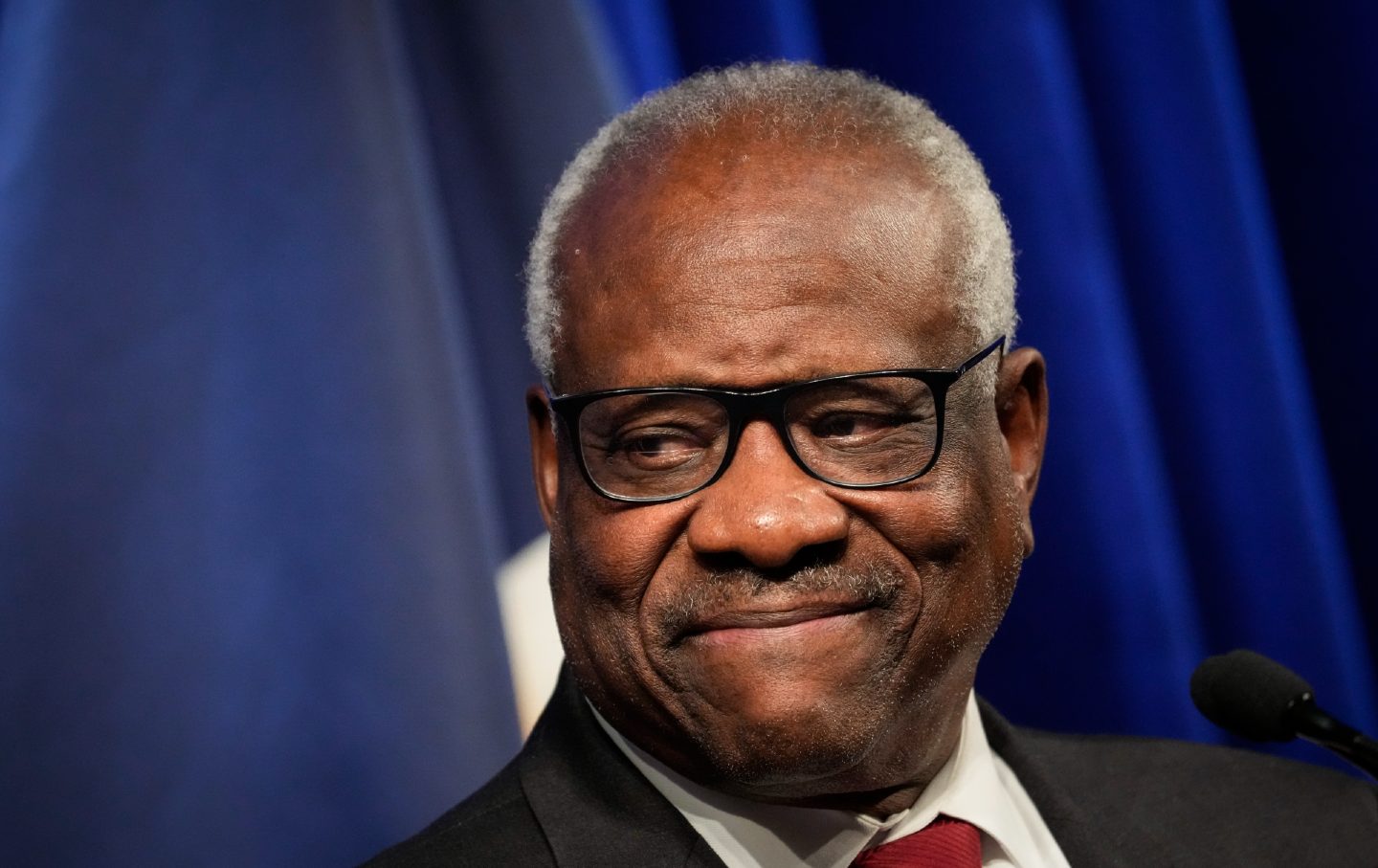
Associate Supreme Court Justice Clarence Thomas speaks at the Heritage Foundation on October 21, 2021.
(Drew Angerer / Getty Images)Clarence Thomas is the worst thing to happen to Black people since Chief Justice Roger Taney, the author of the Dred Scott decision. For nearly 30 years, he has been a kind of bouncer working the door of the Supreme Court for the white supremacists, rebuffing every attempt Black people have made to achieve equality, fairness, and justice.
His latest outrageous attack on equal treatment under the law can be found in his majority opinion in United States Postal Service v. Konan. USPS v. Konan is a critical case that could directly affect the integrity of upcoming elections, but it’s gone somewhat under the radar because, on its face, the case is just about the post office. The plaintiff, Lebene Konan, is a landlord with two rental properties in Texas. Starting in May 2020, the post office stopped delivering her mail. Then it stopped delivering mail to her tenants. The post office claimed there was some dispute over the rightful owner of the properties. Over the course of two years and various attempts to rectify the problem, Konan alleged that the post office was intentionally preventing her from receiving mail, thus making it harder for her to run her properties and discouraging new tenants from moving in.
This is where I point out that Konan happens to be a Black woman trying to be a landlord in Euless, Texas (a suburb of Dallas). Konan filed various lawsuits, including ones alleging racial discrimination at the hands of the post office. Most of her claims were dismissed by the Fifth Circuit Court of Appeals, the most conservative court in the country.
Only one of her claims survived: The Fifth Circuit agreed to let Konan argue her claim under the Federal Tort Claims Act (FTCA). The Trump administration appealed, urging the high court to protect the post office from a trial and additional judicial scrutiny.
Generally speaking, you cannot sue the government to recover damages in a tort lawsuit because of the concept of “sovereign immunity”; the idea, essentially, is that the government cannot be held liable for monetary damages arising out of actions taken by the government. But under the FTCA, the government waives its sovereign immunity for issues involving intentional misconduct by government officials.
There are exceptions to the FTCA, however, and a pretty big one involves the post office. It’s called the “Postal Exception,” and it says that the post office cannot be sued on claims “arising out of the loss, miscarriage, or negligent transmission of letters or postal matter.” I get why this exception is there. Mail gets lost all the time. It would be unworkable if people could sue the government every time a holiday card went missing.
But Konan is not suing over her lost greeting cards. She is suing because, she argued, her mail was neither lost, miscarried, nor negligently transmitted but intentionally not delivered—and the postal exception does not cover intentional malfeasance by the post office. She should therefore be able to recover damages for the post office’s willful attack on her business.
Clarence Thomas and four other Republican justices disagreed, however, and overruled the Fifth Circuit. In his majority decision, Thomas argued that the post office is immune from liability, even when its workers intentionally refuse to do their jobs. To get there, he tortured the English language beyond all recognition. He twisted the words of the postal exception, using the only book he seems to read, the dictionary, to come to the conclusion that “refusal” to deliver mail is the same as “loss” “miscarriage” or “neglect.”
To put this another way: Thomas has made the case that the postal exception is so broad that the post office functionally cannot be sued under the FTCA for anything. The post office already can’t be sued for accidental malfeasance; now, according to his ruling, it can’t be sued for purposeful malfeasance. By Thomas’s logic, the post office can burn your mail and there’s nothing you can do about it.
It is notable that Justice Neil Gorsuch, the most “textual” justices of the bunch, joined the dissent in this case, which was written by Justice Sonia Sotomayor. Thomas’s abuse of the English language in serving of hurting a Black landlord was so ridiculous that it made even Gorsuch blush.
In this dissent, Sotomayor pointed out the problems with Thomas’s word games. Apparently, she also has access to dictionaries. She argued that the whole concept of “losing” something suggests unintentional actions: “see also Webster’s New International Dictionary 1460 (2d ed. 1934) (defining ‘loss’ as an ‘[a]ct or fact of losing…esp[ecially], unintentional parting with something of value’). For good reason: As the Fifth Circuit observed below, ‘no one intentionally loses something.’”
I would like to be able to tell you that the tragedy of this decision will be felt only by Konan, or only by Black women landlords. But if the post office can intentionally refuse to deliver a Black landlord’s mail, you know what else it can intentionally not deliver? A Black woman’s ballot. Or a Black man’s ballot. Or every ballot coming out of a zip code where Black people live. Clarence Thomas just gave the green light to Trump’s post office to intentionally “lose” mail-in ballots, six months before the midterm elections.
If you listened to the State of the Union, you might have noticed—between the awarding of medals and airing of grievances—Trump’s call for an end to mail-in ballots. He said: “We have to stop it, John,” while looking directly at Chief Justice John Roberts.
Roberts voted with the majority and joined Thomas’s opinion in this case, by the way.
If Trump tries to rig the elections, there will be a bevy of lawsuits, of course. But USPS v. Konan just cut off one obvious avenue of legal redress. The ruling will prevent individual voters from suing the post office should the post office simply refuse to transmit their mail-in ballots.
Popular
“swipe left below to view more authors”Swipe →Black voters will be the ones most likely to suffer that deprivation of voting rights at the hands of the US Postal Service. Clarence Thomas knows all this, and while it would be easy to say he knows this and doesn’t care, I think he does care. I think he cares a great deal about the suppression of the Black vote; he just happens to think the suppression of Black votes is a good thing. I think the destruction of Black political power has been one of the motivating factors for his entire judicial career.
To my mind, the difference between Thomas and all the white supremacists that have come before him is that most of those guys were interested in the advancement of white privilege. Thomas is motivated by the destruction of Black power. It’s a slight difference, but that difference is what makes Thomas the worst.
More from The Nation
Michigan Students Are All In for Abdul El-Sayed Michigan Students Are All In for Abdul El-Sayed
The progressive Senate candidate has won over students with his politics—and, in at least one case, his protein intake.

What Are Democrats Prepared to Do if Trump Rigs the Election? What Are Democrats Prepared to Do if Trump Rigs the Election?
In this week’s Elie v. U.S, our justice correspondent challenges Democrats' lack of a plan if Trump steals the midterms. Plus: the most racist, and honest, AI add ever.
Ramaswamy’s Guide to a Better Vocabulary Ramaswamy’s Guide to a Better Vocabulary
Quotes of the Week.
Why Trump Is Embracing Vivek Ramaswamy’s Vile Ad Why Trump Is Embracing Vivek Ramaswamy’s Vile Ad
The president is leaning into the politics of toxic parenting.

The Shadow Knows The Shadow Knows
High-tech weapons, low-tech intelligence.
Tom Hayden’s Legacy and the New American Left Tom Hayden’s Legacy and the New American Left
It’s been 10 years since he passed away.

