
Will America Ever Give White-Man Rights to Everyone Else?
If we want to make it another 250 years, the Constitution is going to have to do a lot more than protect individual political and civil rights.
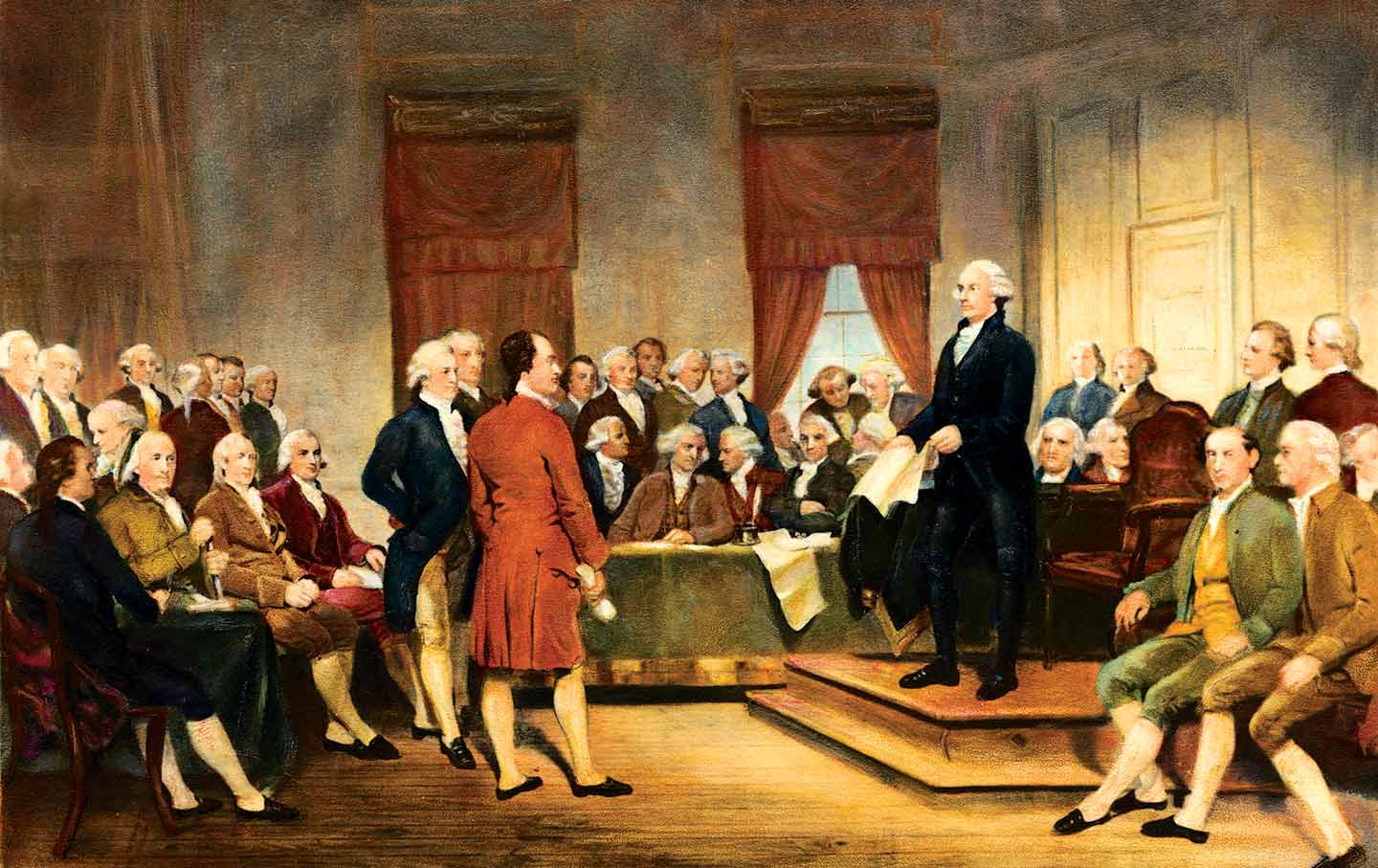
The room where it happened: The signing of the US Constitution in 1787, in a painting by Junius Brutus Stearns.
(Bettmann)
Two hundred and fifty years ago, wealthy white men in the process of colonizing the North American continent declared their independence from the wealthy white men who’d sent them to do the colonizing. Their fundamental disagreement was over which group of white men had the right to profit most from their joint subjugation of other humans. Eventually, the American colonists triumphed over the British venture capitalists.
You don’t need to be a Puritan to recognize that this country was born in sin. The early generations of Americans stole land, murdered the people living on that land, and then forced enslaved people to work the land they’d stolen. That’s a trifecta of evil so twisted that nobody would believe it if you wrote it as the backstory for a dystopian empire that rebels had to take down with laser swords.
250 Years of Searching for a More Perfect Union
For all the founding documents’ grandiose talk about self-evident truths and inalienable rights, neither the white man’s Declaration of Independence nor his Constitution conferred any rights or liberties on Indigenous peoples, enslaved Africans, women, children, or poor people. These documents—and the political philosophy around which they were organized—were written by rich white men for the benefit of rich white men, and this country has never for a day recovered from their failure.
We’ve tried to fix this thing. At every point in US history, people have worked desperately to perfect our Constitution and make it applicable to all of the people living under its principles. But we’ve never addressed the structural failures of our Constitution, and so we’ve really only ever addressed the symptoms of our dysfunction, not the root causes.
The core failure of our Constitution is that it is based on individual political and civil rights, with no mention of economic or social rights. It’s based on what we call “negative rights”: things that the government cannot do to its citizens. What’s missing is a robust conception of “positive rights”: the things that the government must do for its citizens. Indeed, there have been efforts, led by the Supreme Court, to “calcify” the Constitution as “a charter of negative liberties” and nothing more. It’s a mistake that we keep making.
You can see how that design and structure are great from the perspective of a wealthy white man who merely needs the government to stay out of his way (and out of his pocket). It’s not so great from the perspective of a person who needs affirmative things from the government. And it is largely silent on the broader issues of social and public good.
We can see the wealthy-white-man perspective clearly in the Bill of Rights—the part of the Constitution where the rights of the people are finally addressed. The first eight amendments all affirm individual political and civil rights: speech, religion, due process, trial by jury—these are all rights that allow a person to participate in politics without government interference. Only the Third and Fifth amendments hint at any kind of economic rights, but take a close look at whose economic welfare the Constitution is concerned with. The Third Amendment prohibits the government from using your lands and estates to house and feed its soldiers, which is pretty neat if you happen to own lands and estates. The Fifth Amendment forces the government to compensate you if it takes your land for public use, which, again, is pretty nifty if you own land. It’s somewhat less awesome if you want the government to use land for the public good.
The thrust of constitutional improvements has been to make these individual political and civil rights apply to everybody. Despite the Civil War and the civil-rights movement, that project is still incomplete—although, admittedly, we’re closer to making those rights universally available than the people who wrote them ever intended. But even when we add new rights, they consist only of civil or political rights and are, once again, always drafted from the perspective of what the government cannot do.
We don’t, for instance, have a positive right to vote. Instead, we have a couple of restrictions (outlined in the 15th and 19th amendments) that prevent the government from denying the right to vote. The government doesn’t have to provide voting rights. It doesn’t have to make voting easy or efficient. Gerrymandering and the Electoral College exist because the government is not required to make all votes count equally or distribute voting power fairly. It simply isn’t allowed to prevent people from voting based explicitly on their race or gender.
Thanks… I guess?
The expansion of individual political and civil rights—of negative rights—will never get us toward a more perfect union. We have spent 250 years running to catch up to the rights that these wealthy white colonists gave themselves. That effort is not just exhausting; it leads only to the stunted and selfish vision of freedom those unenlightened 18th-century merchants and slavers wanted. It leads only to a society of winners and losers, haves and have-nots, to a place where “all men are created equal,” but those with more money, more power, and more access are more equal than others.
My solution is not to advocate for more political and civil rights; it’s to advocate for economic and social rights—for positive rights—and, with them, more responsibilities from the government.
I’m not the only one, of course. Plenty of people have marched, organized, and fought to establish social and economic rights in our society through legislation. Whenever the Constitution is silent, Congress can speak loudly. The Constitution is not, and should not be, the ceiling on what our society can become; it only establishes the floor.
I just think that floor should be much higher. People should have a right to shelter and to the habitability of that shelter. They should have a right to food and to healthcare, and to clean water and clean air. Children should have a right to a quality education, and adults over 18 should have a right to college or vocational training. These rights should extend to people who don’t work—but people who do work should also have a right to a living wage. All of these rights should be written down, and the government should have a positive responsibility to provide them.
All of these rights can be framed as economic rights, but they can also be understood as social rights. People have a right to dignity, and while that’s a slippery term, things like housing, food, and a living wage all speak to what dignity really means. But there are also more obvious social rights worth codifying. People have a right to have a family (or not have a family) regardless of their gender or sexual orientation. They have a right to privacy—for their personal data, their biometrics, or their genitals—and that right cannot be signed away by clicking on a screen full of legal boilerplate just to unlock a new phone. Speaking of phones, given the realities of the modern world, people should have a right to telecommunications, much as it pains me to think of access to TikFaceGram as a “right.”
And don’t even get me started on all the rights that people are going to need in order to defend themselves from AI. Suffice it to say that reforming our Constitution to think about rights and liberties from the perspective of people instead of capitalists and corporations is more important now than ever.
This might sound like I’m advocating for a bunch of “new” rights, but I’m not, really. I’m advocating for the same rights that wealthy, white, cisheteronormative men have always enjoyed. I just want the rights that money has always bought. Of course this nation’s rich, white founding fathers didn’t write a right to shelter into their grand declarations: They all had homes and thought that everyone who “deserved” one had one, too. Of course they didn’t contemplate a right to dignity: They were far too busy denying the dignity and humanity of all the people they oppressed.
It is because all these rights are already available to those with the power to purchase them that we must require the government to provide the same rights to everyone else. When the market fails, as it so often does, to provide homes or food or healthcare, it is incumbent on the government to step in and fill the breach. When the restaurant or bake shop or private adoption agency doesn’t provide equal dignity for all couples regardless of sexual orientation, it is incumbent on the government to step in and tell those private businesses “no.” It should not be up to the individual to prove that the government has denied them these rights; it should be up to the government to make sure that these rights exist.
If we’re going to make it another 250 years and match the longevity of the Roman Republic, our Constitution is going to have to take this giant leap into the modern world. Yes, our country is relatively young, but our Constitution is old and, frankly, antiquated. Its self-imposed silence on issues of economic and social rights makes it an outlier when compared to modern constitutions. From India to South Africa to post-Nazi Germany, we see that most modern constitutions include a broader conception of rights than the few we’ve been working with.
To get beyond this fundamental weakness, we have to be clear-eyed about our white male founders—who they were, and what they were trying to accomplish. The benefit of nations founded on a mythical past, where people imagine that their laws and rights were given to them by King Arthur or Romulus or Zeus, is that those founders are fake, and so their principles can be manipulated and adapted to fit whatever the society needs. But the United States is saddled with real, historical people who wanted to do some really bad things. Worshipping them and their documents is dangerous because they wrote their actual beliefs down in law, and some of their beliefs were horrific.
We must overcome their faults and failures and imagine ourselves anew. We must not be the white male ethnostate they wanted. We must instead become a country they never imagined: one based on the affirmative promise of life, liberty, and the pursuit of happiness for all—instead of just a chosen few.
More from The Nation

The Jewish Case Against AI The Jewish Case Against AI
Haredi rabbis and the secular left agree: This technology is a threat to the entire social fabric.

The Fight for Educational Equality Is Also a Fight for a Just Supreme Court The Fight for Educational Equality Is Also a Fight for a Just Supreme Court
The court has severely weakened our ability to make an education system that fulfills the promise of Brown.

The Fall of “Scientific American” The Fall of “Scientific American”
When the beloved science publication got too political, its corporate owners stepped in. Now its future is uncertain.

The Bookstore Revolution in Taiwan’s Conservative Heartlands The Bookstore Revolution in Taiwan’s Conservative Heartlands
After Taiwan legalized same-sex marriage, gender-themed bookstores are working to build the social acceptance that the law alone couldn’t deliver.

Jalen Hurts Deserved Better. We All Do. Jalen Hurts Deserved Better. We All Do.
In a country that treats workers as expendable parts, Hurts’s playing through a blood clot is just the highest-profile example of the price workers pay in an oligarchy.

The Terrifying Future of States’ Criminalizing Pregnant People Is Already Here The Terrifying Future of States’ Criminalizing Pregnant People Is Already Here
The idea of charging people who have abortions with murder is gaining traction on the right. But a report finds that people are already being prosecuted for their pregnancy outcom...

