
Separation of Church and State: America’s Best Idea
Christian nationalists keep forgetting what the country’s founders kept writing down.
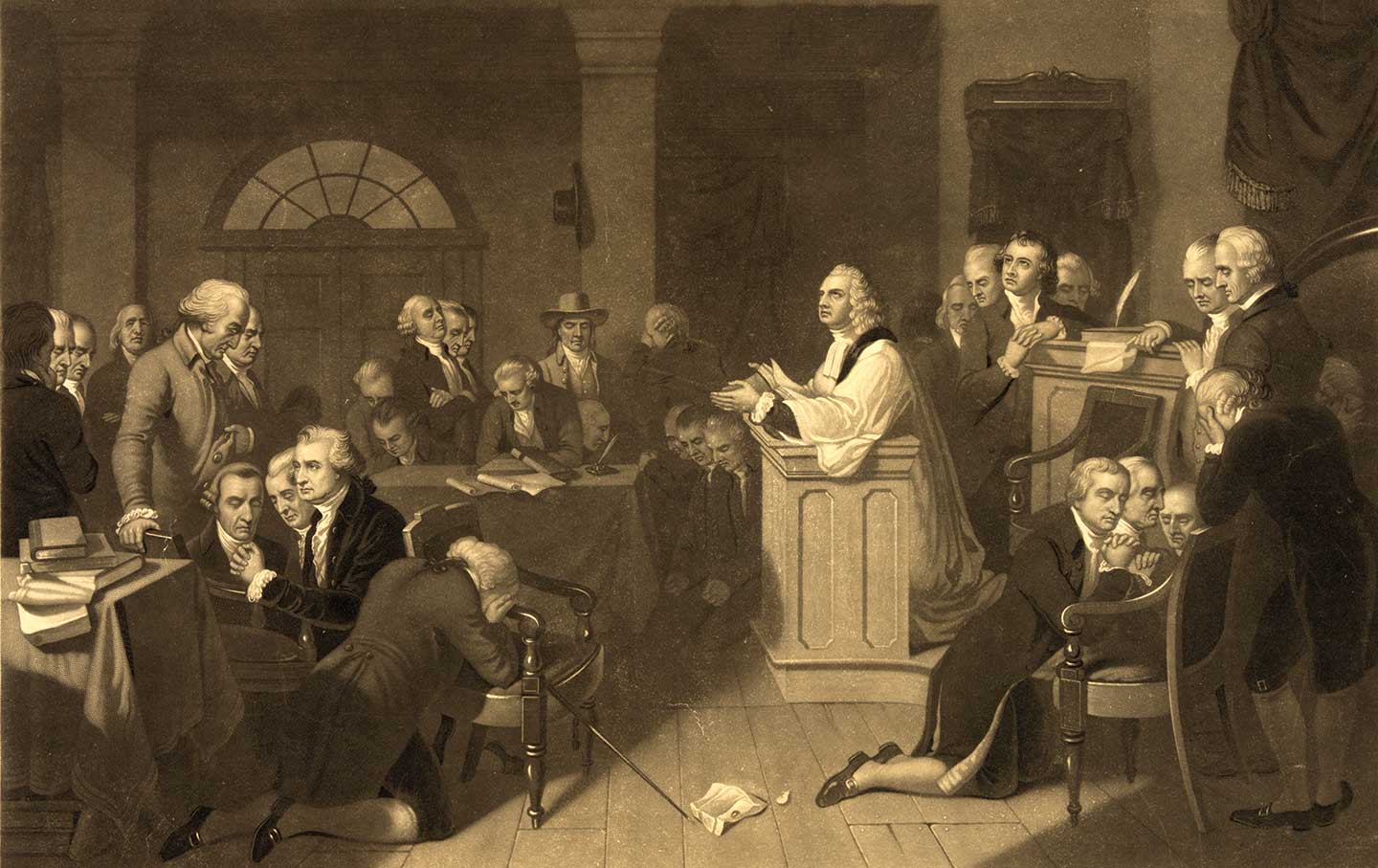
Let us pray: In 1774, the First Continental Congress opened with a prayer—a decision that inspired some sectarian squabbling—but in the new nation that followed, the founders were determined to keep church and state separate.
America is not, has never been, and was never intended to be a Christian nation. To modern Christian nationalists, that sounds like heresy. They’ll argue that all of our presidents have been Christian, the majority of our citizens are Christian, our elected officials swear their oaths on a Bible, and politicians and preachers alike cry out God’s name during sex with their mistresses and male escorts. Everyone knows we were founded by the Puritans, right? And they were so religiously uptight they got kicked out of England. How can we not be a Christian nation?
But the truth is that America is something far more ambitious, and far more fragile: a secular republic where every belief is protected, because none is imposed.
Yes, the founders who began this experiment had flaws—plenty of them. Yes, they were slave owners talking about “freedom.” Yes, they practiced ethnic cleansing against the Indigenous peoples of this land. And yes, they neglected to include women in their democracy.
250 Years of Searching for a More Perfect Union
But the founders got one very simple and moral concept just right: a system under which the government can’t dictate how you can or cannot pray, or whether you should pray at all. They knew the dangers of merging their new government, which at its best was designed to protect individual rights, with religion, which was a matter of individual conscience.
Unfortunately, that’s not how the Christian right sees it. And throughout my entire lifetime, they’ve been trying to rewrite our history. White Christian nationalists have been working for decades to give America a revisionist origin story: a holy Christian republic, ordained from the start by deeply pious followers of Jesus who also just happened to own people.
So, as we mark the 250th anniversary of the United States, let’s remember that the founders were quite clear about the vital importance of this being a deliberately secular nation. They even wrote it down—and more than once.
That’s the part the right wants us to forget.
Today, we’re witnessing a nationwide push by christian-nationalist politicians to force one version of Christianity into public schools, and it’s not just the voucher programs designed to route public money toward specific religions that we all grew up with.
Louisiana recently became the first state to pass a law requiring the Ten Commandments to be displayed in every public-school classroom, so 7-year-olds will know not to covet their neighbors’ wives.
Former Oklahoma superintendent of public instruction Ryan Walters famously ordered all public schools to incorporate the Bible and the Ten Commandments into the curriculum, and multiple Republican-led states have approved the conservative-media nonprofit PragerU’s educational materials for classrooms—which include an animated video of Frederick Douglass explaining that slavery was a “compromise” between the founders and the Southern colonies.
Of course, like most of right-wing Christianity, none of these curricula focus on the moral teachings of Jesus, who commanded His followers—both individuals and nations—to feed the poor, care for the sick, put away their weapons, and welcome the stranger. No, this was pure indoctrination into right-wing authoritarian Christian politics.
Today, while the percentage of Americans identifying as religious continues to decline, the percentage of Christians who believe that America was founded as a Christian nation is increasing. In other words, as the religious population shrinks, the fringe is growing.
The Republican Party platforms in Texas, Oklahoma, and Kentucky even proclaim—or, to be more precise, bear false witness—that the country was founded on “Judeo-Christian” principles. In a 2015 sermon, Republican House Speaker (and America’s Creepiest Youth Pastor) Mike Johnson proclaimed that America is—and was founded as—a Christian nation, and that Thomas Jefferson was “divinely inspired” in his writing of the Declaration of Independence.
In 2023, Johnson appeared on CNBC to gently instruct us that the separation of church and state is “a misnomer.” As the speaker explained, “Of course, it comes from…a letter that Jefferson wrote. It’s not in the Constitution. And what he was explaining is they did not want the government to encroach upon the church—not that they didn’t want principles of faith to have influence on our public life. It’s exactly the opposite.”
Johnson’s claim is the misnomer. But repetition is powerful—especially when it’s employed as part of a blaspheming spiritual grift. So the fantasy that the United States is a Christian nation remains stubbornly popular among people who don’t want the country to do on a policy level the actual things that Jesus commanded.
Consider the polls:
• A majority of Americans believe the founders intended the United States to be Christian (Pew).
• Roughly 30 percent of Americans either endorse or sympathize with Christian nationalism (PRRI).
• Forty-five percent of Americans favor declaring the United States to be a “Christian nation”—even though many of them acknowledge that it would be unconstitutional (Pew).
That’s the paradox: People want a system that they know violates the system. That’s because modern Christian nationalism isn’t about serving the Lord, or fighting Satan, or exercising “religious freedom.” And it’s seriously not about the commandments of Jesus, which they robustly despise. Their true belief system is, and has always been, conservative Christian control over society.
The push to redefine America as a Christian nation isn’t just historical revisionism. It’s a political strategy, with a white-supremacist bent. It reframes citizenship in religious terms; it narrows who belongs and turns faith into a tool of the powerful rather than a matter of individual conscience—or a responsibility to the less fortunate.
Just as Christian nationalism rejects the Beatitudes, it also ignores the very lesson the founders were trying to teach: that when you fuse religion with power, you don’t get more faith. You get less freedom of conscience, less open discourse, and less of the melting pot that the right has always disdained. In 2022, the Public Religion Research Institute reported that nearly a third of Americans—and almost half of Republicans—believe that God intended the United States to be a “new promised land” for European Christians. Tough luck, all you Christians from other continents.
Believe me, I get it. It’s emotionally satisfying. It’s politically useful. But just as the argument for MAGA Christianity collapses when one actually reads the words of Jesus, the belief in America’s Christian origins evaporates under the most cursory reading of the Constitution.
Because here’s the inconvenient history: The founders believed in faith without force. They knew from experience that mixing the two rarely—if ever—ends well. Europe had spent centuries in bloody religious disputes. State-sponsored churches hadn’t produced unity—they had produced persecution. Catholics oppressed Protestants; Protestants oppressed Catholics. Everybody took turns burning somebody. As James Madison put it, established religion had yielded “pride and indolence in the clergy” and “superstition, bigotry and persecution” in society at large.
The 13 US colonies were already a patchwork of religious refugees: Puritans fleeing the Church of England, Quakers who’d been persecuted across Europe, Catholics who’d faced discrimination in Protestant countries. These weren’t people who needed convincing that state religion was dangerous; they already had the scars to prove it.
The founders, influenced by Enlightenment thinkers like John Locke, weren’t anti-religion. Many were religious in their own way, and many admired Jesus as a moral teacher. But they were deeply skeptical of religious institutions wielding political power. A number of them, from Jefferson to John Adams and Benjamin Franklin, were influenced by deism, a belief system that emphasized reason and natural law over doctrine and miracles.
Deists rejected Jesus’s divinity, believing instead in a distant, impersonal God who set up natural laws to govern the universe but wasn’t big on intervening in human affairs, like a boss who only works remotely and never pops into the Zoom meetings.
So they built a very new kind of system based on freedom of conscience. You could worship however you wanted—or not at all—and the government would stay out of it, emphasizing reason and natural law over religious doctrines. Not because religion didn’t matter, but because it mattered too much to hand over to politicians.
Now our right-wing friends like to solemnly intone that the Constitution never actually uses the expression “separation of church and state.” And they’re right. But do remind them: The founders approved a constitution with zero references to Christianity. None—no mention of Jesus, no mention of the Bible, not even a vague nod to divine authority.
Despite what Christian nationalists would have you believe, the Constitution mentions religion only to restrict its abuse as a tool of exclusion—declaring in Article VI that “no religious Test shall ever be required as a Qualification to any Office or public Trust under the United States.”
This was radical. Every 18th-century Christian nation in Europe required oaths, loyalty to state churches, or adherence to some particular creed. Political power was in a deeply codependent marriage with religious identity. If you weren’t the right kind of Christian, you weren’t getting anywhere near the government.
Furthermore, the Constitution’s free-exercise clause was committed to religious pluralism, protecting citizens’ rights to practice their religion without government meddling. So it’s a good thing that the Heritage Foundation has never read it.
But in case anybody still needed it to be spelled out for them, in 1791 the Bill of Rights was added to the Constitution, including the First Amendment, which reinforced that founding principle of religious diversity and explicitly prohibited any national religion, stating: “Congress shall make no law respecting an establishment of religion, or prohibiting the free exercise thereof.” That means you can’t claim “original intent” and then forget the First Amendment, like a dog you left in a locked car on a hot day.
Even if the words “separation of church and state” don’t appear in the Constitution, the idea is baked into its structure like flour in bread.
Keep in mind that the Virginia Statute for Religious Freedom, authored by Jefferson and championed by James Madison, had already declared that no person should be compelled to support or participate in any religious practice. It became the philosophical backbone of the First Amendment. Jefferson later described the result as a “wall of separation between church and state” in that famously despised letter to the Danbury Baptists.
Even claims that the United States was founded on Judeo-Christian values are historically daft and dodgy. The founders deliberately avoided grounding the government in any religious framework precisely to prevent one group from dominating the rest. They recognized that a government free from religious entanglements would be more inclusive and generally more drama-free. Mixing religion with government inevitably leads to factionalism and division, suppression of individual rights, and the mandatory imposition of one belief system—none of which would have helped establish stability for the new nation.
The first presidents and the first Congresses knew this. And again, they wrote it down—even after the Bill of Rights. Which brings us to the Treaty of Tripoli, America’s most ignored mic drop.
Two hundred years before 9/11, when extreme religious fundamentalists would remind the world (again) that power and religion are a bad mix, the young United States had a piracy problem off the coast of North Africa.
To address it, the fledgling country signed treaties with the Barbary States (Tripoli, Tunis, Algiers, and Morocco) to end the targeting of American merchant ships crossing the Mediterranean. The founders, being good diplomats with an eye on successful commerce, were keen to make peace with these Muslim nations, which they referred to as “Mahometan” nations and their inhabitants as “Musselmen.”
That’s why, during the first years of the American experiment, President George Washington initiated negotiations with these nations, which led to the Treaty of Tripoli. Approved without debate by the US Senate in 1797, it was signed by President John Adams, with a notable clause, Article 11, that explicitly states:
As the government of the United States of America is not in any sense founded on the Christian religion—as it has in itself no character of enmity against the laws, religion or tranquillity of Musselmen—and as the said states never have entered into any war or act of hostility against any Mahometan nation, it is declared by the parties, that no pretext arising from religious opinions shall ever produce an interruption of the harmony existing between the two countries.
Got that? “The government of the United States of America is not in any sense founded on the Christian religion.” I mean, I could’ve just started with that and made this a much shorter rant.
And beyond that, the treaty itself shows the wisdom of keeping government and religion separate. By emphasizing that our new nation had a secular government that was friendly to all, the United States was able to get conservative, religion-based societies to trust us, which established and protected international trade. Not having a state religion was extremely good for capitalism.
A secular government could make peace across religious lines, engage in global trade with all faiths, and avoid violent, unnecessary conflicts rooted in theology.
When confronted with Article VI, the free-exercise clause, the First Amendment, the Virginia Statute, and the Treaty of Tripoli, you can expect our Christian-nationalist friends to angrily point out that the Constitution does contain the phrase “Year of our Lord.” That’s when you can let them know: That’s not state theology—it’s a time stamp.
Separation of church and state made it easier to make peace, enjoy freedom, do business, and deal with pirates. So sorry, Christian nationalists: Our official religion remains all and/or none. You get to call yourselves “Christian,” and everyone else gets to be what they want to be. Sit down, and let freedom ring.
More from The Nation

What’s It Like Inside a Data Center? What’s It Like Inside a Data Center?
Northern Virginia is laden with structures that house data for Fortune 500 companies. I went inside just one of those monstrosities that bothers its neighbors.

What Trump and Tucker Carlson Have in Common What Trump and Tucker Carlson Have in Common
Carlson has broken with Trump largely over the war in Iran. But on Ukraine and immigration, the two speak very much the same language.

The Jewish Case Against AI The Jewish Case Against AI
Haredi rabbis and the secular left agree: This technology is a threat to the entire social fabric.
The Fight for Educational Equality Is Also a Fight for a Just Supreme Court The Fight for Educational Equality Is Also a Fight for a Just Supreme Court
The court has severely weakened our ability to make an education system that fulfills the promise of Brown.

The Fall of “Scientific American” The Fall of “Scientific American”
When the beloved science publication got too political, its corporate owners stepped in. Now its future is uncertain.

The Bookstore Revolution in Taiwan’s Conservative Heartlands The Bookstore Revolution in Taiwan’s Conservative Heartlands
After Taiwan legalized same-sex marriage, gender-themed bookstores are working to build the social acceptance that the law alone couldn’t deliver.

