
To Suppress the Latest Protest, Columbia Unveils a Violent New Form of Campus Policing
Protestors rechristened the Lawrence A. Wien Reading Room “Basel Al-Araj Popular University” in honor of the late Palestinian writer before Public Safety and the NYPD arrived.
On May 7, Columbia University authorized the New York Police Department to carry out its fourth mass arrest of pro-Palestine students in 13 months. At least 78 activists protesting Israel’s war on Gaza—and what they argue is the university’s complicity in it—were apprehended following their participation in a Columbia University Apartheid Divest (CUAD) rally in Butler Library. All participants were released, but Columbia has promised disciplinary proceedings that “reflect the severity of the [students’] actions.”
Even before the NYPD’s arrival on the scene, students were met with the ever-intensifying violence of Columbia’s Public Safety officers—36 of whom were recently granted arrest powers. At around 3:15 pm, protesters flooded into Butler’s Lawrence A. Wien Reading Room, rechristening it “Basel Al-Araj Popular University” in honor of the late Palestinian writer. Among their demands were full divestment from Israel, a police- and ICE-free campus, and amnesty for university students, staff, faculty, and workers targeted by Columbia’s disciplinary procedures.
Shortly after the takeover, Public Safety officials arrived, attempting to clear out the roughly 100 demonstrators, forcefully pushing them to the ground, and requiring them to present university identification to exit the vicinity. Reports emerging from the reading room allege that officers choked and beat students, while footage confirms the manhandling of several protesters and the blocking of exits during an active fire alarm. Multiple demonstrators were hospitalized.
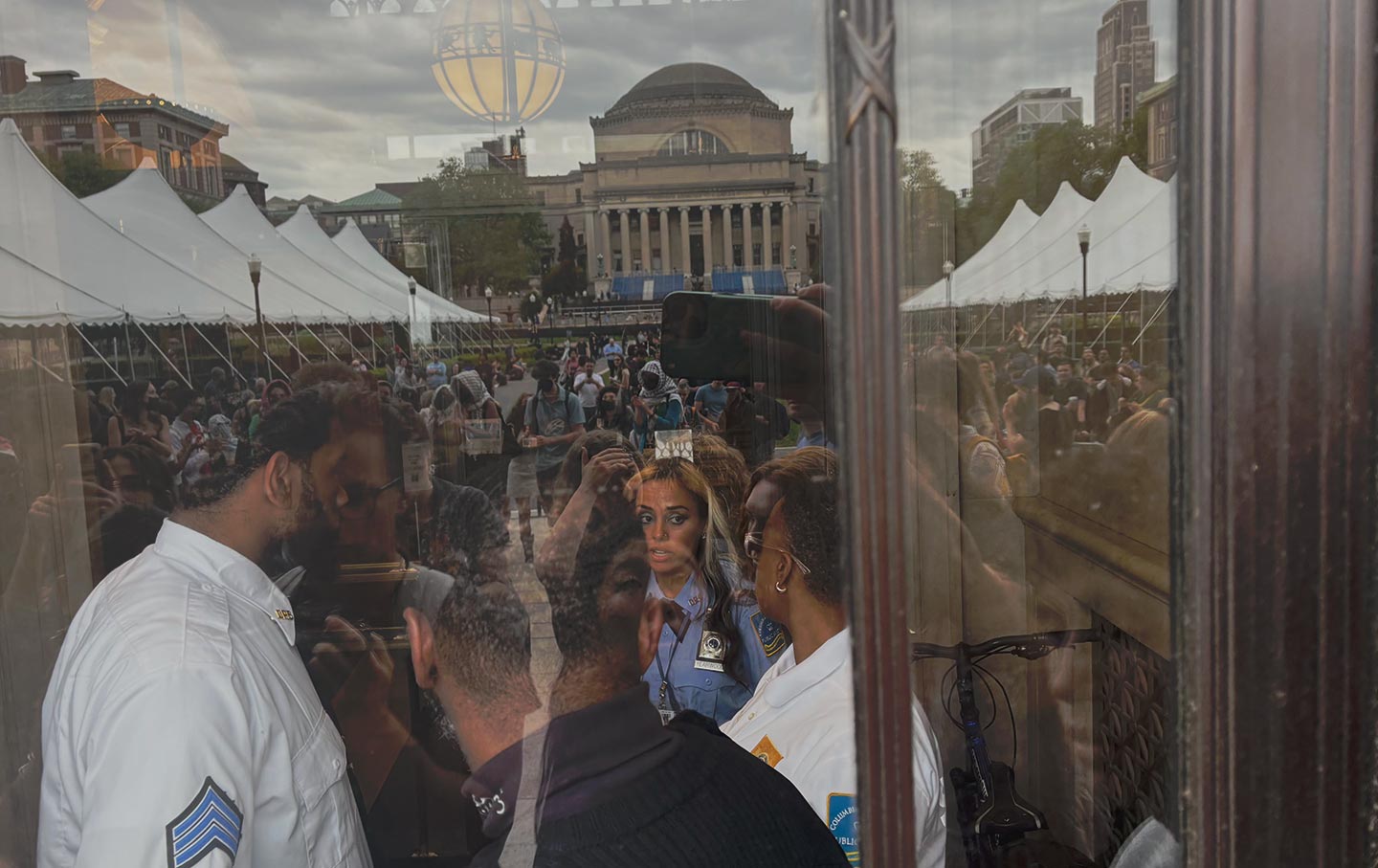
One activist whom Public Safety drove to the floor was allegedly concussed and required medical attention. Medics and Columbia University Emergency Medical Service (CUEMS) attempted to enter the library to attend to the student, but were repeatedly denied access by Public Safety officers guarding the building’s innermost entrance, which they had secured shut with handcuffs. “You’re not going to let me in to treat the student who might have a concussion?” asked one frustrated CUEMS representative after a back and forth with an uncooperative Public Safety guard. Eventually, hours after the incident, at least one CUEMS member was given permission to provide medical attention in the reading room.
Outside the library, Public Safety employed similarly aggressive tactics on the critical mass gathering at Butler’s main doors. Students attempting to retrieve personal belongings from the library, protesters, journalists, and legal observers elbowed their way into the library vestibule before being violently shoved by officers attempting to hinder further entry. One protester ended up on the floor trampled and injured, before two fellow demonstrators removed her from the area.
Ian Borim, a student who was present at Butler’s exterior, says this is the worst violence from Public Safety officers he has witnessed to date. “I truly saw the university in crisis,” he commented. Indeed, up until recently, it was highly atypical for Public Safety to put hands on students.
After the violent suppression of the 1968 anti–Vietnam War and anti-gentrification campus protests, faculty revised student conduct and discipline rules to allow greater tolerance for political dissent. A 2019 Columbia Public Safety policy echoed this legacy when it stated that force ought to be used only as a “last resort.” Even last spring when hundreds of students launched the Gaza Solidarity Encampment and occupied university buildings, Public Safety deferred to NYPD when physical force was required. Today, this is no longer the norm.
Under a Trump presidency that has rescinded over $400 million in university grants and contracts over antisemitism allegations, Columbia has escalated aggression against pro-Palestine demonstrators, leaving them feeling increasingly unsafe. Among the federal government’s demands is that the university “empower internal law enforcement,” which has manifested itself in the deployment of Public Safety officers vested with the authority to remove and detain students.
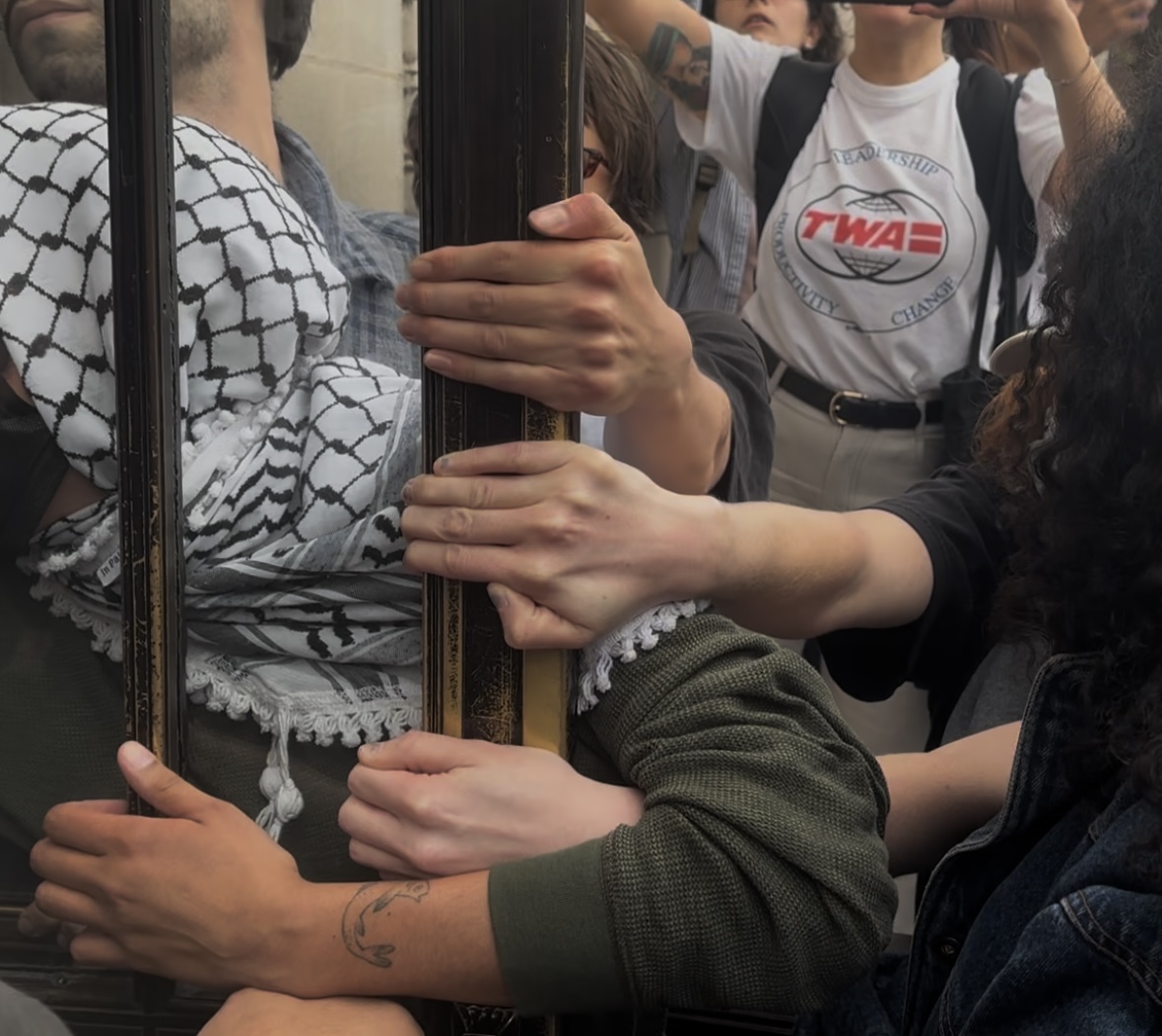
Out of “urgent concern for the well being of students,” Borim asked multiple Public Safety officials who was in charge, and how students may identify the new special patrol with arrest powers. They refused to respond. Later, when he propped open the handcuffed door with his hands and legs to locate a Public Safety representative who might help mediate the situation, officers shut the door on him. “His arm is in there! Do you not care about the safety of your students?” cried one observer.
“The actions wouldn’t keep escalating if…the administration didn’t just repeatedly take authoritarian decisions in how it handles advocacy for…Palestine,” said Borim. “There is an underlying assumption that…student protesters are just insubordinates that need to be forced into compliance. That’s the approach that the administration has been taking for the past two years, and it’s not really working for them or anyone else.”
Acting university president and board of trustees cochair Claire Shipman did not send direct correspondence to the student body when she authorized the NYPD sweep, which took place at around 7:25 in the evening. Instead, she issued a statement affirming that NYPD presence was “absolutely necessary to secure the safety of our community.” Later she sent a school-wide e-mail, which thanked Public Safety officers for working “so hard to make Columbia what we know it can be and should be for our community.”
In addition to using unusually aggressive tactics against student protesters and inviting the NYPD onto campus, the university also barred entry to journalists who were not already inside the library before the action began. This exclusion mirrored university policy during the notoriously harsh Hamilton Hall police sweep, which the press was deliberately prevented from witnessing. “When incidents like this happen, you’d want to have journalists around to be able to bear witness and document what took place,” said Columbia Journalism Review fellow Meghnad Bose, who remained locked out of the library despite numerous efforts to gain access. “What do they have to hide?” he asked.
Popular
“swipe left below to view more authors”Swipe →Several public safety officers pushed and barricaded credentialed journalists attempting to enter the premises. Ultimately, student press like WKCR and the Columbia Daily Spectator vacated prior to the arrests to ensure their teams’ safety. “When we heard from outside reporters that the doors of Butler were locked and that the NYPD were on 114th street, we quickly became uncomfortable with our safety as press,” said WKCR reporter Sawyer Huckabee.
“Acknowledging we were one of few reporters within the reading room while also balancing our safety, we asked Public Safety whether it was safe for us to remain as student press,” Huckabee recalls. “They asked, ‘What type of question is that?’ and that they had been telling us we could leave the entire time without acknowledging our student press status.” It is unclear whether any members of the press were present inside to document the apprehensions.
As Israel’s deadly war on Gaza, which human rights groups maintain is a genocide, continues to unfold, Columbia and the federal government are only ramping up institutional violence against the student movement for Palestinian liberation. This repression has now resulted in the political imprisonment of student activists like Mahmoud Khalil, Mohsen Mahdawi, Rümeysa Öztürk, among many others.. In fact, on the heels of the rally, Secretary of State Marco Rubio declared in an X post that he would be “reviewing the visa status of the trespassers and vandals who took over Columbia University’s library.” Amid this crackdown, Borim cautioned against “infantiliz[ing] the student protesters, [and] dismiss[ing] their motivations as…illegitimate.”
“I think that it’s important for [Columbia] to realize that these students are protesting out of a profoundly felt and held moral position,” he continued. “And you can’t just arrest that away.”
Become a Sustaining Donor This September
Between the reemergence of right-wing red-baiting and Donald Trump’s use of the chilling National Security Presidential Memorandum–7 to criminalize left political organizing, we’re seeing McCarthyism reborn before our eyes.
This assault on democracy cannot be ignored or wished away. Resisting it requires bravery in the face of threats and repression, a steadfast commitment to the truth, and the unwavering belief that we can—and will—overcome this darkness.
We must have an independent media that sets the record straight, unearths corruption and abuses of power, and advances a politics of justice and dignity for all if we’re to win this fight.
That’s why I’m writing to you today. This September, The Nation needs to add 100 monthly donors to sustain our progressive journalism. Your contribution makes the next investigative report, the next truth-speaking column, and the next pathbreaking essay all possible.
I hope you’ll support our work with a recurring donation today. If you donate $10 or more a month, we’ll send you a brand new “Hands Off the Free Press!” sticker to recognise your commitment to our cause. Please, donate today.
Onward,
Katrina vanden Heuvel
Editor and Publisher, The Nation
More from The Nation
The Impossible Will Take a Little While: The Power of Persistence The Impossible Will Take a Little While: The Power of Persistence
In troubled times, history offers a lesson: Seemingly impossible change can begin with ordinary people who refuse to give up.
Gloria Steinem’s Many-Splendored Feminist Life Gloria Steinem’s Many-Splendored Feminist Life
The feminist icon lived the struggle for gender equality and always found time to lend support and solidarity to other women leaders, even in her final days.
No, Woke 1 Was Not Crazy No, Woke 1 Was Not Crazy
AOC and others are laughing off 2020 as a wild, isolated moment. None of that is true.
How Occupy Wall Street Still Explains Politics Today How Occupy Wall Street Still Explains Politics Today
It sowed the seeds for a new era of social movements—but its politics of powerlessness should act as a cautionary tale.
Abdul El-Sayed’s Win Is a Landmark. But the Fight Is Far From Over. Abdul El-Sayed’s Win Is a Landmark. But the Fight Is Far From Over.
Even though the Palestine movement is on the march, we can’t afford any complacency.
Mamdani’s Team Redefined Political Video. Now They’re Betting on Short Films. Mamdani’s Team Redefined Political Video. Now They’re Betting on Short Films.
Premiering exclusively in The Nation, a new short film produced by City Hall and narrated by Morgan Spector highlights the efforts of the biggest tenant-led union in New York City...

