
The Disturbing History of ICE’s “Death Cards”
The Vietnam-era practice is yet another example of ICE agents thrilling to the brutality they have been encouraged to cultivate.
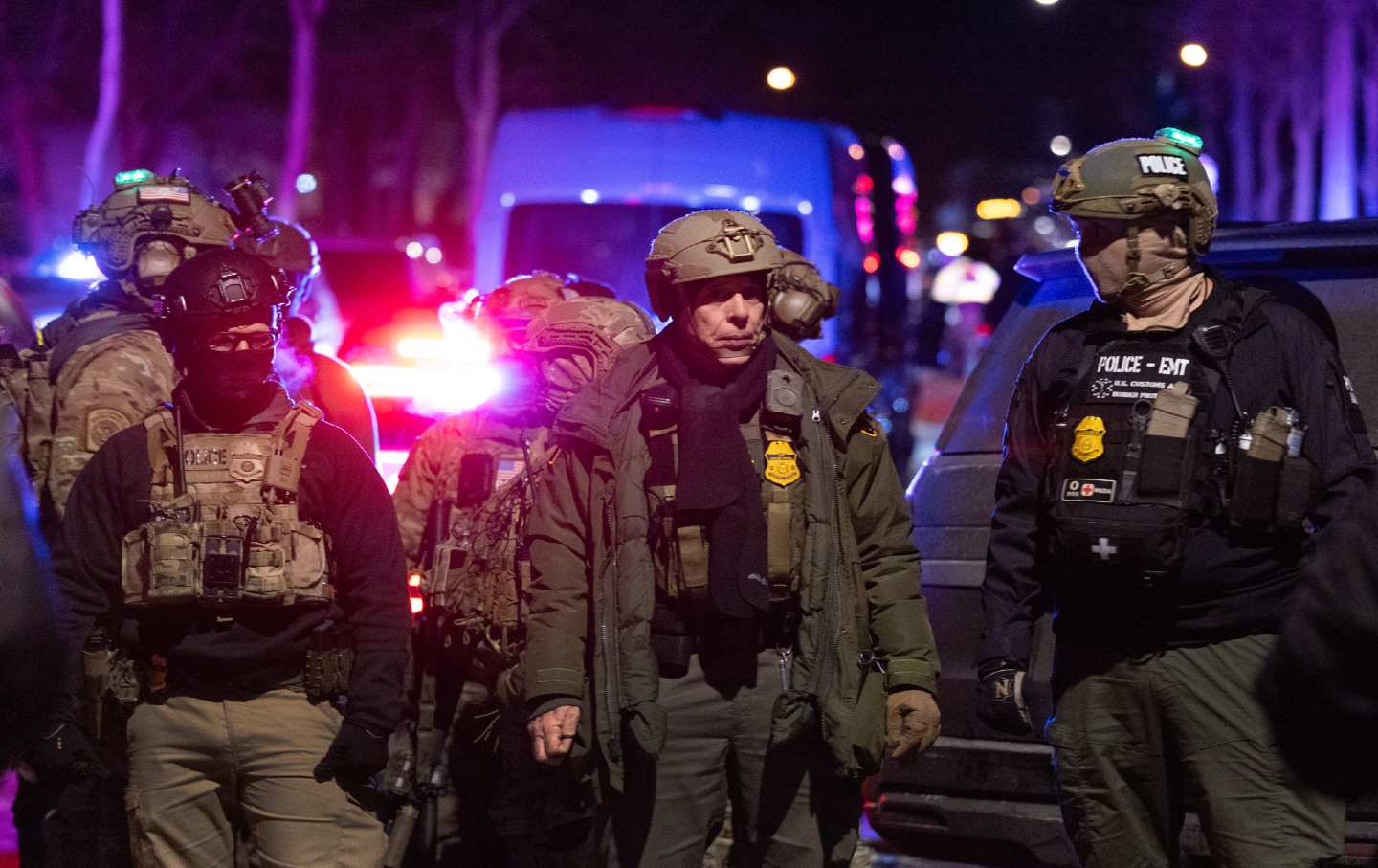
Border Patrol Chief Gregory Bovino, flanked by masked agents, at the perimeter of the site where Renee Good was shot to death.
(Scott Olson / Getty Images)This article originally appeared at TomDispatch.com. To stay on top of important articles like these, sign up to receive the latest updates from TomDispatch.com.
Last month, Immigration and Customs Enforcement officers pulled over several cars in Eagle County, Colorado. They took the people away in handcuffs, according to a witness, and left the cars idling at the side of the road. When family members of the disappeared immigrants arrived, there was no sign of their loved ones. What they found instead were customized ace-of-spades playing cards that read “ICE Denver Field Office.”
When I saw an image of that card, the memories came flooding back. I’d seen something similar many years before. Sitting in the US National Archives building—Archives II—in College Park, Maryland, sometime in the late 2000s or early 2010s, I’d spent parts of several afternoons watching film footage shot by—and of—US troops in Vietnam back in the 1960s. One of those silent military home movies always stuck with me.
That short film opened with a Vietnamese woman clutching a child next to a group of 10 or 15 other children huddled together. They all look wary. Worried. Scared. The camera lingered on a young girl, perhaps 5 years old, clutching a baby. If that girl survived, she would be around 64 years old today.
After several shots of those children, the source of their fear was revealed. The film cut to a group of foreign young men—heavily armed US soldiers. They were tanned and gaunt, smoking and talking, standing over the corpses of some young Vietnamese men or boys. We see the dead bodies at a distance, again. Lying together and yet eerily alone. Next, the film cuts to a collection of weapons—perhaps a cache found in or near the Vietnamese village where all of this occurred—that resembled old junk more than lethal armaments. The film kept cutting between short scenes of American troops and Vietnamese bodies until it happened.
I’ve never forgotten the scene that followed because I was initially shocked that it had been immortalized on film. I was also surprised that the film had never been destroyed. But then I remembered how ubiquitous such activity was at the time. How soldiers bragged about it. How it was covered—positively—in the US press. How it even showed up in the Congressional Record, not as an outrage deserving of investigation but essentially as a thank-you to a manufacturer of playing cards.
In the next scene, we see a soldier pull an ace of spades from what looks like a big stack of such cards. He’s nonchalant. He’s clearly not worried about an officer seeing what he’s doing. He obviously knows he’s being filmed. He reaches down and, as another soldier presses his boot into the chest of that corpse to hold it steady, he tries to insert the card into the mouth of one of the dead Vietnamese. It’s apparently not so easy. It takes a bit of doing, but it proves possible. The next scene shows an ace of spades sticking out of the dead boy’s mouth. The camera lingers. It’s oddly and sickeningly cinematic. The following scene shows another Vietnamese, his face blackened. There’s a battered ace of spades jammed in his mouth, too.
“Impeding” ICE
Such “death cards”—generally either an ace of spades or a custom-printed business card claiming credit for a kill—were ubiquitous among US troops in Vietnam in those years. Some soldiers, like those in that unit of the 25th Infantry Division operating in Quang Ngai Province in 1967, used a regular ace of spades of the type you’d find in a standard deck of cards. But Company A, 1st Battalion, 6th Infantry of the 198th Light Infantry Brigade, for instance, left their victims with a customized ace of spades sporting the unit’s nickname “Gunfighters,” a skull-and-crossbones, and the phrase “dealers of death.” Helicopter pilots, like Captain Lynn Carlson, occasionally dropped similar specially made calling cards from their gunships. One side of Carlson’s card read: “Congratulations. You have been killed through courtesy of the 361st. Yours truly, Pink Panther 20.” The other side proclaimed, “The Lord giveth and the 20mm [cannon] taketh away. Killing is our business and business is good.”
The cards found last month in Eagle County harken back to that brutal heritage. They were the same general size and shape as those shoved into the mouths of dead Vietnamese: black and white 4×6-inch cards with an “A” over a spade in their top left and bottom right corners. A larger ornate black-and-white spade dominates the center of the card. Above it is the phrase “ICE Denver Field Office.” Below it, you find the address and phone number of the ICE detention facility in nearby Aurora, Colorado.
The 10 people taken away by ICE in Eagle County are now reportedly being held in that very same Aurora Detention Facility.
In a recent letter to Homeland Security Secretary Kristi Noem, the Democrats in Colorado’s Congressional delegation called out ICE’s use of the ace of spades. The card, they wrote, “has long been known as the ‘death card’ and has been used by white supremacist groups to inspire fear and threaten physical violence. It is unacceptable and dangerous for federal law enforcement to use this symbol to intimidate Latino communities.” They continued: “This behavior undermines public trust in law enforcement, raises serious civil rights concerns, and falls far short of the professional standards expected of federal agents.”
ICE’s Denver field office offered a boilerplate response to TomDispatch when questioned about the use of the cards. “ICE is investigating this situation but unequivocally condemns this type of action and/or officer conduct,” a spokesperson wrote in an email, adding, “Once notified, ICE supervisors acted swiftly to address the issue.” The spokesperson said that ICE’s Office of Professional Responsibility, which deals with employee misconduct, will conduct a “thorough investigation,” but the Colorado lawmakers asked for more. Those lawmakers called for an independent investigation by the Department of Homeland Security’s Office of Inspector General.
“As the son of immigrants and the father of two young children, I am horrified by the abuses being committed by the Trump administration—from the streets of Minneapolis to right here in Eagle County,” said Democratic Representative Joe Neguse, a member of the delegation that wrote the letter. “These outrageous, aggressive intimidation tactics,” he added, “are meant to stoke fear among our neighbors, and it is immoral and wrong. This administration must be held accountable, and we cannot allow this to continue unchecked.”
ICE Denver has a much different opinion. “Under President Trump and Secretary Noem, ICE is held to the highest professional standard,” the spokesperson there told TomDispatch. “America can be proud of the professionalism our officers bring to the job day-in and day-out.”
Americans think otherwise. A clear majority of voters—63 percent—disapprove of the way ICE is doing its job after more than a year of immigration crackdowns across the United States, according to a January poll by The New York Times and Siena University. Sixty-one percent of voters said that ICE had “gone too far,” including nearly one in five Republicans. The poll was conducted after Renee Good, a 37-year-old US citizen and legal observer, was gunned down in Minneapolis by an ICE officer.
Federal immigration officers have shot at least 13 people since September, according to data compiled by The Trace, killing at least five, including Good and Alex Pretti, a Minnesota resident who was gunned down by Border Patrol agents last month. Before their killings, Good and Pretti had been observing the activities of agents. Federal officers frequently confront and threaten those observing, following, and filming them for “impeding” their efforts. In numerous prior instances, they had unholstered or pointed weapons at people who filmed or followed them.
A recent report by the Cato Institute notes that it is “crucial to understand that ICE and the Department of Homeland Security (DHS) consider people who follow DHS and ICE agents to observe, record, or protest their operations as engaging in ‘impeding.’” It goes on to note that DHS “has a systematic policy of threatening people who follow ICE or DHS agents to record their activities with detentions, arrests, and violence, and agents have already chased, detained, arrested, charged, struck, and shot at people who follow them.” In the wake of Good’s death, to take one example, the Justice Department opened an investigation of Good’s widow for allegedly “interfering” with an ICE operation—apparently for filming the shooting.
A Death Card Moment
Killing, wounding, threatening, or investigating observers are just some of the many abuses and violent tactics of immigration officers in the era of Donald Trump. Others include brutally beating detainees, employing banned choke holds, or spraying chemical irritants on protesters. They also have carried out arbitrary and unlawful arrests and detentions, fired tear gas and flash-bang grenades into crowds, and shattered the windows of vehicles.
Popular
“swipe left below to view more authors”Swipe →Colorado specifically has seen numerous abuses by immigration agents in addition to the use of those death cards. ICE officers in Colorado continue to arrest people because of the color of their skin and in violation of a federal judge’s order, according to a complaint filed earlier this month by the American Civil Liberties Union of Colorado and two Denver law firms. In November, US District Court Judge R. Brooke Jackson found that ICE was routinely conducting illegal arrests in the state.
“Just in Colorado, we’ve seen ICE agents pepper-spray protestors in the face. We’ve seen ICE drag elderly women on the ground,” said Judith Marquez, a volunteer for the Colorado Rapid Response Network and a campaign manager for the Colorado Immigrants Rights Coalition. “We don’t want to wait for another Renee Nicole Good to be murdered.”
Alex Sánchez, president and CEO of Voces Unidas, the immigrant rights group that took possession of those death cards in Colorado, fears that ICE might be using such cards as an intimidation tactic elsewhere, too, but that information about such acts remains unreported because those affected are unlikely to trust local law enforcement officers, elected officials, or even mainstream human-rights groups.
In the wake of the killings of Good and Pretti, the Trump administration quickly branded those observing ICE as domestic terrorists, and federal authorities insisted that Minnesota had “no jurisdiction” to investigate those killings, while blocking the access of state investigators to evidence at the crime scene.
As US District Judge Alex Tostrud wrote in an 18-page decision: “Federal agents collected evidence from the scene.… They won’t share it with the Minnesota Bureau of Criminal Apprehension [BCA].… After BCA agents arrived, federal agents blocked them from accessing the scene.” Earlier this month, Tostrud, an appointee of President Donald Trump no less, lifted the emergency order he had issued the day of Pretti’s shooting that required federal investigators to preserve evidence gathered at the scene of that fatal shooting.
In the absence of independent oversight of the crime scenes, TomDispatch asked DHS if the federal agents who gunned down Good and Pretti had left death cards at the scene of those killings.
The Department never responded.
For more than two decades, America’s forever wars have been coming home in large and small ways. But in 2026, death cards made famous in a war that ended more than 50 years ago—a war that America’s president dodged via a draft deferment for seemingly spurious bone spurs—have made a reappearance. It shouldn’t be a surprise that a war of extreme brutality rooted in racism would have resonance with ICE any more than that those macabre calling cards are on brand for a self-proclaimed peacemaker president who has made war on Iran, Iraq, Nigeria, Somalia, Syria, Venezuela, and Yemen, as well as on civilians in boats in the Caribbean Sea and Pacific Ocean. While he might not have actually dealt those cards in Colorado, it’s hard not to see them as Donald Trump’s death cards.
More from The Nation

What’s It Like Inside a Data Center? What’s It Like Inside a Data Center?
Northern Virginia is laden with structures that house data for Fortune 500 companies. I went inside just one of those monstrosities that bothers its neighbors.
What Trump and Tucker Carlson Have in Common What Trump and Tucker Carlson Have in Common
Carlson has broken with Trump largely over the war in Iran. But on Ukraine and immigration, the two speak very much the same language.

The Jewish Case Against AI The Jewish Case Against AI
Haredi rabbis and the secular left agree: This technology is a threat to the entire social fabric.
The Fight for Educational Equality Is Also a Fight for a Just Supreme Court The Fight for Educational Equality Is Also a Fight for a Just Supreme Court
The court has severely weakened our ability to make an education system that fulfills the promise of Brown.

The Fall of “Scientific American” The Fall of “Scientific American”
When the beloved science publication got too political, its corporate owners stepped in. Now its future is uncertain.

The Bookstore Revolution in Taiwan’s Conservative Heartlands The Bookstore Revolution in Taiwan’s Conservative Heartlands
After Taiwan legalized same-sex marriage, gender-themed bookstores are working to build the social acceptance that the law alone couldn’t deliver.

