
I Fled the US to Escape the Security State. Instead, It Followed Me.
My recent detention at Heathrow shows that the architecture of state repression knows no borders.
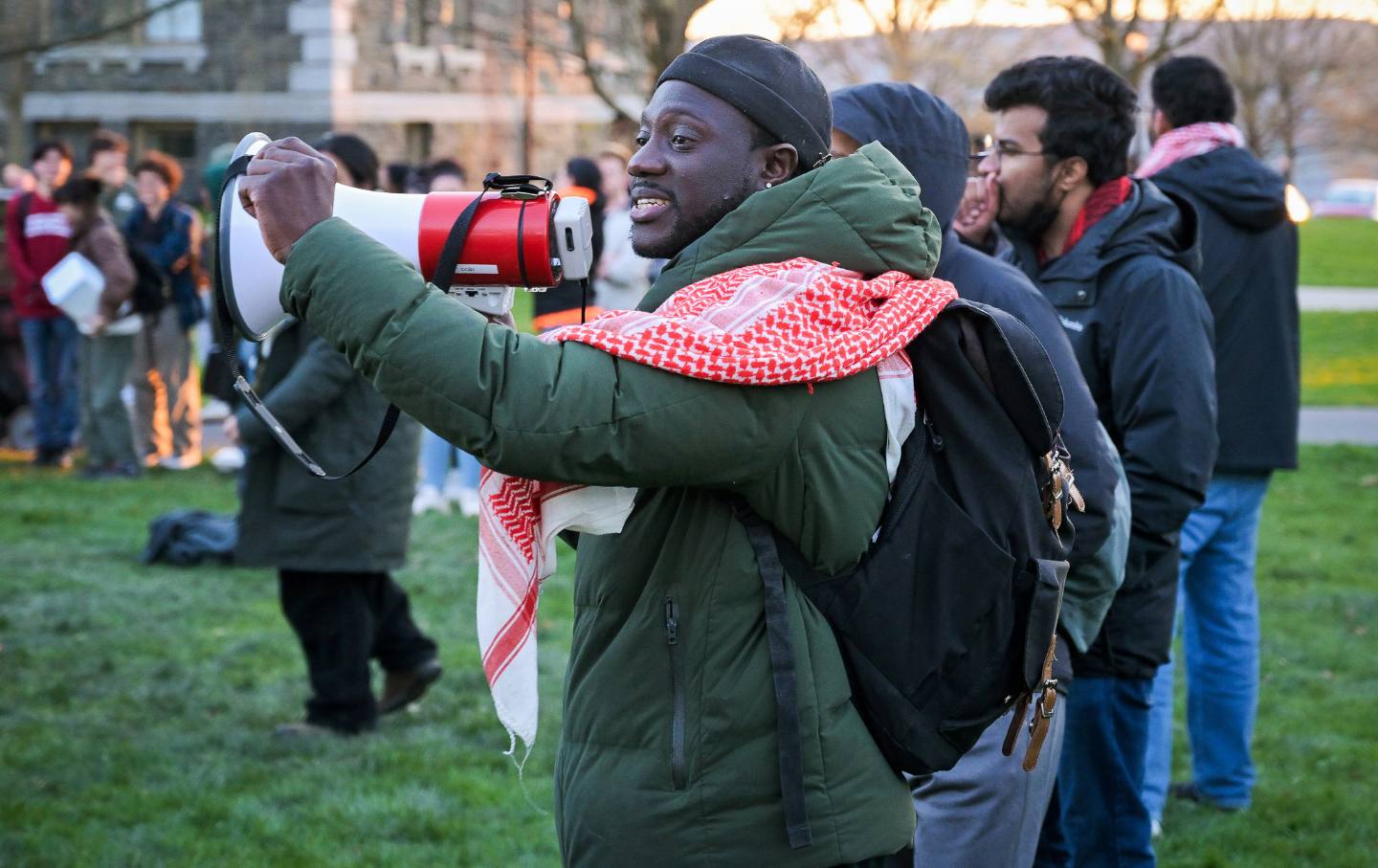
Momodou Taal at a pro-Palestinian encampment at Cornell University in Ithaca, NY, Thursday, April 25, 2024.
(Heather Ainsworth / AP)After I was forced to leave the United States, I thought that my days of being targeted by government security agencies were over. I couldn’t have been more wrong.
Just before 9 pm on Wednesday, January 21, I landed at the British Airways terminal at London’s Heathrow Airport. I was flying in from Cairo for what was my fourth visit since I left the US. I was headed to Birmingham. It hadn’t even been a year since I had been forced to leave the United States after sustained political pressure connected to my activism in support of Palestine. I am a British citizen; I assumed that returning to the UK, my “home,” would mean stepping outside the reach of the security state. Instead, within minutes of landing at Heathrow, I found myself back inside it.
I was met immediately after stepping off the plane by three officers in civilian clothing. I hadn’t even reached customs yet. They asked my name and took my passport from me. When I asked why I was being stopped, one of them said bluntly, “You’re being detained under Britain’s terrorism laws.” He went on to explain that, under Schedule 7 of the Terrorism Act 2000, I had no right to remain silent, and that refusing to answer questions could itself lead to a minimum three-month prison sentence.
The irony was hard to miss. I was evidently being stopped for using my voice, and in the moment I most wanted to remain silent, it was the one thing I couldn’t do.
I was escorted to a processing facility where my phone and laptop were taken, my bags searched, and my body examined. Officers took my fingerprints and palm prints, swabbed my DNA, and photographed me from every angle. One of them told me I could technically refuse, but added that a senior officer could compel compliance at a police station if I did not cooperate. Exhausted from travel and aware of how little choice I really had, I assented.
They offered me a phone call. When they rang a friend, they would say only that I was “safe” but “being detained,” refusing to explain why. The unknown is what caused great anxiety to my friends and family. What was meant to reassure instead caused panic, leaving people close to me imagining the worst while I waited alone in a small, windowless room.
When the questioning began, it quickly became clear what this stop was really about. I was asked, “Is your mother a devout Muslim?” “Did you attend Quran school growing up.?” They wanted to know whether I spoke Arabic and what I thought caused Islamophobia in Britain today. At one point an officer asked, “Have you read Karl Marx?” I naturally chuckled and nodded yes.
They reminded me that Schedule 7 existed “to determine involvement in terrorism.” Yet nothing they asked had anything to do with violence or criminal acts. Instead, they traced my faith, my upbringing, my political views, and my intellectual life. Only once did Palestine come up.
For six hours, the maximum allowed under the law, I answered questions and kept asking my own. Why was I being stopped? Why now? What could’ve triggered it? Eventually, one officer said, “We’re just trying to keep Britain safe.” I thought about that word, “safe,” and about how often I had heard it before.
During my time at Cornell University, I watched administrators describe peaceful student protests for Palestinian rights as a threat to campus safety. Meetings were monitored. Students were disciplined. Surveillance was framed as protection. “Safety” had slowly come to mean control, especially when the voices involved were Muslim or openly critical of Western foreign policy.
Only days before my detention, messages from United Nations special rapporteurs raising serious concerns about the violation of my human rights by Cornell had been publicly released. Whether or not that directly led to my detention, it was difficult to ignore the pattern: When you speak out, the consequences do not stay confined to one country.
When the interrogation finally ended, I was told I was free to go. My devices, however, would be kept. They said I could “hope” to get them back within a week. I asked how I was meant to get home without a phone. How I would contact anyone. How I was supposed to continue my dissertation without my laptop. One officer said quietly, “I understand,” but nothing changed.
It was just after three in the morning when I stepped outside into the cold. What should have been a simple journey home from London to Birmingham turned into an all-night ordeal, navigated without a phone, without contact, and without any real sense of what would come next.
My experience is not an anomaly. Across Britain, Europe, and North America, counterterrorism powers are increasingly being used to monitor activists, disrupt protests, and question people whose only offense is political dissent. Laws supposedly built for extraordinary threats are now routinely applied to ordinary acts of speech, particularly when those acts involve Muslim communities or solidarity with Palestinians. Again and again, support for Palestinian rights is treated as something suspicious. Advocacy becomes a risk. Speaking out carries consequences.
Popular
“swipe left below to view more authors”Swipe →The message does not need to be spelled out. It is felt in detentions, in confiscated devices, in hours spent answering questions about one’s beliefs and upbringing. I was not detained because I had done anything illegal. I was detained because I am vocal, because I refuse to be silent about mass civilian suffering, and because I insist that Palestinian lives deserve the same concern as any others.
There is a cost to that insistence, even if it is incomparable to the suffering of the people I hope to give a voice. I felt it standing outside Heathrow in the early hours of the morning, cold, exhausted, and suddenly cut off from the basic tools of everyday life.
But while you can confiscate phones, seize laptops, and interrogate beliefs, you cannot easily remove conscience and conviction. If speaking out is increasingly treated as a security problem, then the real issue is not safety but discomfort with dissent. The question now is not whether more people will be stopped, questioned, or watched. It is whether fear will succeed in quieting those who refuse to look away from injustice.
More from The Nation
The Accidental Activists of Data Center Alley The Accidental Activists of Data Center Alley
These would-be rebels in Northern Virginia joined the fight against data centers mostly to stop the encroachment on their homes and exclusive private communities.
An Effective Movement for Palestine Needs Allies Like Zohran Mamdani An Effective Movement for Palestine Needs Allies Like Zohran Mamdani
In order to build a broad-based coalition, we need to work together—not practice purity politics.
The First Amendment Applies to Concert Stages Too The First Amendment Applies to Concert Stages Too
Protests like that of Macklemore on Palestine should never be silenced by billionaire owners.
France’s Students Won’t Back Down France’s Students Won’t Back Down
Without full-time teachers, temperature-regulated classrooms, or school nurses, French students are turning their grievances into a national movement.
Inside Cornell’s Week of Protest Inside Cornell’s Week of Protest
“We won’t be silenced anymore. Our university needs to start protecting us, like they should’ve with Jane Doe and all other survivors on campus.”
Netanyahu Came to New York. New Yorkers Were Ready for Him. Netanyahu Came to New York. New Yorkers Were Ready for Him.
Scenes from the defiant protest against the genocidal leader’s UN speech.

