The Second Life of Gaza’s Rubble
The strip is buried under 61 million tons of rubble. Some people are finding creative ways to use it as a resource.
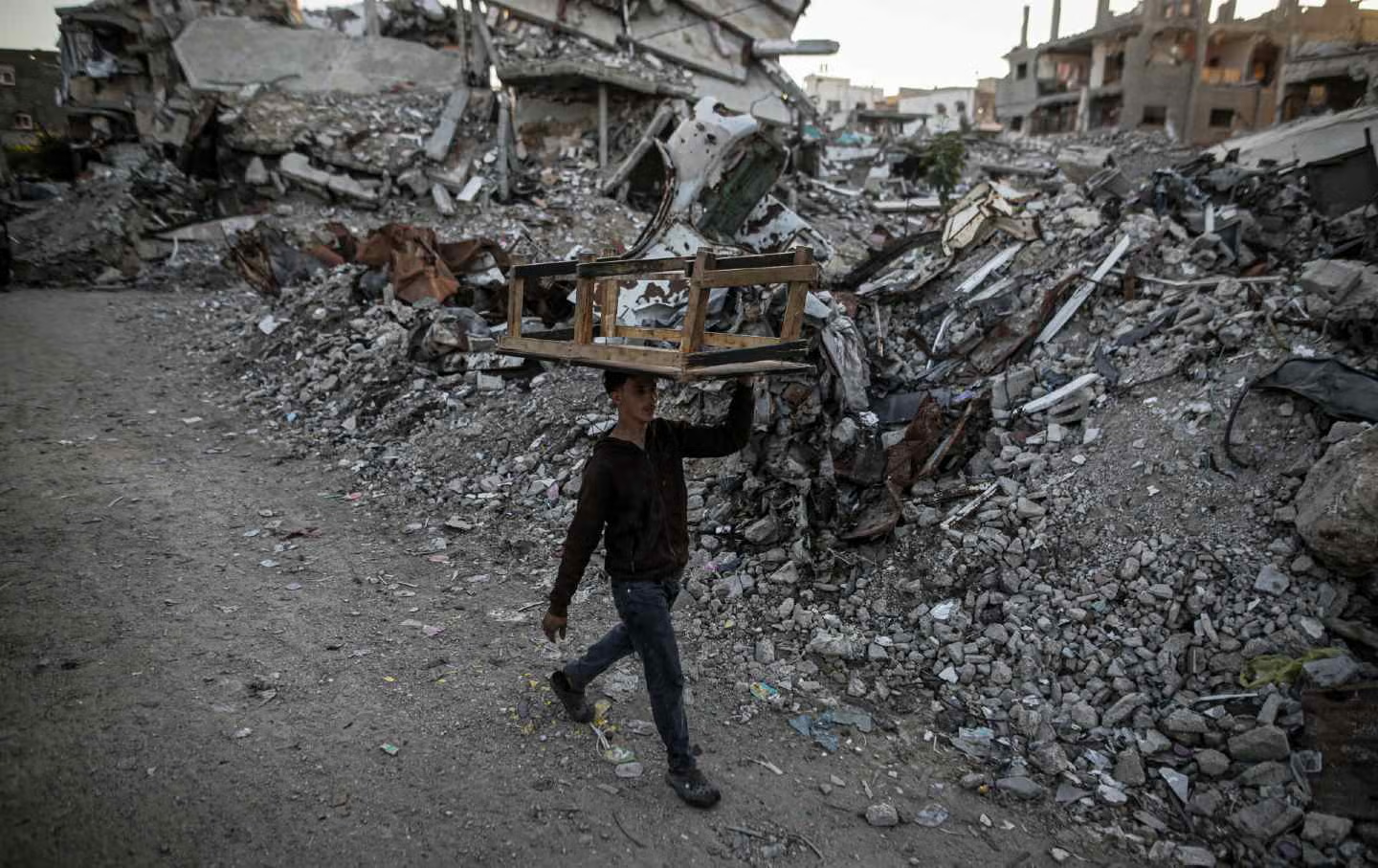
Displaced Palestinians salvage belongings from the rubble of their destroyed homes in Gaza City, on November 14. 2026.
(Saeed M.M.T. Jaras / Anadolu via Getty Images)In mid-October, as the weather began to change, rain fell on the displacement camp where I live in al-Mawasi, Khan Younis, in southern Gaza. When I woke up that morning, our tent seemed more fragile than ever. The tarpaulin that shielded us from the rain and wind was old, worn, and torn, and water had seeped into the small kitchen beside our tent. There were still no signs of new tents arriving, reconstruction getting underway, or any recovery plans. It looked like we were in for another winter of rain and cold in a deteriorating tent.
Later that day, on my way to a café near our camp to charge my phone, I saw Abu Omar beside his tent, using a hand-operated machine to straighten iron bars. At 50, Abu Omar had spent most of his life working as a blacksmith. But he was now forced to put his profession to a different use.
As displacement continued and ready-made tents became unaffordable, Abu Omar turned his blacksmithing skills into a way to support his family. Through his connections with scrap dealers, he began buying iron salvaged from destroyed buildings, straightening it and selling it on. He also made complete tents from iron bars and tarpaulins, along with beds, tables, and other items needed by families in the camp.
His work sometimes took him directly to families, where he assembled shelters using the straightened iron. He charged what people could afford. “I don’t pressure people,” he said. “Everyone has their own circumstances, and in the end, we are all displaced.”
Three years into Israel’s ongoing genocide in Gaza, more than 370,000 housing units have been destroyed by Israeli attacks. But the rubble left behind is no longer merely a symbol of devastation. For many displaced people, it has become a resource.
Some sift through the ruins for iron, wood, and aluminum to sell and earn money for daily necessities. Others reuse these materials to repair tents and make furniture. Then there are those seeking to turn the rubble into building blocks that could be used to construct temporary shelters for displaced families.
“We left with nothing and had to start from scratch,” Abu Omar told me. He salvaged iron bars from the roof of his destroyed home and used them to build a tent for his family. When they were forced to flee again, he took the iron with him, never imagining that it would one day become his only source of income.
Abu Omar’s 20-year-old son, Omar, works alongside his father. He had hoped to continue his education, but Israel’s decimation of Gaza’s schools and universities made that impossible.
Omar explained how iron is salvaged from the rubble, straightened, and reused. First, workers extract iron bars from the ruins of destroyed buildings and sell them to scrap dealers. The dealers then straighten the bent bars using specialized hand-operated machines before selling them to people who need them. (The materials are not cheap; everything has become expensive for people in Gaza given the circumstances we are living in. Even a small iron-framed tent measuring three by three meters can cost around $300.)
The iron is used not only to build tent frames but also to make other items for displaced families. “Beds, kitchens, tables, and everything,” Omar said, listing the many things that can be made from salvaged iron and put to use again.
But the iron that reaches Abu Omar is far from ready to use. Before he can straighten the bars and turn them into tent frames, other workers have already spent hours, sometimes days, breaking apart concrete to extract the iron from the rubble.
Mahmoud al-Mughayir, 21, is in his second year of university. His father, Saleh al-Mughayir, was known in Rafah for his work as a carpenter. But the genocide disrupted his father’s work, leaving the family struggling to meet its basic needs. Mahmoud needed a laptop to continue his studies, but buying one was beyond the family’s means. He found himself breaking up concrete to earn enough money to pay for his education and buy a laptop. “I never thought I would work in this line of work, but the circumstances I’m living through pushed me into it,” he said.
Badr Abu Ansa, 28, from Khan Younis, works alongside a group of men breaking up concrete and salvaging materials from destroyed buildings to sell. The process begins when a scrap dealer arranges with the owner of a destroyed house for the group to work at the site. Badr and the other men then break up the concrete and retrieve iron bars, aluminum, tiles, and wood. They hand over what they collect to the dealer in exchange for a daily wage—around 17 to 20 dollars per day.
The work demands more than physical strength. The men lack proper protective equipment and work amid thick clouds of dust as they break up concrete with sledgehammers. When the dust becomes so dense that it is difficult to breathe, some cover their faces with pieces of cloth in an attempt to protect themselves. They also suffer cuts and other injuries while breaking up concrete.
Badr told me that what he earns each day barely covers his basic needs. “After working for 10 hours [one day], I got injured and had to buy medicine. More than half of what I earned that day went on it,” he said.
Badr has two children, but the exhaustion from his long work leaves him with little time to spend with them.
Gaza is buried under an estimated 61 million tons of rubble, while Israeli restrictions on the entry of construction materials, particularly cement, continue to hinder reconstruction. With the need to rebuild far greater than the available supply of building materials, Suleiman Abu Hassanein is trying to find another use for the rubble itself.
Popular
“swipe left below to view more authors”Swipe →Suleiman told me he began developing machines to produce interlocking building blocks in 2021. “The idea came from a need in the community,” he said. His project, Green Rock, turns rubble from destroyed buildings into building blocks resembling Lego bricks. The blocks can be fitted together without the cement used in the whole process. Unlike traditional building blocks, these blocks are made mainly from recycled rubble. Their design allows them to fit and lock together like Lego bricks, without needing cement to join them.
The project aims to reuse material from destroyed buildings, and, according to Suleiman, a comparison conducted by his team between conventional construction and building with these blocks suggests that the overall cost of construction could be negligible. “We found that we could reduce total construction costs by 60 percent,” he told me.
With Gaza’s labor market in collapse and unemployment reaching 78 percent in 2025, Suleiman sees the project as more than a way to produce alternative building materials. He also hopes it will create jobs for displaced people. By crushing, sorting, and recycling rubble, then producing the blocks and using them to build, he aims to create a local economic cycle. It would also give displaced people a chance to help build the shelters they need.
Still, his idea requires funding. Suleiman told me that his team had made significant progress in developing the blocks, and that the samples and designs were ready. However, they still need financial support. He hopes this funding will allow the project to move beyond small-scale experiments and become a practical approach that can be tested and used to provide shelters for displaced families.
The iron bars did not bring Abu Omar’s home back, but they gave him a shelter he built with his own hands, and while Mahmoud and Badr continue working among the rubble to meet their daily needs, Suleiman is trying to turn it into building materials. Their approaches differ, but all are finding ways to survive amid the Israeli destruction that cost them their homes and livelihoods, hoping that what the war left behind can help them get through today and rebuild tomorrow.
More from The Nation
Critical Condition: What Are We Doing About Nuclear War? Critical Condition: What Are We Doing About Nuclear War?
Doctors are calling for verifiable, deadline-driven agreement to eliminate all nuclear weapons. The flourishing—and even the survival—of the human species is at stake.

What We Can Learn From Lula’s Seismic Win What We Can Learn From Lula’s Seismic Win
The Brazilian president looked headed for defeat. The Brazilian people had other ideas.
Pope Leo Goes to War—Against the Department of War Pope Leo Goes to War—Against the Department of War
The growing divide between Rome and Washington.
France’s Left, Divided at the Worst Possible Time France’s Left, Divided at the Worst Possible Time
Years of progressive infighting weigh on Jean-Luc Mélenchon’s presidential ambitions.

The Fugitive From Brazil The Fugitive From Brazil
The implications of Trump’s red-carpet rollout for Flávio Bolsonaro.
Inside France’s Biggest Uprising Since 1968 Inside France’s Biggest Uprising Since 1968
Despite harsh reprisal from the government, students show no sign of stopping.

