
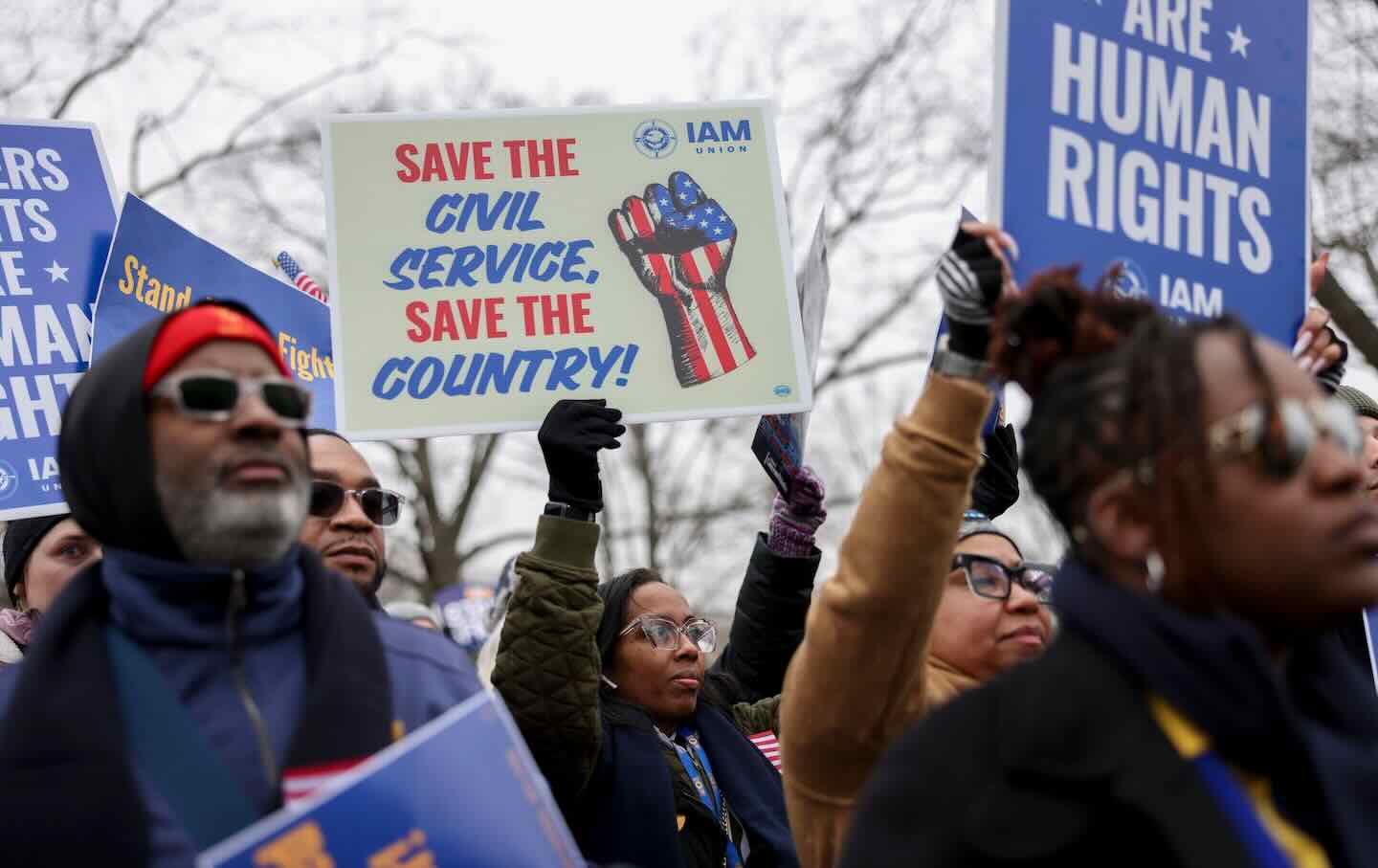
Demonstrators hold signs during a rally for federal workers at the US Capitol in Washington, DC, on February 11, 2025.
(Tierney L. Cross / Bloomberg)Darnese Foster remembers the day she learned she was fired from her federal government job. “I was off that Friday, which was Valentine’s Day. Then that Monday was the holiday,” said Foster. “I went to log in that Tuesday, I couldn’t get in.”
Foster thought her password had expired and needed to be reset. She called the help desk to submit her request. Then someone from the IT department called her back.
“He said, ‘You didn’t get a phone call from your supervisor?’ I said, ‘No.’ He said, ‘Well, unfortunately, your name was on the list of names that was denied access.’ I didn’t know what that meant. I called my supervisor. He said, ‘Well, let me call you back. Let me talk to (the IT) supervisor to see what’s going on.’”
Later that day, they both called back to tell her that she was on a list of employees on probation that were being terminated during the mass firing.
Foster’s initial reaction was numbness, then panic and dread. She had a child in private school and rent and a car note to pay.
“I would go in a corner and cry,” Foster recalled.
Now, more than a year after being fired from her position as a grant management specialist in the Department of Health and Human Services, Foster is struggling, not just financially, but to cope: struggling to stay strong, struggling to keep the faith. The constant strain, she says, has taken a toll on her mental health.

“I thought I would have a job a year later,” Foster, 47, said. “The worry of where I’m going to get the money to do what I need to do and how long will I be out of work, it’s mentally draining.”
When Trump eliminated diversity, equity, and inclusion programs by an executive order in January 2025 and empowered Elon Musk and his Department of Government Efficiency (DOGE) to gut the federal workforce that February and March, thousands of Black women lost their jobs. But the job cuts did more than just dismantle a longtime pipeline that helped lift DC’s majority-Black community into the middle class; it also gutted the well-being of the Black women who hold up that community.
A recent study by University of Maryland labor economist Brandon Enriquez found that DOGE cuts “disproportionately affected” the federal employment of Black women compared with other demographic groups. The study estimated that while DOGE “did not have statistically significant effects for any other race, gender, education, or age group,” it reduced Black women’s federal employment by 25 percent.
“At its lowest point in April 2025, employment was almost 50% reduced for Black women, with little effect for other groups,” Enriquez noted, although there was a partial rebound in subsequent months. Given the overrepresentation of Black workers in the federal government, Enriquez concluded that the layoffs increased racial inequality.
In many of the agencies that were targeted for massive staff reductions, women and people of color made up the majority of the workforce, according to a 2025 report by Sarah Javaid for the National Women’s Law Center. Javaid wrote that “while women made up 46% of the total federal workforce in September 2024, they represented the majority of the workforce” in the departments of Veterans Affairs, Education, Health and Human Services, Treasury, and Housing and Urban Development.
People of color—including Darnese Foster—made up 46 percent of probationary workers, according to the report, including 65 percent of those at the Department of the Treasury, 55 percent at Housing and Urban Development and at Homeland Security, and 53 percent at Health and Human Services.
Like some of her federal colleagues, Foster’s probation was for two years. After years of contracting, first with companies in the private sector, then with the State Department, Foster had finally landed a permanent position at Health and Human Services.
A single mother of two, she’d been in her job for a year and seven months when she got the shocking news that she had been laid off.
“It was always my goal to try to get into the government,” said Foster. “My parents always said: ‘Get with the government, it’s stable. You can grow. You can move up.’”

Foster had been excited about her new job and working with her new co-workers. And she was proud that despite struggling with a learning disability and adult ADHD, she’d recently gotten a raise in her pay and job grade.
Her work felt important to her, too. As a grant management specialist, her responsibilities included working with organizations such as hospitals or construction companies seeking government funding. If a hospital wanted new X-ray machines or a therapy facility wanted equipment, she helped them navigate the application process.
“I had finally gotten my dream job. It was devastating to have it snatched from me,” said Foster. “I had things in my life that I was putting in order, and goals that I wanted to do. This is where I was going to retire from.”
At the time of her firing, Foster’s oldest daughter was a senior in college and her youngest daughter, who was 9, was in private school and an avid dancer who took part in competitions. Since the firings, her daughter has continued to dance, but Foster can’t afford the cost of competitions.
“I try not to take too much from her because she’s 10,” says Foster. “I did keep her in dance, so she doesn’t lose all that she’s learned, so she won’t feel like, ‘Oh, I can’t do anything.’”
Foster says she has not been coping well. She received unemployment benefits for only six months. She lost the items in her storage unit because she couldn’t afford the fees, and she has struggled to pay for her daughter’s private school tuition.
She feels like she’s in a “sunken place.”
“I’ll drop my youngest off at school and just sit in the car and cry,” Foster said. “What’s next? Where am I going to get the money to keep a roof over our heads?”
For a 2022 study focused on Black women’s gender and race-related stress, epidemiologists Meghan Tipre and Tiffany L. Carson conducted focus groups and found that the top stressors identified by Black women were single parenting, Black children’s safety and finances. “Black women report higher levels of psychological stress than White women and carry a disproportionate burden of chronic conditions associated with psychological stress,” the authors wrote in the journal Women’s Health Reports.
Dr. Raquel Martin, a licensed clinical psychologist who focuses on Black mental health, says abrupt termination can be both a financial stressor and a traumatic stressor, because it’s not just about the loss of income.
“It’s the sudden loss of predictability and control, identity, community, and even future planning,” Martin says. “There’s a significant association between unemployment and increased depression, anxiety, and psychological distress, as well as just life satisfaction overall.”
Job loss is more than just about money, Martin points out.
“When you think about job loss, you often think about money, but psychologically, abrupt termination can create a profound sense of instability, (and) human beings need and thrive off of predictability,” Martin says. “When employment disappears suddenly, people aren’t just grieving that aspect of a paycheck, they’re grieving a future of a world that they could count on.”
And when demands exceed your resources, Martin adds, the stress can be almost unbearable.
“When an experience overwhelms your ability to cope, and it leaves this lasting impact on your sense of self, safety, and sense of the world around you, that’s trauma,” Martin said. “Trauma is not only what happens to you, it’s also what happens inside of you, when you’re repeatedly forced to adapt to conditions that threaten your safety or your dignity or your humanity or your ability to thrive.”
The way people respond to trauma varies greatly from irritability to depression to becoming sedentary or changing eating habits. Foster said after her job loss, she sometimes slept all day or sat at her desk and scrolled. She also admitted being “a lot more snappy,” toward family and friends.
Martin says some people who lose their jobs experience “low pressure tolerance,” which she describes as being really irritable so that every little thing makes you want to “flip a table.”
Black women like Foster who are breadwinners and heads of household may be especially stressed since they are overwhelmed with guilt and shame for not being able to provide at their previous levels. Even though the federal firings aren’t something that they brought on themselves, the experience left some, like Foster, shattered.
“Mental health is affected by policy decisions, economic instability, and access to health care and employment protection. The solution can’t be only telling Black women to cope better with the trash circumstances that they didn’t create in the first place,” Martin explained.
“We have to ask, what does it mean when the people who are often expected to care for everyone suddenly need to care for themselves?” she said. “What got in the way of them being able to do that in the first place? How can we come together as a community?”
Popular
“swipe left below to view more authors”Swipe →When trying to comfort people who have been fired or experienced traumatic events, Martin suggests avoiding statements like “everything happens for a reason” or “stay positive.” Instead, she suggests, ask how you can be helpful: “How are you doing today and what would be helpful for you right now?” or “You don’t have to carry this alone. What are some tangible things I can do?”
But it’s also important, Martin says, that people experiencing this kind of stress let others help. She encourages staying connected to community and leaning into mutual aid. If neighbors want to bring dinner or provide a gift certificate, or if relatives want to take the kids to a park, let them.
“I know how we feel about the system failing us, but when it comes down to Black people, the system has failed us for such a significant amount of time we have to remember that the goal is for us not to fail each other and still keep it going,” Martin said.
Foster says she’s applied unsuccessfully for more than 100 jobs since her firing last year. In the interim, she braids hair and has worked as a consultant on political campaigns to make ends meet. She meets regularly with a mental health practitioner and tries to stay upbeat through prayer and affirmations.
Nevertheless, Foster feels like she is failing—failing as a mother, failing as a provider, failing at parenting.
“I feel like I’m almost 50 and I’m way behind. I don’t have a life insurance policy to leave my kids. No savings,” Foster says. “It weighs heavy for me as a mother.”
It’s not only the stress of not having the money to do what she needs to do as a parent, but the stress of having to lean on her 23-year-old daughter and mother to help pay the bills. As she continues to look for full-time employment, she says she is drained by the rejections.
Right now, Foster says, she’s holding it together, taking it one day at a time.
“I do believe in God, but when you’ve been down in life and have had disappointments, it’s kind of hard to keep your faith,” said Foster. “You try to stay strong, but you wonder, when is there going to be light at the end of the tunnel? How long do I have to stay like this?”
More from The Nation
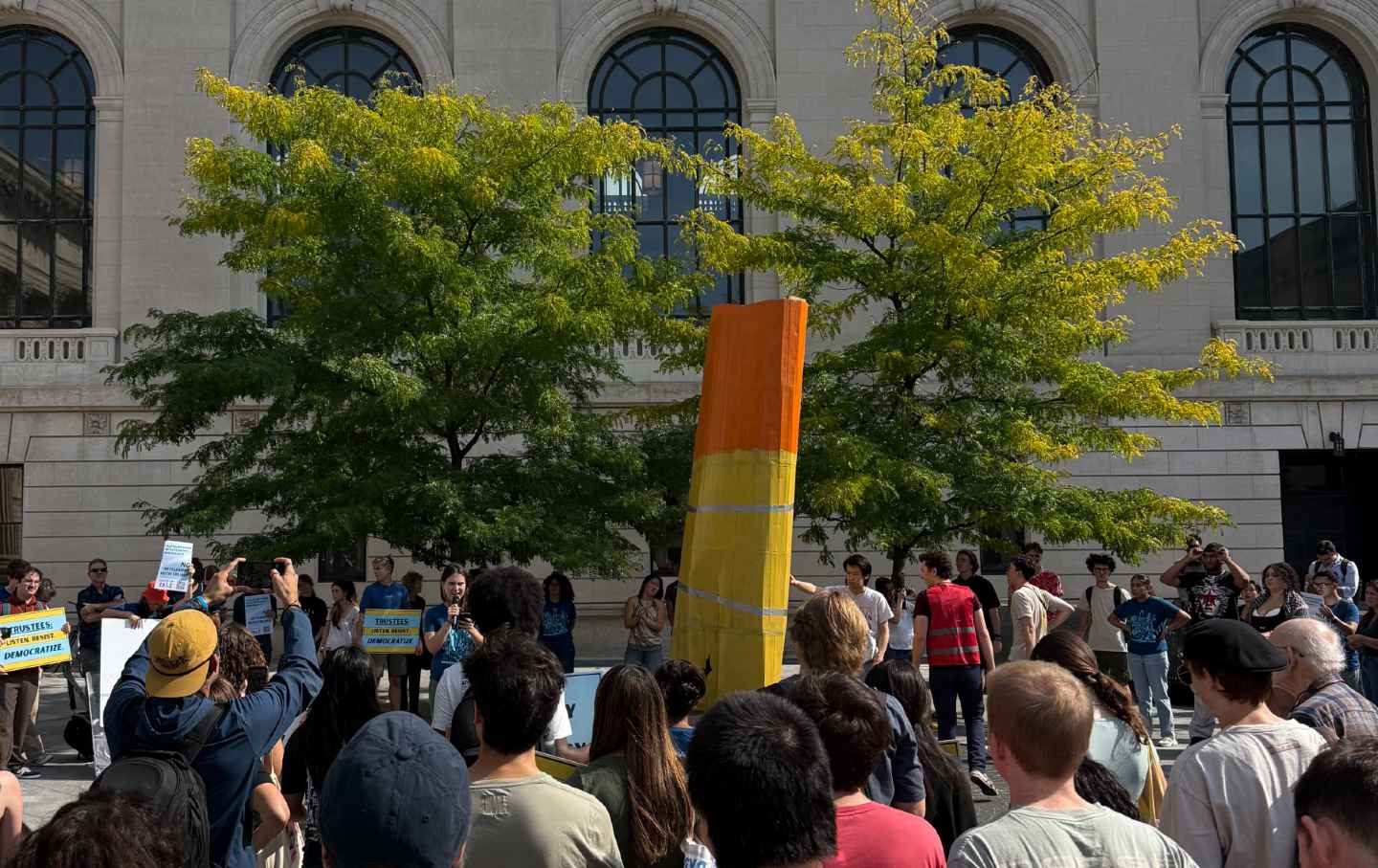
Yale’s Protest Tradition Is Back Yale’s Protest Tradition Is Back
For the first time in 50 years, Yale students gathered around an iconic sculpture to protest their university and their government.

Red Vienna Is Still Alive Red Vienna Is Still Alive
The Austrian capital chose not to privatize the commons, and it shows.

How Mexico Proved Mainstream Economics Wrong How Mexico Proved Mainstream Economics Wrong
American analysts have long viewed inequality as a byproduct of technological causes. But Claudia Sheinbaum’s Morena Party has boosted workers’ income without any technological tr...

My Rape, the Cornell Case—and Why We Need Better Approaches to Teaching How Consent Works My Rape, the Cornell Case—and Why We Need Better Approaches to Teaching How Consent Works
I tried to process the experience of being raped by disassociating. We have to show our kids a better way.
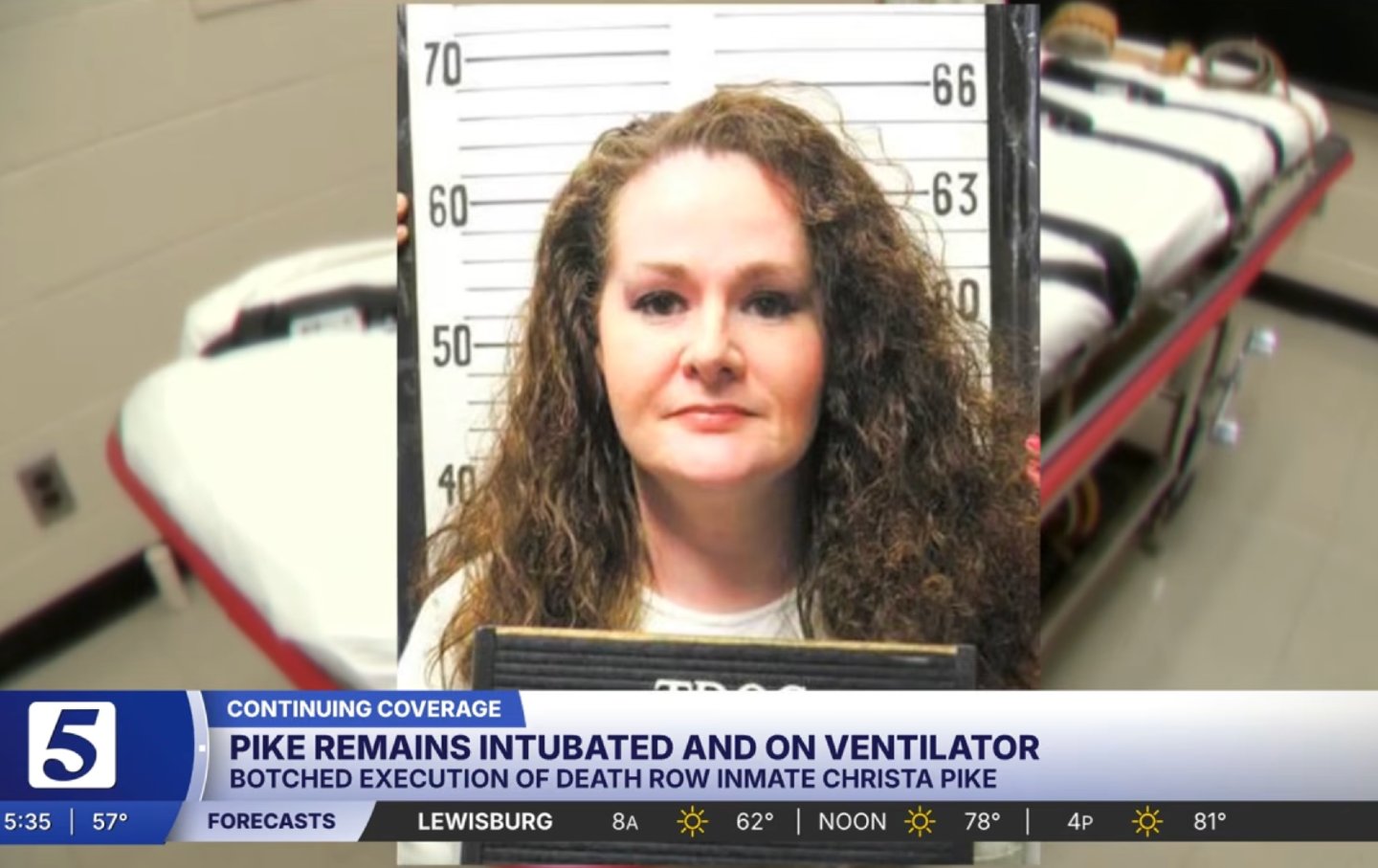
The Death Penalty Has Become a Torture Machine The Death Penalty Has Become a Torture Machine
Christa Pike's botched lethal injection proves there is no humane form of execution.
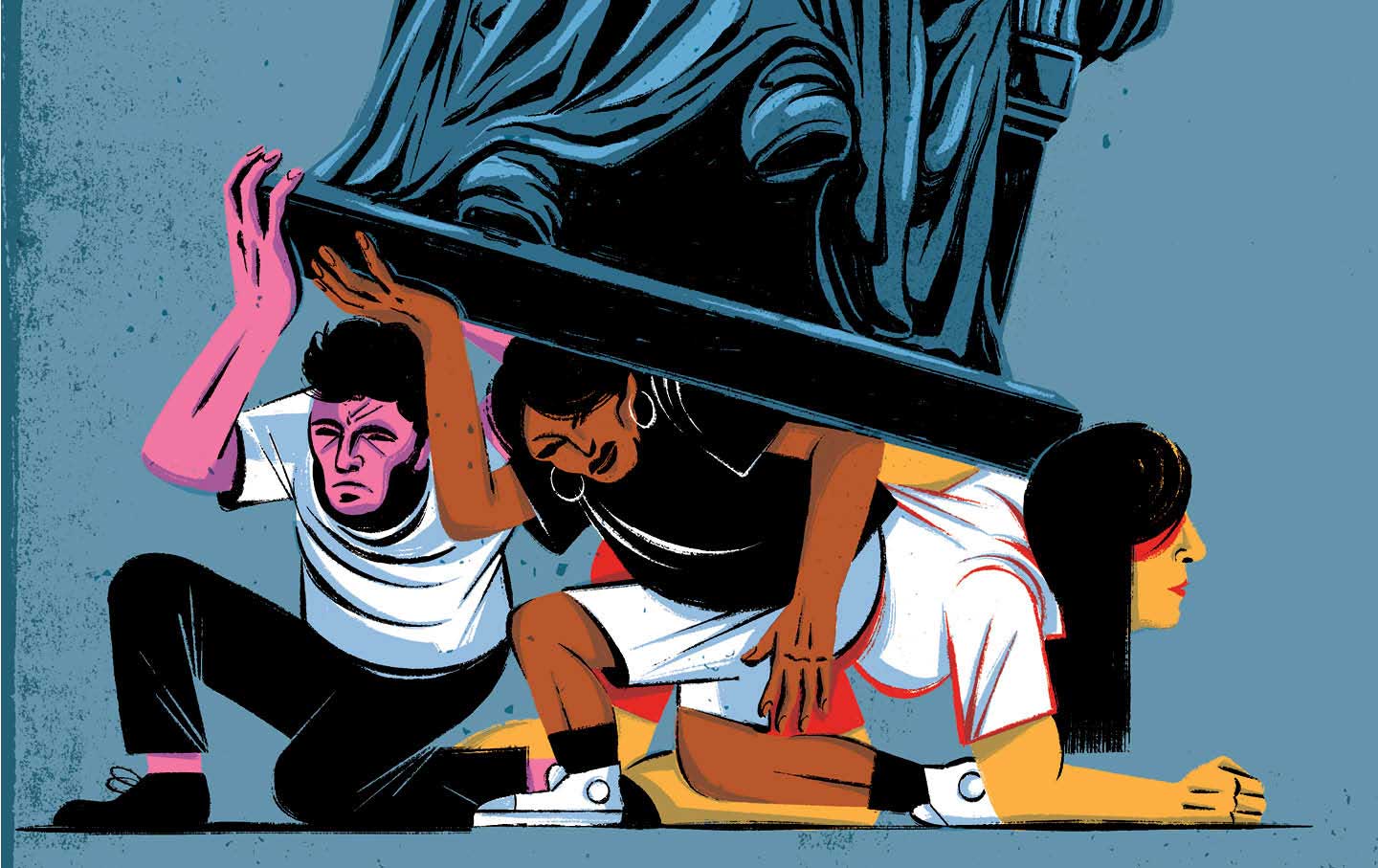
The People vs. the Supreme Court The People vs. the Supreme Court
This term the Supreme Court has plans to trample
even more of our rights. But we, the people, are not powerless
in the face of their power grab.

