
Black Freedom in an Age of White Oligarchy
Justin Leroy’s The Lowest Freedom points toward the limits of liberty under racial capitalism.
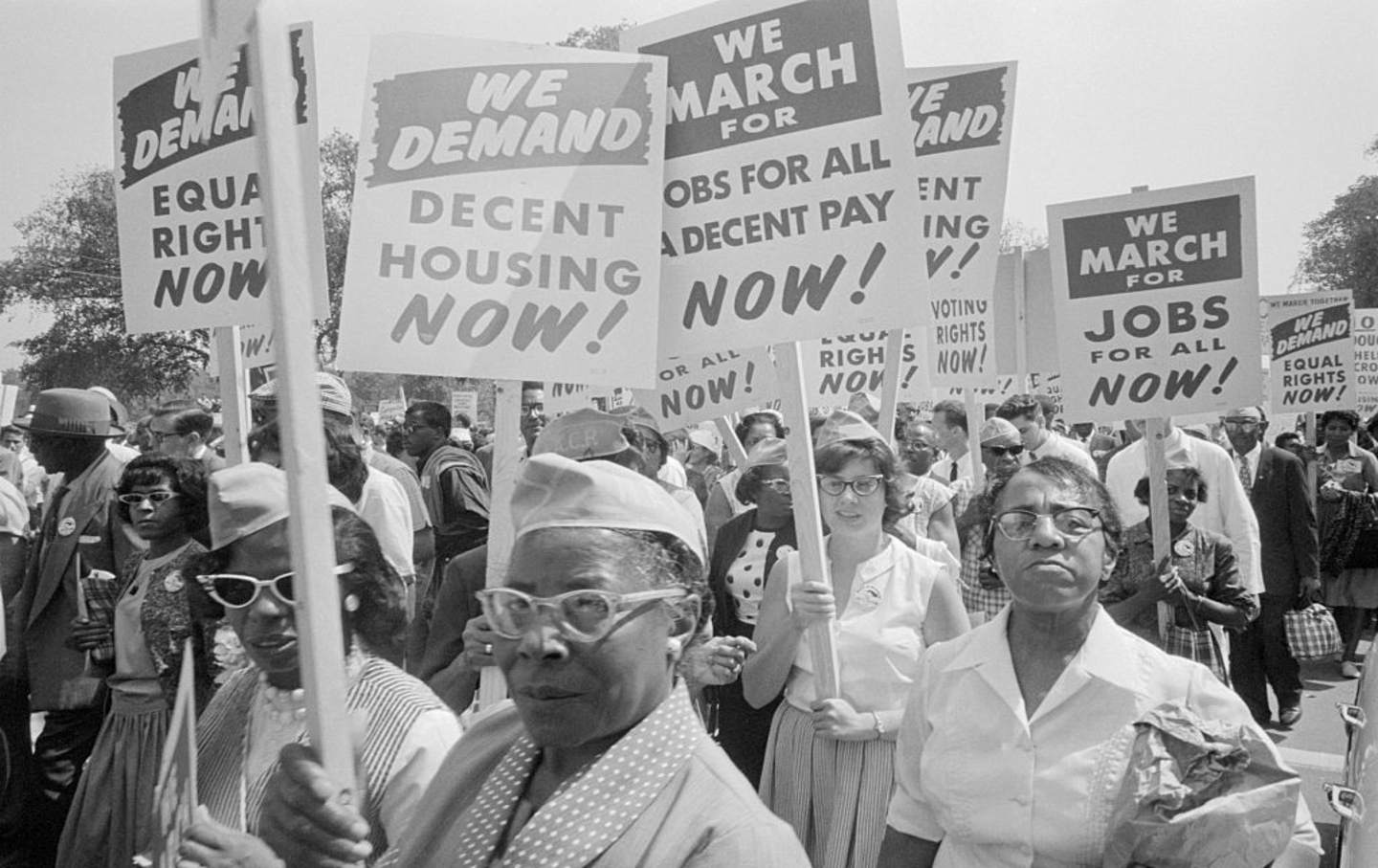
Protesters at the March on Washington for Jobs and Freedom, August 28, 1963.
(Wally McNamee / Corbis Historical / Getty Images)
Among race scholars, it remains an open question if, or when, slavery ever ended. Some say the practice died in 1865, heaving on the bloody hills of Petersburg and Appomattox at the Civil War’s conclusion. Yet just 12 years later, with the imposition of the Black Codes, Black folks saw slavery rise again in another form—through a web of vagrancy laws, convict leasing, tenant farming, and voter suppression. As Frederick Douglass put it, by the 1880s Blacks were again “under the iron heel of slavery.” W.E.B. Du Bois, in his description of the post-Reconstruction era, was just as damning: “The slave went free, stood a brief moment in the sun, then moved back again toward slavery.”
For Martin Luther King Jr., what came after the Black Codes—the 20th-century regime of Jim Crow—was “at bottom a form of slavery covered up with certain niceties of complexity.” For the historian Douglas Blackmon, Jim Crow was merely “Slavery by Another Name.” And a number of Afropessimist scholars contend today that slavery continues even now.
Books in review
The Lowest Freedom: Racial Capitalism and Black Thought in the Nineteenth Century
Buy this bookWading through this discursive dilemma over what to call the political purgatory between slavery and freedom, the Duke historian Justin Leroy offers a new heuristic: “low freedom.” In Leroy’s The Lowest Freedom: Racial Capitalism and Black Thought in the Nineteenth Century, he adds to a growing body of scholarship that describes slavery not as ending so much as transforming.
Borrowing from the abolitionist writer David Walker, Leroy uses the phrase “low freedom” as a moniker for the ambiguous muddle that Black people found themselves in after emancipation—the continuities of racial and economic domination that persisted long after slavery’s legal abolition. “Racial capitalism shaped freedom no less profoundly than it did enslavement and colonialism,” Leroy writes.
Despite the endurance and dynamism of racial capitalism, Leroy’s intellectual history offers a vision of freedom as daring as the oppression was daunting. In The Lowest Freedom, Leroy turns to a set of 19th-century thinkers who combined unionism, socialism, cooperativism, mutualism, land reform, and more into a capacious concept of abolition democracy. This vision for a radically egalitarian economy served, for a time, as a foil for the emergent racial capitalism of the post–Civil War years. It’s a vision still sorely needed today. For while slavery’s vestiges still haunt our economy, it is mastery’s structures that are even more of a menace.
As the University of Alaska, Anchorage, political scientist Forrest A. Nabors writes in From Oligarchy to Republicanism: The Great Task of Reconstruction, the Southern secessionists fought for “revolutionary oligarchy” and “oligarchic constitutionalism.” Du Bois makes a similar point in Black Reconstruction, explaining that Southern radicals prioritized “caste and oligarchy” and erected “political oligarchy and economic dictatorship in the most extreme form in which the world had seen it for five hundred years.” The South’s war to enshrine “caste and oligarchy” is why the Reconstruction amendments were designed to protect citizens against discrimination based on “race, color, or previous condition of servitude,” and why Republican Senator Charles Sumner of Massachusetts introduced resolutions to ensure that “in all states lately declared to be in rebellion there shall be no oligarchy.”
Yet white oligarchy survived both the war and Reconstruction. As the historian John Hope Franklin writes in Reconstruction After the Civil War, “Effective political power therefore remained where it had been before the war—with an oligarchy, a small ruling clique, which wielded power far out of proportion to its numerical strength.” Generations later, the civil rights movement also failed to break the white oligarchy. The Harvard sociologist Lawrence D. Bobo argues that “the successes of the civil rights movement…did not eradicate sharp black-white differences in social and economic status.” Today, in a nation ruled by an overwhelmingly white billionaire class, it’s clear that the old oligarchy still breathes.
If one accepts the analysis of Civil War scholars like Nabors that “the ultimate goal of the Republican Party, the war, and Reconstruction was the same—to preserve and advance republicanism as the American founders understood it and wished it to be advanced against its natural, existential enemy, oligarchy,” then the Civil War did not achieve its ultimate aim. To live in America today is to live in a country that practices white oligarchy while purporting to be a multiracial democracy.
This paradox of continued white economic dominance alongside alleged Black political liberty makes The Lowest Freedom a pertinent and timely work. Leroy reminds readers that Black people’s oppression in this country involved not only the absence of legal rights or citizenship but also outright plunder. While debates about freedom address citizenship, rights, and legal representation, they all too often avoid what freedom means materially.
The Lowest Freedom corrects that, rendering household names like Ida B. Wells, David Walker, and Frederick Douglass—the book’s protagonists—in a new light, “as economic thinkers or theorists of racial capitalism.” Leroy argues that if we reposition them as economic thinkers, we can better see that “any analysis of 19th-century Black thought that excludes economic questions or renders them subordinate to political and social questions cannot fully capture how Black reformers thought about the conscripted nature of their freedom or analyzed and campaigned against racial violence.”
Writing of Black newspaper editors like T. Thomas Fortune and Ida B. Wells, Leroy explains that “they elevated economic issues to the highest importance; rather than framing Black poverty and dispossession as consequences of disenfranchisement, they theorized economic domination as the foundation of racial subjugation. Both thinkers rejected the view that political rights alone could secure Black freedom.”
For Fortune, this took the shape of his socialist columns in The New York Globe and his book, Black and White: Land, Labor, and Politics in the South, which served as a rallying cry against the abuses of land monopoly. “Fortune reimagined abolition as a revolutionary and unfinished project that challenged property rights and class hierarchy in [the] South,” Leroy writes.
Popular
“swipe left below to view more authors”Swipe →For Wells, the investigations she did into lynching unveiled racial violence as more than just physical terrorism, but rather “a calculated enforcement of economic dispossession, punishing attempts at autonomy and success in order to uphold the racial hierarchies on which Southern capitalism depended.” Or, as Wells described this economic terrorism in a speech to the National Press Association, a Black journalists’ organization: “Honest, hardworking, land owning men and women of the race have been hung, shot, whipped and driven out of communities in Texas and Arkansas for no greater crime than that of too much prosperity.”
Together, Fortune’s and Wells’s journalism revealed exploitation in labor and law as inseparable. “They made politics economic by arguing that disenfranchisement and political repression were tools of economic domination that maintained labor exploitation and upheld capitalist interests,” Leroy writes. “And they made economics political, advocating collective action to interrupt the circuits of capital that made white supremacy profitable.”
Drawing on a tradition of progressive historians of the Reconstruction era—from Eric Foner to Alexander Gourevitch—The Lowest Freedom foregrounds how Black 19th-century thinkers shaped the meaning of freedom, emphasizing both its political and economic dimensions, producing what Leroy describes as “an economically inflected understanding of freedom.”
This vision of freedom often held wage labor in low esteem. Leroy notes that “for much of the antebellum period, working for a wage carried an association of dependency that made it seem closer to indenture and enslavement than independent yeomanry in the minds of many white people.” Indeed, Black scholars have long studied how freedmen rejected participation in free-market capitalism and considered this the definition of freedom. In The Work of Reconstruction: From Slave to Wage Laborer in South Carolina, 1860–1870, the historian Julie Saville writes, “Former slaves [were] little inclined to accept such terms of wage employment as the fulfillment of emancipation.”
Leroy builds out that idea here, explaining that luminaries like Frederick Douglass believed that “wage labor, in its most exploitative form, could become a kind of slavery.” Leroy also profiles the doctor and abolitionist McCune Smith, who “thought of wages without ownership of land or capital as merely a more sophisticated form of slavery.” For Smith, “freedom would not be found in transforming millions of slaves into wage laborers.”
Rejecting the argument that wage labor was free labor, Black thinkers in the 19th century argued that a free economy would be one structured around abolition democracy, a term Leroy defines as “that elusive union between expansive participatory democracy and redistributive political economy secured by an egalitarian state.”
These Black thinkers “conceived of freedom not only as the end of the institution of slavery and the equitable incorporation into the political forms of American democracy,” Leroy writes, “but also, crucially, as a project to rework the relationship among land, labor, and capital.”
This commitment to “an economically inflected understanding of freedom” would endure well after the 19th century. As Leroy notes in his epilogue, “The Black thinkers who challenged regimes of racial capitalism in the twentieth century revitalized the aspect of abolition democracy that sought to compel state power in defense of both political equality and economic redistribution.”
One need only read the words of 1966’s “Freedom Budget,” helmed by Martin Luther King Jr., A. Philip Randolph, and Bayard Rustin, to see how true this is. “For the first time, everyone in America who is fit and able to work will have a job. For the first time, everyone who can’t work, or shouldn’t be working, will have an income adequate to live in comfort and dignity. And that is freedom,” the document declared. “For freedom from want is the basic freedom from which all others flow.”
This belief that “freedom from want” is a prerequisite to true liberation persisted as a key tenet of civil rights philosophy. Yet, sadly, it is an idea that has come under dispute in our modern era, even among Black thinkers.
As the scholar Robin D.G. Kelly wrote in Freedom Dreams, by the 21st century, neoliberalism had generated a political rupture in Black thought; the early aughts saw the rise of a generation “whose dreams have been utterly co-opted by the marketplace” and who believe “that ‘getting paid’ and living ostentatiously was the goal of the Black freedom movement.” Kelly’s concerns are echoed by Black scholars like Lester K. Spence, who describes how, in the 2010s, Black life made “the neoliberal turn,” and Frederick C. Harris, who describes how, in the Obama era, neoliberalism and respectability politics fused into the dominant Black political philosophy. Today, when so much of the language and pageantry of the Black freedom struggle has been co-opted by market logic, Leroy’s The Lowest Freedom serves as a wake-up call, reminding readers of the true North Star of liberation, pointing us toward those abolitionists who conceptualized liberation not so much as the freedom to participate in capitalism but as the freedom from its rapacious maw.
More from The Nation
The School Behind the Billionaires and the Billionaire Tax The School Behind the Billionaires and the Billionaire Tax
UC Berkeley will inevitably be behind the defeat or victory of Proposition 40.
Dolly Parton Was a Proud Union Sister Dolly Parton Was a Proud Union Sister
Organized labor is celebrating the life and legacy of an artist who championed working women and carried a union card for almost 60 years.
Of Debt and Deficits and the Dollar System Of Debt and Deficits and the Dollar System
By force of preset agendas, conservatives and liberals react to debt headlines like Pavlov’s dogs.

What Happens When 8 Million People Lose Their Student Loan Repayment Plan? What Happens When 8 Million People Lose Their Student Loan Repayment Plan?
As the Biden-era SAVE plan ends, borrowers are facing unaffordable bills, lost payment records, and errors that have falsely put some into default.

David Ellison’s Delusional Stab at Self-Justification David Ellison’s Delusional Stab at Self-Justification
While the Skydance–Warner Bros. merger is in legal limbo, the CEO seeking to pull it off makes a disingenuous case for it in the court of public opinion.
The War on the UAW The War on the UAW
The United Auto Workers called for a ceasefire in Gaza. The union’s federal monitor didn’t like it—and now he’s investigating Shawn Fain, just weeks before union elections.

