
Of Debt and Deficits and the Dollar System
By force of preset agendas, conservatives and liberals react to debt headlines like Pavlov’s dogs.
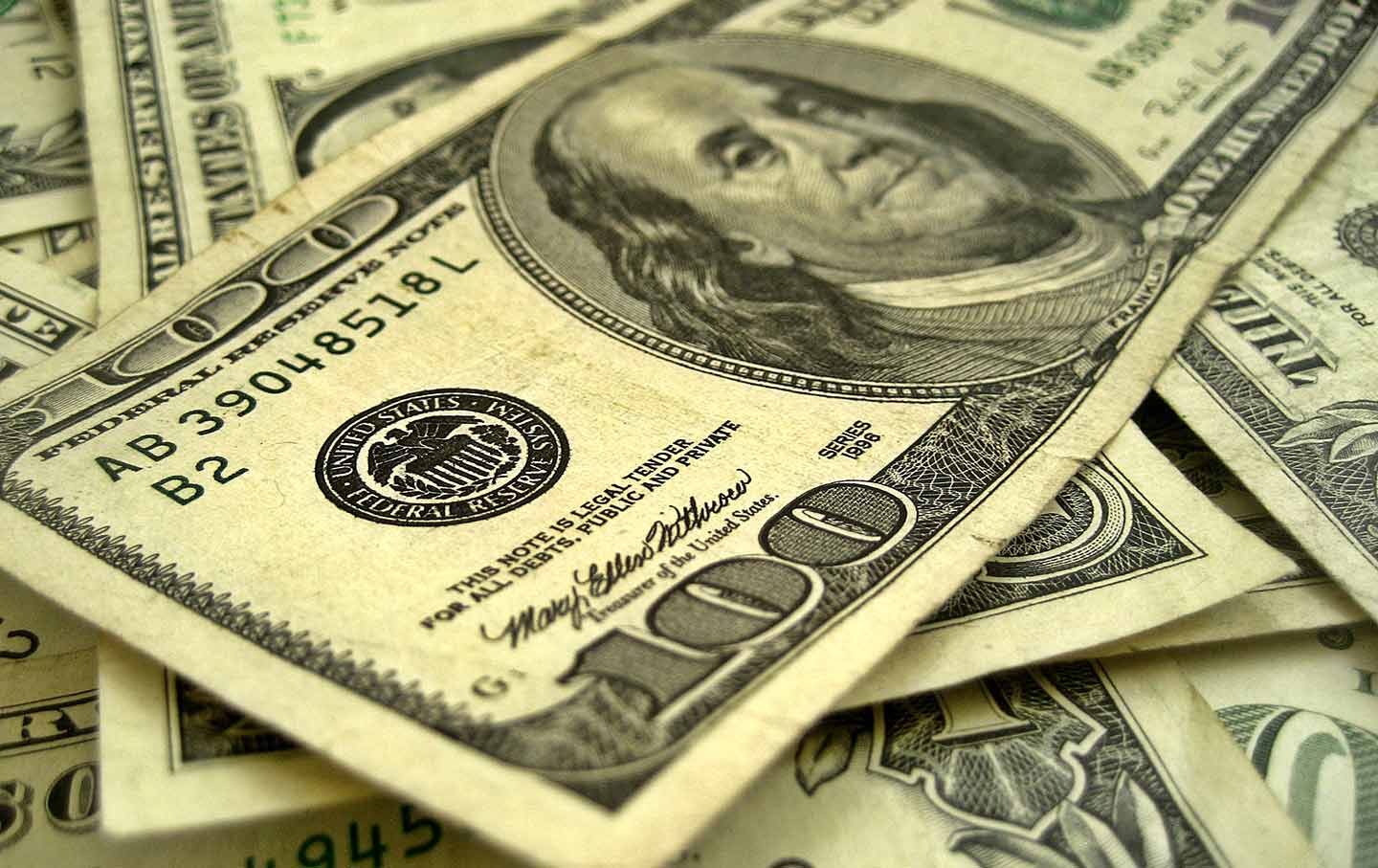
The chiming of the debt clock at $40 trillion—just as Voyager 1 reached one light-day’s distance from Earth and for similar reasons—has provoked a flood of comment. Milestones are milestones: They measure, and they help pass the time. Otherwise, they have no intrinsic importance.
By force of preset agendas, conservatives and liberals react to debt headlines like Pavlov’s dogs. For one side, it’s about Social Security and Medicare. For the other, it’s about making the wealthy pay. There is surely good reason to control healthcare costs. And we do need progressive taxation, to restore the democratic middle-class society we once enjoyed. Neither has to do with the so-called problem of the federal debt.
Is the federal debt “sustainable”? The simplest answer is: “obviously.” United States debts are due in US dollars produced by the US itself. All debts of that type are sustainable: They can always be paid, exactly as promised, “debt limit” or no.
Fans of complexity have cooked up a criterion: a stable or declining ratio of government debt to gross domestic product. This metric compares growth of debt to growth of GDP. Here the key determinant is the interest rate on the existing debt. So long as that rate (averaged over all the maturities) is below the nominal (meaning real growth plus inflation) GDP growth rate, the debt/GDP ratio will eventually shrink. When Secretary Bessent says that we can “grow out of the debt,” this is the commonsense meaning of that shorthand.
Guess what? Today’s federal debt interest rates are well below today’s growth of GDP. We are already “growing” out of the so-called problem. You have to add in the current deficit, but over time it’s the interest rate and the growth rate that decide which way the ratio goes.
True, interest rates have gone up, and may rise further. But it takes time for that to work through the federal debt stock. And the macro effect of interest rates—the double-whammy of higher interest and lower GDP, both driving up the debt/GDP ratio—isn’t what it used to be.
Back when the federal debt was much smaller, higher interest rates mainly hit the private sector: business investment, housing, consumer credit. In 1981, Volcker could (and did) raise rates to 20 percent and take the economy down. Today, with a federal debt greater than GDP, higher interest payments flood debt holders with cash, which they tend to put into stocks and other assets. That is why the Fed under Powell couldn’t slow the economy after 2021. The distributive effect, more money to the rich, is bad. But these days the macro effects are at worst a wash.
What then is going on with “long” bonds? Again, it’s simple enough: Existing long bonds have a low coupon. So when short rates rise, their price falls and the yield goes up. This inflicts a capital loss on bond funds. It has nothing to do with risk, confidence, or the $40 trillion milestone. Bessent tried to buck up the long bond market by buying some back. It didn’t work: The interest rate is powerful and the purchases were small. The buybacks also replaced low-rate long bonds with high-rate short-term debt, increasing Treasury’s interest payout. Why, pray, would a public servant, supposedly not working for the bondholders, want to do that?
What about that bailout of Japan? Japan faces two very big problems: a steep oil bill (thanks to Mr. Trump’s Iran War) and a “carry trade” that takes advantage of the low interest rates Japan has maintained for decades. Traders borrow in yen, invest in (say) pesos, and pocket the spread. This means constant selling of yen, and that places unremitting pressure on the yen’s value.
To offset that, and to pay for oil, Japan might have to sell US bonds, causing more grief for the bond funds. So Bessent recently swapped euros for yen. When this stopgap expires (I predict, in November), Japan will have to raise its own interest rates (destroying much local business), or let the yen fall (bringing on inflation), or liquidate those US bonds, or impose capital controls (decapitating the carry trade). It should have imposed controls long ago.
Japan’s dilemma exposes contradictions within the dollar system. The Fed’s move toward higher rates and Treasury’s desire to keep the dollar down, relative to the yen and any other country in similar trouble, are in conflict. Japan’s domestic economic objectives, locked into low interest rates, conflict with stable exchange rates in open capital markets. But capital controls, should Japan finally go that route, do not spell the end for the dollar. China amassed trillions in US bonds while maintaining capital controls—before selling many of them off to build stockpiles of oil and other key resources.
Many US adversaries, and not a few Americans—including Vice President Vance, to his credit—have reservations about the dollar-reserve system. Some would like to get rid of it. But it’s not so easy; there is no other place in the world system to place all the existing reserves. China is the obvious successor state—a large, stable country with great industry and technical talent. But China isn’t run by bankers. The Chinese can see very well what being run by bankers has done to us.
The system may fall apart someday. Maybe the Iran War will bring it down. Maybe it won’t. For now, though, the dollar is like the dictionary: You can move around in it, from one asset to another, but you can’t easily jump to the outside. To put it all in two words: Hotel California.
More from The Nation
Black Freedom in an Age of White Oligarchy Black Freedom in an Age of White Oligarchy
Justin Leroy’s The Lowest Freedom points toward the limits of liberty under racial capitalism.
The School Behind the Billionaires and the Billionaire Tax The School Behind the Billionaires and the Billionaire Tax
UC Berkeley will inevitably be behind the defeat or victory of Proposition 40.

Dolly Parton Was a Proud Union Sister Dolly Parton Was a Proud Union Sister
Organized labor is celebrating the life and legacy of an artist who championed working women and carried a union card for almost 60 years.

What Happens When 8 Million People Lose Their Student Loan Repayment Plan? What Happens When 8 Million People Lose Their Student Loan Repayment Plan?
As the Biden-era SAVE plan ends, borrowers are facing unaffordable bills, lost payment records, and errors that have falsely put some into default.
David Ellison’s Delusional Stab at Self-Justification David Ellison’s Delusional Stab at Self-Justification
While the Skydance–Warner Bros. merger is in legal limbo, the CEO seeking to pull it off makes a disingenuous case for it in the court of public opinion.
The War on the UAW The War on the UAW
The United Auto Workers called for a ceasefire in Gaza. The union’s federal monitor didn’t like it—and now he’s investigating Shawn Fain, just weeks before union elections.

