What Would Roberto Clemente Do?
The right fielder would want the baseball players’ union to fight the Trump administration’s campaign of terror against immigrants and their families.
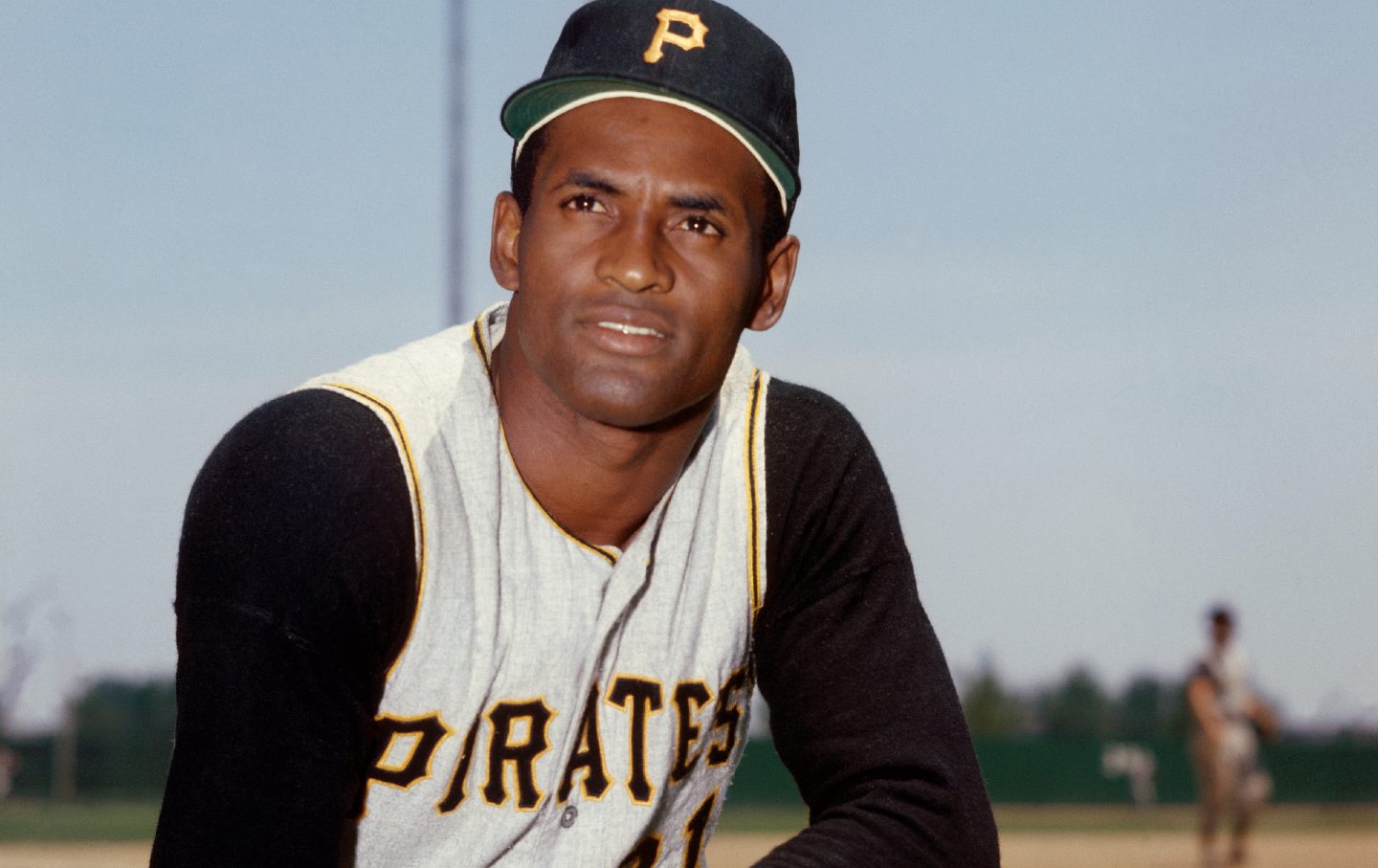
Roberto Clemente. #21 of the Pittsburgh Pirates. poses for a photo in 1968.
(Louis Requena / MLB via Getty Images)The Pulitzer Prize–winning journalist David Maraniss says that he never speaks for the dead, but in this one case, he’ll make an exception. I had asked the best-selling author of Clemente: The Passion and Grace of Baseball’s Last Hero what baseball Hall of Famer and Latin American icon Roberto Clemente would say about Trump’s sadistic immigration policies and Major League Baseball’s silence in the face of these policies. Maraniss responded, “I have no doubt: Clemente would speak out on behalf of the many thousands of Latino jibaros and trabajadores who give so much to this country and are now living in fear of ICE shock troops. Clemente would be clearly denouncing Trump’s overtly racist policies.” Maraniss added that Puerto Rico’s favorite son would also be agitating for a league so dependent upon Latin American talent to stand up for its players.
Major League Baseball’s silence over (or perhaps silent support for) Trump’s denaturalization efforts would have been shattering for Clemente, because his era was one of progress. Clemente’s generation changed the complexion—and languages—of MLB clubhouses forever. When Clemente entered the league in 1954, he was one of the first Latino players with the dark skin tone that would have kept him out of the game before Jackie Robinson broke the color barrier in 1947. Clemente later said that he first learned about racism—and first learned about what it meant to be Black—upon entering Major League Baseball and coming to the US mainland. Clemente fervently supported the rising Black freedom struggle. Clemente entered a league with racial quotas, which on some teams was still zero. In 1972, he left as captain of a Pirates team that could field a lineup of African American and Afro Latino players, a team beloved in what was then a white, blue-collar town.
Today one can imagine Clemente, if somehow reanimated for the present, initially ebullient over the state of Major League Baseball. He would see a record six managers of Latino descent. He would hear his first language and music in the clubhouse, including the reggaetón of Puerto Rico’s own Bad Bunny. He would appreciate stars like Manny Machado and Julio Rodriguez. And then his heart would break to see the league refuse to defy Trump and protect these players and their families. Not even the ballpark, that place of escape and community connectivity, is a sanctuary. If anything, they are ICE target zones.
Mari Corugedo, vice president of the League of United Latin American Citizens, wrote me, “The fact that you can’t go to a favorite pastime of the United States, like a baseball game, without thinking in the back of your head, that someone in a mask, someone who won’t show you their badge or name, can come and separate and use this as a weapon against your parents, your family members, your friends, anyone who attends these sports events.”
If the NFL’s tagline is “Football Is Family,” MLB’s might as well be, “Baseball: Your family is not at present in an undisclosed location. Enjoy the game.”
Maraniss made another point about Clemente. “As a strong member of the players union,” Maraniss said, “he’d be pushing for them to take an unequivocal stand.”
Indeed, Clemente helped lead baseball’s first union strike in 1971 and was one of the few Major League Baseball players to defend fellow All-Star Curt Flood’s efforts in 1969 to win free agency for all baseball players. Clemente’s instincts to look to his union to fight Trumpism would have been spot-on. The Major League Baseball Player’s Association could be a uniquely powerful force against Trump’s anti-Latino assault.
This is a union where a quarter of its members were born in Latin America and many of the rest of its players are from comfortable suburban backgrounds and colleges with names like Gunnar, Colton, and Adley (to just use my favorite team as an example). What a statement to a divided country and a nativist president if this union of both Kades and Eduardos could publicly condemn the terror being imposed on their members. The players would become leaders giving voice to people who right now are living in shadows, deliberately unheard.
The Nation reached out to the MLBPA, but on this issue, it has been less deliberately unheard and more deliberately silent. “The PA is closely monitoring all U.S. immigration developments that could impact our members,” a representative of the MLBPA wrote. “We have advised non-U.S. citizen Players to carry proper immigration documentation with them when they travel and to ensure that their paperwork and personal information is up to date with U.S. Citizenship and Immigration Services (USCIS). We are available to Players and agents around the clock as a source of information and support, and we will remain attentive to any enforcement trends that could impact Players and their families.”
This echoes what Tony Clark, the executive director of the MLBPA, told the Baseball Writers Association of America during the All-Star break. The following was sent to us by the union, complete with vocalized pauses. After Clark made the same declaration of legal support, he said, “We told them to carry their documentation, uh, uh, wherever they go.… we’ve got immigration council and immigration lawyers on staff to provide, support in a way that we have in the past, but not to the extent that we do now in order to ensure guys are in the best position possible to get to the ballpark and do their job.”
There is no way this would be good enough for Clemente. Make sure you have your papers? Here is a number of a good lawyer? That doesn’t meet the moment. It accedes to it.
There is no shortage of bold and brave people speaking truth to this administration. Yet, while people are speaking out, institution after institution refuses to lift a finger, even to an alleged child rapist using racism to ransack this country. Baseball isn’t special. It is just one institution on a list. And Clemente would definitely be calling out the league for not raising hell. After winning MVP of the 1971 World Series, Clemente, being interviewed on the field, said, “Before I say anything in English, I would like to say something in Spanish to my mother and father in Puerto Rico.” His words were simple: “En el día más grande de mi vida, para los nenes la benedición mia y que mis padres me échen la benedición.”
Popular
“swipe left below to view more authors”Swipe →The crowd’s response was rapturous. Even those fans who couldn’t understand him roared. The great Clemente was never ashamed of who he was. And he would never cower before that angry, burning rash known as Stephen Miller.
Clemente’s heroism turned into mythos on December 31, 1972, when, despite a crippling fear of flying, he attempted to travel with aid to Nicaragua following a massive earthquake. Almost immediately, his plane crashed off the coast of Puerto Rico’s Piñones Beach. Since that day, MLB has celebrated his legacy as a humanitarian, but he was more than that. He was someone who would never surrender an inch of his dignity.
It is staggering how much Clemente gave to Major League Baseball, how many doors he opened, how much life he brought to the game. And it is equally staggering how comfortable MLB owners are that the families of 25 percent of their players live in terror. It is staggering that they have said nothing about the 63 players from Venezuela whose families must live in a state of fear. It is staggering that so many white MLB players have said nothing on behalf of their teammates. And it is staggering that the union’s approach is just “carry your papers, and we have lawyers if you need them.” None of this is good enough.
Yes, Maraniss is correct that we should be wary of speaking for the dead, but we also cannot let MLB erase the dead: their beliefs, their words, or their sacrifices. The MLBPA cannot erase Clemente’s fierce pride. It cannot erase the fact that Clemente, if alive, would use his moral authority to stand up to an aspiring dictator and condemn the cowardice of the sport that he loved so dearly.
Disobey authoritarians, support The Nation
Over the past year you’ve read Nation writers like Elie Mystal, Kaveh Akbar, John Nichols, Joan Walsh, Bryce Covert, Dave Zirin, Jeet Heer, Michael T. Klare, Katha Pollitt, Amy Littlefield, Gregg Gonsalves, and Sasha Abramsky take on the Trump family’s corruption, set the record straight about Robert F. Kennedy Jr.’s catastrophic Make America Healthy Again movement, survey the fallout and human cost of the DOGE wrecking ball, anticipate the Supreme Court’s dangerous antidemocratic rulings, and amplify successful tactics of resistance on the streets and in Congress.
We publish these stories because when members of our communities are being abducted, household debt is climbing, and AI data centers are causing water and electricity shortages, we have a duty as journalists to do all we can to inform the public.
In 2026, our aim is to do more than ever before—but we need your support to make that happen.
Through December 31, a generous donor will match all donations up to $75,000. That means that your contribution will be doubled, dollar for dollar. If we hit the full match, we’ll be starting 2026 with $150,000 to invest in the stories that impact real people’s lives—the kinds of stories that billionaire-owned, corporate-backed outlets aren’t covering.
With your support, our team will publish major stories that the president and his allies won’t want you to read. We’ll cover the emerging military-tech industrial complex and matters of war, peace, and surveillance, as well as the affordability crisis, hunger, housing, healthcare, the environment, attacks on reproductive rights, and much more. At the same time, we’ll imagine alternatives to Trumpian rule and uplift efforts to create a better world, here and now.
While your gift has twice the impact, I’m asking you to support The Nation with a donation today. You’ll empower the journalists, editors, and fact-checkers best equipped to hold this authoritarian administration to account.
I hope you won’t miss this moment—donate to The Nation today.
Onward,
Katrina vanden Heuvel
Editor and publisher, The Nation
More from The Nation
How the Border Patrol Moved Inland—and Created a Police State How the Border Patrol Moved Inland—and Created a Police State
In 1994, the writer Leslie Marmon Silko wrote a piece for The Nation warning of a frightening new immigration regime.
Why Epstein’s Links to the CIA Are So Important Why Epstein’s Links to the CIA Are So Important
We won’t know the full truth about his crimes until the extent of his ties to US intelligence are clear.
The Public Health Heroes of 2025 The Public Health Heroes of 2025
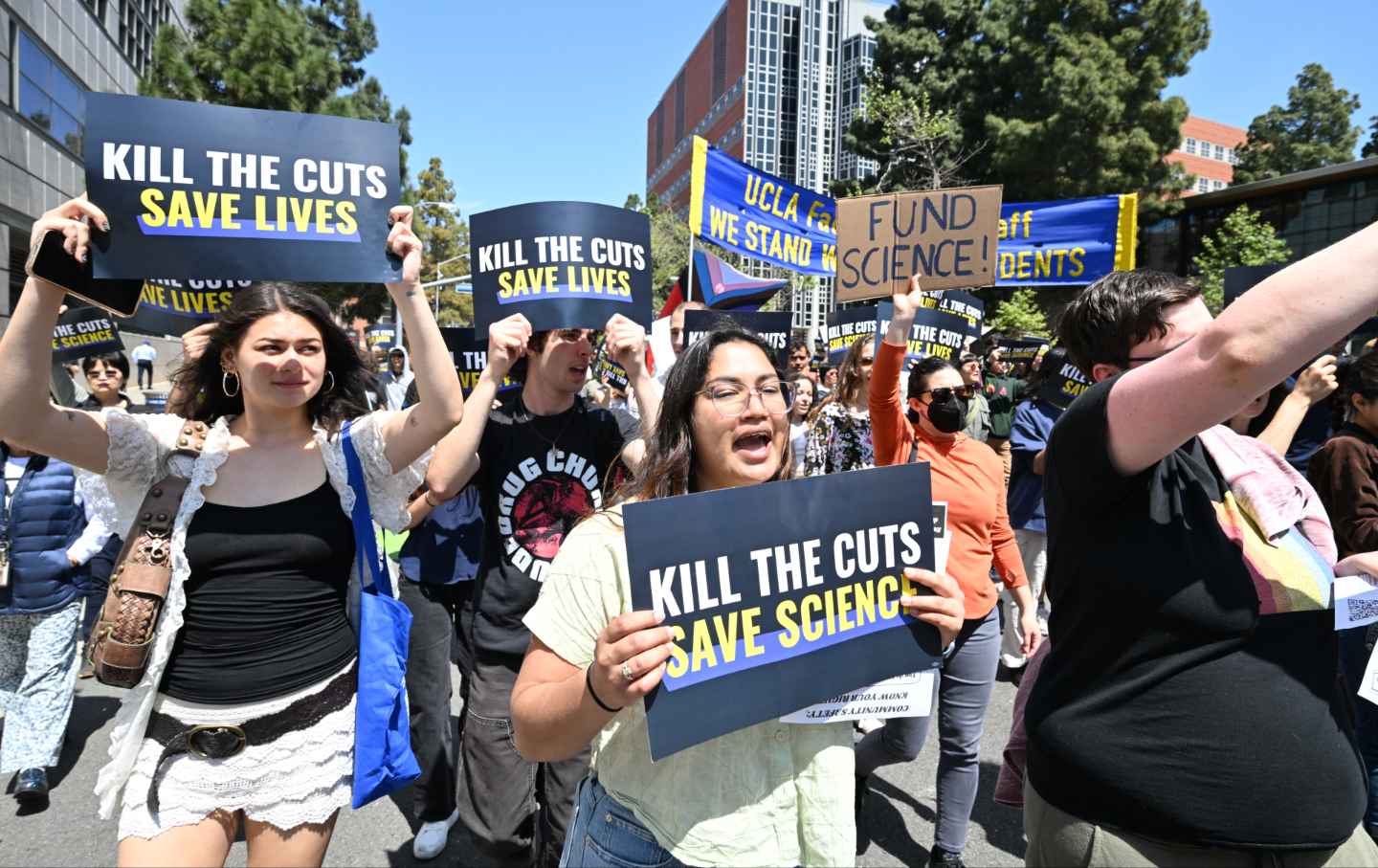
The Trump administration wants to destroy our health infrastructure. These warriors aren't letting that happen without a fight.
Rob Reiner, Bari Weiss, and the Shifting Politics of Hollywood Rob Reiner, Bari Weiss, and the Shifting Politics of Hollywood
Weiss’s ascent reveals the extent to which Hollywood, once a Democratic stronghold, has defected for a politics that puts the concerns and egos of wealthy people first.
The Longest Journey Is Over The Longest Journey Is Over
With the death of Norman Podhoretz at 95, the transition from New York’s intellectual golden age to the age of grievance and provocation is complete.

Breaking the LAPD’s Choke Hold Breaking the LAPD’s Choke Hold
How the late-20th-century battles over race and policing in Los Angeles foreshadowed the Trump era.

