How the Border Patrol Moved Inland—and Created a Police State
In 1994, the writer Leslie Marmon Silko wrote a piece for The Nation warning of a frightening new immigration regime.
In recent months, as the Trump administration has grown frustrated by the pace of deportations organized by ICE, it has sicced the even nastier Border Patrol on American cities—first Los Angeles, then Chicago, and now Charlotte. The move is the vicious culmination of a decades-long trend of hyper-militarized immigration enforcement.
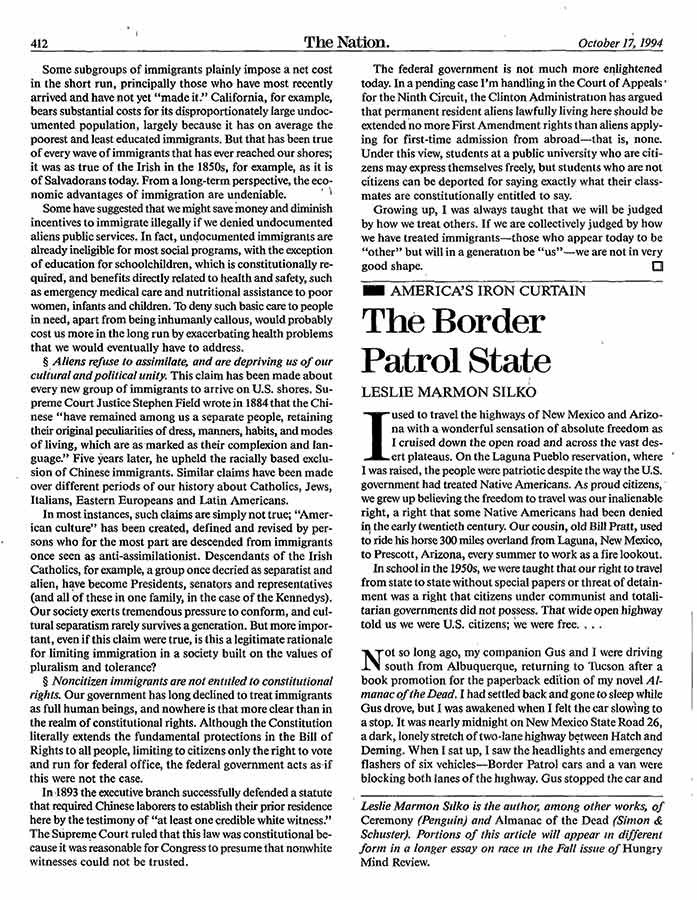
In 1994, The Nation published “The Border Patrol State,” an essay by the Laguna Pueblo writer Leslie Marmon Silko about the increased presence of the Border Patrol far from the actual border. Silko grew up on a reservation and knew how the US government had mistreated Native peoples. Even so, this didn’t change the “wonderful sense of absolute freedom” she felt as she “cruised down the open road and across the vast desert plateaus.”
“That wide open highway told us we were U.S. citizens,” she wrote, “we were free….”
That sense of freedom was destroyed, however, by an incident when she was driving with a companion from Albuquerque to Tucson. They came across a roadblock set up by the Border Patrol. The officers told them to step out of the car. “I will never forget that night beside the highway,” Silko wrote. “There was an awful feeling of menace and violence straining to break loose. It was clear that the uniformed men would be only too happy to drag us out of the car if we did not speedily comply with their request (asking a question is tantamount to resistance, it seems).”
“The weird anger of these Border Patrolmen,” Silko continued, made her think of a report she had read about the thousands of people who had been disappeared during Argentina’s 1970s dirty war.
It was also clear that travelers were being racially targeted. The Border Patrol “exercises a power that no highway patrol or city patrolman possesses,” Silko wrote. “Other law-enforcement officers need a shred of probable cause in order to detain someone. On the books, so does the Border Patrol; but on the road, it’s another matter.”
“This is the police state that has developed in the southwestern United States since the 1980s,” she added. Now, 31 years later, that police state has gone national.
Even at the time, though, Silko understood where it was headed: “Manifest Destiny may lack its old grandeur of theft and blood—‘lock the door’ is what it means now.”
How darkly ironic it was, she reflected, that just a few years after the Iron Curtain came down in Europe, the US government had begun building a steel wall on the border with Mexico. “It is no use; borders haven’t worked, and they won’t work,” Silko concluded. “The great human migration within the Americas cannot be stopped; human beings are natural forces of the Earth, just as rivers and winds are natural forces.”