
HUD Is Refusing to Enforce Anti-Discrimination Law—and Won’t Let Anyone Else Do It, Either
The initial chaos of layoffs has been followed by a concerted effort by the Trump administration to halt the enforcement of the Fair Housing Act.
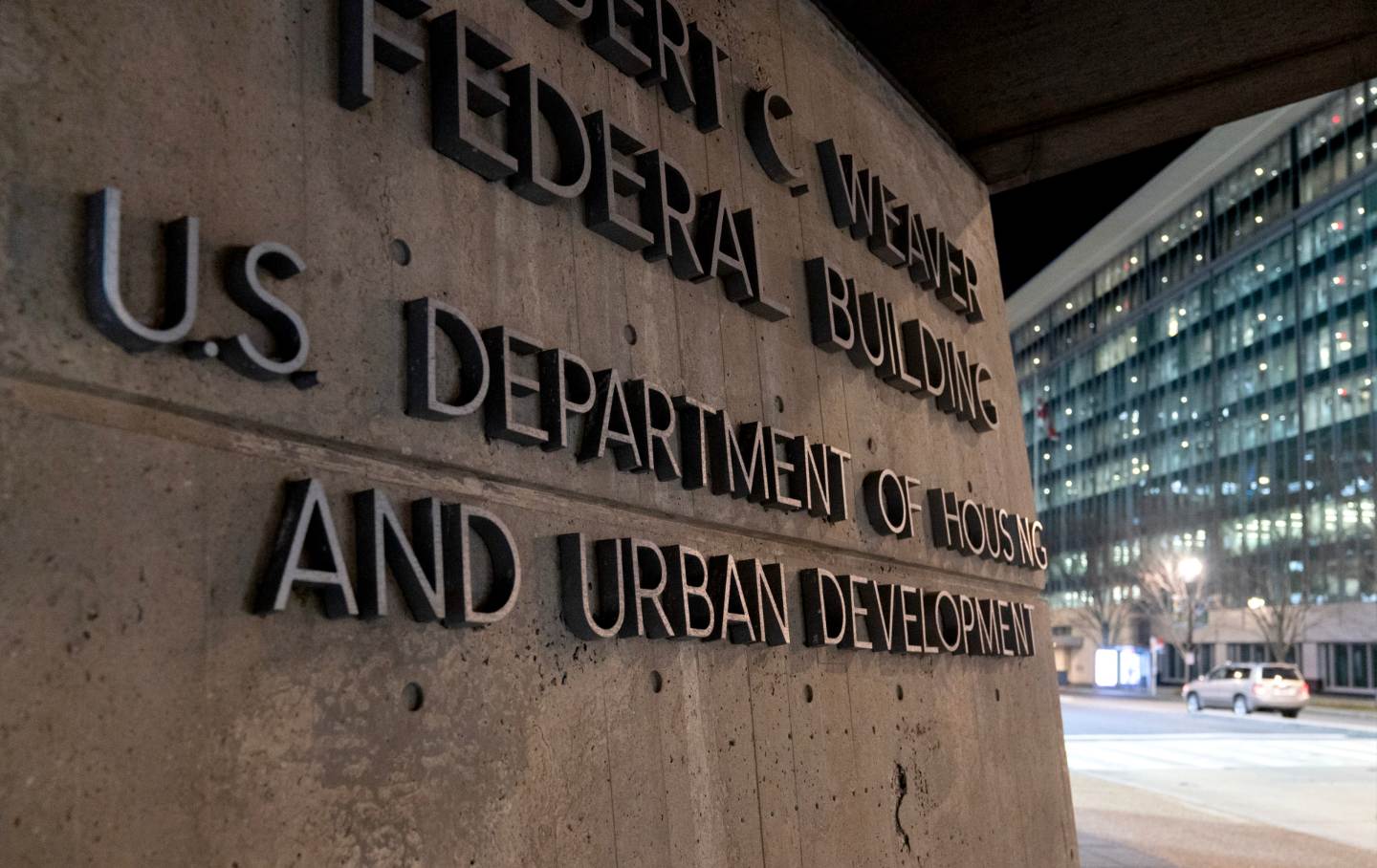
The Department of Housing and Urban Development (HUD) headquarters in Washington, DC.
(Stefani Reynolds / Bloomberg via Getty Images)
Kenneth Hansbrough’s problems began with a key fob. Hansbrough, who uses a wheelchair due to a spinal cord disease and is legally blind, moved into a low-income apartment in St Louis, Missouri, three years ago. If Hansbrough falls, his son, who lives nearby, can help him, so he gave his son a key to his apartment. But to get in the building his son also needs a fob for the front door, and Hansbrough’s landlord will only give him an extra one if he pays $50, money Hansbrough doesn’t have. So now, when he falls and needs help, he calls the fire department to force its way into the building and break down his door to get him up. “They’ve done it twice,” he noted.
Next Hansbrough asked his landlord for a device that would allow him to open the gate to the large parking lot behind the building. Hansbrough relies on the city’s Call-A-Ride service for transportation to everything from doctor appointments to the grocery store. But the front of his building, where the Call-A-Ride usually picks him up, is right near a highway onramp, and if the six street parking spaces are taken Hansbrough is forced to risk his safety going onto the sidewalk right near the onramp, which is “very dangerous,” he said. He asked his landlord for access to the parking lot, but he was denied—he doesn’t have a car, so he doesn’t qualify, he was told.
Then there’s his bathroom. The shower has a lip about 10 inches high. To get in, Hansbrough raises the seat of his wheelchair all the way up—which he’s not supposed to do—and then tries to ease himself in. Getting out when he’s wet is even more dangerous. He’s fallen several times, so he avoids bathing. “It is totally frustrating and I hate it,” he said. “I want to be able to take a shower without putting my life in danger.” He asked his landlord to install a grab bar he bought himself over the toilet, but one night when he tried to use it it came out of the wall and hit him on the head, which made him knock his head on the toilet, leaving him with a concussion. He’s told his landlord about the problems with the bathroom, but other than the shoddy grab bar installation he says he’s been ignored.
“It’s just been one terrible ordeal,” he said.
All of Hansbrough’s requests should have been straightforward accommodations for people with disabilities that are required of landlords under federal law. So in January 2024, Hansbrough availed himself of his rights under the Fair Housing Act—a key Civil Rights-era law enacted in 1968 that prohibits discrimination in housing on the basis of race, color, religion, sex, national origin, familial status, and disability—and filed a complaint with the Department of Housing and Urban Development (HUD). “Some fair housing cases are complicated. Some of them have facts that might be subject to interpretation,” said Kalila Jackson, a volunteer attorney with the Metropolitan St. Louis Equal Housing Opportunity Council who is representing Hansbrough. “This was really black and white.”
HUD began investigating Hansbrough’s case over a year ago and, before January, had begun negotiations with his landlord. But Hansbrough’s case is one of many to be completely upended by the second Trump administration, which has essentially stopped enforcing civil rights at HUD entirely.
At first, HUD civil rights cases were “shuffled” between staff, Jackson said, when DOGE layoffs and early retirement enticements led to an exodus. HUD’s Office of Fair Housing and Equal Opportunity (FHEO), which enforces the Fair Housing Act, has experienced a 65 percent staffing reduction, going from 31 employees to 11, since the start of the year. That was before another 114 FHEO employees were fired by the administration during the recent government shutdown. The investigator on Hansbrough’s case was a probationary employee and was fired in the initial layoffs in February, so a new investigator was assigned. His case didn’t move forward for months; the new investigator who was assigned never spoke to Jackson or Hansbrough, she said.
Jackson has other cases without an investigator on them at all. “We’re being told, ‘You can keep asking for updates, but I have nothing to tell you,’” she said. “Nothing is moving at all.”
“The government is shutting down HUD systemically,” Jackson added. “It rolls back the clock to the pre-Civil Rights age.”
The initial chaos of layoffs and resignations has been followed by a concerted effort by the Trump administration to halt the enforcement of the Fair Housing Act at HUD. According to dozens of emails and communications reviewed by the New York Times, Trump appointees have made it “nearly impossible” for those normally tasked with this work to do their jobs. HUD whistleblowers say they’ve been subjected to a “gag order” that prevents them from communicating directly with external parties, cutting then off from talking to victims of discrimination or the entities being accused without getting approval from a Trump appointee, approval that is “rarely granted.” As Paul Osadebe, a trial attorney in HUD’s Office of Fair Housing, told The Nation, “No one would hire a lawyer who can’t talk to them.” As of September, FHEO employees have to get approval before settlements or charges can be issued, according to a memo that John Gibbs, Trump’s appointee to Principal Deputy Assistance Secretary at HUD’s Office of Policy Development & Research, sent to staff. That’s allowed political appointees to unilaterally change settlement terms or reject compensation amounts for victims of discrimination.
Gibbs’s memo also stated that cases involving gender identity, screening for criminal backgrounds, environmental justice, appraisal bias, or local zoning are based on “tenuous theories of discrimination” and “will no longer be prioritized.” Guidance on redlining and reverse redlining are “legally unsound,” he wrote, and won’t be used in enforcement. He also rescinded agency guidance on disparate impact discrimination—the legal doctrine that holds actions or policies are discriminatory if they have a disproportionate impact on protected groups, even if those impacts aren’t intentional—as well as other guidance documents related to people with limited English or without documented status. Other documents the Times reviewed said the work of the FHEO is “not a priority of the administration.” Since Trump took office, Osadebe has yet to see a civil rights claim HUD was willing to pursue, he said. “We don’t do anything.”
The agency is now enforcing these priorities, or lack thereof, on state and local fair housing agencies that are paid by HUD to process about 20 percent of all discrimination complaints (HUD itself handles only about five percent of complaints, with nonprofit fair housing groups handling three-quarters). In a memo sent to all such agency directors shared with The Nation, Nathan S. Roth, acting director of office of programs at FHEO, wrote that cases of discrimination based on gender identity, sexual orientation, rental voucher use, criminal records, limited English, and weight and height “will not be reimbursed.” It also threatened to pull these agencies’ ability to process discrimination claims on HUD’s behalf if they enforce local fair housing laws that are more protective than the federal baseline. If the memo pushes these agencies to stop doing this work, “That’s going to be as big a deal as HUD essentially going out of business,” said Sasha Samberg-Champion, special counsel for civil rights at the National Fair Housing Alliance who served as deputy general counsel for enforcement and fair housing and HUD under President Biden.
Meanwhile, the administration terminated grants for many housing nonprofits and other legal advocacy organizations that also deal with discrimination complaints, funding that was appropriated by Congress, and “has yet to turn that money back on,” Samberg-Champion said. That means that the organizations that handle most housing discrimination complaints have spent a year “getting their funding off and on,” likely leading to layoffs and less enforcement capacity. Trump’s proposed budget eliminates their funding entirely.
“They’re attacking effective fair housing enforcement across any mechanism that they have,” Samberg-Champion said. “They’re pulling every lever to make it impossible to enforce your rights under the Fair Housing Act.”
HUD has also withdrawn at least three charges, in which HUD had found evidence of lawbreaking and either put the case in front of an administrative law judge or handed it over to the Department of Justice, which it lacks the legal authority to do. That leaves claimants “scrambling,” Osadebe said, to “start over and get another lawyer if they can find one.” Other charges that are ready to be brought, meanwhile, are “sitting on a desk somewhere, they’re just refusing to go forward,” Osadebe said. Hundreds of cases are frozen, according to the Times. HUD has also withdrawn settlements that were reached years ago. Many settlements last over a period of years, and HUD stays involved to make sure the terms are met and the victims aren’t retaliated against. That’s no longer happening in the ones it’s yanked.
“If you’re not enforcing the Fair Housing Act, then it’s just another dead law,” Palmer Heenan, a career lawyer at the FHEO, told the Times. He was fired after the article came out. Osadebe has been recommended for removal.
The result of the administration’s actions is a lack of relief and justice for people like Hansbrough. Over the last five years, the FHEO has collected between $4 million and $8 million a year through legal settlements in discrimination cases. But between January and July of this year, it approved settlements totaling less than $200,000, according to the Times. Charges have fallen from an average of 25 a year to just four since the start of 2025.
Popular
“swipe left below to view more authors”Swipe →In July, HUD decided to close Hansbrough’s case. “I was shocked,” he said. “I just felt like I had no one but Ms. Jackson to support me.” Jackson said the document outlining HUD’s decision “was wildly inconsistent with the reality.”
In the meantime, his landlord has attempted to evict him multiple times despite the fact that he insists he pays his rent ahead of time and he hasn’t damaged any property. The most recent attempt came in early October just after HUD dismissed his case.
Hansbrough can’t move, though. He lives on a fixed income, surviving solely on Social Security Disability payments and Missouri’s Blind Pension Program, and he can’t find an available, affordable wheelchair accessible apartment in the city. “It’s not like I’m not looking for a place to live, there just aren’t any places available,” he said. His son’s apartment lacks the accommodations Hansborough needs to be able to live with him.
Fear of being forced out of his apartment, with HUD turning its back on him, plagues him. “I have never lived on the street. I have never been homeless. I’ve always had a roof over my head,” he said. “It just scares the crap out of me. It keeps me up at night.”
There are few places for him to turn with HUD rejecting civil rights enforcement. Missouri’s protections against housing discrimination fall below the federal government’s minimum standard, so Hansbrough isn’t likely to be able to secure justice through the state. He could bring his own lawsuit in court, but litigation is costly and time consuming. And it’s difficult to get a lawyer to take most fair housing cases; they usually don’t have a lot of damages to be recovered, making them financially untenable. Pursuing a case without a lawyer, meanwhile, is “going to be extremely difficult,” Samberg-Champion said.
“We are the only place where someone can get free legal help by experts who are required to bring the case,” Osadebe said. Without HUD, “You’re just on your own.”
Hansbrough is lucky to have Jackson by his side; many people go to HUD without lawyers and may now have to file claims with state agencies or in the courts by themselves.
But with HUD abdicating responsibility for enforcing fair housing laws, Hansbrough feels abandoned. “I am so disappointed in HUD. I expected better of them,” Hansbrough said. “It hurts a lot.”
More from The Nation

What Are Democrats Prepared to Do if Trump Rigs the Election? What Are Democrats Prepared to Do if Trump Rigs the Election?
In this week’s Elie v. U.S, our justice correspondent challenges Democrats' lack of a plan if Trump steals the midterms. Plus: the most racist, and honest, AI add ever.
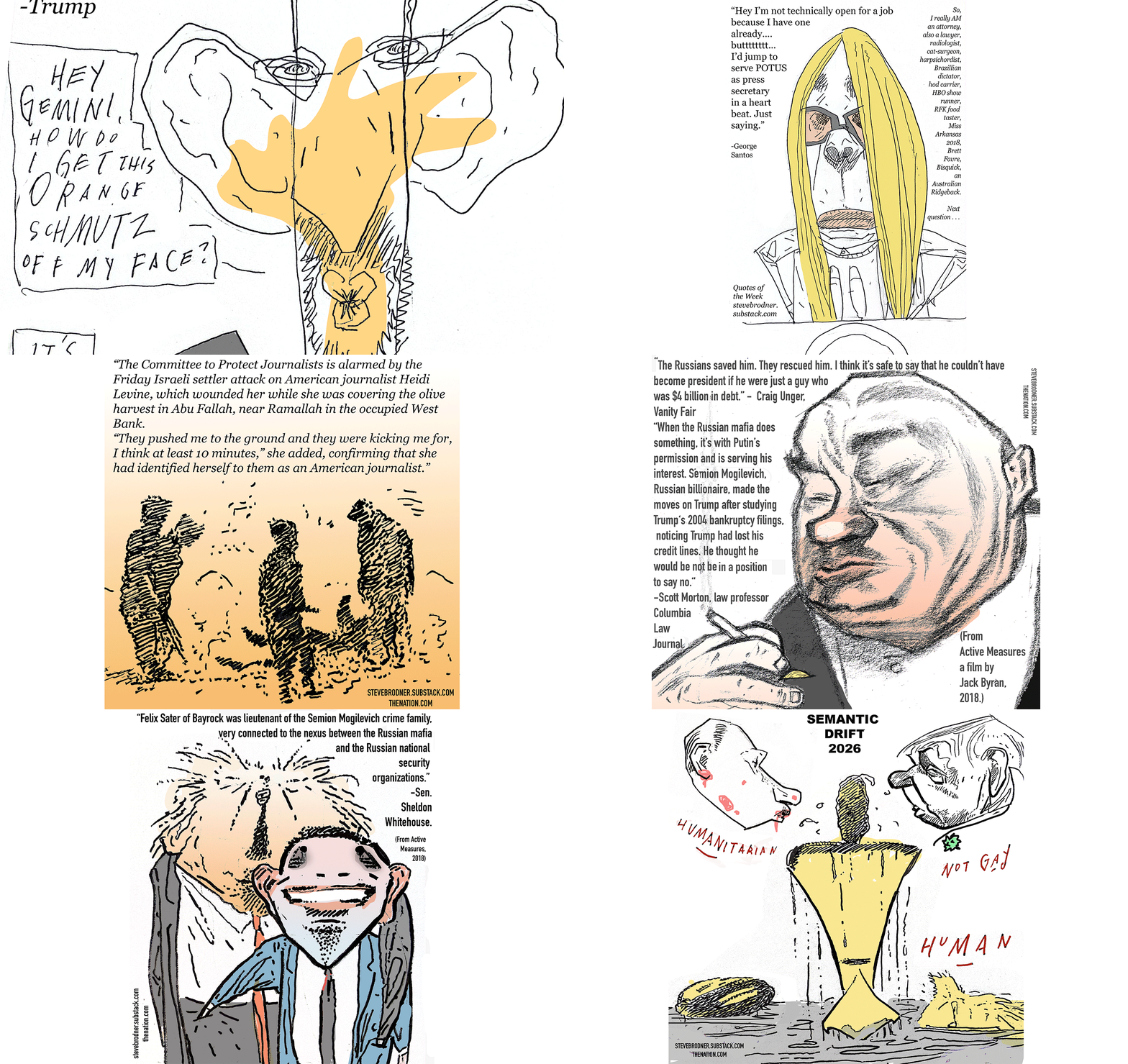
Ramaswamy’s Guide to a Better Vocabulary Ramaswamy’s Guide to a Better Vocabulary
Quotes of the Week.
Why Trump Is Embracing Vivek Ramaswamy’s Vile Ad Why Trump Is Embracing Vivek Ramaswamy’s Vile Ad
The president is leaning into the politics of toxic parenting.

The Shadow Knows The Shadow Knows
High-tech weapons, low-tech intelligence.
Tom Hayden’s Legacy and the New American Left Tom Hayden’s Legacy and the New American Left
It’s been 10 years since he passed away.
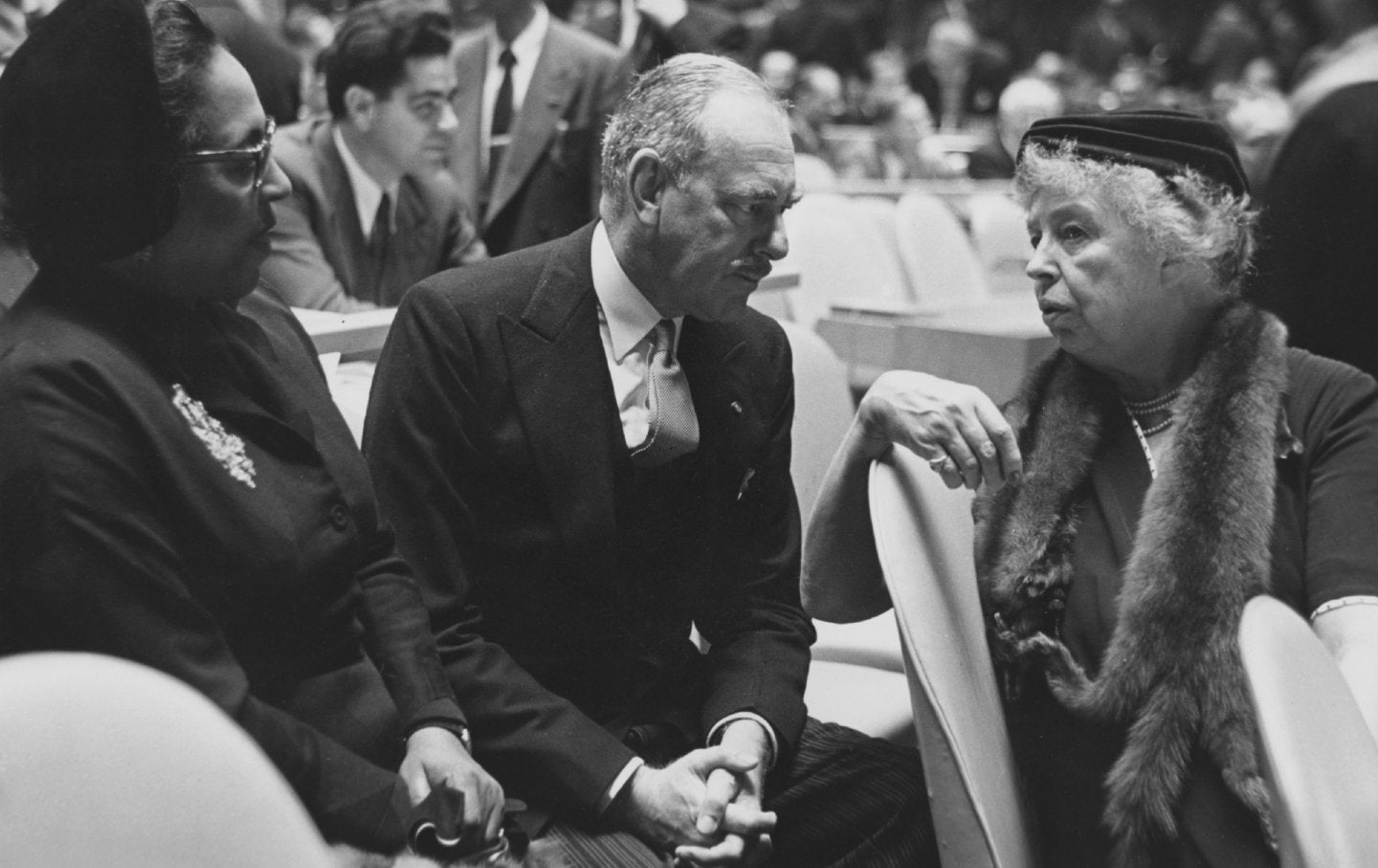
The Decades-Long Battle Within the Democratic Party Establishment Between the Heirs of Dean Acheson and Franklin Roosevelt The Decades-Long Battle Within the Democratic Party Establishment Between the Heirs of Dean Acheson and Franklin Roosevelt
The calamitous history of America’s wars of choice.

