
Why Epstein’s Links to the CIA Are So Important
We won’t know the full truth about his crimes until the extent of his ties to US intelligence are clear.
On November 18, Donald Trump suffered a major political defeat when the House of Representatives passed the Epstein Files Transparency Act by a nearly unanimous vote: 427–1. But while emphatic, the House measure included a significant proviso that might yet prevent a full reckoning with Jeffrey Epstein’s crimes.
Trump had fought for months against the bill, which was drafted by a bipartisan coalition created by California Democrat Ro Khanna and Kentucky Republican Thomas Massie. In the end, the strong public revulsion for Epstein’s crimes made opposing the bill untenable. But the final version specified that the Department of Justice must make public “all unclassified” documents on Epstein.
The word unclassified potentially gives Trump and the CIA wide latitude to hold back Epstein-related materials that they claim are too sensitive to release. In this, they have the support of House Speaker Mike Johnson, who insisted that US intelligence agencies be allowed to “protect their critical sources and methods. It is incredibly dangerous to demand that officials or employees of the DOJ declassify material that originated in other agencies and intelligence agencies.”
Johnson’s words stand in stark contrast to the remarks by Marjorie Taylor Greene, one of four dissident House Republicans who forced Trump to abandon his opposition to the Epstein bill. “The real test will be: Will the Department of Justice release the files, or will it all remain tied up in investigations?” she asked in a November 18 press conference. “Will the CIA release the files?” Greene—perhaps feeling too bruised by the clash with Trump, who attacked her repeatedly over her Epstein heresy—subsequently announced that she will be retiring from Congress. But her words still cut to the heart of why getting the whole truth about Epstein is so difficult.
Epstein almost certainly had “close ties to [US] intelligence agencies and Israel’s intelligence agencies,” as Massie put it to reporters on November 19. The fact that the American and Israeli security states appear to have worked with so toxic a figure is deeply disturbing, embarrassing to those in power, and a major reason why the full extent of Epstein’s activities continues to be concealed.
People have linked Epstein to the spy world for years. In 2019, Vicky Ward, writing in The Daily Beast, reported that Trump’s then–labor secretary, Alex Acosta—who, as a federal prosecutor, had cut a notorious sweetheart plea deal with Epstein before his trial in 2008—had made some startling comments about Epstein when he was being vetted for his role in the first Trump administration. As Ward noted, Acosta claimed that he had “cut the non-prosecution deal with one of Epstein’s attorneys because he had ‘been told’ to back off, that Epstein was above his pay grade. ‘I was told Epstein “belonged to intelligence” and to leave it alone,’ he told his interviewers in the Trump transition [team].”
Asked about these comments in a House Oversight Committee hearing on September 19, Acosta denied having made them and said that he had “no knowledge as to whether [Epstein] was or was not a member of the intelligence community.” But the statement originally attributed to him chimes with the facts that have since emerged about Epstein’s intelligence ties.
Even so, “belonged to intelligence” doesn’t fully capture the scope of those ties, since it suggests that Epstein was an underling or a minor player. This is similar to the language used by Jacobin’s Branko Marcetic, who speaks of Epstein as an Israeli intelligence “asset.”
This view rests on the excellent reporting done by Ryan Grim and Murtaza Hussain on Drop Site News concerning Epstein’s extensive work on behalf of Israel—often alongside former Israeli prime minister Ehud Barak—as well as earlier work done by Matthew Petti in Reason. As Marcetic notes, this reporting shows Epstein, among other activities, “repeatedly hosting an Israeli military intelligence officer and Barak aide who was in the United States to conduct official business; working with Barak to secure actions against Israeli adversaries, whether a US bombing of Iran or Russian backing for regime change in Syria; [and] brokering security agreements between Israel and Mongolia and Côte d’Ivoire.”
Marcetic is right to emphasize that Epstein was tightly entwined with Israel, a fact that, despite mountains of evidence, the mainstream media has almost entirely ignored. But “asset” doesn’t quite describe how Epstein operated, which was not as an agent carrying out orders but as a shaper of policy.
Epstein was a power player in global politics, a kind of diplomat without portfolio with better access to the wealthy and politically powerful than most real ambassadors. One way to understand him is as a product of a hyper-privatized neoliberal age. Just as much of the policing of the American empire is now done by private military companies (notably Constellis, formerly known as Academi and Blackwater), billionaires like Epstein have their own private foreign policy. Whatever work Epstein did with the CIA or the Mossad would have been as a peer rather than an employee.
In a 2014 e-mail to Barak about their shared journey into the worlds of cybersecurity, cyberwarfare, and surveillance, Epstein expressed excitement at the spread of global chaos, writing: “with civil unrest exploding in ukraine syria, somolia [sic], libya, and the desperation of those in power, isn’t this perfect for you.” Barak responded, “You’re right [in] a way. But not simple to transform it into a cash flow.”
Epstein and Barak were masters of what Naomi Klein and others have called disaster capitalism, profiting from the “desperation of those in power.” But it is unlikely they could have done this without the complicity of American intelligence. That’s why Epstein’s intelligence ties are central to understanding his crimes.
More from The Nation

What’s It Like Inside a Data Center? What’s It Like Inside a Data Center?
Northern Virginia is laden with structures that house data for Fortune 500 companies. I went inside just one of those monstrosities that bothers its neighbors.
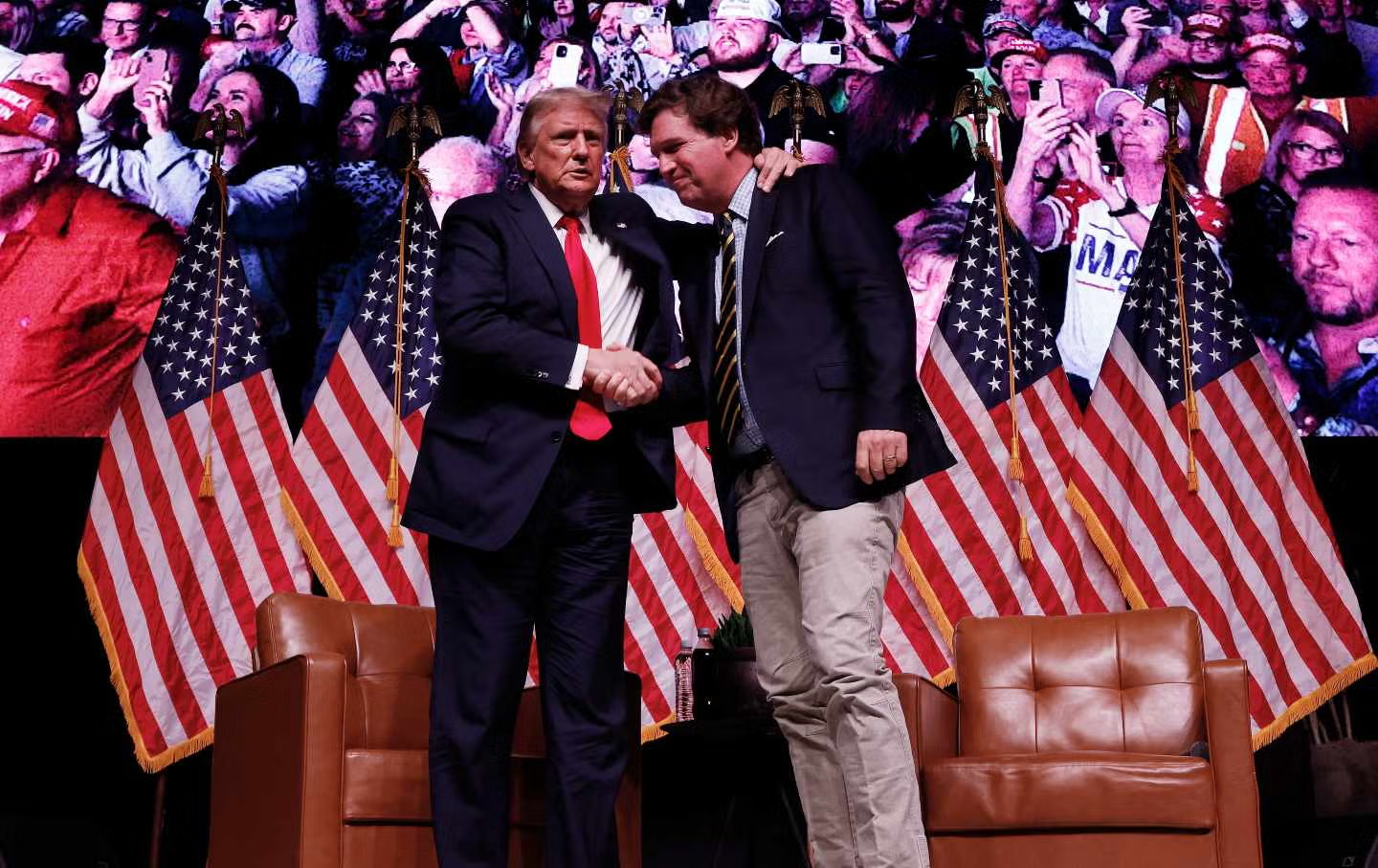
What Trump and Tucker Carlson Have in Common What Trump and Tucker Carlson Have in Common
Carlson has broken with Trump largely over the war in Iran. But on Ukraine and immigration, the two speak very much the same language.

The Jewish Case Against AI The Jewish Case Against AI
Haredi rabbis and the secular left agree: This technology is a threat to the entire social fabric.
The Fight for Educational Equality Is Also a Fight for a Just Supreme Court The Fight for Educational Equality Is Also a Fight for a Just Supreme Court
The court has severely weakened our ability to make an education system that fulfills the promise of Brown.
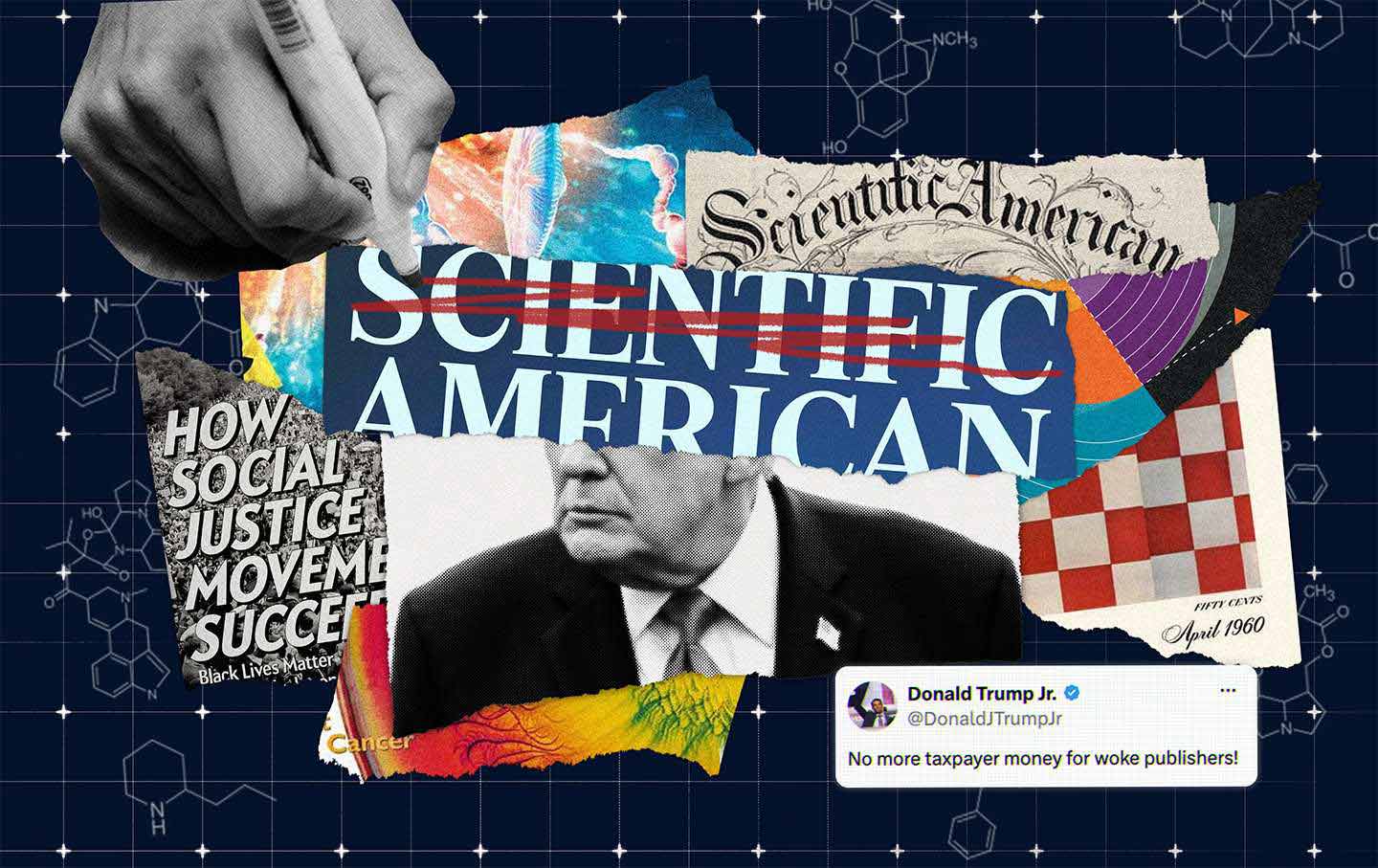
The Fall of “Scientific American” The Fall of “Scientific American”
When the beloved science publication got too political, its corporate owners stepped in. Now its future is uncertain.

The Bookstore Revolution in Taiwan’s Conservative Heartlands The Bookstore Revolution in Taiwan’s Conservative Heartlands
After Taiwan legalized same-sex marriage, gender-themed bookstores are working to build the social acceptance that the law alone couldn’t deliver.

