Happy 160th Anniversary to The Nation!
Happy 160th Anniversary to “The Nation”!
Since 1865, we’ve held fast in our belief in the liberating power of simply telling people the truth.
In June of 1863, in the wake of Confederate victories at Chancellorsville and Winchester—when the issue of whether a nation dedicated to the proposition that all men are created equal could long endure seemed far from certain—the journalist Frederick Law Olmsted made a pitch to potential backers laying out his “dream of an honest weekly paper.”
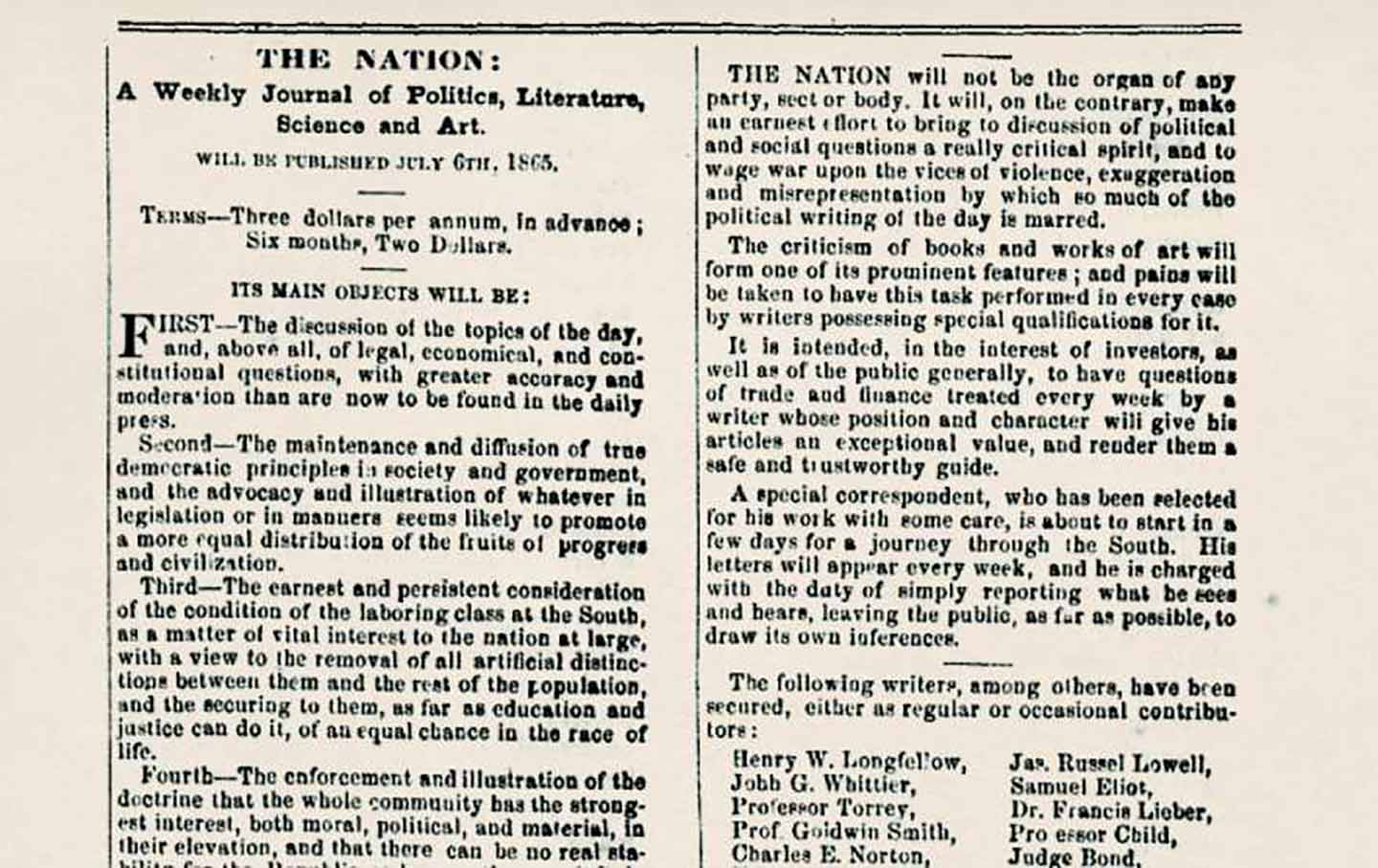
By the end of the night, Olmsted had raised $1,000 in capital; by the end of the week, he had trustees, a fundraising committee, and an editor. Though Olmsted himself would soon be temporarily distracted by his duties on the United States Sanitary Commission (a precursor to the Red Cross), his editor, an Irish immigrant named E.L. Godkin, kept the project moving forward, and on July 6, 1865, the first issue of The Nation rolled off the presses.
Godkin’s Nation promised “greater accuracy” than is “now to be found in the daily press,” while striving “to bring to discussion of political and social questions a really critical spirit.” It would promote “a more equal distribution of the fruits of progress” and promised “sound and impartial criticism of books and works of art.” As testament of the new magazine’s refusal to pander to its readers, the debut issue led off with this summary of the news: “The week has been singularly barren of exciting events.”
In 2025, we suffer a surfeit of exciting events, from the depredations of Elon Musk’s Department of Government Efficiency to Donald Trump’s latest authoritarian excess—or naked scheme for corrupt self-enrichment—to the most recent revelations about the Democratic Party’s ongoing failures of leadership. But as we mark our 160th birthday, it seemed more useful to look outward than backward or inward (though readers curious about how The Nation’s history runs alongside the country’s can consult the magazine’s official biography). Despite the daily barrage of dispiriting headlines, we choose to keep faith in this nation’s promise of liberty and justice for all—and in Olmsted’s belief in the liberating power of simply telling people the truth.
So we have asked 50 of the country’s leading writers and artists for (mostly) ground-level dispatches (though some are images or poems) of the view from where they stand. And since the other constant in this magazine’s history has been skepticism of the dreams of empire, we asked Viet Thanh Nguyen to reflect on America’s relations with the rest of the world. The result is one of the most profound and provocative essays I’ve had the pleasure to publish—an unsparing account of the costs, at home and abroad, of pursuing the chimera Nguyen calls Greater America, a gruesome national doppelgänger built on conquest and leaving a trail of blood and ruin from the killing fields of Cambodia to the prisons of El Salvador.
Double vision also animates John Nichols’s report on what the governors’ races in New Jersey and Virginia tell us about the future of the Democratic Party. Michele Goodwin meditates on how the Supreme Court’s Dobbs decision, which has deprived women in 19 states of the right to control their own fertility, has rendered them subject to the “Jane Crow” of court-sanctioned discrimination.
Our critics this month include Atossa Araxia Abrahamian on the relations between shipping and capitalism; Jorge Cotte on the series Deli Boys; Karrie Jacobs on Norman Foster’s edifice 270 Park Avenue; Evan Kindley on the poet James Schuyler; Samuel Moyn on Quentin Skinner and the politics of freedom; and Libby Watson on Brian Goldstone’s deep dive into the housing crisis.
Finally, a personal note: After many years as London correspondent, I began a deeper involvement with The Nation when Katrina vanden Heuvel asked me to coedit our 150th anniversary special issue (with a great deal of assistance from a young staffer named Richard Kreitner). Four years later, I took over as editor. So it is both fitting and a great pleasure to mark this, my last issue as editor, by again working with Ricky to put together the 50 states package that graces our 160th anniversary issue.
Editing The Nation these past six years has been demanding and rewarding in equal measure, but I am tremendously proud of the journalism we’ve published, and of our entire editorial team. And, of course, grateful to Katrina and Bhaskar Sunkara—and our donors and subscribers—for their support. I’ll be back in the fall as a special correspondent.
Thanks for reading!
D.D. Guttenplan
Editor
Disobey authoritarians, support The Nation
Over the past year you’ve read Nation writers like Elie Mystal, Kaveh Akbar, John Nichols, Joan Walsh, Bryce Covert, Dave Zirin, Jeet Heer, Michael T. Klare, Katha Pollitt, Amy Littlefield, Gregg Gonsalves, and Sasha Abramsky take on the Trump family’s corruption, set the record straight about Robert F. Kennedy Jr.’s catastrophic Make America Healthy Again movement, survey the fallout and human cost of the DOGE wrecking ball, anticipate the Supreme Court’s dangerous antidemocratic rulings, and amplify successful tactics of resistance on the streets and in Congress.
We publish these stories because when members of our communities are being abducted, household debt is climbing, and AI data centers are causing water and electricity shortages, we have a duty as journalists to do all we can to inform the public.
In 2026, our aim is to do more than ever before—but we need your support to make that happen.
Through December 31, a generous donor will match all donations up to $75,000. That means that your contribution will be doubled, dollar for dollar. If we hit the full match, we’ll be starting 2026 with $150,000 to invest in the stories that impact real people’s lives—the kinds of stories that billionaire-owned, corporate-backed outlets aren’t covering.
With your support, our team will publish major stories that the president and his allies won’t want you to read. We’ll cover the emerging military-tech industrial complex and matters of war, peace, and surveillance, as well as the affordability crisis, hunger, housing, healthcare, the environment, attacks on reproductive rights, and much more. At the same time, we’ll imagine alternatives to Trumpian rule and uplift efforts to create a better world, here and now.
While your gift has twice the impact, I’m asking you to support The Nation with a donation today. You’ll empower the journalists, editors, and fact-checkers best equipped to hold this authoritarian administration to account.
I hope you won’t miss this moment—donate to The Nation today.
Onward,
Katrina vanden Heuvel
Editor and publisher, The Nation