
Corporate Democrats Are Foolishly Surrendering the AI Fight
Voters want the party to get tough on the industry. But Democratic leaders are following the money instead.
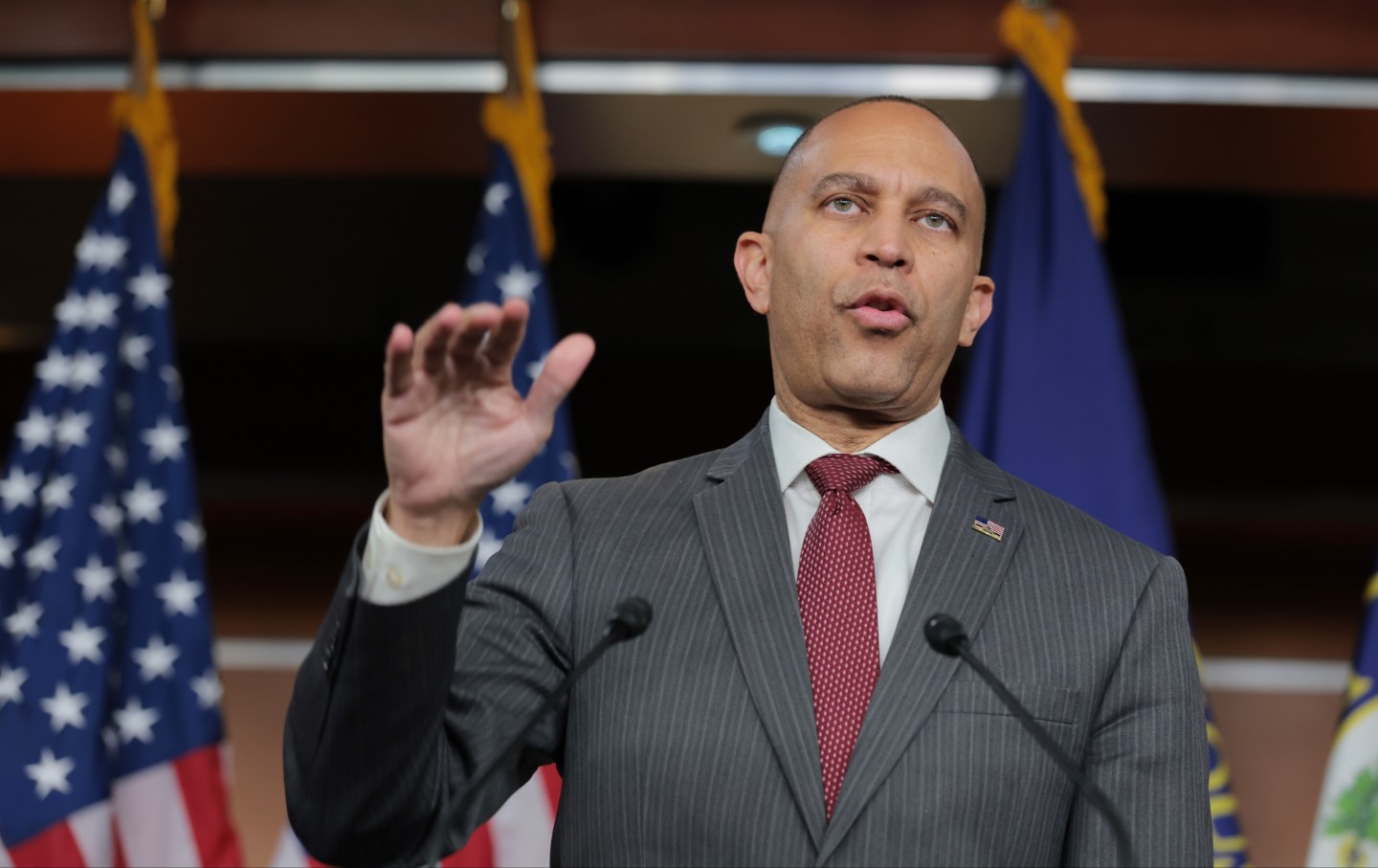
House minority leader Hakeem Jeffries speaks at a news conference at the Capitol on December 1, 2025.
(Anna Moneymaker / Getty Images))On Thursday, Time magazine named “the architects of AI” as its 2025 “Person of the Year”—a decision that obtusely revealed one of the deepest divides in American politics.
One of the covers for the Time issue is a painting by Jason Seiler that repurposes the iconic 1932 photograph Lunch atop a Skyscraper (whose photographer remains anonymous). The original photo shows a group of ironworkers jauntily eating lunch on a steel beam during the construction of Rockefeller Center, seemingly oblivious to the fact that they are 850 feet above the ground. In the Seiler cover, the workers are replaced by the Silicon Valley billionaires who are investing in AI: Meta CEO Mark Zuckerberg, AMD CEO Lisa Su, Tesla CEO Elon Musk, Nvidia CEO Jensen Huang, OpenAI CEO Sam Altman, the CEO of Google’s DeepMind division Demis Hassabis, Anthropic CEO Dario Amodei, and World Labs founder Fei-Fei Li.
Whether intentionally or not, the cover highlights many of the reasons AI has become a polarizing political issue. Like AI itself, Time has elevated the ultrarich at the expense of the working class, who are displaced and erased. The cover also thwarts creativity by mindlessly aping an earlier work of art, another shared trait with AI.
Time’s enthusiasm for AI is widely shared by American elites (including, perhaps most pertinently, the magazine’s owner, tech billionaire Marc Benioff). That enthusiasm has fueled a frenzy that is rapidly distorting the wider economy. As The New York Times reports, “The U.S. economy in 2025 is split in two: Everything tied to artificial intelligence is booming. Just about everything else is not.”
The Silicon Valley elite has bet heavily on AI as an economic savior and have found powerful allies in the GOP and the corporate wing of the Democratic Party. On Monday, Axios noted,
President Trump is betting his presidency—and the future of the GOP—on lightly regulated, fast expansion of AI….
Yes, Trump zigs and zags into countless political and diplomatic issues. But none comes close to his sustained, and surging, all-in alliance with tech billionaires and AI companies reshaping the US economy.
He won on the backs of working-class MAGA. But he governs, socializes and surrounds himself with tech swells and moguls.
As this account makes clear, there is a tension between Trump’s embrace of AI and the economic populism he sometimes voiced as a candidate. Edward Luce of the Financial Times cites the AI issue as proof that Trump has neglected his “blue-collar base” while embracing the Silicon Valley “broligarchy.”
Writing in The New Republic last month, Aaron Regunberg argued that opposition to AI was “electorally compelling” and likely to become even more potent in the future. The data we have tends to back this up. There are good reasons to think AI is a bubble. Industry leaders are already making arguments for a bailout, a scenario that would enrage voters. Other sources of AI unpopularity are the way it drives job loss and the low quality of the services it provides (which is helping popularize the term “enshittification.”
Opinion polls show that the public, and especially working-class voters, are wary about AI and pessimistic about the changes it is bringing. A Pew poll from April showed that 64 percent of Americans thought AI would lead to fewer jobs. Further, 43 percent believed AI would harm them, while 24 percent believed AI would benefit them. Fifty-eight percent worried that regulation of AI would not go far enough, while 21 percent believed that regulation would go too far.
The data centers that power AI are also terrible for the environment and drive up electrical bills by sucking up so much energy.
As Regunberg documents, the backlash to these data centers buoyed Democrats in off-year elections in early November:
Last week’s election results demonstrated the first concrete proof of the potency of an anti-AI message, as the effects of AI data centers on utility bills played a significant role in several major Democratic victories. In New Jersey, Governor-elect Mikie Sherrill’s closing argument was a pledge to freeze electricity rates, which have soared because of data-center demand. In Virginia, Governor-elect Abigail Spanberger won after pledging to make data centers “pay their own way,” and many Democrats went even further. At least one candidate, John McAuliff, flipped a seat in the House of Delegates by focusing almost entirely on tying his Republican opponent to the “unchecked growth” of data centers, with an ad that asked, “Do you want more of these in your backyard?” And in Georgia, Democrats won their first nonfederal statewide races in decades, earning 60 percent of the vote against two Republican members of the Public Service Commission by criticizing Big Tech “sweetheart deals” and campaigning for policies “to ensure that the communities that they’re extracting from” don’t end up with their “water supplies…tapped out or their energy…maxed out.”
As these election results suggest, data center opposition is remarkably bipartisan. A large proportion of Big Tech’s AI infrastructure buildout is occurring in red states, like Indiana, Texas, Ohio, and West Virginia, where data centers have added billions of dollars to household energy bills and inspired serious hostility from Democrats and Republicans alike.
Based on these results, Democrats have a tremendous opportunity to use the AI backlash for wedge politics. It’s a way to win back working-class voters who are already disillusioned with the GOP and Trump (whose own approval on the economy is at a record low of 31 percent, according to a recent AP-NORC poll). Not surprisingly, Bernie Sanders has been banging the drum on the need for AI regulation as part of his populist economic message.
Unfortunately, the congressional leaders of the Democratic Party, notably House minority leader Hakeem Jeffries, are almost as enamored of AI as Trump is. On Tuesday, as David Dayen of The American Prospect noted, “Jeffries announced an AI commission and put the most right-wing pro-business member of the caucus and the pro-Big Tech House member representing Silicon Valley on it.” One of the members of this new AI commission is New York Representative Josh Gottheimer, who owns more than $40 million in Microsoft stock.
Writing in The American Prospect on Thursday, Dayen reported, “New York Gov. Kathy Hochul completely rewrote a bill passed by the state legislature intended to regulate artificial intelligence models to ensure public safety, substituting it with language favored by the same Big Tech interests that have held fundraisers for her in recent weeks.”
Popular
“swipe left below to view more authors”Swipe →There is a deep political divide on AI. Voters clearly want the industry to be regulated. But under Trump, Republicans have embraced Silicon Valley’s agenda of minimum regulation. Democrats, meanwhile, are divided, with economic populists ready to tame the industry while pro-corporate party leaders are ready to serve Silicon Valley. Until Democrats change the leadership of their party, they won’t be able to win on AI.
More from The Nation

Donald Trump Is Bad at Politics Donald Trump Is Bad at Politics
The president’s flailing midterms campaign underscores a truth we should be acknowledging more often: He kind of sucks at this.

Obama Delivers a Scorching Rebuke to Trump—and Centrist Dems Obama Delivers a Scorching Rebuke to Trump—and Centrist Dems
Unlike other establishment figures, the former president isn’t scared to associate with the party’s left flank.
Elon Musk’s Mortal Threat to Democracy Elon Musk’s Mortal Threat to Democracy
The world’s richest man—saying he’s “wised up” to the fiction of self-government—is leveraging his wealth to sway elections, threaten Congress, and alter the global balance of pow...

Michigan Students Are All In for Abdul El-Sayed Michigan Students Are All In for Abdul El-Sayed
The progressive Senate candidate has won over students with his politics—and, in at least one case, his protein intake.
What Are Democrats Prepared to Do if Trump Rigs the Election? What Are Democrats Prepared to Do if Trump Rigs the Election?
In this week’s Elie v. U.S, our justice correspondent challenges Democrats' lack of a plan if Trump steals the midterms. Plus: the most racist, and honest, AI add ever.

