
The Coming Crisis in Kashmir
In the aftermath of an attack that claimed the lives of 26 Indian civilians, Kashmiri locals are afraid of what comes next.
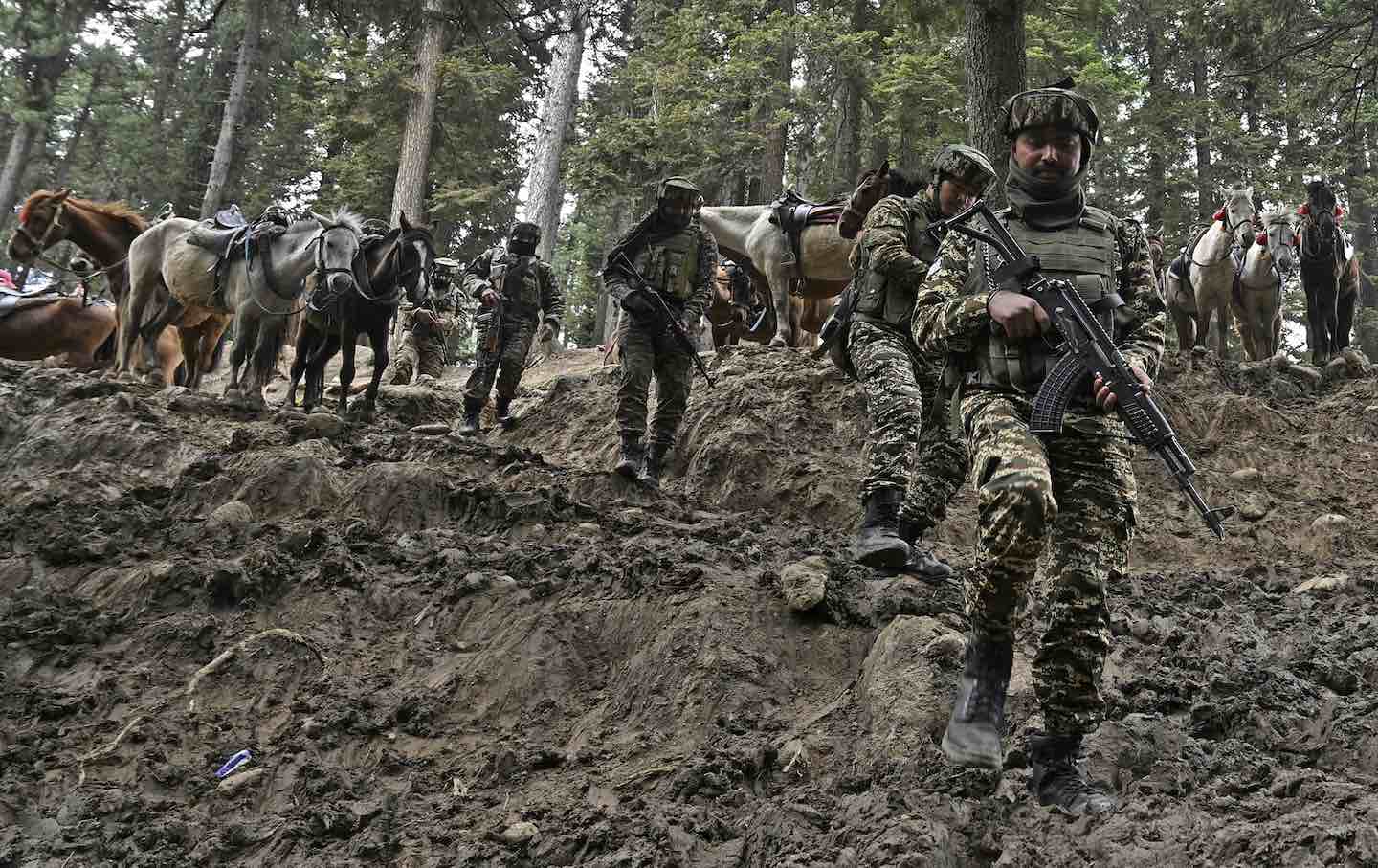
Indian soldiers during a search operation around Baisaran meadow in the aftermath of an attack in Pahalgam, 2025
(Tauseef Mustafa / AFP)
Pahalgam, Kashmir—Last week, Adil Hussain Shah, a 27-year-old horse operator, was taking a group of tourists to the Baisaran meadow, a scenic destination just outside the Kashmiri resort town of Pahalgam. The area is accessible only by horseback, and its views of the Himalayas and the ring of pine forests that surrounds the lush meadow is a favorite among visitors to the southern valley of Kashmir; it has been described as a “mini-Switzerland” by locals. On a normal day, families sprawl across the meadow, taking part in picnics and horseback riding and snapping photos of the mountains and greenery. Yet this idyllic scene became the site of the deadliest attack on Indian civilians in more than two decades—26 people died, Shah among them.
On the afternoon of April 22, armed militants emerged from the forests surrounding the meadow and trained their guns on the tourists. But before they began firing into the crowd, according to eyewitnesses, the militants questioned a number of men about their religion and asked them to recite verses from the Quran. If the answers didn’t establish that they were Muslim, they were shot at point-blank range. (By all accounts, women and children were not targeted.)
Since the meadow is not accessible by car, it took government forces more than an hour to reach the site of the attack. Local guides and horse operators were, as a result, the first responders, carrying the wounded on their backs or on horses to the nearest hospital in Pahalgam. At least 17 people were reported injured in the chaos.
Shah was among those who scrambled to help. “He was trying to carry a wounded man to safety,” said an eyewitness. “He kept shouting for help, asking others to stay low.”
“He left home that morning like always. When we heard [of the attack], we tried calling him—he didn’t answer,” Shah’s father, Syed Haider Shah, told me.
In his final moments, Shah intervened as the militants were about to shoot a group of tourists. A local who performed Shah’s final rites said, “He was shot three times—once in the neck, once in the shoulder, and once in the chest. He died trying to save lives.”
On social media, a number of videos detailed the scale of the carnage. A serene scene of children playing in the meadow is suddenly shattered by gunfire. In one clip, a man, smiling as he records his zip line ride with a selfie stick, remains unaware as chaos erupts below. In the background, people are seen running in all directions; a few fall to the ground, likely shot dead.
Rishi Bhat, the man who posted the video, was visiting the meadow with his wife and son. “We had reached Pahalgam that day and spent time sightseeing,” he told me from his home in Ahmedabad. As soon as Bhat had landed on the zip line, he and his family saw two men shot dead after being asked about their religion. “We ran together, terrified, and found a spot close to forests in the meadow where we could hide. There were already a few people sheltering there,” he said.
By the time the government forces arrived, the gunmen had already managed to escape. In the immediate aftermath, the Indian government blamed the attack on Pakistan-based militants, but it has otherwise provided scant details connecting the attack to Pakistan. The police have said that three of the shooters they’ve been able to identify belong to Lashkar-e-Taiba, a militant group that seeks to claim Kashmir for Pakistan. Pakistani officials have denied that the attackers belong to Lashkar-e-Taiba or any other group operating in the country.
In the week since the attack, a search operation for the militants has transformed into a brutal crackdown in Kashmir: Government forces have already detained hundreds of individuals for questioning and have demolished at least 10 residential houses—including a Pulwama home that reportedly belongs to the family of one of the accused militants. The explosives used to demolish the house damaged several other houses in the vicinity, including that of Ali Mohammad Thokar, who said, “We appeal to the government to do justice with us. And our houses are turned into ruins!”
The attack has sent shock waves across India and Pakistan, with fears that a renewed wave of violence will shatter an already fragile state of affairs between the two countries, which have disputed their claims of sovereignty over Kashmir for decades. In the last few years, the tensions have reached new heights: A 2019 suicide bomb attack, which killed at least 40 soldiers, led to Indian air strikes in Pakistan. And last summer, nine people were killed and 33 injured when militants opened fire on a bus carrying Hindu pilgrims. With the April attack in the Baisaran meadow, there are fears that an outright war is inevitable.
In response to the attack, India has rolled out a series of diplomatic actions and security measures that will surely lead to further escalation: The border has been closed, almost all Pakistani nationals have been ordered to leave the country, and a water-sharing treaty (the Indus Waters Treaty of 1960) has been suspended.
The treaty lays out parameters for regulating the flows of the Indus, Chenab, and Jhelum rivers, and India’s cooperation is vital for helping to ensure safe drinking water, access to hydropower, and planning for flooding. This is the first time either country has moved to suspend the treaty—an action that could prove to have dire consequences for Pakistan’s economy and agriculture.
India’s water minister, C.R. Patil, called the decision “historic” and “completely justified and in the national interest.” “We will [make sure] that not even a drop of water from the Indus River goes to Pakistan,” Patil wrote in Hindi on X.
Pakistan strongly rejected India’s suspension of the treaty, calling the move a threat to the livelihoods of 240 million Pakistanis, and warned that any interference with its water rights would be considered an “act of war.” Any threat to Pakistan’s sovereignty, officials have said, would be met with “firm reciprocal measures across all domains.”
Pakistan swiftly retaliated against India by suspending all trade and expelling Indian diplomats from Islamabad, closing Pakistan’s airspace to Indian airlines, and suspending the Simla Agreement, a peace treaty that was supposed to normalize relations between the countries in the aftermath of the Indo-Pakistani War of 1971.
“Long-standing agreements like the Indus Waters Treaty and the Simla Agreement have withstood past conflicts; disturbing these frameworks would only further destabilize the region,” said Anuradha Chenoy, a professor of international affairs at Jindal Global University.
Pakistani Prime Minister Shehbaz Sharif, while addressing a graduation ceremony at the Pakistan Military Academy, stated that he is ready for a “neutral investigation” of the attack. “The recent tragedy in Pahalgam is yet another example of this perpetual blame game, which must come to a grinding halt,” he said. “Continuing with its role as a responsible country, Pakistan is open to participating in any neutral, transparent, and credible investigation.”
Popular
“swipe left below to view more authors”Swipe →But Indian Prime Minister Narendra Modi has been less neutral: “I once again assure the affected families that they will get justice, and justice will be done. The perpetrators and conspirators of this attack will be served with the harshest response,” he said in a recent address.
Ajaz Ahmad Malik, a manual laborer in the Bandipore district of northern Kashmir, is scared of what might come next: “Mass arrests aren’t the answer, though only God truly knows who was involved. We have families too. Kashmiris are being threatened and attacked outside the valley.… Ordinary people shouldn’t be punished for the actions of a few.”
In the aftermath of the 2019 bombing, when Kashmir’s limited autonomy was revoked by India, hundreds of people were placed in preventive detention. This recent attack, some fear, will intensify India’s search operations and detentions, and that the space for dissent will shrink further.
In the valley, tensions are high, and residents are grappling with the possibility of a military confrontation. “If there’s a war, what can we do? It doesn’t feel like one yet, but if it comes, we’ll have to accept whatever fate brings us,” says Malik.
“We’ve seen situations like this before, and they do take a toll on your mental health,” says Gazala, a medical student from Srinagar. “If I’m being honest, I’m scared. The way students from Kashmir are being treated outside the region, and how people in the outskirts of Pahalgam are living in fear—it’s unsettling.”
In the last few days, several students from Kashmir who are studying in different parts of India have been attacked or harassed. Gazala is among those who are convinced that forced detentions and increased scrutiny on Kashmiri people will become a regular feature of daily life: “Just two years ago, my brother was taken into custody without any charges. Seeing what’s happening now brings all that fear back. The tension has only grown. I told my sister that it feels like something terrible is about to happen—maybe even war.”
According to recent reports, Pakistan believes it has “credible intelligence” that India will carry out a “military action” in the coming days. The unease in the air is hard to ignore, Gazala adds: “The fear is real, but we’ve lived through worse. And even in chaos, we continue to hold on to hope.”
Become a Sustaining Donor This September
Between the reemergence of right-wing red-baiting and Donald Trump’s use of the chilling National Security Presidential Memorandum–7 to criminalize left political organizing, we’re seeing McCarthyism reborn before our eyes.
This assault on democracy cannot be ignored or wished away. Resisting it requires bravery in the face of threats and repression, a steadfast commitment to the truth, and the unwavering belief that we can—and will—overcome this darkness.
We must have an independent media that sets the record straight, unearths corruption and abuses of power, and advances a politics of justice and dignity for all if we’re to win this fight.
That’s why I’m writing to you today. This September, The Nation needs to add 100 monthly donors to sustain our progressive journalism. Your contribution makes the next investigative report, the next truth-speaking column, and the next pathbreaking essay all possible.
I hope you’ll support our work with a recurring donation today. If you donate $10 or more a month, we’ll send you a brand new “Hands Off the Free Press!” sticker to recognise your commitment to our cause. Please, donate today.
Onward,
Katrina vanden Heuvel
Editor and Publisher, The Nation
More from The Nation
Israel’s Election Can’t Fix What Netanyahu Broke Israel’s Election Can’t Fix What Netanyahu Broke
The fundamental problem is not the name of the prime minister, but rather the actions of the Israeli government and the urgent issues that need to be addressed.

The AfD’s Rise Isn’t Just About East Germany The AfD’s Rise Isn’t Just About East Germany
The Alternative für Deutschland has a stable national poll lead, including in the former West Germany. Its rise owes to much more than Eastern grievances.
Chinese Development Is the Betrayal Washington Cannot Forgive Chinese Development Is the Betrayal Washington Cannot Forgive
The prospects for Xi Jinping’s visit are dim because American leaders are blaming China for the failures of globalization.

Pinochet: The Verdict of History in the Letelier-Moffitt Case Pinochet: The Verdict of History in the Letelier-Moffitt Case
An act of international terrorism on the streets of Washington, DC, still reverberates 50 years later.
How to Arrest Benjamin Netanyahu How to Arrest Benjamin Netanyahu
Make no mistake: The United States can seize Netanyahu for crimes under US law and prosecute him in US courts when he is in New York City this week.
In the Age of AI, Nuclear Weapons Abolition Is a Renewed Imperative In the Age of AI, Nuclear Weapons Abolition Is a Renewed Imperative
As long as we have nuclear weapons, the job of ending humanity will continue to be as easy as the push of a button—or an AI agent hacking into a nuclear command-and-control system...

