
Turkey Is Brutally Oppressing Queer People. Here’s What You Need to Know.
The government’s sweeping crackdown on the LGBTQ community is an escalation of a decades-long pattern.
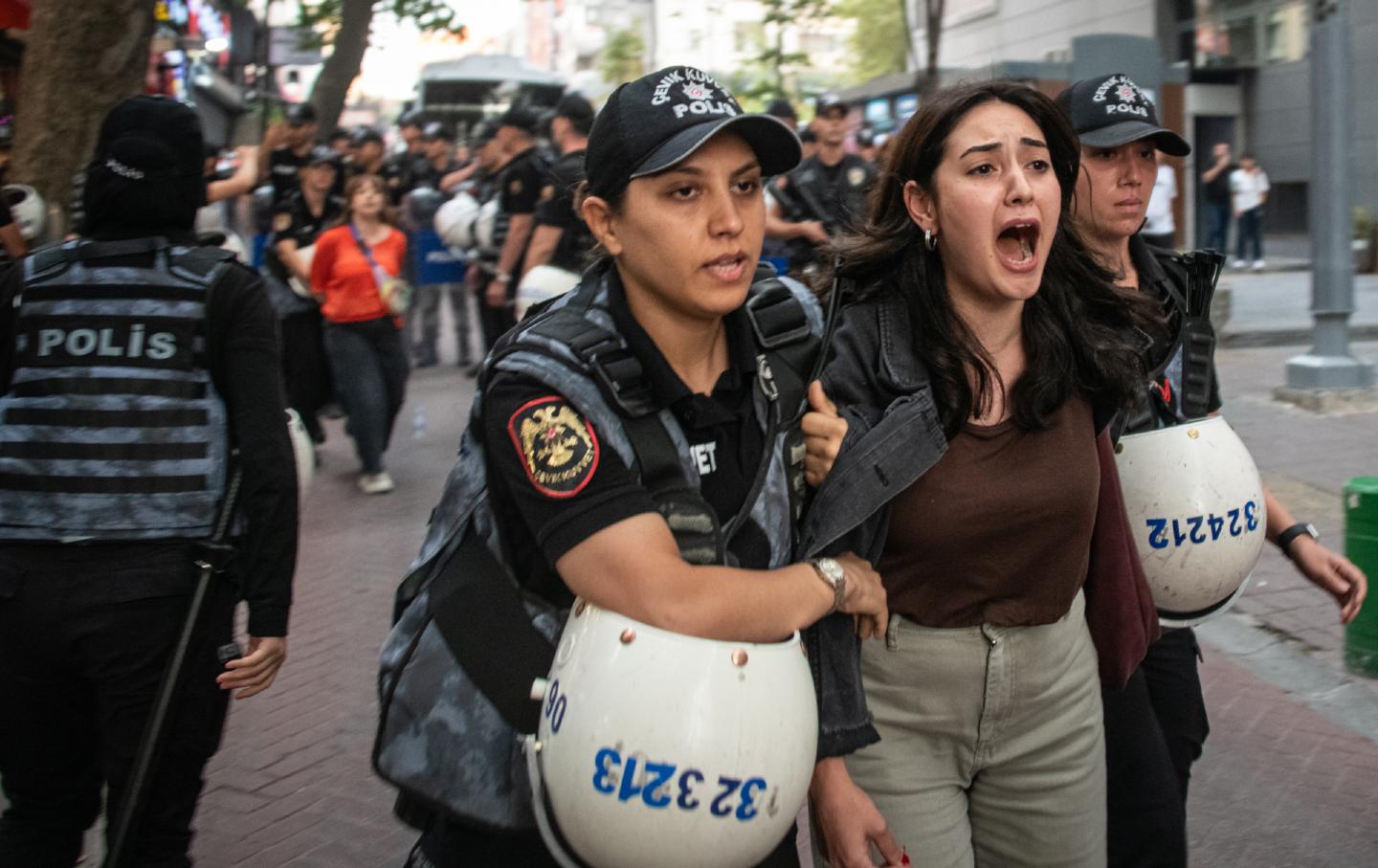
Turkish police detain dozens of LGBTQ rights protesters in Ankara, on September 15, 2026.
(Diego Cupolo / NurPhoto via Getty Images)Between September 12 and 14, in coordinated overnight raids across five cities, Turkish police targeted seven LGBTQI+ rights organizations, two groups supporting people living with HIV, and 13 bars and clubs where queer people gather. Board members of some of the country’s oldest LGBTQI+ associations, including Kaos GL and Lambda Istanbul, were taken from their homes. Human Rights Watch reports that at least 112 people were arrested and that 82 remain in detention by court order. Courts also ordered the blocking of dozens of websites and social-media accounts belonging to LGBTQI+ groups and activists; when people gathered outside Istanbul’s main courthouse to protest, more than a hundred were detained as well. The alleged offenses were “obscenity,” “prostitution”, and crimes against “public morality.”
Justice Minister Akın Gürlek named the operation “My Family Is Safe” and placed it squarely within President Recep Tayyip Erdoğan’s “Decade of Family and Population,” a 10-year programme launched this year to reverse Turkey’s falling birth rate and defend what the government calls “national and moral values.” That framing is the most important aspect of the raids. Homosexuality has never been a crime in Turkey. What this month showed is a state that has found other ways to criminalize queer life and now presents such measures as family policy.
This didn’t come out of nowhere. Istanbul’s Pride march has been banned every year since 2015, on the grounds of public safety, and police have detained hundreds of people who tried to march anyway. But those detentions were fleeting. Marchers were picked up on the street and, for the most part, released within hours. This month’s operation was different in kind. It did not target a march; it targeted the infrastructure of a movement, including its offices, leadership, health services, websites, and social spaces, in five cities at once. It relied on criminal law rather than public-order powers, and courts have kept dozens of people in pretrial detention. And it was announced not as a policing matter but as the enforcement of a government program.
To understand how Turkey arrived here, it helps to know how the family became the organizing principle of the state’s politics, and how much of that politics follows a script written transnationally.
Same-sex relations have been legal in Turkey since 1858, earlier than in most of Europe. Yet LGBTQI+ people have never enjoyed equal citizenship in practice. As with other minority groups, including ethnic and religious minorities, the state’s approach to LGBTQI+ people was long defined primarily by denial, repression, and nonrecognition. This decades-old policy began to shift after the neoliberal-Islamist Justice and Development Party (AKP) came to power in 2002, but not toward greater equality. Instead, LGBTQI+ people increasingly became targets of explicit political, administrative and legal action, driven by the party’s conservative gender politics. This is not to say that queer people had been free from state harassment or the “indirect” violence of the law before then. What distinguishes the AKP era is the increasingly overt use of law, administrative power and state institutions to act against LGBTQI+ visibility, organization and public life.
Earlier manifestations included, among others, the removal of sexual orientation from the antidiscrimination provision of the draft 2004 Penal Code during its drafting; repeated fines imposed on trans women under the 2005 Misdemeanours Law; persistent impunity for police violence; the requirement that gay conscripts “prove” their homosexuality to obtain an exemption from military service; the use of “unjust provocation” to reduce sentences for men who killed gay or trans people; legal proceedings seeking the dissolution of Lambda İstanbul, one of Turkey’s oldest LGBTQI+ organizations; and the declaration by the minister responsible for women and family affairs, Selma Aliye Kavaf, that “homosexuality is a disease.”
The turning point came in June 2015, when the Istanbul Pride march was banned for the first time and dispersed with water cannons. It has been banned every year since, and activists who defy the ban face mass detentions each June. Repression did not stop the movement from growing, though. By the mid-2010s, LGBTQI+ organizing had become a visible, consolidated social and political force, with organized marches drawing tens of thousands. That visibility changed what came next. After the attempted coup of July 2016 and the authoritarian consolidation that followed, restrictions on LGBTQI+ activism became part of a broader campaign against any social movement the government saw as a challenge to its authority.
Sporadic bans and moralizing statements hardened into coordinated institutional repression. Under the post-coup state of emergency, the governor of Ankara imposed an indefinite ban on all LGBTQI+ events in the province in 2017. By 2020, the restrictions had reached the regulatory state: The broadcasting authority imposed sanctions on programs depicting same-sex relationships, and the Ministry of Trade required rainbow-themed products sold online to carry an 18+ warning.
In 2021, institutional repression and political rhetoric fused. Erdoğan declared that there was “no such thing” as “LGBT.” Weeks later, his government justified Turkey’s withdrawal from the Istanbul Convention—the Council of Europe treaty on preventing violence against women—on the grounds that it had been used to “normalize homosexuality.
From 2022 onwards, “LGBT” became an organizing theme in government politics. Official discourse now casts the LGBTQI+ movement, and increasingly LGBTQI+ people themselves, as a threat to the family, social values, and the national order. Government policy has also moved beyond state institutions into organized public mobilization, most visibly through so-called “Great Family Gatherings” held in opposition to LGBTQI+ visibility. The resulting dichotomy places queer existence outside the family altogether, as if queer people neither belonged to families nor formed families of their own. That is the framing Gürlek invoked when he called the September raids “My Family Is Safe.”
None of this is a purely Turkish story. The government is working from the script of the transnational “anti-gender” movement, so called because it organizes against what it labels “gender ideology,” a catch-all for feminism, LGBTQI+ rights and any loosening of traditional gender roles. What makes this movement international is not merely that similar ideas circulate across borders. Rather, a shared political repertoire, built around a heterosexual, cisgender ideal of the “traditional family,” is translated into local vocabularies and written into law and institutions.
Across many countries, LGBTQI+ people have come to be portrayed as incompatible with, or a threat to, the “traditional family,” and that rhetoric is used to justify exclusionary policies and, in some places, criminalization. Coalitions such as the Political Network for Values and the Group of Friends of the Family have carried conservative understandings of family, gender, and sexuality into international institutions, including the United Nations. The clearest example is the Geneva Consensus Declaration on Promoting Women’s Health and Strengthening the Family. Cosponsored by the United States alongside Brazil, Egypt, Hungary, Indonesia and Uganda, signed by 32 states in October 2020, and later transmitted to the UN General Assembly, the Declaration listed among its principal aims the defense of the family as “foundational to any healthy society,” described the family as the “natural and fundamental group unit of society” entitled to state protection, and insisted that abortion “in no case should be promoted.” (The Trump administration rejoined within days of returning to office in January 2025.) The family thereby becomes more than a social or legal category: It operates as a normative and political framework through which reproductive policy, gender, sexuality and LGBTQI+ rights are contested.
What is new in this politics, therefore, is not hostility toward LGBTQI+ people. Rather, previously distinct questions, including LGBTQI+ rights, feminism, reproductive rights, fertility and the protection of children, are folded into a single narrative about threats to the family, demographic continuity, and the national social order. In Turkey, that narrative has been expressed in an Islamic-nationalist vocabulary centered on the “traditional family,” falling birth rates, “national and moral values,” and resistance to supposedly foreign projects of “gender-neutralization.”
Popular
“swipe left below to view more authors”Swipe →Erdoğan’s speech to the International Family Forum on May 23, 2025, illustrates how the translation from transnational to national works. He blamed individualism and changing family structures on globalization and “cultural imperialism”; described “gender-neutralization” as an organized global project “infiltrating the fabric of [Turkish] society” and threatening “national integrity”; and, within this narrative, cast LGBTQI+ people as “enemies of humanity, enemies of women, enemies of children.” He tied all of this to Turkey’s falling fertility rate, praised countries that had defined the family in law or Constitution as a union between a man and a woman, and promised that Turkey would take a “leading role” internationally on the issue. In the same speech, he called declining fertility a “disaster,” declared that “every abortion is a murder,” and announced that 2026–35 would be the “Decade of Family and Population.”
That agenda has since been embedded in the machinery of the state. On May 2, 2026, the Official Gazette published Presidential Circular No. 2026/4. The circular (the equivalent of a US presidential executive order) frames human rights and individual freedoms as a tool of what it calls “harmful movements” promoting “gender-neutralization”; treats changes to family and population structures as an “existential threat”; and calls for measures to protect future generations from “gender-neutralizing” trends, including laws to promote marriage and to protect what it terms “traditional marriage,” with the stated aim of “protecting and strengthening the family and population structure.” Four months later, police were raiding LGBTQI+ organizations under the banner “My Family Is Safe.”
Taken together, these developments show that anti-LGBTQI+ politics in Turkey cannot be reduced to hostile rhetoric or episodic repression. The family has become the framework through which demographic anxiety, gender and sexuality, national identity, and state authority are bound together. LGBTQI+ people are positioned not merely as a moral or cultural “other” but as a threat to the demographic and social order the state has set out to preserve. The Turkish case also shows what transnational anti-gender politics looks like on the ground: a narrative that circulates globally, is translated into a national political vocabulary, institutionalized through law and policy, and then enforced by the police.
It is LGBTQI+ people who pay the price: shrinking space for visibility and association, greater exposure to state and social violence, and an increasingly hostile environment in which our rights, our organizations and our presence in public life are under pressure. All of this unfolds against a legal framework that offered scant protection to begin with. Anti-gender politics does not merely reshape political discourse. It deepens the legal and social insecurity in which queer people in Turkey are required to live, an insecurity that, this month, was given a name.
More from The Nation
Writing About War as Bombs Fall Writing About War as Bombs Fall
While the Israeli government launched a well-orchestrated offensive of disinformation and hyperbole that would make the illegal permissible in the war on Gaza.
The Anatomy of a Literary Scandal The Anatomy of a Literary Scandal
The pillorying of Canadian-Haitian novelist Thélyson Orélien, accused of using AI to write his new novel, is the latest in a chaotic year for French publishing.
Has France’s Government Overplayed Its Hand? Has France’s Government Overplayed Its Hand?
The speed and scale of the police response mark a dangerous new normal.
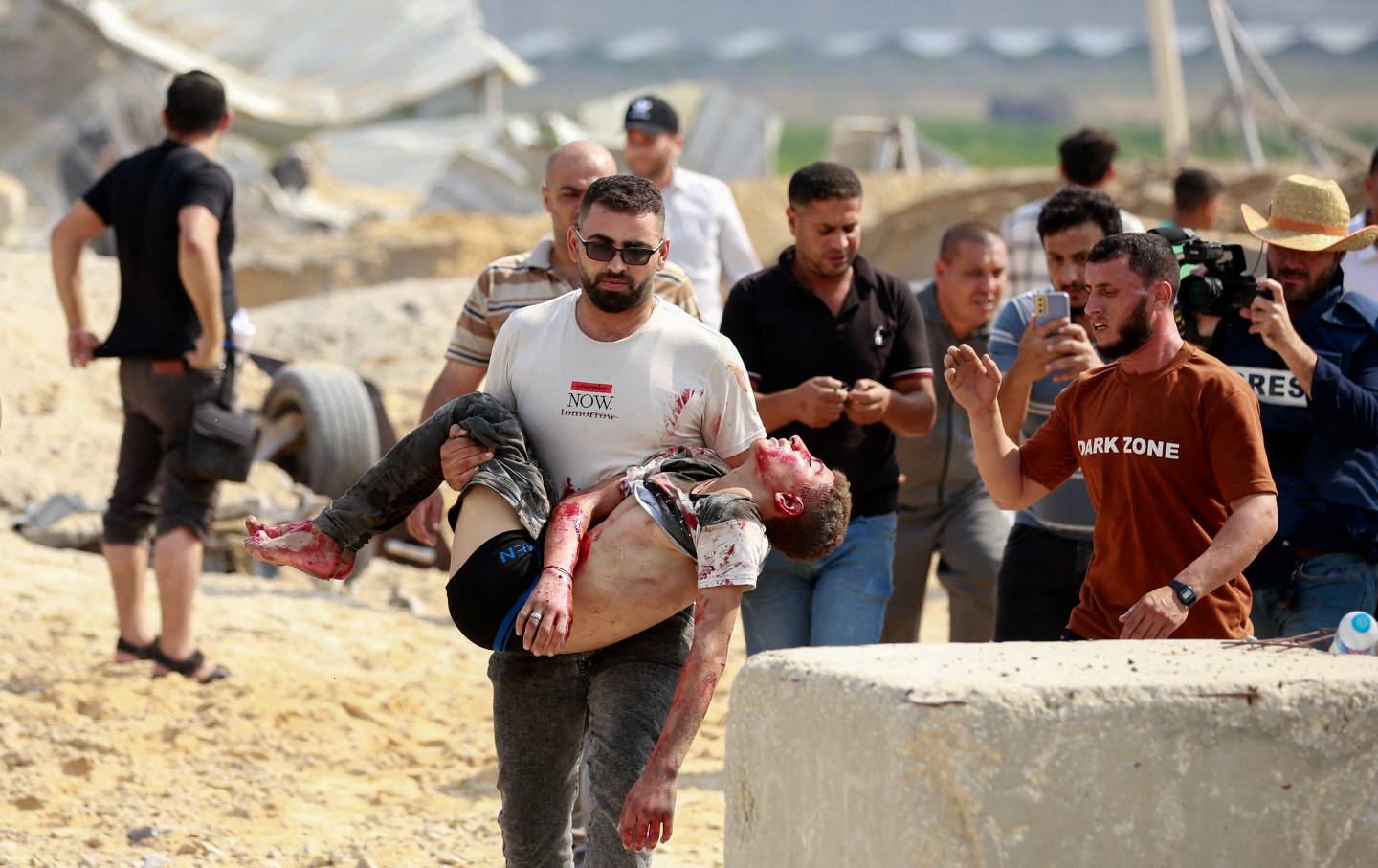
This Is Not an Anniversary This Is Not an Anniversary
Does remembering the date of October 7 make it easier to name?
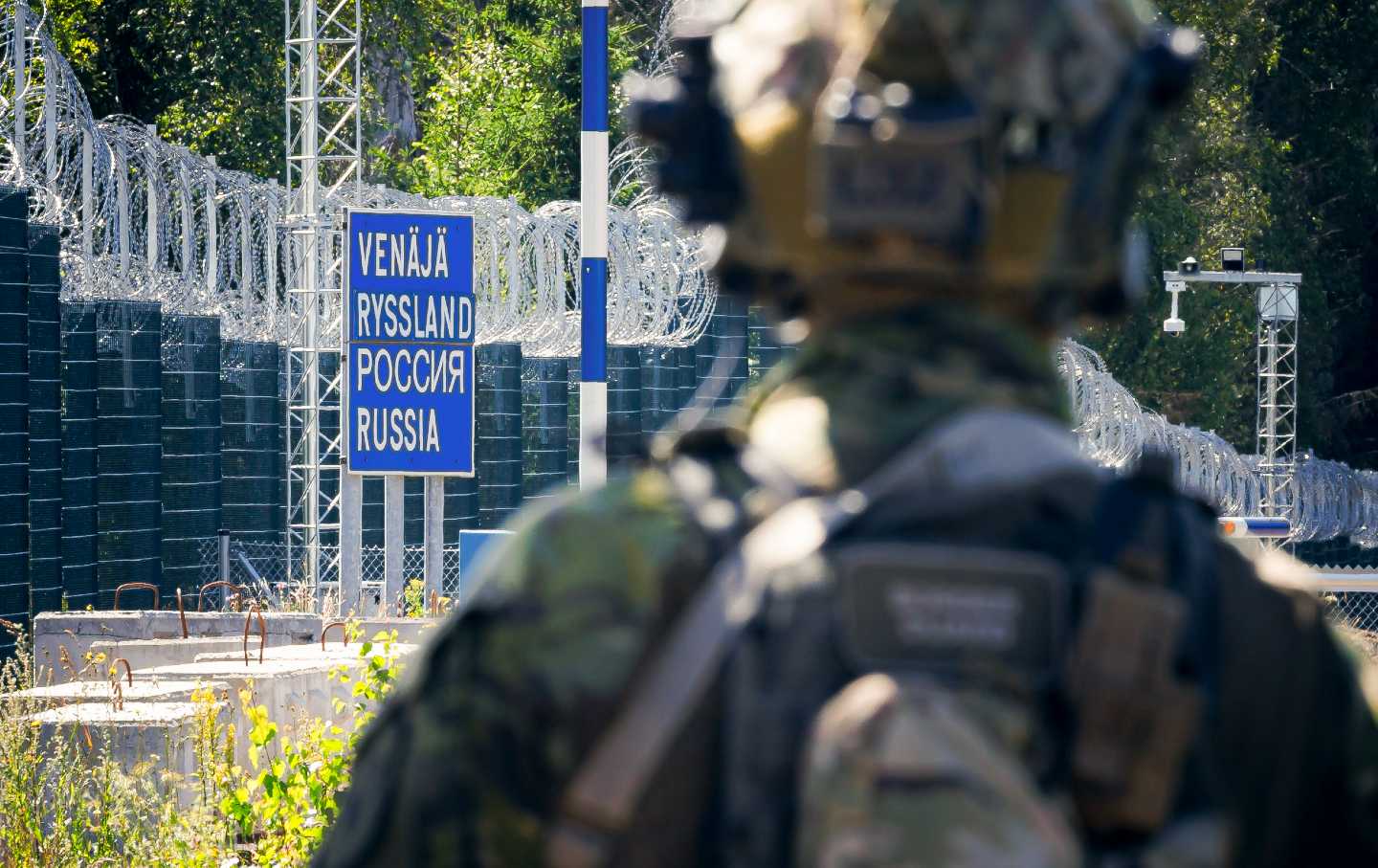
Are Europe and Russia Slow-Walking to World War III? Are Europe and Russia Slow-Walking to World War III?
Dangerous rhetoric has been escalating on both sides for some time now.
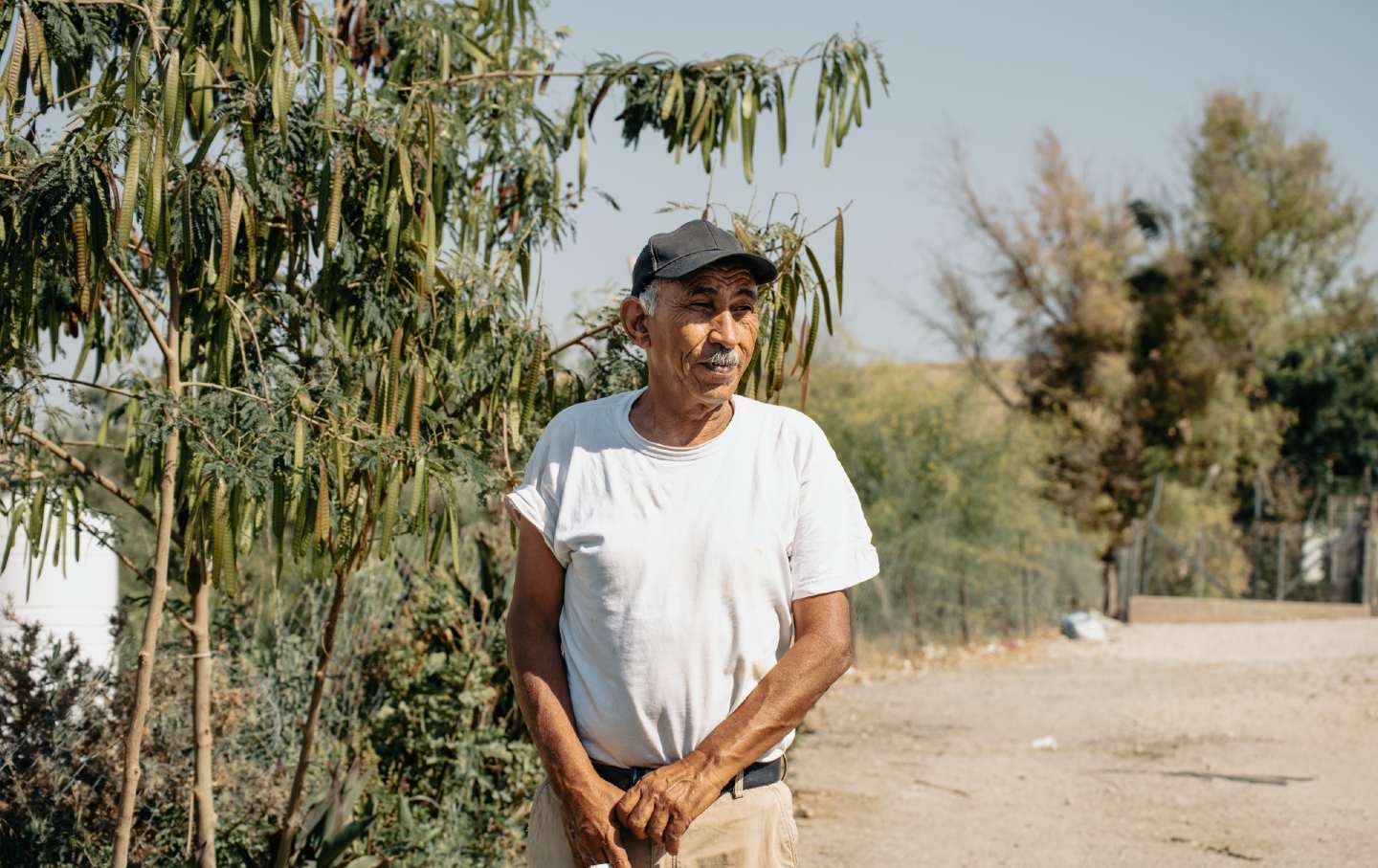
This Village Has Been Fighting Israel’s Demolition Orders for Years. It May Be on Its Last Stand. This Village Has Been Fighting Israel’s Demolition Orders for Years. It May Be on Its Last Stand.
A new order for Khan al-Ahmar’s destruction failed to attract the international attention that had protected it in the past, and residents fear they can no longer stop the bulldoz...

