
The Supreme Court Absolutely Shredded Trump’s Birthright Citizenship Case
But this also begs the question: why is this facially unconstitutional case before the court in the first place?
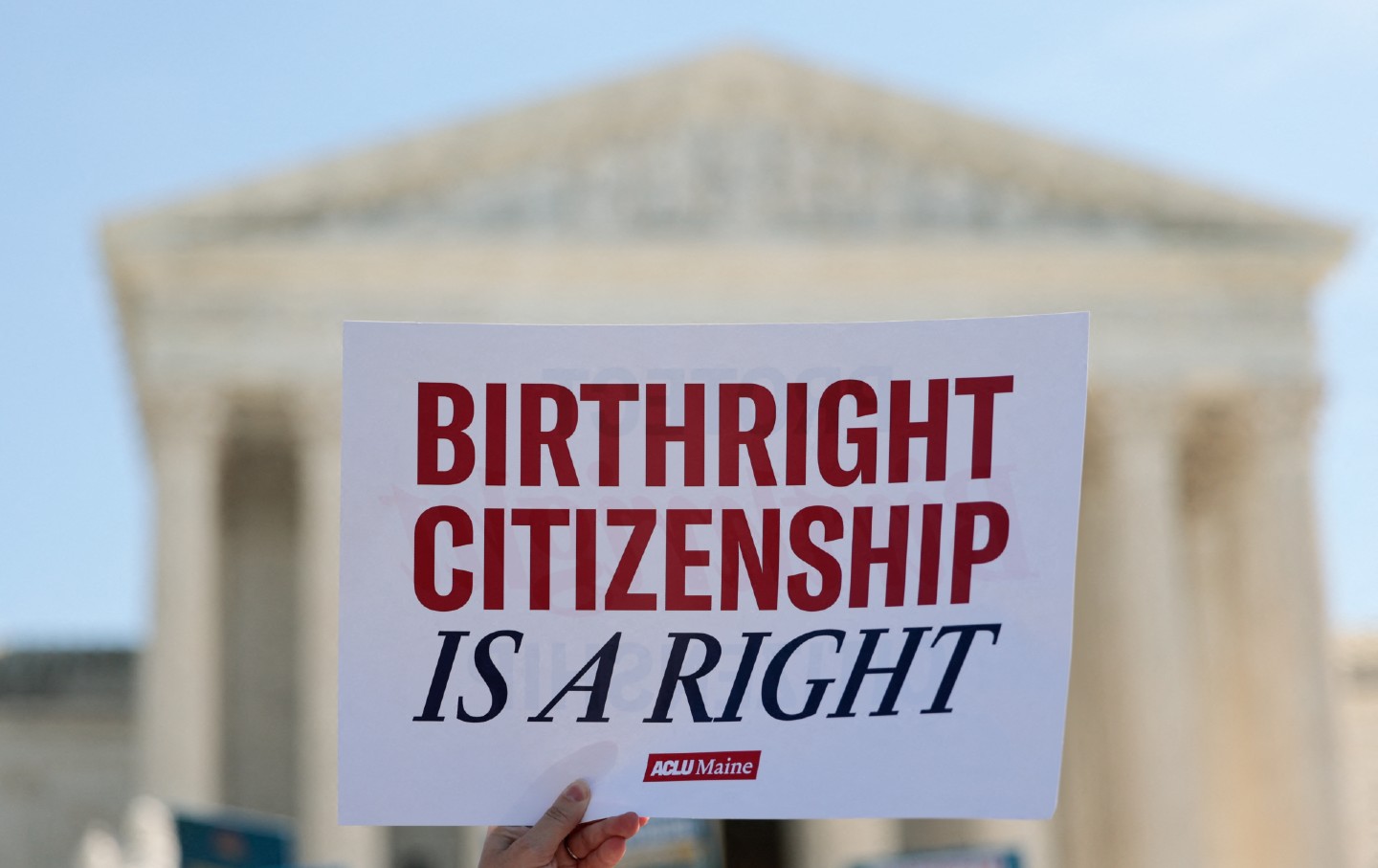
Demonstrators rally in support of birthright citizenship outside the Supreme Court on April 1, 2026.
(Mandel Ngan / AFP via Getty Images)
On Wednesday, Donald Trump’s executive order challenging birthright citizenship got its day at the Supreme Court. In honor of the occasion—or, more likely, in a foolish attempt at intimidating his handpicked justices—Trump briefly attended oral arguments, marking the first time in recorded history that a sitting president has come to a Supreme Court hearing.
The case pits Trump’s deeply held anti-immigrant bigotry against the clear language of the 14th Amendment and nearly 130 years of Supreme Court precedent. At its heart is the question of whether the president can change the meaning of the Constitution to prevent children born on US soil to undocumented immigrants and temporary travelers from being citizens. It’s the highest-profile case of the court’s term—and Trump got crushed. He will not lose 9–0, as he should. His crusade against immigrants and their children will continue in other forms. But I believe Trump will lose this case. And given the Republican and MAGA-aligned composition of the Supreme Court, that will have to be enough for now.
The case is called Trump v. Barbara—with “Barbara” being a pseudonym for a plaintiff represented by the ACLU who challenged Trump’s executive order. The ACLU’s argument is simple: Birthright citizenship is conferred on all people who are born within the territory of the United States by virtue of the 14th Amendment. The first sentence of the first section of that amendment states: “All persons born or naturalized in the United States, and subject to the jurisdiction thereof, are citizens of the United States and of the State wherein they reside.”
This is all the evidence the plaintiffs need. Pointing to this clause of the 14th Amendment is like Tom Brady responding to the question “Were you a good quarterback?” by pointing to the Super Bowl rings on his fingers. Still, the plaintiffs have even more law on their side if they want it: a 1898 case by the name of United States v. Wong Kim Ark. In that case, the citizenship of a child born in the United States to Chinese-American parents was challenged. The court ruled that the child was a citizen because he was born in San Francisco, which is where his parents were living at the time of his birth. In terms of birthright citizenship, that case should be game, set, match.
In response, the Trump administration, as represented by US Solicitor General John Sauer, made a series of wild arguments steeped in bigotry and xenophobia. First, the administration argued that the 14th Amendment was a narrow, time-specific intervention that applied only to the enslaved people freed by the Civil War. While it is true that the 14th Amendment directly overturned the Dred Scott decision (which held that no slave—and, indeed, no Black person—could become a citizen), the text, which I just quoted for you, makes it unequivocally clear that Trump and Sauer are wrong. It does not say, “All formerly enslaved persons”; it says, “All persons.”
Next, the Trump administration tried to get around the obvious implications of the Wong Kim Ark ruling by arguing that it applied only to children born to parents who are either “domiciled” in the United States or who owe “allegiance” to the United States. In court, Sauer argued that undocumented immigrants and temporary foreign visitors can never be lawfully “domiciled” in the US nor owe allegiance to this country, and therefore their children cannot be citizens.
This argument is bollocks. During oral arguments, six of the justices ripped it apart.
The ripping started almost immediately, with Chief Justice John Roberts telling Sauer that the sources he was using as evidence were “quirky.” Justice Elena Kagan followed up by observing that Sauer was using some “pretty obscure sources.” Roberts and Kagan were actually being nice; those “sources” were not merely “quirky” and “obscure”; they were the writings of straight-up white supremacists who tried to undermine the 14th Amendment by arguing openly for a white ethno-state where Chinese Americans could never be citizens. Sauer relied in particular on the work of Alexander Porter Morse, a white supremacist lawyer who argued Plessy v. Ferguson on behalf of the segregationists. He also argued against Wong Kim Ark, saying that “transient” people are not sufficiently connected to the United States to confer citizenship onto their children. The fact that Roberts and Kagan noted, however politely, that Sauer’s sources are reprehensible racists, is significant.
Later in the hearing, Roberts also questioned one of Trump’s stated reasons for rewriting the Constitution. Trump and his MAGA allies have repeatedly said the executive order is needed to stop “birth tourism”—which is the idea that tourists come to the United States to have children specifically so their children can have US citizenship. Roberts asked if Sauer had any evidence that birth tourism is really a thing. Sauer cited (not making this up) unnamed Chinese media reports. Roberts did not sound impressed. He responded by asking Sauer to agree that such reports should not impact the legal analysis of the 14th Amendment or Wong Kim Ark. Sauer, amazingly, said it should, because we’re “living in a different world” from Wong Kim Ark, where citizenship is potentially a mere “plane ride away.”
That led Roberts to proclaim a phrase that will probably be etched onto his tombstone: “It’s a different world, but it’s the same Constitution.”
I do not think Roberts is on board with rewriting that Constitution to appease Trump and his Chinese media sources.
Assuming the liberals agree (and, just trust me here, there is nothing that Justices Kagan, Sonia Sotomayor, and Ketanji Brown Jackson said that suggested they were even slightly interested in Sauer’s arguments), that brings us to four votes to uphold birthright citizenship.
A fifth vote can almost surely be found from Justice Amy Coney Barrett. She really homed in on the difference between two jargony terms: jus sanguinis versus jus soli. Jus sanguinis (right of blood) is the idea that citizenship flows from the citizenship status of your parents; jus soli (right of soil) is the idea that citizenship flows from where you are born. Sauer and MAGA have been arguing that we should do citizenship by right of blood. But Barrett’s questions heavily favored the right-of-soil approach, and she (along with Justice Jackson) seemed to be trying to show that Sauer’s position was not just antithetical to how citizenship has always been done in the US since the 14th Amendment essentially invented the concept of a US Citizen (as opposed to a citizen of an individual state), but is also unworkable.
Barrett took particular issue with Sauer’s formulation of “allegiance,” questioning how the Trump administration could know whether a parent “owed allegiance” to the United States or not. She then brought up the case of captured Africans, illegally brought here even after the slave trade was officially outlawed. She said that, under Sauer’s reasoning, those people could not be lawfully “domiciled” in the US, since they were brought here illegally. She also argued that the captives would obviously want to “escape” back to their home countries as soon as possible, thus proving that they owed no allegiance to the US. And yet, the US treated their children as citizens.
Sauer responded (and, again, I couldn’t possibly make up this level of idiocy) that former slaves always had the “intent to remain” in the US, thus proving their allegiance to the country. Pro tip for any white people out there: When your argument requires inventing apocryphal Black people who love their captors, you’ve lost. You should shut up, sit in a corner, and rethink your life’s choices.
And that wasn’t even the best line by Barrett. In a different colloquy with Sauer, she asked about “foundlings”—children “found” in the US whose parents cannot be identified. Sauer said that there were, potentially, statutory protections for these children, and she cut him off by saying: “Yeah, yeah, yeah, but what about the Constitution?” Sauer did not have a good answer for that whole “Constitution” thing. And this is where I gently remind you that Barrett is the mother of adopted children and probably does not put a lot of weight behind the idea that “blood” determines “citizenship.”
Barrett likely brings us to five votes in favor of birthright citizenship, but wait, there’s more, because Justice Neil Gorsuch was also triggered. Gorsuch’s first question was about the issue of what “domiciled” actually means, and he seemed unsatisfied with Sauer’s various answers. Then Sauer really stepped in it when Gorsuch asked, “Would Native Americans be citizens under your standards?” Sauer said, “I’d have to think about it.” Folks, if you know one thing about Neil Gorsuch, it should be that he cares deeply about the rights of Native Americans. It is borderline malpractice to go before the Supreme Court and not be prepared to answer a question from Gorsuch about how your argument impacts Native Americans.
This doesn’t mean Gorsuch is a definite “Yes” for birthright citizenship. He seems like a little less of a sure thing than Roberts or Barrett, because he was more concerned with the domiciled question than they were and pushed the ACLU’s lawyer (Cecilla Wang, who did an excellent job) on the point. He didn’t seem to like Wang’s answers to his questions either. But I think Gorsuch will ultimately uphold birthright citizenship because he considers even out-of-status immigrants as domiciled in the US, at least until Congress explicitly says they’re not.
Friends, six votes is more than enough for me in this case. But there’s a chance we could get to seven, depending on which way the wind is blowing through alleged attempted rapist Brett Kavanaugh’s empty head. On the one hand, Kavanaugh seemed to try to argue that, while Congress probably can change the constitutional definition of citizenship, Trump probably cannot. On the other, Kavanaugh was also the one of the justices who brought up the part of the case I thought would be front and center if Trump were going to win: the difference between people lawfully in the country, if only temporarily, versus people unlawfully in the country, regardless of how long they’ve been here.
I expected the Republican justices to harp on this point ad nauseam, arguing that, no matter what the Constitution or Wong Kim Ark say, a parent who is not allowed to be here can never confer citizenship on a child subsequently born here. But only Kavanaugh (and Alito) brought it up, and only to Wang (he didn’t throw it out there to help Sauer while he was floundering), and even then he didn’t belabor the point. I won’t know Kavanaugh’s vote until I see it, but if you want to argue that he’s actually a seventh vote to uphold birthright citizenship (with one of his classic four-paragraph concurrences where he tries to appease all sides), it would be a reasonable bet.
Getting to eight votes will be harder, but not impossible. That’s because I don’t think Justice Clarence Thomas fully bought Trump and Sauer’s argument. Thomas asked three questions (which is a lot for him), and only one was obviously helpful to Sauer. Thomas seems to agree with Sauer’s initial point about the 14th Amendment: that it applies to former slaves and former slaves only. He pointed out (correctly) that immigration was not really a focus in the discussions surrounding ratification of the 14th Amendment. But his first question was whether Sauer’s position would lead to different citizenship status depending on the state you’re born in (which I think Thomas thinks would be bad). And he really didn’t give any opinion on the argument over Wong Kim Ark and whether birthright citizenship for all was confirmed in that case, over and above what the 14th Amendment offered. I wouldn’t say Thomas is a likely vote to uphold birthright citizenship, but he didn’t sit there like a troll under the bridge who thinks history ended in 1865 like he usually does.
But that’s where the winning streak ends. There is no chance that we’ll get to nine votes, because Justice Samuel Alito’s brain remains entirely pickled by Fox News. Late-stage Alito is always good for one absolutely insane analogy, and, in this case, it was about the specter of an “Iranian immigrant” who comes to this country to give birth to a child so that child can eventually be raised as some kind of sleeper-cell agent waiting to be deployed against America.
Alito is gone. There is no hope for him. But there surely is hope for the rest of us. Trump will lose, 5–4 at least, and it’s not beyond reason that he could lose by a stunning 8–1.
Popular
“swipe left below to view more authors”Swipe →Which raises the question: Why is this stupid case even here in the first place? Trump’s arguments bear almost no relation to the law or how the law has been interpreted for over 100 years. Trump repeatedly lost this case in lower courts, meaning the Supreme Court didn’t even have to grant him a hearing. Why are we being dragged through this spectacle to fight the facially unconstitutional proposition that Trump can change the meaning of the Constitution through executive order?
My best guess, after listening to the oral arguments, is that Roberts wanted to make a bit of a show of “standing up to Trump” on a fundamentally easy case. Roberts and his cabal want to say no to this argument, and then bathe in all the “the Supreme Court is an independent institution” stories that will surely follow. Defeating Trump in this case, loudly and thoroughly, gives the Republican justices cover (they think) for all the other times they capitulate to the Trump administration. Trump’s birthright citizenship argument is a straw man, a device designed to be beaten so the court can show how strong it is.
It will probably work. The media is just addled enough to make it work. Trump will lose birthright citizenship, then have a complete meltdown, and the court’s Republican supermajority, which is just about to gut the Voting Rights Act, will be made to seem reasonable by comparison.
Sadly, I’ll take it. Because there have been other easy cases that the court should have smashed (I’m thinking of Trump’s immunity argument) that Trump actually won. This case never should have gotten to the Supreme Court, but it’s here. Trump should lose 9–0, but he won’t. The media shouldn’t praise the Roberts court for ruling against Trump on this ludicrous argument, but it will.
Still, Trump will lose. In Trump’s America, that has to be enough for me. I will take the “W” when it comes down, likely in June, and then move on to the next fight against the fascists.
Your support makes stories like this possible
From illegal war on Iran to an inhumane fuel blockade of Cuba, from AI weapons to crypto corruption, this is a time of staggering chaos, cruelty, and violence.
Unlike other publications that parrot the views of authoritarians, billionaires, and corporations, The Nation publishes stories that hold the powerful to account and center the communities too often denied a voice in the national media—stories like the one you’ve just read.
Each day, our journalism cuts through lies and distortions, contextualizes the developments reshaping politics around the globe, and advances progressive ideas that oxygenate our movements and instigate change in the halls of power.
This independent journalism is only possible with the support of our readers. If you want to see more urgent coverage like this, please donate to The Nation today.
More from The Nation

How the Military Mindset Has Crushed Our Country’s Men How the Military Mindset Has Crushed Our Country’s Men
I talked to troops and cadets about the kind of masculinity the military encourages. Its ripple effects on mental health are dire.

What the Dissents in the Mifepristone Case Tell Us About What’s to Come What the Dissents in the Mifepristone Case Tell Us About What’s to Come
Justice Alito called the Supreme Court’s order “unreasoned” and “remarkable,” while feigning ignorance over the decades of research pointing to mifepristone’s safety.
The Hypocrisy of Trump’s 9-Hour Prayer Festival The Hypocrisy of Trump’s 9-Hour Prayer Festival
The claim that the founders meant America to be a Christian nation isn’t just bad history—it’s a declaration of war by the religious right.
Government by Payback Squad Government by Payback Squad
The Trump White House has weaponized all the arms of federal law enforcement to intimidate its political enemies and critics, undermining the rule of law and democracy.

AI Is Incapable of Poetry AI Is Incapable of Poetry
It’s incapable of producing anything creative that isn’t dreck.

Is Antitrust Enough? Is Antitrust Enough?
Tim Wu’s Age of Extraction lays out an antitrust strategy for fighting platform capitalism. But does the challenge posed by Big Tech require a new playbook?

