
We Need to Tear Down the Adoption Industry
Adoption as practiced in the US is rooted in racism, imperialism, colonialism, and outright abduction. It’s time to do something different.

Joshua Mast, speaking to CBS News in 2023.
(CBS News / YouTube)On the eve of September 5, 2019, death stalked a quiet agrarian community in rural Afghanistan. First, the blades of helicopters cut through the autumn air, a hum thickening into a roar. Then bullets and explosives cut through mud walls and flesh. As American and Afghan troops descended upon her home, a young girl felt her infant sister slip out of her arms and vanish into a cloud of dust and “red fire,” as did the family and home she once knew. The infant was only 40 days old.
The girl recalled this moment to the Associated Press as if nature itself had betrayed her: “The wind blew her out of my hands.” For her, what the West wrought that evening was an inescapable inferno. “I see this attack every night.… it comes to me in my dreams.” As is often the case in episodes of US military aggression, the attack was shrouded in conflicting accounts of who was targeted, who was killed, and who managed to survive beneath the rubble.
The US claimed it was targeting an Al Qaeda compound, along with foreign fighters from Turkmenistan. Family and community members said that the Americans had attacked an Afghan farmer, his wife, and their 10 children, who all lived next door to foreigners who often carried guns. The farmer’s brother and neighbors told the AP that four of the children survived—he and neighbors dug through the rubble to rescue them, as well as the bodies of their parents, whom they buried along with their five dead children. But one child—the infant who had seemingly been lost to the wind—was still missing.
It turned out that the baby was not lost at all. She was on a military helicopter with her family’s attackers. (The raid team would soon tell an orphan rescue story for the ages, in which US troops saved the girl’s life from Afghan partner forces trying to throw her into a river—a claim supported, according to CBS, only by fellow Army Rangers on the ground that night.) Instead, she was taken to a hospital at Bagram Air Base, where Marine lawyer Joshua Mast first encountered yet another child possibly made an orphan by the United States.
The baby, whom the US troops named “Sparrow” and who officially became known as “Baby Doe,” swiftly became subject to a multitude of competing interests. Baby Doe’s uncle—who suffered the tremendous loss of his kin and had to bury the dead and painstakingly account for the living—finally found his missing family member. For weeks, the Red Cross and Afghan officials searched for surviving relatives, eventually locating him and informing him that Doe had survived the raid. Meanwhile, Mast, along with several others, was already making plans to adopt her. The Afghan state confirmed her uncle’s familial status; the military signed off on it, and Baby Doe was reunited with her family: Now to be raised by her uncle’s son and his wife, young professionals living in the city.
What Baby Doe’s uncle and surviving family considered a miracle following a period of immense heartbreak, Joshua Mast sought to undo. Within weeks of the raid, Mast and his legal team convinced a Virginia juvenile court to grant custody of Doe to him, and days later a circuit judge, acting on an emergency request, granted a temporary adoption after being told the baby was a “stateless” orphan in desperate need of medical care. Federal officials would later say she was neither stateless nor in a health crisis, yet the adoption was finalized in December 2020. The following September, Mast—with the help of an Afghan translator—convinced Doe’s family that if they came to the United States, he would help them acquire medical care for Doe and safety for all three of them during the fall of Kabul, knowing full well that if they stepped foot on US soil, he would have legal rights to the child. In the chaos of America’s retreat, the couple made the fearful decision to board an evacuation flight. But when they arrived at Fort Pickett, Doe, now to be renamed “Baby L,” was taken from them and handed over to the Masts.
The AP captures the handoff in harrowing detail: Doe squirmed and cried as the Afghan woman reached out for her, only to have her hands pushed away by a State Department official. “It’s like you are kidnapping her,” the Afghan man said, before his wife collapsed to the floor in tears. The couple had been betrayed by the Masts, thus continuing this family’s long American-induced ordeal. The Afghan woman later told the outlet, “Our hearts are broken. We have no plans for a future without her. Food has no taste and sleep gives us no rest.” This handoff would go on to spark an international incident between two sides—with Mast, an evangelical Marine Corps lawyer, and his wife who adopted the infant on one side, and Baby Doe’s Afghan family, as well as the US State Department, the Justice Department, and the Taliban on the other—strange bedfellows, indeed.
In February, the Virginia Supreme Court decided to uphold the adoption, once again thrusting the controversy back to the fore, just days after the AP’s release of thousands of court documents related to the case, which revealed the extent of the Masts’ fraud and government officials who went along with it until they couldn’t. These revelations are damning and wholly deserving of fervent public outrage. However, the case of “Baby Doe” isn’t exceptional—it’s illustrative of adoption as it is ordinarily practiced in the West. Child-taking, and even outright abduction at its most explicit, are the historic foundations of acceptable adoption practice today. Adoption can’t outrun this legacy; it remains constitutive of US imperialism. The power of adoption scandals like this one lies in their ability to reveal to the general public, albeit through a brief window, the contradictions of Western adoption norms, and if taken seriously, an opportunity to rethink them.
Adoption in the West, also known as plenary adoption, functions as a legal process for the full termination of parental rights, or rather property rights, to another party. Adoption is intended to serve the interests of adopters first, of relinquishing parents second, and of adoptees last—providing legal protections to ensure the security of the adopter’s right to the child above all else, while masquerading as a privacy shield for the relinquishing parents. To do this, an adoptee’s birth certificate is overwritten, reflecting a new name, and in a majority of states, allowing little to no access to their original birth records or medical history. The “better life” that is promised for so many adoptees fails to consider the trauma of severance and alienation inherent to adoption. Research shows that adoptees are overrepresented in mental health settings and are four times more likely to attempt suicide than their non-adopted peers.
Behind the particular horror of Doe’s case lies a long American tradition. As Laura Briggs traces in her book Taking Children, the United States has facilitated family separation, and the threat of it, as a method of counterinsurgency since its inception. This terror has been used to control enslaved populations, Native tribes, migrants, and other so-called surplus populations both domestically and abroad. The possibility of rebellion plagued the slave owner, and so too did the specter of Black kinship; in response, families were separated through public auction and the everyday sale and hire of enslaved people across plantations. To remain with one’s kin was a privilege, rarely afforded to enslaved peoples, but often enough for its promise to serve as a deterrence.
In the late 19th century, child-taking was central to the US strategy to end the Indian Wars of westward expansion. Richard Henry Pratt, the architect of the US’s first Indian boarding school, the Carlisle Indian Industrial School in Pennsylvania, had previously overseen a prisoner-of-war camp at Fort Marion in Florida that tortured and killed Kiowa, Cheyenne, Comanche, and Caddo prisoners. As tribes were picked off throughout the 19th and into the 20th century, it was Native children who became the prisoners of war, and it was in the terms of that forced surrender that these schools became institutionalized—with each one built, an innovation in the slow drip of a long genocide.
The facilities functioned much more as prisons than schools. As the 1928 Meriam Report revealed, a vast majority of the children who passed through their halls remained illiterate in the English language, and suffered horrific abuse designed to tame the very Indian-ness from their bones. Many Native children died during this period, and by the 1970s, an estimated one-third of all Native children had been separated from their families and placed in adoptive homes, foster homes, or institutions—many in white homes through programs such as the Indian Adoption Project—another innovation in genocide. The Native children growing up in white families came to symbolize a certain victory in the US’s domination over their enemy, but they also formed a site of resistance as tribes sought to claw back their sovereignty from the settlers following the termination period, culminating in the Indian Child Welfare Act in 1978.
In the 20th century, child-taking became more fully absorbed into the political economy of reproduction. As the value of children shifted from their labor capacity to their symbolic and emotional utility, a market demand for parentage emerged among those who could not otherwise have children of their own—and with it, a powerful conceit: that the desire to parent could harden into something like a right, one to be satisfied—and monetized—at the expense of the poor. For over 30 years, Georgia Tann, the architect of the modern adoption industry, orchestrated a trafficking ring that sold as many as 5,000 children to wealthy and often powerful people—including a governor of New York, Herbert Lehman.
Tann’s methods included targeting poor and single mothers: for some, outright abductions from a hospital; for others, coercing consent through other means. Tann colluded with hospitals, judges, social workers, and politicians to approve adoptions without scrutiny. Because of her aggressive lobbying efforts, Tann is often credited with the institutionalization of sealed birth records, among many other adoption practices still used today, a violent legacy that extends far beyond the thousands of children she sold.
Nearly two decades ago, Foreign Policy published a piece that confronts the very premise of Western adoption practice—the narrative conception of the orphan—incisively referring to it as “the lie we love.” A healthy infant (or toddler) who has suffered the death of both parents and has no extended family left to raise them is incredibly rare. In addition to all the families actively fighting the foster care system for their children, nearly all infants placed for private domestic adoption are relinquished by living parents, and globally, at least 80 percent of children labeled as “orphans” have one or both living parents. But it’s easier to conceive of adoption as a humanitarian response to “orphans” than to confront the social conditions that produce adoptable children in the first place. The crisis, more often than not, isn’t orphans who need raising but families facing poverty, displacement, or criminalization who need support.
Gretchen Sisson’s Relinquished pushes this contradiction further, confronting the assumptions we make about whom Western adoption ultimately serves, and whether relinquishing one’s child could ever be considered a wholly free choice. Sisson depicts a spectrum of coercion that effectively manufactures “orphans” domestically to benefit demand for parenthood rather than the best interests of a child: firstly, economic constraint as the primary driver of relinquishment, with many of the women she interviewed reporting that as little as a few thousand dollars in financial support would have allowed them to parent. Secondly, a potent cultural narrative about the deservingness of parenthood along race and class lines—of giving one’s child up for a “better life” as an act of sacrificial love.
Through gut-wrenching interviews with relinquishing mothers, Sisson details the billion-dollar adoption industry’s exhaustive efforts to source infants for adoption, from aggressive marketing campaigns that target poor women in crisis to post-birth coercive practices that aim to quickly finalize adoptions before a mother can change her mind. That such extensive efforts are necessary to convince people to relinquish their children casts serious doubt on the narrative that it is a decision made voluntarily—it often looks more like surrender under the weight of combined pressures.
But child-taking never lost its function as a tool of counterinsurgency. Indeed, it continued through the family policing system, where Black, brown, and Native children faced removal from their families not under the banner of abuse as often as “neglect,” a poverty crime, or for nontraditional kinship arrangements that weren’t considered civilized—a moral crime.
And with the onset of the Cold War, the US exported its Indian Wars around the world, from the reservations and boarding schools at home to the jungles and hamlets of South Vietnam, where enemy territory was referred to as “Indian country.” Their enemies, the Viet Cong, considered “savages,” shorthand for those living outside the bounds of their civilizational standards, whom they would soon tame to surrender. Just as child-taking came to serve multiple functions at home—social control and a booming baby business—it did abroad as well.
This meant the US was getting into manufacturing orphans overseas now, which later ballooned into a massive transnational adoption system rife with fraud, taking advantage of wars or poverty, and relying on coercion or, in many cases, outright child abduction to reach its ends. For the Americans, rescuing these “orphans” did several things at once: It met the market demand for children domestically, bolstered the image of the US by justifying the righteousness of its foreign policy objectives, and served as a tool of imperial dominance and population management abroad.
Just as trucks had rolled through the reservations of the American Southwest rounding up Native children whom they sought to tame through imprisonment and placement in white families, planes now did the same: Through the postwar construction of a notoriously exploitative and profitable international adoption system in Korea, and later in Vietnam, child extraction became one more way of laundering anti-communist violence as rescue.
Operation Babylift, a plan by the US government to fly more than 3,000 Vietnamese children out of the country, began with a false start—the very first flight crashed into a rice paddy outside Saigon after a rear cargo door blew out, killing more than 130 people, most of whom were children. The US nevertheless proceeded to put hundreds more children on the next flight less than 24 hours after the crash, confident that a life in Vietnam was a fate worse than the risk of death. Roughly 1,945 children were ultimately processed for placement in the United States under Operation Babylift—some had secured adoptions prior to flight; others were left to be picked out “like puppies,” as one translator put it.
It soon became clear that many of these Vietnamese children were not orphans at all but had living families desperately searching for them at home. Their kin in Vietnam went on to sue the US government to reunify with their children, but the case was thrown out, and records were sealed—in the end, only a dozen families were reunited, many years and lawsuits later. The saintly image of President Gerald Ford at San Francisco International Airport on April 5, 1975, remains haunted by imperial hubris: There he stands, holding a Vietnamese infant who may very well have been torn from her mother’s arms and sent halfway across the world—not unlike many before and after her.
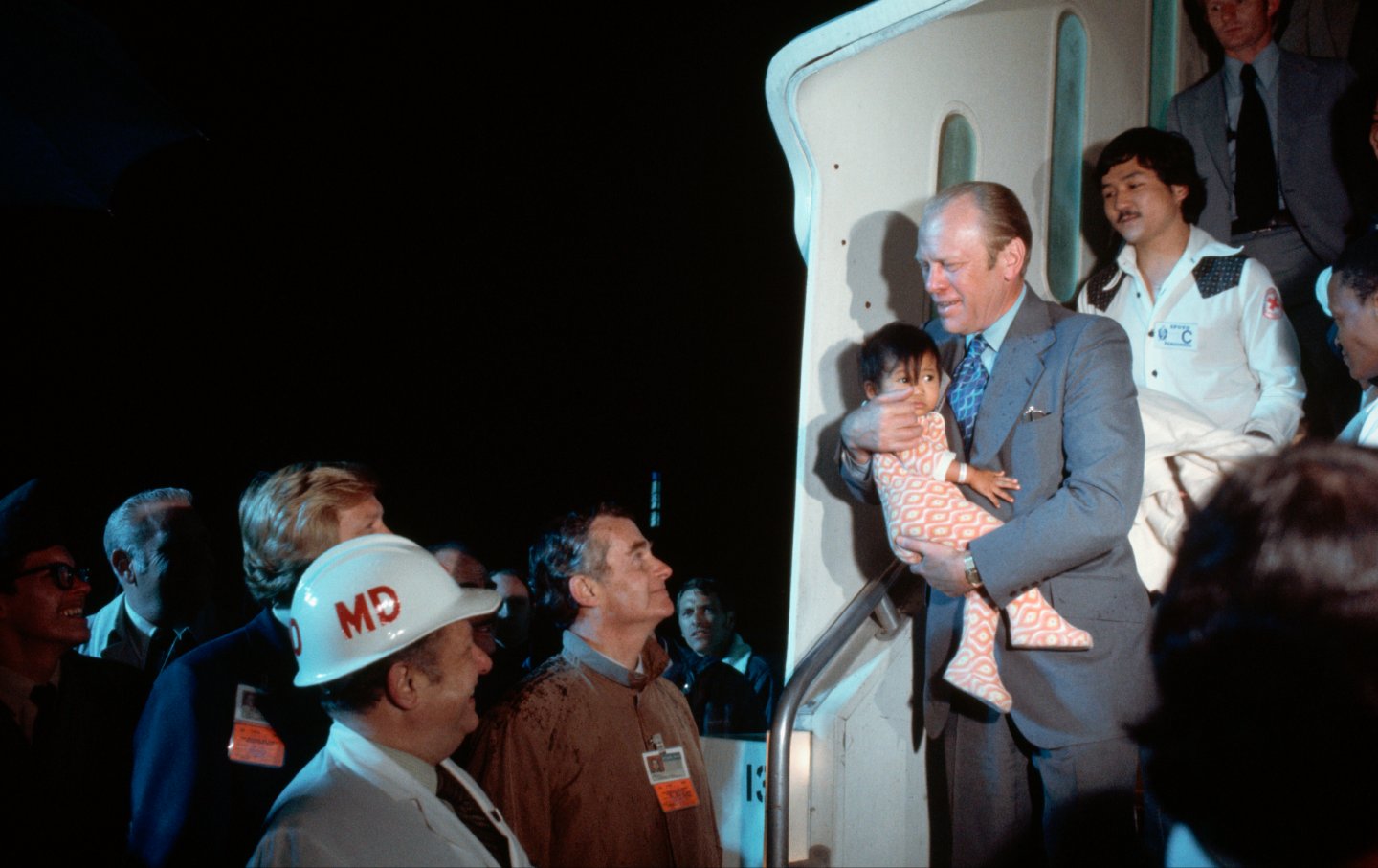
Aquarter century after Vietnam, US soldiers were still committed to taming the frontier, carrying the old wars of the plains and the newer wars of the jungle into the mountains and deserts of Afghanistan. Much of the rhetoric Joshua and Stephanie Mast later used to defend their adoption of Doe reflects the broader imperial attitudes of the time—the Americans were there in part, we were told, to liberate Afghan women and girls. For Joshua Mast, Doe’s alienation from her kin and an upbringing in a white, evangelical family in the American South amounts to freedom, while life with her Afghan family—whom he smears as “puppets of the Taliban”—is cast as a future in which she could never “go to college, marry who she wants, or grow up to be who she wants to be.”
The Afghan couple recall Stephanie Mast lecturing them about sacrificial love, asserting that with the Masts, Doe would have “the best life possible.” We are now watching that same conceit migrate once again, in the language now marshaled around Iran, where the promise of supposed liberation for women and girls is again made in service of US terror—a paper-thin alibi while over a hundred people lie dead in Minab, crushed under the walls of their school by American munitions.
But the “better life” remains the fantasy of the savior. When the Masts spoke to CBS News about their case in 2023, they brandished a photograph of Doe, taken shortly after Doe arrived at the US military hospital following the siege of her family’s farm and the murder of her parents and siblings. They seemed convinced of its persuasive power; Joshua Mast said that it was his favorite image of the baby, with both he and Stephanie cooing about her beautiful eyes.
But the image reveals unmistakably dilated pupils and a vacant wide stare. This is the condition one would expect reflected in the gaze of a newborn who has survived unimaginable violence, a rupture she will carry in her body for the rest of her life. It is a look we have grown accustomed to in the wake of Israel’s genocide in Gaza. What the Masts found charming appears instead profoundly harrowing—an Afghan infant, her face bruised and bloodied, perched in front of an American flag and a sign that reads, “Home of the free, because of the brave.” This is a confounding choice for a favorite photo if you don’t consider what Baby Doe represents to Mast: a victory—her tiny body swaddled in a blanket designed with arrows, another child surrendered in the long Indian Wars.
A vast majority of the critiques surrounding the Masts point to how they broke the rules—implying that all would be forgiven if they had just done adoption “the right way.” The Justice Department went as far as correctly characterizing the Virginia court’s decision to grant the adoption as “endorsing an act of international child abduction.” It’s true that Joshua and Stephanie shirked all the traditional steps required to be granted an adoption in the US, such as completing a formal home study administered through a licensed agency, undergoing background checks, and securing a lawful termination of parental rights after proper notice to the child’s family. However, these same laws and procedures that we may rely on to justify adoption as it is practiced legally have never protected children from being fraudulently taken from their families and placed for adoption.
In Afghanistan, the conception of adoption is very different from the one we are used to in the United States. It is rooted in the Islamic system of Kafalah, a guardianship arrangement in which Doe and her family were already engaged. Kafalah is organized around a child’s need for care, rather than an individual or couple’s demand for exclusive parentage. As a result, there is no need for a consumer adoption industry. If a child is in need of guardianship, an exhaustive search for biological kin comes first, then community kin. At the very least, placements aim for cultural continuity.
Kafalah prohibits many of the elements of plenary adoption, instead seeking to honor kinship and cultural belonging, with the guardians not replacing biological family but rather contributing to a continuum of care. In practice, this means there is no full legal transfer of parentage, and children in the care of their kafil (“protector”) retain their family names, identities, and ties to their family of origin rather than being legally absorbed into another one.
Reimagining adoption in the West requires confronting the legal infrastructure that allows for children to be purchased through a private market and families to be policed by the state. The guardianship model of Kafalah, in tandem with direct material support to families in crisis, provides a reasonable alternative.
However, the orphan-rescue story has considerable cultural and political purchase, and adoption occupies a nearly unparalleled position in American politics; the Congressional Coalition on Adoption is one of the largest bipartisan, bicameral caucuses in Congress. Adoption serves both sides of the political spectrum: It maintains the right’s ideal of the heteronormative family structure at the same time that it flatters the left’s commitment to the nontraditional “chosen family.”
Consequently, the United States is becoming more “adoption-friendly,” and with a capitalist economy that produces widespread deprivation and intense demand for parentage, paired with eroding reproductive rights, it seems likely that family separation will continue, if not expand substantially, in the coming decades.
To undermine this deeply entrenched structure requires, in the first instance, seeding a politics of refusal: a disorientation from the idea that there exists a right to parenthood regardless of the means required to secure it, and a rejection of the consumer demand that considers other people’s children as the answer to the desire for parenthood.
Today, adoption is a billion-dollar industry, with an estimated 1–2 million people waiting to adopt at a given time. Cutting this demand would require making adoption, as it is currently practiced, socially and politically stigmatized. This is no easy feat—the practice has been lionized in our culture for decades, from our media consumption to our religious spaces. But the well-being of children has the power to mobilize the masses and bring about seismic cultural shifts.
Popular
“swipe left below to view more authors”Swipe →Imperialism is marked by the violent arrogance of making claims—on land, on people, on those people’s children. The US is engaged in many wars in addition to its so-called War on Terror—the war on poverty, the war on drugs, the war on immigrants. We see these wars play out in theaters across the country, from the halls of family courthouses to the detention centers at the border. The Masts’ claim on Doe is a continuation of a long war, as children have always symbolized a future for the enemy they seek to eliminate. It’s in what I call the “terms of surrender” among these many wars that the orphan subject, stripped of its history, is born. But this is ultimately a myth: A child with or without living parents exists within a lineage that legal documents and distance can’t erase.
Although many have lost their children to the US empire, the flame of contestation remains alive. This particular court battle began because Doe’s Afghan family, now residing here in the United States, dared to resist. In this, they carry a legacy—stretching from enslaved kin who fought to stay together to Native communities that made child-taking a site of their political struggle for self-determination, to migrants who have refused the state’s theft of their children at the border. Those who have resisted have done so not because victory was assured, but because to face the US empire is to see with spectacular clarity that it does not stop at annihilating all that stands in its way, and it will come to collect all that remains.
I often return to the interview with Doe’s sister, as she remembers the wind that carried Doe away, further than she could have ever imagined in 2019. There was a bitter truth in conflating the US siege on her home with a natural event. The occupation of her country was natural to her, as it preexisted her lifetime. But just as the empire’s stranglehold may feel natural to her, so too is her grief, the wind’s lament, as is her memory. The Masts may be betting on Doe’s forgetting her first few years spent with her Afghan family—the sound of her name given to her by her parents, her native Pashto echoing through their apartment back home—but for her sake, I hope she doesn’t.
Become a Sustaining Donor This September
Between the reemergence of right-wing red-baiting and Donald Trump’s use of the chilling National Security Presidential Memorandum–7 to criminalize left political organizing, we’re seeing McCarthyism reborn before our eyes.
This assault on democracy cannot be ignored or wished away. Resisting it requires bravery in the face of threats and repression, a steadfast commitment to the truth, and the unwavering belief that we can—and will—overcome this darkness.
We must have an independent media that sets the record straight, unearths corruption and abuses of power, and advances a politics of justice and dignity for all if we’re to win this fight.
That’s why I’m writing to you today. This September, The Nation needs to add 100 monthly donors to sustain our progressive journalism. Your contribution makes the next investigative report, the next truth-speaking column, and the next pathbreaking essay all possible.
I hope you’ll support our work with a recurring donation today. If you donate $10 or more a month, we’ll send you a brand new “Hands Off the Free Press!” sticker to recognise your commitment to our cause. Please, donate today.
Onward,
Katrina vanden Heuvel
Editor and Publisher, The Nation
More from The Nation

Irish Goalkeeper Gavin Bazunu's Refusal to Play Against Israel Puts Him on the Right Side of History Irish Goalkeeper Gavin Bazunu's Refusal to Play Against Israel Puts Him on the Right Side of History
Bazunu's decision raises the perennial question: Why is a country that is currently committing a genocide allowed to compete in the first place?
The Promises and Compromises of the University of California The Promises and Compromises of the University of California
I grew up in a neighborhood manufactured by the University of California, Irvine. It felt like a utopia for academics—until the university forsook its mission of serving the publi...
Is Platonic Co-Parenting the Future of the Family? Is Platonic Co-Parenting the Future of the Family?
Disillusioned with the nuclear family and apprehensive of tethering their reproductive futures to the bleak hellscape of modern love, young people are seeking a different way.

How Trump’s Crackdown on Speech Has Damaged the Student Press How Trump’s Crackdown on Speech Has Damaged the Student Press
I serve as editor in chief and president of The Stanford Daily. Our newsroom has keenly felt the effects of Trump’s campus crackdown, which is why we sued the federal government.

Treat Spotify Like a Public Utility Treat Spotify Like a Public Utility
Music streaming platforms have way too much control over musicians and music lovers. It’s time to rein them in.

