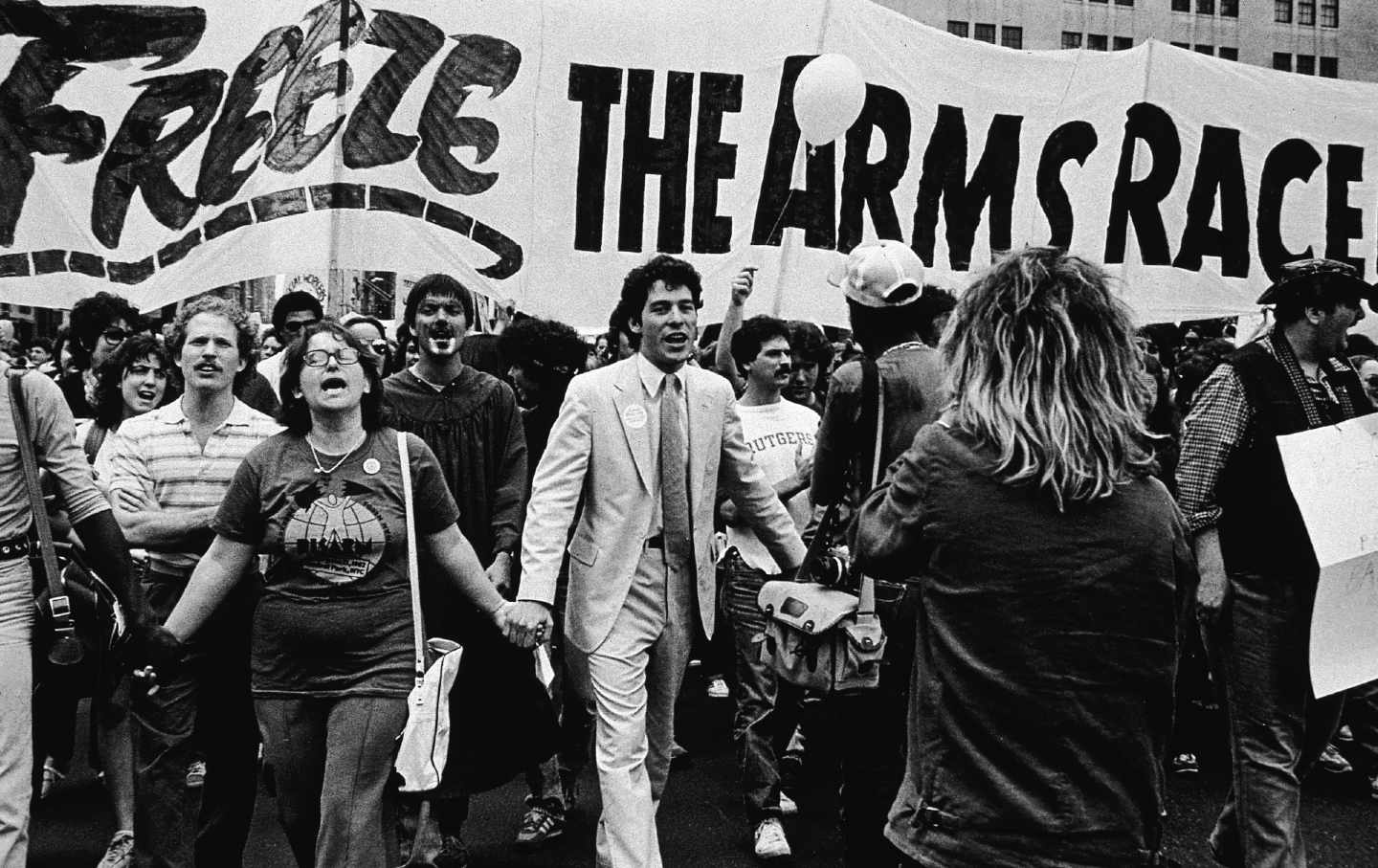
How the Military Mindset Has Crushed Our Country’s Men
I talked to troops and cadets about the kind of masculinity the military encourages. Its ripple effects on mental health are dire.
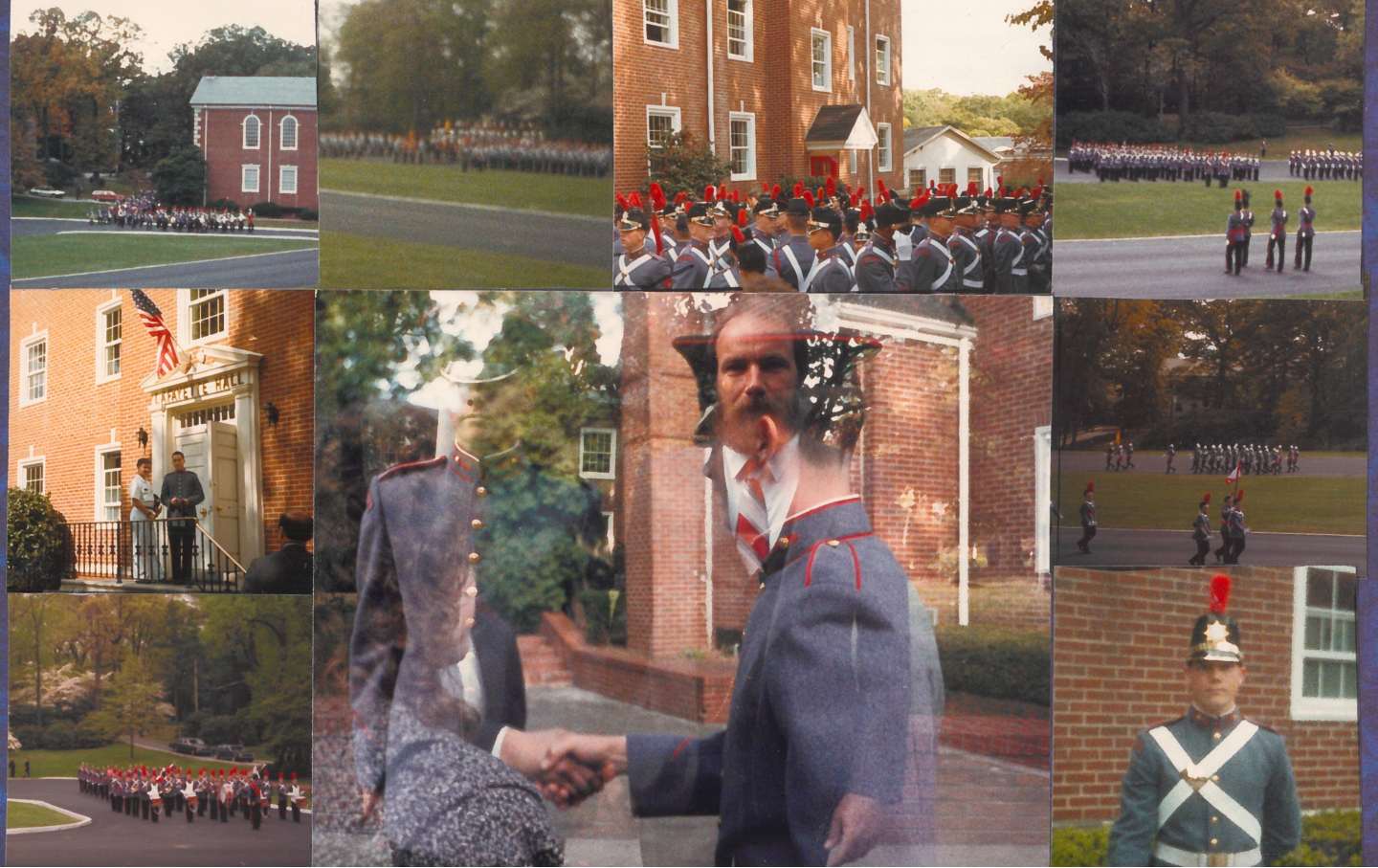
Carefully stored away in Jesse Holland’s condo in East Brunswick, New Jersey, are the totems of a culture that nearly killed him.
When I visited his place on a cold afternoon in December of 2023, it had been nearly four decades since Jesse first donned his dress blues as a first-year, or “plebe,” at the Valley Forge Military Academy, just north of Philadelphia. He showed me the uniform he was given at age 14, neatly folded, still hanging in his closet. Jesse’s old textbooks and academic records from the Forge were tucked away, too, as was a towel and laundry basket the school had issued him. Also, a brass badge depicting Gen. George Washington praying on the Pennsylvania Revolutionary War battleground for which the Forge is named.
As we settled on the couch, Jesse acknowledged that even most of his computer passwords play on the school’s name. “For so many years, I never left the Forge, even though I was physically removed from the property,” he explained. This insight, he added, stemmed from a passage he’d read in The Body Keeps the Score, a somewhat controversial 2014 bestseller that tries to explain how trauma can seemingly trap someone in time. Jesse and I were speaking now because he was on a journey to finally wriggle free. “The only way out,” he reasoned, “is through.”
Per his own harsh admission, Jesse was born a coward. “Apparently, as a baby, you couldn’t put me down without me crying,” he said, somewhat ashamed. “The stove was scary; trees were scary.” To me, these seemed like the typical behaviors of a newborn, though I understood why Jesse saw them differently. His father, Christian, was macho—and mean. He would become especially butch around his drinking buddies, many of them Vietnam War veterans. Today, Jesse reasons that his dad’s hypermasculine posturing was a response to his shame over the fact that he never served in the military himself—a shame, it seems, that also drove him to raise a son who might be able to do what he never did.
Jesse tried desperately to meet his fathers’s high bar for manliness. Once, after he won an arm-wrestling match in middle school, he rushed home and excitedly shared the good news. Not to be outmanned, Christian slapped a $100 bill on the table and told his son that it was his if Jesse could beat him in another match. Then he called Jesse’s mom into the room to bear witness. “Not only did he need to win, he had to pulverize me,” Jesse recalled. “I couldn’t move my arm for like a week.” Later, on a pheasant hunt, Jesse’s dad ordered him to strangle a bird he had clumsily wounded with buckshot. “The bird wasn’t dead—it just couldn’t fly,” Jesse said. “I’m wringing its neck, and it’s kicking me and making noises, and I’m doing my best not to burst into tears.”
On the handful of occasions when Christian physically beat him, Jesse felt deeply ashamed for not fighting back. It was in these moments that Jesse dreamed he would be able to “stand tall and be proud” like his fictional military hero, G.I. Joe, whom Jesse dressed up as for Halloween nearly every year. G.I. Joe had power, Jesse reasoned, but, unlike his dad, he wielded it “responsibly.”
When, in the summer of 1988, Jesse was first dropped off at the Forge, he was excited: The campus seemed like a well-honed masculine breeding ground where he might finally be made into the man his father always wanted him to be. Weeks later, he informed his folks in a letter that the campus environment had all been a mirage. “The minute you left they broke out the whips and chains,” he wrote, comparing his experience thus far to “a party in hell.” “It’s Rough! Rough! Rough!” he concluded.
As a plebe, Jesse was yelled at and dehumanized by roving packs of upperclassmen, some of whom were first-wave gym rats and, according to Jesse, were using steroids. “They were monsters,” he recalled. Adult supervision was scarce, empowering a cadet-run hierarchy that Jesse compared to Lord of the Flies. The older boys called him “scum puke” and “pussy” and put him through a gauntlet of intense hazing. Early in Jesse’s first semester, a couple of older cadets beat him up in the gym, though most of their bullying was psychological—they trashed his room, screamed at him, and refused to promote him within the hierarchy. At first, Jesse tried to make the best of his bad situation. In letters home, he reported getting “a lot skinnier” and “a lot stronger.” He was performing well academically, too. His teachers recognized his smarts with a red-star pin that declared him a “meritorious student.” On at least one occasion, he signed a letter home denoting his newfound identity: “Jesse Holland, the trooper.”
When he returned to New Jersey for the fall break, Jesse cut the figure of a war hero, and his dad was thrilled, trotting him out repeatedly in full military garb to a nearby Italian restaurant—called Liberty—to show him off to his friends. “I was a piece of shit, and now I’m somebody,” Jesse thought over bites of spaghetti. “I’m the golden boy.”
“It was not real,” Jesse clarified during our conversation many years later. “But it felt great.”
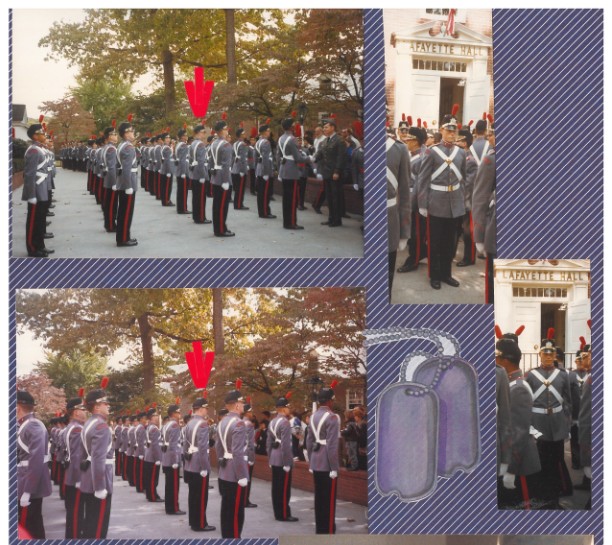
Back at the Forge, though, Jesse remained a target. He was called names, had his room trashed some more, and was spit on—treatment he endured because he equated scar tissue with strength. At one point, he wrote a letter to his dad begging to be picked up and brought home, but crumpled it up and threw it in the trash instead. “I couldn’t face being vulnerable and being weak and being rejected” by his own father too, Jesse told me. Not long after, he took out a pocketknife his dad had gifted him and started crudely cutting his wrist in his dorm room. He landed in the hospital, where he spent six weeks in an inpatient psychiatric program.
After being discharged, Jesse returned to his local public high school, where students found that he was still reserved, but in a new way: tinged with anger, hardness, and resentment. His classmates were impressed by his résumé. Jesse began to understand that he could use his time at military school “as some sort of mystique.”
He went to great ends to maintain this status. After high school, he attempted to join the Army but was disqualified because of his suicide attempt. He then went to community college and tried to join the Marines, but they had met their quotas for the year and declined to offer him an enlistment waiver. Then he signed up again for the Army via Temple University’s ROTC program, but this time he lied on his forms about his mental-health history and was initially accepted. Jesse thrived in the program’s summer boot camp at Fort Knox, Kentucky, with Army evaluators hailing his deep commitment to the “highest ethical standard.” But there had apparently been some clerical confusion, and when Jesse turned 23, his commander notified him that he was no longer eligible for ROTC scholarship money. He was too old.
After this, Jesse was transformed into a hollow simulacrum of a soldier, taking jobs “as long as there was a badge.” First he tried to become a cop, then worked as a bouncer, where he became jacked and often got into fights, only to feel ugly afterward. He also spent years in the security industry, including stints at several of Donald Trump’s Manhattan properties. But none of these gigs gave him the kind of satisfaction he was seeking. “I was chasing something that wasn’t me,” he told me. But when I asked him if he would enlist today if the military would take him, Jesse didn’t hesitate. “Yes,” he said. “So maybe it hasn’t died.” Maybe, in other words, Jesse is still caught in the middle of two identities.
Over the past four years, as I’ve embarked on writing a book about military masculinity, I’ve met lots of people like Jesse: men, mostly, whose natural identities were warped or stunted by heavy doses of military training. Pete Hegseth is like Jesse. So is Donald Trump. All are alumni of the military’s sprawling educational network, which includes private military schools like the Forge and New York Military Academy; service academies like West Point; and the ROTC, which provides military courses at 5,200 American high schools and colleges—among them Princeton University, where Hegseth was a member of the famed Tiger Battalion program.
I’d venture a guess that virtually all American men have, at least fleetingly, felt some latent drive to be a soldier, or at least act like one. I myself was raised as far removed from military culture as is geographically possible: up near the Canadian border, in rural Vermont, by peacenik parents who provided me love and denied me television and violent video games. My dad, a prominent anti-war activist during the Vietnam era, frequently hauled me out as a tyke to protest the Iraq War and the “Pentagoons.” At 14, I wrote a school essay against the war called “Freedom From Oil.” In it, I presciently noted that “many fatalities in this war result from soldiers on fuel movement convoys” and raged against the Bush administration for waging war “for one reason: securing Middle Eastern oil reserves.”
And yet, through cultural osmosis, even I have experienced intrusive thoughts about military valor and righteous violence. These competing urges are blatantly symbolized by my first tattoo, which I got on my 18th birthday, of a peace-sign grenade. Like Jesse, some part of me was caught between two ideals.
Such internal tensions are inevitable in a country awash in military culture, where alternative paths for masculine redemption and meaning are culturally and budgetarily starved. America’s pitch today is not simply that the military is the ultimate proving ground for masculinity but that it is the best place for ameliorating all of men’s problems and desires. Billions are spent annually to fortify this message, which is delivered by military recruiters, fathers, brothers, actors, influencers, Boy Scout troop masters, and self-help gurus.
It is also a bipartisan message, delivered loudest on the right but enthusiastically adopted by liberals, too. In his 2025 book Notes on Being a Man, Vox’s alpha-bro podcaster Scott Galloway argues that proper masculinity involves “acting as if you are wearing military fatigues, recognizing that a core reason you are here is to protect yourself, your partner, your family, and your country.” Out of these age-old messages has recently sprung a series of military-style “Alpha Male” camps, in which men are churned through “heavy shit,” from intense physical drills to the fatalistic exercise of digging one’s grave.
All of this has created a dangerous paradox, in which the American institution endorsed as the remedy for a host of masculine ills is, in fact, the driving force for much male dysfunction. Lost boys in need of mentorship and guidance find themselves instead committed to an institution marked by abuse, sky-high drinking and divorce rates, and other dangerous conditions. Military service today is the top predictor of violent extremism. The Pentagon is also experiencing a raging suicide crisis.
Many military suicides stem from complex PTSD linked to moral injuries and other wounds from battle, but military culture can play a significant role in these symptoms, too. One 2012 article in the journal Social Science & Medicine points to an overlooked element in the Pentagon’s suicide crisis: “masculine ideologies,” which, the authors contend, encourage and romanticize fatalism. This outlook was well articulated by John Wheeler, a 1966 West Point graduate, who explained that his commitment to the Army revolved around his belief that there are “things worth dying for.” This distinctly masculine outlook, Wheeler reasoned, inverts a more optimistic, feminine-coded belief that “there are things worth living for.”
It’s unclear how many young cadets take their own lives—or, like Jesse, try to. The Pentagon doesn’t break out those statistics in its annual suicide reports. But during my book research, I found dozens of instances dating back to 1900 in which young cadets were hospitalized for acute mental-health issues, died after intense bouts of hazing, or committed suicide. Often it was due to a tortured identity, or a breakage after finding shallowness in military ideals.
The mother of one cadet I met saw her son transformed from a warm and idealistic schoolboy into a withdrawn adult who drinks to excess and sleeps with a hunting knife under his pillow. Other cadets told me they go to bed with weapons in close proximity or, decades after graduation, remain wracked by nightmares and anxiety stemming from their time on campus.
Popular
“swipe left below to view more authors”Swipe →In 2017, Jesse returned to the Forge out of a mistaken belief that the experience would be therapeutic. Instead, he bawled mournfully as he peered into the window of his former barracks, thinking about his tribulations and those of all the other youngsters who had occupied his room.
Unbeknownst to Jesse, an 18-year-old Forge cadet named Carey LeCamp had killed himself a few dorms over just months prior. Whereas Jesse had loved G.I. Joe in middle school, Carey became enamored with The Odyssey. In private journal entries, he wrote admiringly of Odysseus, who, through the Trojan War’s brutal battles, was “broken down and rebirthed into a wise and resilient individual.”
Like Jesse, Carey saw neither of these traits in himself. He was raised in a well-appointed waterfront home in Greenwich, Connecticut, a tony New York City suburb on the region’s so-called Gold Coast. Carey quietly vented against this uncannily perfect backdrop, worrying in his journal that it would make him soft. “A smooth sea never made skilled sailors,” he wrote. Carey yearned instead for adversity, for hardscrabble conditions that would force his own hero’s journey and make him a real man.
His romantic reading of The Odyssey ignored the epic poem’s frank depiction of war’s realities. After the conflict, Odysseus is paranoid, suicidal, and likely suffering from PTSD. He encounters treacherous waters—real and imagined—to arrive at a home he no longer recognizes. Carey read past this subtext, wanting, like many American boys, to be a hero and believing that the only way to become one was to fight.
“Something more important in my life was missing and all I knew was that I had to change it all and start over again to find my own purpose,” he wrote. “I had no idea how far I had to grind myself down, how much pain I had to endure to find my limit. This was my odyssey.”
Whenever Carey spotted an Army-Navy store, he pleaded with his mother, Terri, to go in. His most prized childhood possession, a camouflage ghillie suit, came from one such shop. So dedicated was Carey to World War II roleplay that he would sometimes roll up a Post-It note like a Lucky Strike, light it, and listen to music from the 1940s. Once, after breaking his ankle in the woods, Carey refused care, stood stoically, and swallowed his pain. “I feed off of it,” he wrote in his journal. “The hardest journeys are the best teachers.”
When he felt most comfortable, Carey was prone to goofiness, often contorting his face or crossing his eyes to make friends and family laugh. “He had this side of him that got pushed down very early on that was open to expression, that was very sensitive,” his brother, Bryce, told me. “He created a thin exterior of badassery over something mushy and ill-formed and insecure.”
Shortly before his death, Carey wrote an essay on the military, just as I had as a boy. In it, he set forth his view of military schools. He acknowledged their potential failings: that they can breed abuse and a punishing hierarchy, and that they’re increasingly used to “hide away society’s misfit children in hopes that the environment will straighten them out.” In a moment of tragic prophecy, he also warned of conditions in which “unmonitored behaviors push [students] off the deep end.”
But Carey concluded on a hopeful note, writing that military schools can “keep cadets on a good path” so long as punishment is used only as a tool for improvement, a means to a righteous end. “We do not pray for an easy life,” he wrote. “We pray to be stronger men.”
Become a Sustaining Donor This September
Between the reemergence of right-wing red-baiting and Donald Trump’s use of the chilling National Security Presidential Memorandum–7 to criminalize left political organizing, we’re seeing McCarthyism reborn before our eyes.
This assault on democracy cannot be ignored or wished away. Resisting it requires bravery in the face of threats and repression, a steadfast commitment to the truth, and the unwavering belief that we can—and will—overcome this darkness.
We must have an independent media that sets the record straight, unearths corruption and abuses of power, and advances a politics of justice and dignity for all if we’re to win this fight.
That’s why I’m writing to you today. This September, The Nation needs to add 100 monthly donors to sustain our progressive journalism. Your contribution makes the next investigative report, the next truth-speaking column, and the next pathbreaking essay all possible.
I hope you’ll support our work with a recurring donation today. If you donate $10 or more a month, we’ll send you a brand new “Hands Off the Free Press!” sticker to recognise your commitment to our cause. Please, donate today.
Onward,
Katrina vanden Heuvel
Editor and Publisher, The Nation
More from The Nation
Journalist Meaghan Beatley on Latin America’s Feminist Resistance Journalist Meaghan Beatley on Latin America’s Feminist Resistance
A conversation with the author of Sex and Dissent about what American feminists can learn from the Green Wave movement.
As Cornell’s Rape Case Draws National Attention, Students Want Accountability. As Cornell’s Rape Case Draws National Attention, Students Want Accountability.
A new lawsuit alleging that a former student was drugged and gang-raped by Chi Phi fraternity members is sparking outrage in the Cornell community.
Irish Goalkeeper Gavin Bazunu’s Refusal to Play Against Israel Puts Him on the Right Side of History Irish Goalkeeper Gavin Bazunu’s Refusal to Play Against Israel Puts Him on the Right Side of History
Bazunu’s decision raises the perennial question: Why is a country that is currently committing a genocide allowed to compete in the first place?
The Promises and Compromises of the University of California The Promises and Compromises of the University of California
I grew up in a neighborhood manufactured by the University of California, Irvine. It felt like a utopia for academics—until the university forsook its mission of serving the publi...

Is Platonic Co-Parenting the Future of the Family? Is Platonic Co-Parenting the Future of the Family?
Disillusioned with the nuclear family and apprehensive of tethering their reproductive futures to the bleak hellscape of modern love, young people are seeking a different way.