
AI Is Incapable of Poetry
It’s incapable of producing anything creative that isn’t dreck.
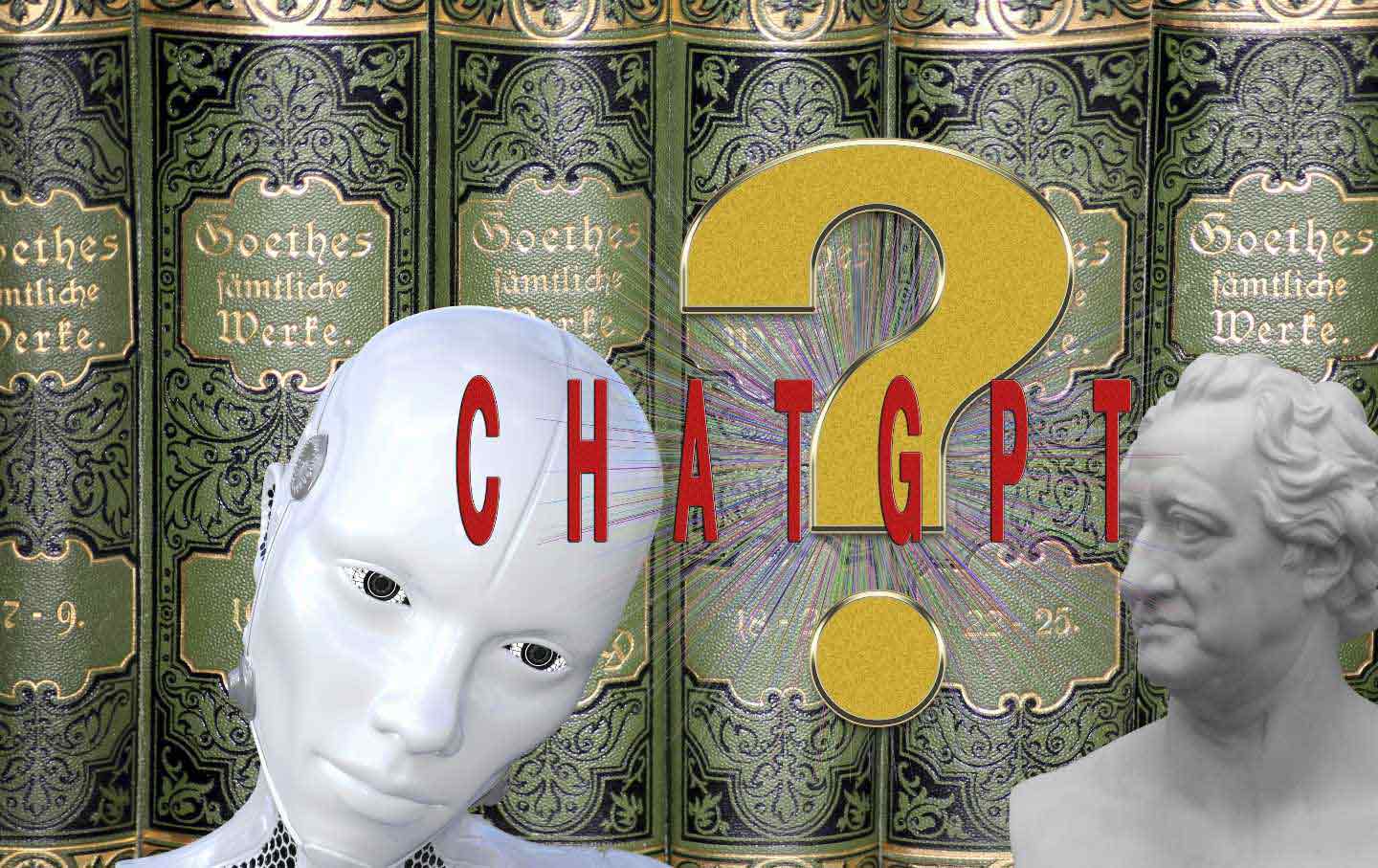
If Anthropic had offered me $15,000 to use five pieces of my published work to train its large language models, I would have said no way. Why should I help Dario Amodei, the company’s CEO, to debase language, imagination, individuality, art? Aren’t people stupid enough already? Perhaps anticipating this response from writers, a proud and prickly lot, Anthropic simply took some 500,000 books and articles and used them without the authors’ knowledge or permission. That’s plagiarism. Three authors filed a lawsuit, and a court ruling requires Anthropic to pay out $1.5 billion—lunch money for the company, which is valued at $380 billion. I filled out the online forms to collect my $15,000 share—well, actually my brilliant young assistant, who describes herself as a “digital native,” did that. The forms were pretty complicated, probably just to remind us old-fashioned scribblers who really holds the upper hand here. After all, the damage is done, and no amount of settlement money can undo it.
About a year ago, I asked ChatGPT to write a poem “in the style of Katha Pollitt.” The result was fairly ridiculous: more like a greeting-card jingle than a poem by anyone over the age of 10. Whew! I tested ChatGPT again just now. Apparently it has been taking poetry workshops. Singsong rhyme and meter are out; free verse and wistfulness are in. Here’s the beginning:
The meeting runs long, as meetings do—
a table of voices, mostly baritone,
interrupted by a careful soprano
that learns to fold itself between commas.
Outside, the city conducts its own debate:
sirens insisting, buses sighing dissent,
a woman on the corner counting tips
like a rosary of small survivals.
This has all the tics of contemporary mediocre poetry: the knowing nudge (“as meetings do”), the look out the window (“Outside, the city”), the careless mixed metaphors. That quality of weariness, of pity at a safe MFA-protected distance, is all over poetry now. It makes me cringe. Its subject—the subtle thwarting of women in the office and at home (“at home the sink stages its quiet rebellion”) and women’s inability to do much about it—produces one cliché after another:
Still, the stubborn verb of living persists—
we cook, we call, we show up again,
our small revisions penciled in the day,
hoping the final draft will bear our names.
Gag me with a spoon! There is nothing fresh or original here, no wit or zing, no pressure on language or form or voice or thought. It’s full of decorative phrases like “the stubborn verb of living” that sound “poetic” but do no work. It’s boring and generic and there are probably dozens of magazines that would publish it. But do you know what bothered me the most? The thought that this is what ChatGPT “thinks” my poems are like: obedient, saddish, “feminist” but defeated (get that woman a dishwasher!). Please believe me, reader: That is not how I write. And yet it has enough echoes of my writing that I was anxious and unsettled all day. “Am I that name?” as Desdemona asked Iago. Is that really me, a me that the world can see but I can’t? No, ChatGPT Katha is the uncanny-valley version of me, a Stepford writer. Its poems have the same relation to mine that a department-store mannequin has to a real person.
Next I tried Grok, X’s AI “assistant,” which was already familiar to me from an experiment I conducted when I asked it to put Queen Elizabeth, Melania Trump, and me in bikinis. Grok’s first Katha poem was even worse than ChatGPT’s—more clichéd, more obvious, more awkward: “We fold the laundry like it’s a treaty with the state of being female.” (That “like” should be “as if,” and does one fold a treaty?) Grok offered to revise for more “urgency” and “intensity,” and each revision made the poem worse: “We fold the laundry like it’s the last thin barrier before the state storms the house.” (Always with the laundry.) If the state was about to storm the house, no one would be worrying about pillowcases.
And how about this: “Somewhere a judge is sharpening his pen like a scalpel, writing rulings that feel like fingers inside us.” Yuck. And does one sharpen a pen? Or a scalpel? Maybe Grok should stick to deepfake porn.
Anthropic’s Claude is the AI of the moment, so I thought it might be better at impersonating me. But no:
Outside, the street does what streets do:
a woman hauls a stroller up the curb alone,
a man in a good coat looks at his phone,
two pigeons share a grievance near the trash.
The usual arrangements. The usual cost.
The street does what streets do? What’s that, exactly? I’ll pass over Grok on the death of Genghis Khan (“The tents fold. The horses move on. The grass forgets”) and ChatGPT on daffodils (“So here they are again, the yellow-hatted / hooligans of spring”). A faint sour fog of exhaustion and depression hangs over every poem. What is wrong with these not-people? Did Claude have its heart broken by a washing machine? Did Grok put ChatGPT in an ugly bikini? Cheer up, non-persons! You could be a human being, and then you’d really have something to complain about.
Writers of the world, take it from me: AI can’t make you a better writer. It can only make you a more conventional, lazy one. If that’s your goal, publish and be damned. You’ll miss a lot of struggle and suffering and self-doubt. But you’ll also miss the excitement, the discovery, the joy.
Become a Sustaining Donor This September
Between the reemergence of right-wing red-baiting and Donald Trump’s use of the chilling National Security Presidential Memorandum–7 to criminalize left political organizing, we’re seeing McCarthyism reborn before our eyes.
This assault on democracy cannot be ignored or wished away. Resisting it requires bravery in the face of threats and repression, a steadfast commitment to the truth, and the unwavering belief that we can—and will—overcome this darkness.
We must have an independent media that sets the record straight, unearths corruption and abuses of power, and advances a politics of justice and dignity for all if we’re to win this fight.
That’s why I’m writing to you today. This September, The Nation needs to add 100 monthly donors to sustain our progressive journalism. Your contribution makes the next investigative report, the next truth-speaking column, and the next pathbreaking essay all possible.
I hope you’ll support our work with a recurring donation today. If you donate $10 or more a month, we’ll send you a brand new “Hands Off the Free Press!” sticker to recognise your commitment to our cause. Please, donate today.
Onward,
Katrina vanden Heuvel
Editor and Publisher, The Nation
More from The Nation

As Cornell’s Rape Case Draws National Attention, Students Want Accountability. As Cornell’s Rape Case Draws National Attention, Students Want Accountability.
A new lawsuit alleging that a former student was drugged and gang-raped by Chi Phi fraternity members is sparking outrage in the Cornell community.

Irish Goalkeeper Gavin Bazunu’s Refusal to Play Against Israel Puts Him on the Right Side of History Irish Goalkeeper Gavin Bazunu’s Refusal to Play Against Israel Puts Him on the Right Side of History
Bazunu’s decision raises the perennial question: Why is a country that is currently committing a genocide allowed to compete in the first place?

The Promises and Compromises of the University of California The Promises and Compromises of the University of California
I grew up in a neighborhood manufactured by the University of California, Irvine. It felt like a utopia for academics—until the university forsook its mission of serving the publi...
Is Platonic Co-Parenting the Future of the Family? Is Platonic Co-Parenting the Future of the Family?
Disillusioned with the nuclear family and apprehensive of tethering their reproductive futures to the bleak hellscape of modern love, young people are seeking a different way.

How Trump’s Crackdown on Speech Has Damaged the Student Press How Trump’s Crackdown on Speech Has Damaged the Student Press
I serve as editor in chief and president of The Stanford Daily. Our newsroom has keenly felt the effects of Trump’s campus crackdown, which is why we sued the federal government.

