What the Dissents in the Mifepristone Case Tell Us About What’s to Come
Justice Alito called the Supreme Court’s order “unreasoned” and “remarkable,” while feigning ignorance over the decades of research pointing to mifepristone’s safety.
Despite the fact that the block on the mailing of mifepristone is lifted, serious concerns remain.
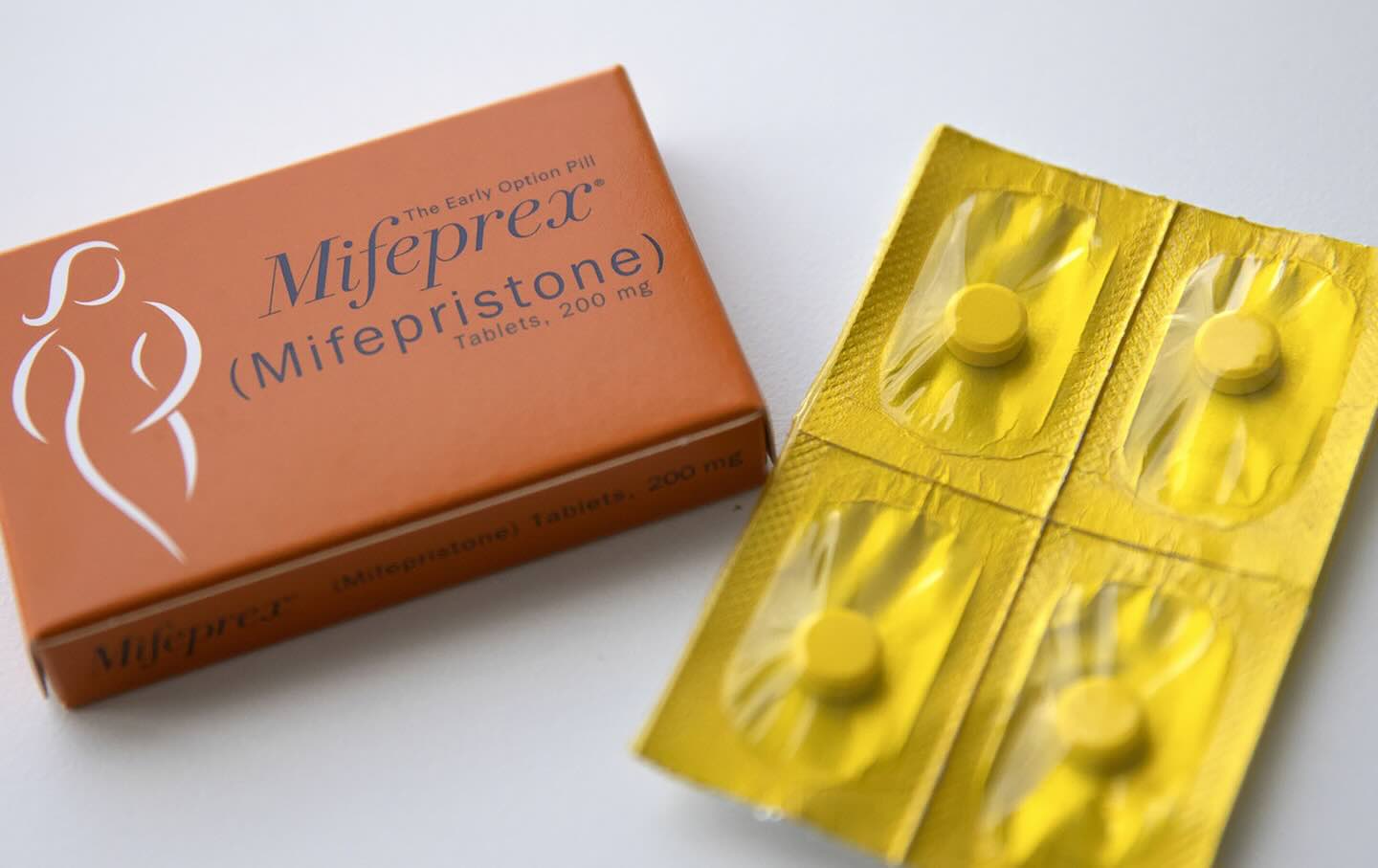
(Erin Hooley / Chicago Tribune)On Thursday, the Supreme Court issued an order to permanently stay a ruling from the US Court of Appeals for the Fifth Circuit prohibiting the distribution of the abortion medication mifepristone by mail. The court announced that the stay is in place “pending disposition of the appeal” in the lower court, meaning that while mifepristone may continue to be mailed throughout the United States, it remains unclear for how long.
The ruling—barely a paragraph in length—was strictly procedural. The court did not weigh in on the scientifically discredited and debunked arguments that undergird the challenges to mifepristone made by anti-abortion advocates, namely their claim that the drug is unsafe and ineffective.
Even though this ruling centers on the Fifth Circuit’s order, the ongoing dispute reflects the legal chaos, confusion, misinformation, and medical turmoil for women unleashed by the Supreme Court’s 2022 decision in Dobbs v. Jackson Women’s Health Organization, which overturned Roe v. Wade. In that case, authored by Justice Samuel Alito, he argued that Roe was “egregiously wrong,” “deeply damaging,” and “exceptionally weak” in its reasoning.
Alito’s dissent in the joined cases Danco Laboratories, LLC v. Louisiana and GenBioPro, Inc. v. Louisiana shows equal hostility, antagonism, and irrationality. According to Justice Alito, the Supreme Court’s order is “unreasoned” and “remarkable.” In essence, he refers to the drug manufacturers as profit seekers, engaged in a “scheme” to “undermine” his majority opinion in Dobbs and ultimately thwart states’ bans on abortion.
Justice Alito feigns ignorance of the decades of research pointing to mifepristone’s safety, referencing “concerns [that] have arisen ‘about the safety of mifepristone as currently administered.’” This is ironic, especially since the medication has been on the market in the United States for nearly 26 years, and decades before that in France. This type of cynicism and contempt is what women expect from Justice Alito on matters of reproductive health, rights, and justice—and beyond.
He dispenses with key arguments made in the manufacturers’ briefs, calling their claims of potential serious harm only a “passing reference to the possibility of lost sales.”
That said, Justice Alito’s overwrought dissent and that of Justice Clarence Thomas (alleging that mifepristone’s pharmaceutical manufacturers, Danco Laboratories and GenBioPro, are engaged in criminal acts) should not be ignored. These dissents not only mirror the arguments peddled by abortion foes but strategically plant seeds from which future cases may bear fruit for criminal prosecutions and punishments involving not only patients and doctors but possibly pharmaceutical company executives. As an example, Justice Thomas noted that he wrote separately ostensibly to unmask a criminal enterprise, explaining, “The Comstock Act bans using ‘the mails’ to ship any ‘drug…for producing abortion.’” That this law has been dormant for decades and potentially implicates products ranging from contraception to medical books is disconcerting.
In other words, despite what is clearly a sign and sigh of relief for patients and telehealth medical providers, the dissents potentially serve as the foundation for a later majority opinion forcing the implementation of the long-dormant Comstock Act. This is worrying because the Comstock Act wasn’t simply in hibernation; it was defunct and rejected. Justice Thomas now seeks to give CPR to an act that justified the banning of medical textbooks simply because of diagrams of the naked human body.
Fortunately, that is now public.
This case is undeniably messy, and not just because the court issued a decision after missing its own self-imposed deadline. For example, the Supreme Court ordered the Food and Drug Administration to issue a brief, given that its 2023 Risk Evaluation and Mitigation Strategy (REMS) policy that allows for the mailing of mifepristone is at issue. Stunningly, the Trump administration failed to even respond to the Supreme Court’s request and issued no brief in the case.
Instead, with the backdrop of the midterm elections looming and political pressure at its peak, President Donald Trump forced the removal of FDA Commissioner Marty Makary, seemingly responding to the calls from anti-abortion groups. Makary issued his resignation by text just two days before the decision in this case.
Further, as noted in the Danco brief, “there has never been a court-enjoined REMS,” meaning that for the first time a court has inserted itself against the judgment of the FDA to block the mail distribution of a drug.
Indeed, Thursday’s order is a response to Danco’s and GenBioPro’s emergency application petitioning the Supreme Court to stay the Fifth Circuit’s judgment imposing a ban on the mailing of mifepristone. This lower-court ban, sought by the state of Louisiana, is a vital part of the post-Dobbs anti-abortion strategy, and it affected every state, including those where abortion is not only legal but also protected by state Constitutions.
Despite the fact that the block is lifted, serious concerns remain, including the trafficking in medical misinformation and disinformation related to abortion generally, and mifepristone specifically, including its proven safety and efficacy.
As a procedural matter, according to Danco and GenBioPro, the case should never have advanced or been heard by the Fifth Circuit because the plaintiffs lacked standing—a crucial bar that must be met in order for litigants to proceed in the adjudication of a dispute. To underscore their argument, in their briefs they explain that the FDA’s REMS policy does not pose economic nor sovereign harms to Louisiana.
Neither the majority nor dissents paid any attention to that argument or any of the other important substantive claims made by the manufacturers, including the most relevant: If the lower court order were allowed to take effect, it would impose avoidable immediate and irreparable harm on patients. Already, in the post-Dobbs legal reality, pregnant patients in the United States have suffered and been forced into a new Jane Crow landscape. This includes fleeing their home states by all means available to reach needed healthcare in sanctuary states; bleeding for hours outside hospitals in parking lots—until hospitals deem them sick enough to receive treatment, a practice to avoid civil and criminal punishments in anti-abortion states; criminal punishments and convictions; and sorrowfully, preventable deaths due to pregnancy complications.
The Roberts court will be remembered for playing roulette with pregnant patients’ lives. In this sense, both Dobbs and this current order are on the same wheel. The lesson from this week’s order is that through their dissents, Justices Alito and Thomas exposed what may come, providing those who care about the rule of law, reproductive health, and abortion rights with insight and the opportunity to counter their cynicism and deceit.
Become a Sustaining Donor This September
Between the reemergence of right-wing red-baiting and Donald Trump’s use of the chilling National Security Presidential Memorandum–7 to criminalize left political organizing, we’re seeing McCarthyism reborn before our eyes.
This assault on democracy cannot be ignored or wished away. Resisting it requires bravery in the face of threats and repression, a steadfast commitment to the truth, and the unwavering belief that we can—and will—overcome this darkness.
We must have an independent media that sets the record straight, unearths corruption and abuses of power, and advances a politics of justice and dignity for all if we’re to win this fight.
That’s why I’m writing to you today. This September, The Nation needs to add 100 monthly donors to sustain our progressive journalism. Your contribution makes the next investigative report, the next truth-speaking column, and the next pathbreaking essay all possible.
I hope you’ll support our work with a recurring donation today. If you donate $10 or more a month, we’ll send you a brand new “Hands Off the Free Press!” sticker to recognise your commitment to our cause. Please, donate today.
Onward,
Katrina vanden Heuvel
Editor and Publisher, The Nation