
Why a School Cell Phone Ban Isn’t the Right Call
New York Governor Kathy Hochul has considered a statewide ban on smart devices in schools, but many parents, students, and teachers have a more nuanced view.
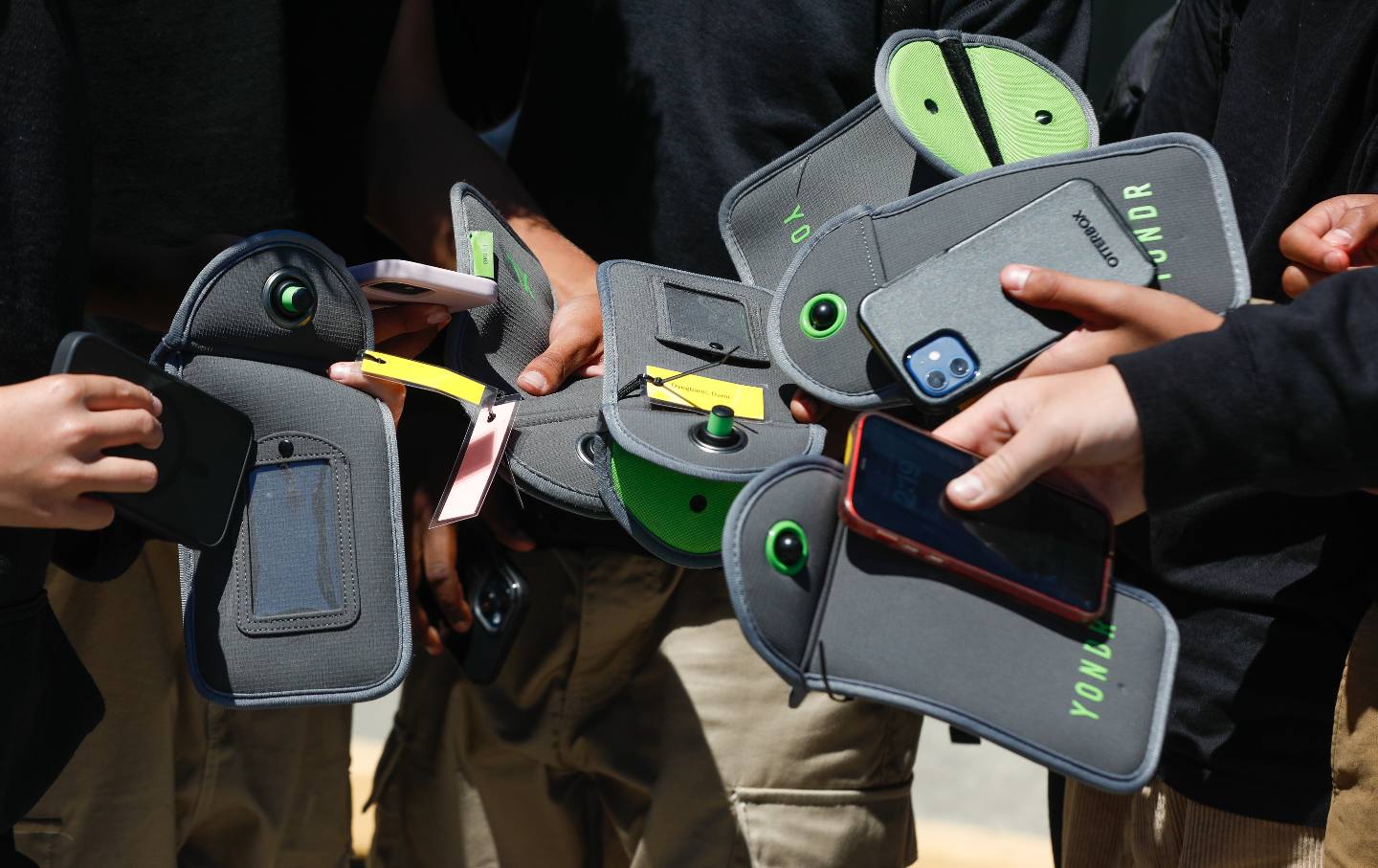
A student uses their cell phone after unlocking the pouch that secures it from use during the school day at Bayside Academy in California.
(Lea Suzuki / Getty)When I began seventh grade, my middle school banned all cell phones. This was in 2019, just before the Covid pandemic, and the school administration was tired of dealing with preteen TikTokers. It didn’t matter if we brought flip phones or the latest iPhone—they were all locked away in our homeroom teacher’s closet at the start of the school day.
We were dismayed: The previous year, our phones were often part of the lesson plan. Teachers would tell us to pull out our phones to look something up or to fill out a Google Form. We used it like a small computer—for quick tasks when school laptops were unavailable.
Across the country, states and school districts are enacting laws and policies to restrict student smartphone use. Governor Kathy Hochul proposed a statewide ban on smart devices in schools, and Mayor Eric Adams and New York City Schools Chancellor David Banks also pushed for a ban over the summer. Banks, a few days before resigning on October 7, told FOX 5 New York that “now is not the time” to implement a ban, saying that he received pushback from parents who were worried about contacting their children during an emergency.
In 2015, Mayor Bill de Blasio lifted the city’s ban on cell phones in public schools calling it “out of touch with modern parenting.” In practice, the ban led to “unequal enforcement” and penalized students “mostly at schools with metal detectors in low-income communities,” according to a press release at the time. “Parents should be able to call or text their kids,” said de Blasio.
Of course, past generations of teenagers survived without devices and parents never worried, but they also did not grow up in a world where frequent school shootings were a reality. Now, in my fourth and final year at Stuyvesant High School, where we are still allowed to have phones, I’ve experienced several bomb scares—all hoaxes, but nonetheless unsettling, and the evacuations got me home hours late. I was able to text my parents, which prevented them from worrying. Governor Hochul argues that “going on your cell phone” during an emergency might distract students and place them “in harm’s way.” But if we cannot guarantee safety in our own classrooms, what is the wisdom in taking away perhaps the one line of communication we have?
In a school of about 3,400 students, many don’t have the time to come to school earlier and leave later, as we would have to do if phones were collected. Yondr pouches, which can be locked and unlocked at designated areas by school staff, are costly and place additional strain on already thin school budgets. These magnetic cases cost between $25 and $30 for every student. While a pouch would allow me to keep track of my own device, not every school can afford them. Moreover, the logistics of unlocking and locking pouches for various scenarios, such as after-school activities or lunch, are cumbersome.
If a student had to leave early during the seventh-grade ban, for example, they had to find the teacher and disrupt class to reclaim their phone. In the meantime, our parents, who had bought us the phones in order to track our locations (as many of us were going to school unaccompanied for the first time), were upset because our devices were powered off from 8:30 am to 3 pm.
Most importantly, we need phones, and I’m not just saying that because I’m a screenager. At a school like mine with a large population, phones are used for everyday communication. My classmate and fellow senior Astrid Harrington bemoaned the logistical issues a ban could impose on competitive teams: “Stuyvesant’s debate team uses Messenger to deliver messages throughout the day. Math team uses Discord and email to send schedules to members. I used email last year to spread the word about Spanish tutoring sessions.” Waiting until the end of the day to pass on information could mean losing a competition or a coveted tutoring session.
Teachers at my school also use phones as part of their lessons, both as a way to enrich the learning experience through online educational games, and to teach digital literacy. Pretty much every day, a teacher asks my class to pull out our phones and research information. While NYC DOE Security Director Mark Rampersant has suggested that even with a ban, phones could be allowed for academic purposes, but this admission feels like an afterthought and doesn’t consider the flexible ways that phones can be used in a lesson plan.
Many teachers have a more nuanced view of the utility of cell phones. “My students can handle being told when to take out their devices and when not,” says English teacher Kerry Garfinkel, who pointed out that it would depend on the school and that blanket bans would “not be a good idea.” He adds, “My use of phones in the classroom is part of the pedagogy.”
He mentions, however, that it may not work in every school: “I have been in city schools that have a major problem with phones. The kids use them in every class, all the time, and it’s adding a layer of discipline to an already difficult job.” Most people I spoke to pointed out that cell phones are a part of everyday life and cannot be totally excluded.
It’s true that cell phones distract us. According to a study conducted by Common Sense Media, about 97 percent of students use their phones “for a median of 43 minutes” through the school day. That’s the length of one class at my school. Eden Lewke, another classmate, agreed that “when kids have access to phones they are automatically somewhat checked out or preoccupied and so an absence of phones would help students be more present.” Jolie Yeung, a junior at Stuyvesant, concurred: “I do find my cell phone distracting me throughout the school day. It makes me struggle to focus on my classwork or what we’re learning in class because I’m either on my phone or distracted thinking about something I just saw on my phone.”
Popular
“swipe left below to view more authors”Swipe →But generations of students have zoned out without the aid of tech, as decades of overlapping graffiti on our school desks attest. A simple reminder before class by the teacher to pay attention and not look at cell phones will probably increase concentration. If that doesn’t work, putting phones in an organizer at the front of the class as the students walk in is a better idea than a blanket ban.
“Teens would continue to use phones at home, potentially for more time than before in order to compensate for lost time during the school day,” said Harrington. “They would also find ways around the ban. High schoolers are nothing if not persistent.”
More from The Nation

Trump’s Reverse Midas Touch Even Got the World Cup Trump’s Reverse Midas Touch Even Got the World Cup
Of course fans roundly booed the president at the World Cup final: Damaging the integrity of anything he touches is true to the Trump brand.

Why Andrew Tate Is a MAGA Superstar Why Andrew Tate Is a MAGA Superstar
Manosphere celebrities—including alleged sexual predators like Tate—are a symptom of a politically resurgent misogyny.

Paying Tribute to Richard Lingeman—Longtime Executive Editor and a Quiet Force at “The Nation” for More Than Three Decades Paying Tribute to Richard Lingeman—Longtime Executive Editor and a Quiet Force at “The Nation” for More Than Three Decades
A man of few spoken words, on the page he was a marvel.

Root for Spain for Their Play and Their Politics Root for Spain for Their Play and Their Politics
A World Cup victory will not just feel like a soccer triumph but a national triumph. For that reason, fans should support Pedro Sánchez’s Spain over Javier Milei’s Argentina.

What We Can Learn From the Current Menopause Moment What We Can Learn From the Current Menopause Moment
At a time when the Trump administration is endangering women’s health, more than half the states, red and blue alike, have introduced menopause legislation.

Golf Caddies Just Unionized for the First Time Golf Caddies Just Unionized for the First Time
Caddies—workers tasked with everything from carrying golfers’ bags to giving them armchair therapy—won out after a recent change to their employment structure.

