The Iran War Is Also a Climate War
Climate change is not a peripheral part of what we’re seeing in Iran—it’s structurally embedded in modern warfare.
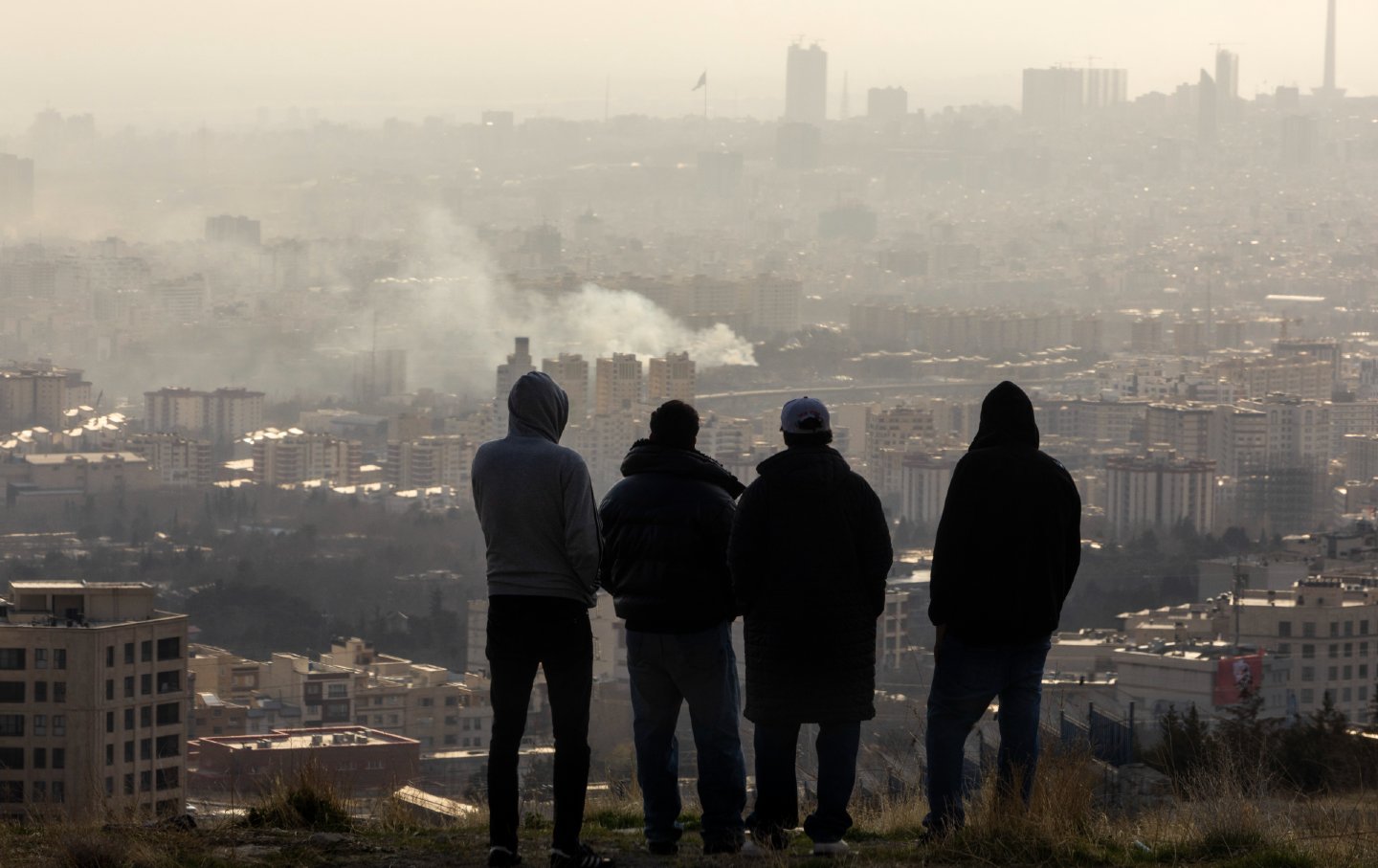
Men watch from a hillside as a plume of smoke rises after an explosion on March 2, 2026, in Tehran, Iran.
(Majid Saeedi / Getty Images)
War makes climate change worse in many ways, and vice versa. The human costs of the US-Israel attack on Iran—the hundreds of people who have died, including a reported 175 young girls and teachers killed at the Shajareh Tayyibeh primary school—are a tragedy. The mounting economic risks—disrupted supply chains, rising energy prices, shaken stock markets—are ominous. The danger that this war of choice launched by two nuclear-armed states will escalate further, drawing in powers across the region and beyond, is alarming. And threaded through each of these concerns is the fact that modern warfare is inextricably linked with climate change.
The linkages flow in both directions. Wars unleash gargantuan amounts of planet-warming emissions: Russia’s war in Ukraine, for example, has generated emissions equal to the annual emissions of France. Those extra emissions drive deadlier heat, drought, storms, and other impacts that wreck livelihoods, destabilize economies, and spur migration, making armed conflict more likely. The British intelligence agencies MI5 and MI6 warned in January that climate disruption and biodiversity loss, if left unchecked, will cause “crop failures, intensified natural disasters, and infectious disease outbreaks…exacerbating existing conflicts, starting new ones, and threatening global security and prosperity.”
The outbreak of any war is bad news for the climate, just as the election of politicians hostile to climate action is. The climate implications of this new war are not the center of attention at the moment, but they are essential context for understanding what’s at stake. At a time when civilization is hurtling toward irreversible climate breakdown, to overlook the climate consequences of three of the deadliest militaries on Earth going to war would be journalistic malpractice.
Yet war has the perverse effect of pushing the climate story down the news agenda. The news media is event-driven, prioritizing breaking developments and immediate threats. And wars generate powerful images and dramatic narratives, which stoke the public appetite for news (at least in a war’s initial stages). Climate change, by contrast, typically unfolds over longer timescales. Except during acute disasters such as hurricanes or wildfires, the climate story tends to lack the urgency that garners headlines and boosts audience interest.
Is this a war for oil? The fact that Iran possesses the third-largest oil reserves on Earth inevitably raises the question, as does the long history of US-Iranian conflict over those reserves, including the CIA’s overthrowing a democratically elected leader who sought to nationalize them. When the US attacked Venezuela in January, President Donald Trump openly said that he wanted to gain control of that country’s vast oil reserves. Now more reporting is needed to establish just how much of a factor oil was in the decision to attack Iran.
What’s beyond dispute is that this war could not be fought without oil. The aircraft carriers, jet planes, and the myriad support systems they require gobble immense quantities of fossil fuels. Which helps explain why the US Department of Defense is the largest institutional emitter of greenhouse gases globally, as Neta Crawford, a professor at Oxford University, documents in her book The Pentagon, Climate Change, and War. Taken together, the world’s militaries have a bigger annual carbon footprint than all but three of the world’s countries.
Given this war’s immense implications—for the climate emergency and so much else—the question of why it was launched in the first place demands scrutiny, especially in view of the wild shifts in the Trump administration’s stated rationales. Within 24 hours of the first strikes, The Washington Post cited four administration sources as saying that “US intelligence assessments saw no immediate threat” from Iran. Nevertheless, Trump opted to attack, the Post reported, “after a weeks-long lobbying effort” by Israel, which views Iran as a bitter enemy, and Saudi Arabia, Iran’s long-standing regional rival and fellow petro-state.
As with most wars, so with climate change: The poor and the innocent suffer most. Climate change is not peripheral but structurally embedded in modern warfare. Journalists cannot fully and fairly cover a war this carbon-intensive, destabilizing, and consequential if its climate dimensions are treated as optional add-ons rather than core fact.