

People rally and march in support of universities and education on April 17, 2025 in New York City. Called a “Rally for the Right to Learn,” the protest consisted of students, teachers, and activists marching to demand that the administration of Donald Trump to stop arresting foreign students and cutting money from universities, among numerous other concerns.
(Spencer Platt / Getty Images)Dear students,
If you add up our time in college classrooms, we’ve been teaching for over four decades. We spent this much time in academia, because we believe in the transformational potential, for you and for society, of what one coworker calls your “right to an intellectual life.” At the very least, this right should ensure access to every kind of knowledge; the opportunity to learn from experts; the freedom to pursue questions; and, crucially, the material stability to follow your intellectual curiosities.
It can be transformational to explore an academic field in multiple scales, from the subatomic to the interstellar, and in ways that exceed or overturn inherited metrics for comprehending it. In the process of this study, you will hopefully forge a more sophisticated understanding of how much and what kind of evidence it takes for you to change your mind. When enough people change their mind in any single direction, it can shift the course of history.
But there are those who are opposed to granting you this right. The most obvious case is those who seek to censor knowledge. They do so because this right gives you access to books that can teach you just how often learning—not always from books, often through connection with one another—inspires people to fight for a better world. To quote Assata Shakur, “No one is going to give you the education you need to overthrow them.”
Meaningful protection of the right to an intellectual life ensures that you will have the conceptual tools to overthrow tyrants. These tools will also help sustain the spiritual ones of courage and tenacity; they help distinguish between passion and bluster, between righteousness and snake oil. Right-wing media and politicians (along with their ostensibly centrist apologists) caricature these tools as disconnected from everyday life or as damaging to the pursuit of that life. These folks promote such distortions to push forward legislative reforms and federal enactments that will impoverish or eliminate precisely the knowledge that could change your life, that could deepen your sense of how interconnected you are with the well-being of others. And what is even more heartbreaking is that the people charged with protecting your access to transformational education often convey, in word and deed, that you should not want to have it, let alone exercise it to its fullest degree.
The magnitude of the changes confronting higher education defies easy expression or any one news story. The targeting of higher-education institutions by the US federal government is the grotesque fruit of a multi-decade political movement to erode public trust in universities. The goal is and has been to compromise them as agents for resource redistribution. If the current administration forces universities to bend to its whims, any prospect of a broadly shared and generously funded social commitment to free and widely available education will evaporate. But the blame is not Trump’s alone. A perniciously neoliberal and instrumentalist perspective on what university learning is for has accelerated the corrosion of US higher education.
Sometimes this corrosion manifests in how people talk about education: Think of the number of studies of which jobs different majors get after graduating. That conversation presumes that the only reason to study is to lock in the size of your paycheck. That conversation ignores any other motivation, and, maybe even more egregiously, it ignores what and who establishes paychecks and the tight grasp the wealthiest have on most of our working conditions. The undermining of education’s purpose is apparent in the very structure of educational institutions and, most visibly, in the jobs that university trustees had before or concurrently with their roles on the boards that run universities: They’re CEOs, partners of consulting firms, investment bankers, real estate developers. This structure can be opaque from off-campus, but it matters to what is possible on campus: These boards—not presidents, not deans, and certainly not faculty—are now the final bosses.
But nowhere is the assault on higher education and its associated freedoms more urgently literal and murderously organized than in the ongoing scholasticide in Gaza. Faced with students calling on their institutions to recognize and rectify their own material investments in violence, university boards—in some cases staffed by CEOs of companies profiting directly and indirectly from Gaza’s obliteration—authorized and oversaw unprecedented crackdowns on student protests. In the process, they betrayed the foundational commitment of the very institutions that they steward: to advance knowledge and to empower students in search of new knowledge. At the same time, they took no steps to check or undo the role of their universities in the destruction of Palestinian institutions.
In the face of these and other assaults, it is hard not to feel powerless. We will be frank with you: We have felt powerless. The ceaseless drive to build university endowments has warped the image of what we think of as study. When administrators and colleagues profess faith in the sanctity of university endowments—it would be funny if it weren’t so debilitating—how, after all, is an institution going to model for you the nonfinancial value of education?
But actual deep, sustained, collaborative studying can build solidarity. This process does not happen exclusively inside universities, but it is what turns personal transformations into social ones. And it is this kind of studying that questions the false gods of capital and financialization. It reveals the motive of profit and the allure of wealth-hoarding as inimical to our collective well-being. Extensive and wide-ranging study should clarify the difference between ideology and history, the kind that many in our ruling class do not want you to learn. The term “ruling class” is helpful here. It pinpoints the overriding motivation for obliterating your right to an intellectual life. The goal is to make you desire to be ruled and to have you call that freedom.
Winning the fight for an intellectual life will require solidarity across generations. For that to happen, we should admit that we get frustrated when you sometimes undermine your own precious freedom to think richly and expansively. We get frustrated when you instead embrace the most rapaciously consumerist modes of careerist self-actualization. Here is a very short story to illustrate what we mean: We were on a panel together, and one of your peers unwittingly presented their own self-ejection from intellectual life as a clever question: Why would you choose a life of humanistic study when there were other ways to make much more money?
No matter the messaging about good careers, the virtues of studying are not reducible to the accumulation of wealth. We have chosen a life of humanistic study, because we believe it will bind us more closely to you, to those who have preceded us, to those who will follow, and to the lands that we rely on. What you probably intuit is that our generation, like the one before, has, for the most part, doubled down on the financialization of earth, space, life, and death. This is the true social context that we need to contend with and struggle against.
Let’s keep that broader reality in mind as we talk about what you have likely become familiar with in your schools: the tyranny of STEM and the anti-intellectual weight of delimiting STEM as a specific kind of learning isolated from (and valued above) all other learning. Behind the student’s snarky question to us was the presumption that humanistic study was incommensurate with the study of STEM and that these more “practical” fields lead to bigger paychecks. Like them, you have no doubt been encouraged to think in terms of what job you might get and to work back from there to determine what you should study.
Popular
“swipe left below to view more authors”Swipe →Here is an actual practical reality: This diminished vision of STEM has helped erode the capacity of institutions of higher education to incubate and sustain the disciplines that are best positioned to make sense of the world around you. The brands of elite private universities may continue to evoke excellence, but their curricular offerings lag behind institutions that have fared a bit better at retaining the best people whose research and expertise might help you gain a multidimensional understanding of this world. Those who should prioritize your right to an intellectual life deny you access to expertise even as they reassure you that yours is an elite education. Meanwhile, those teachers who can make holistic understandings of knowledge come most electrifyingly alive for you are marginalized or cast aside.
The keys for imagining otherwise are in your hands. You should remember that students have led or been in solidarity with the most important struggles for a sustainable, equitable world in the 20th and 21st centuries. Students have connected their ability to study power’s intentions to these global struggles. Because of students, universities have also become better places: Students have insisted that their education befit the breadth and depth of their curiosities, an education that is current with every branch of making knowledge, both those that are established and those that are still emerging into classrooms. They struggled so that you could, for example, study race and class in a global context, or forms of dispossession as they are experienced and understood by Indigenous peoples, or the myriad anti-colonial imaginations that gift us glimmering visions of worlds beyond this one, or traditions of interracial and interclass solidarity, or the concurrence of colonialism and ecocide, to name just some examples. But their victories—your inheritance—are now being stealthily memory-holed.
If we were together in a classroom, we would ask you: What does it mean that “the practical” that has been presented to you as a foregone conclusion is ultimately to the detriment of the planet’s well-being? Has power conditioned you to accept “the practical”—this idea of common sense and this limited notion of the possible—precisely because it has created structural realities that echo its interests: keeping you in material and spiritual debt through a life’s indenture to careers it deems “practical,” while and so that the wealthy get wealthier and the world burns?
Our fates are intertwined. Whether you decide to fight for your right to an intellectual life determines much more than the nature of your own jobs. Your decisions, or not, to insist on immersion in every kind of knowledge, on curricula that include every kind of imagined world, on easy access to every book no matter its politics or author, and on opposing the censorship of your minds by a profit motive will help determine the future of the planet.
Counter to the right-wing caricature of people like us who teach and profess, we won’t ever tell you what to think. But in keeping with the best impulses of the traditions of study and solidarity we come from, we will beg you to fight for your right to an intellectual life that is richer than any acronym and much more—urgently and joyously more—than an incidental precursor to a job. It will look differently depending on whom you are around and what you decide, but rest assured that there are many more of us—the millennials, the Gen Xers—who are willing to stand alongside you. If we’re lucky and relentless and work together, we might even rebuild a society unbound by paychecks.
More from The Nation

The Endless Hypocrisy of Bari Weiss The Endless Hypocrisy of Bari Weiss
She claims to be a free speech champion. But as her actions at CBS News keep showing, she seems to think free speech should run only in a rightward direction.
What Will Be Left After the University of Texas Destroys Itself? What Will Be Left After the University of Texas Destroys Itself?
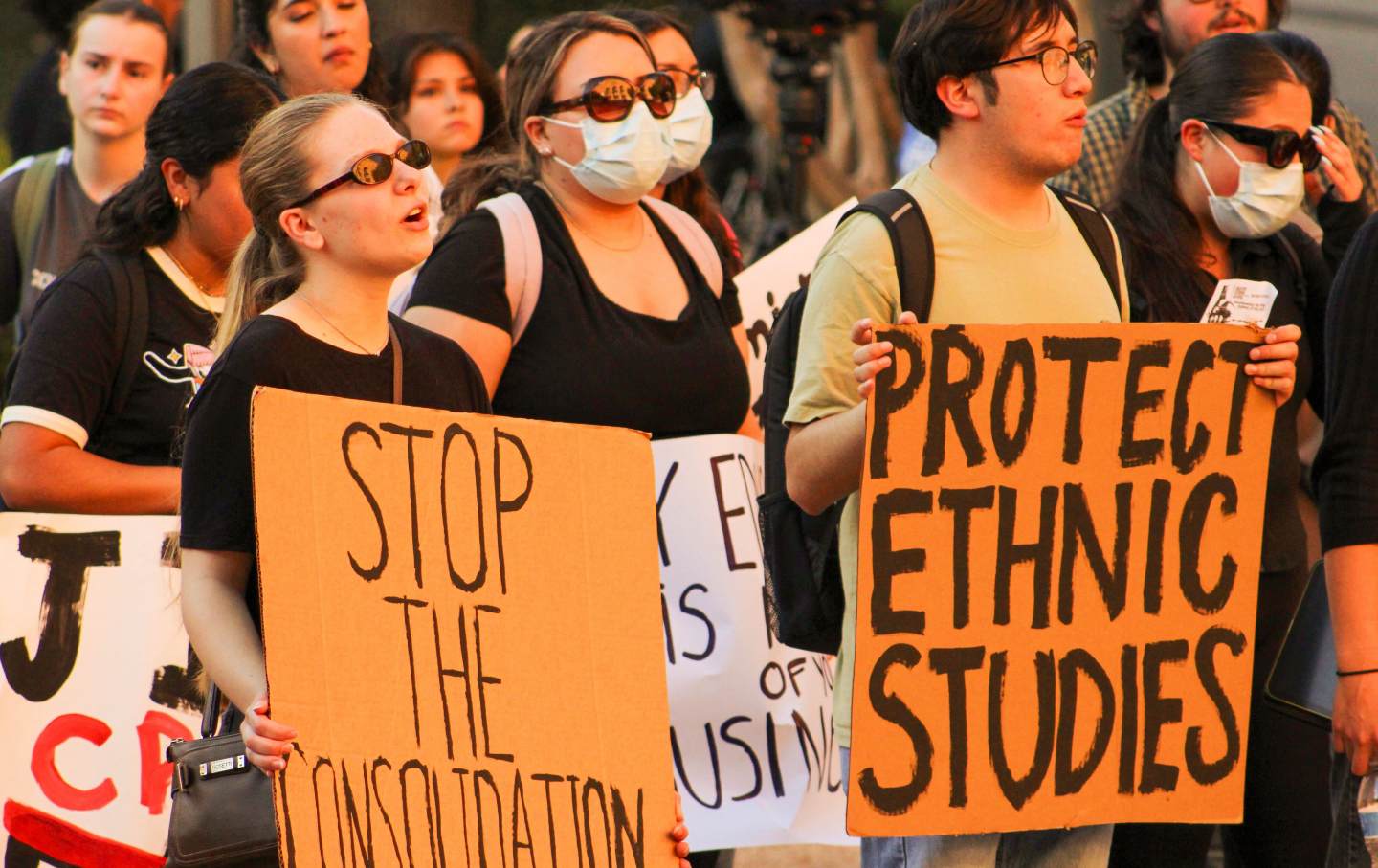
UT-Austin has collapsed its race, ethnic, and gender studies into a single program while a new policy asks faculty to avoid “controversial” topics. But the attacks won’t end there...

The Corporate Media Is Head Over Heels for the Iran War The Corporate Media Is Head Over Heels for the Iran War
Donald Trump’s attack may be surreal, unjustified, and illegal. But that’s not stopping the press from turning the propaganda dial way up.

The Disturbing History of ICE’s “Death Cards” The Disturbing History of ICE’s “Death Cards”
The Vietnam-era practice is yet another example of ICE agents thrilling to the brutality they have been encouraged to cultivate.

The Red State–Blue State Healthcare Divide Is Dangerous for Everyone The Red State–Blue State Healthcare Divide Is Dangerous for Everyone
Whether or not you have access to independent, scientifically sound public health guidance may depend on how your state voted for governor.

The American Universities Programming Israel’s Killer Drones The American Universities Programming Israel’s Killer Drones
Industry partnerships in higher education are pushing STEM graduates into the business of weapons manufacturing and genocide profiteering.

