Is Blockbuster Video the Answer to Our Digital Privacy Woes?
The Supreme Court is weighing whether a 1988 video-store law can be used to protect our digital privacy.
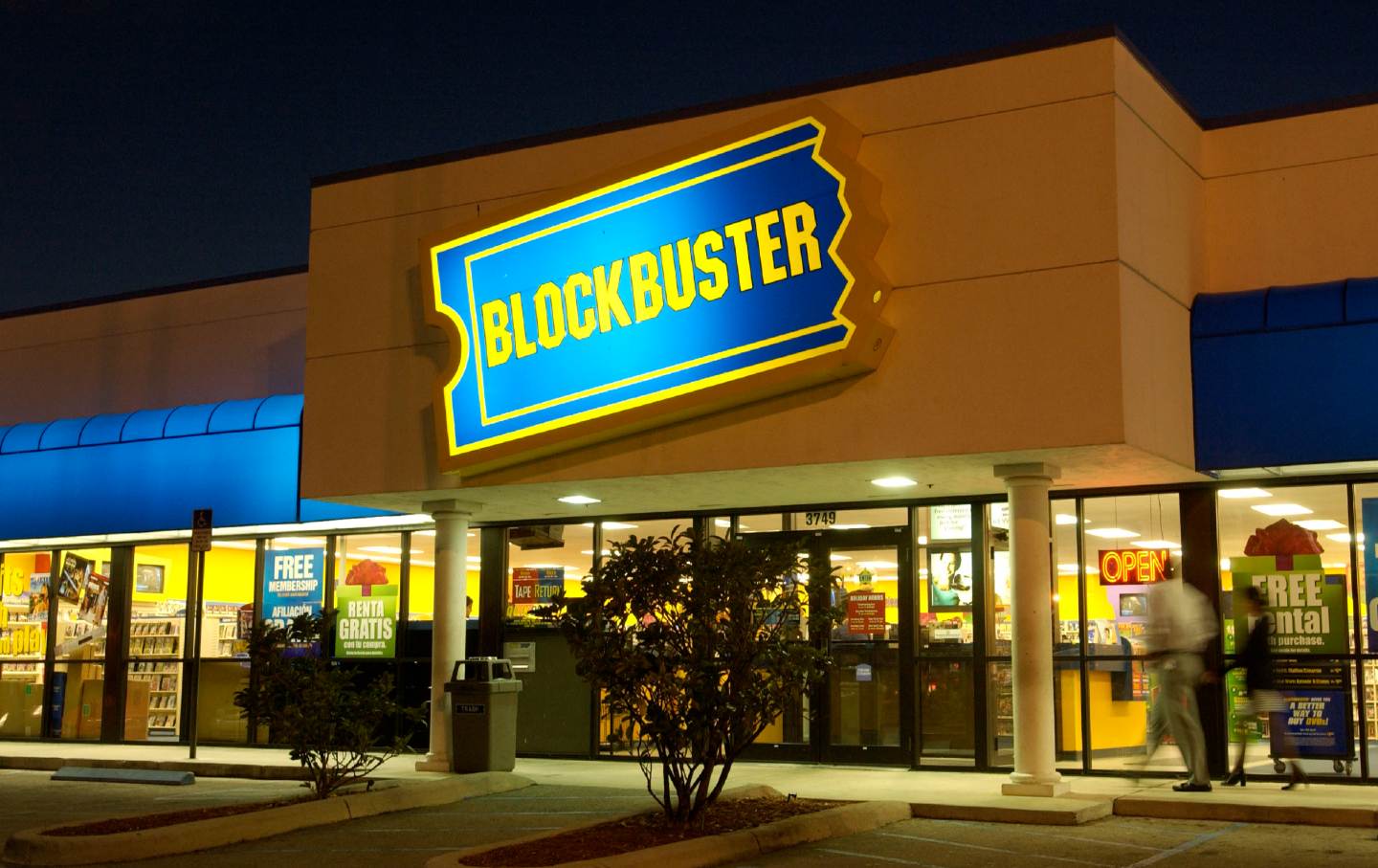
Customers walk into a Blockbuster Video store in 2002.
(David Friedman / Getty Images)
The Supreme Court heard oral arguments on Wednesday in Salazar v. Paramount Global, a case about digital privacy. Well, it should be a case about digital privacy, but it is actually about whether a law passed in 1988 to regulate (not making this up) Blockbuster Video can be used to protect us from prying, data-hungry tech giants. Which… is asinine. It is absurd that a law meant to protect people who rented Emmanuelle IV represents our best chance to get stronger data privacy regulations in the year 2026. And yet, here we are.
This issue starts at the beginning of the modern Supreme Court, which most people date to the confirmation hearing of Robert H. Bork. Bork was a very bad, very racist man who was nonetheless nominated by Republicans to the Supreme Court. Stopping his confirmation became an all-hands-on-deck proposition for many Democrats and people of conscience. That effort included doing anything possible to smear the man (which was unnecessary, in my opinion, because his public record was damning enough), and that somehow led to the clerk at Bork’s local Blockbuster video testifying about Bork’s viewing habits. (For our younger readers: Blockbuster was a store where people would go to rent video tapes of movies, and stores were physical places where goods or services could be exchanged for money, and goods and services were things people could afford to buy before Trump started a trade war as well as a war-war for no reason.)
Bork’s video rental history was pedestrian and unexciting, but the fact that his viewing history became public knowledge freaked out a lot of politicians. (I can’t imagine why. I’m sure Denny Hastert’s private video rentals were totally normal and cool.) In response, Congress passed a whole-ass law to prevent their (I mean “our”) video rental histories from being outed: The Video Privacy Protection Act (VPPA). The law prohibits “video tape service providers” from disclosing personal information about any customer.
As I mentioned, all of this happened in 1988. We have to use a DeLorean to fast forward through multiple technological revolutions to get all the way to 2022 and a man named Michael Salazar, who is the named plaintiff in this case. Salazar was a subscriber to the newsletter for a sports website called 247Sports. The site is owned by Paramount. Salazar viewed free videos that were embedded or linked to parts of the newsletter. The information about which videos Salazar viewed was shared by Paramount with Facebook, without Salazar’s consent. Salazar filed a class-action lawsuit arguing that Paramount’s disclosure of his personal data violated the VPPA and he was entitled to damages. Salazar’s case was dismissed by lower courts based on various theories, including that 247Sports is not a “video tape service provider,” and Salazar appealed to the Supreme Court.
The problem here is obvious: there is no law exactly like the VPPA that applies to “the internet.” Nor is Blockbuster Video particularly like “the internet.” Nevertheless, people have or should have a reasonable expectation of privacy in their video viewing history. The VPPA seems to stand for the principle that your personal viewing history should remain private.
Is it a stretch to apply the VPPA to modern internet habits? Sure. Of course it is. But the foundational regulations of the internet itself are merely stretched from regulations we applied to books or newspapers. Everybody reading this article is protected from Kash Patel’s thought police under the same framework that applies to reading a newspaper article. It makes sense that everybody who clicks on a video linked to this article is protected under the same framework that protected people who went to the video store right after school on Fridays to pick a movie before all the good ones were out of stock.
Much of the discussion during Supreme Court arguments centered on the definition of “video tape service provider.” What makes a store, or a website, or a newsletter, a video tape service provider? Justice Clarence Thomas suggested that stores have to provide a physical product—like an actual VHS cassette or DVD—to be covered by the VPPA. In a world of streaming services, such a narrow definition would render the VPPA functionally obsolete. Other justices rejected that ribbon-thin reading, instead focusing on whether the business of the store has to be dedicated primarily to providing videos—a standard that would encompass, say, Netflix, but little else.
Republican superlawyer Paul Clement, arguing on behalf of Paramount (because of course he was), kept pushing the most wild hypothetical scenario. He kept bringing up Chick-fil-A, arguing that a person who watches a video provided by Chick-fil-A should not be protected by the VPPA, because Chick-fil-A is clearly not a “video tape service provider.” Literally nobody disagreed with him, not even the lawyer for Salazar, Joshua Hammack, but Clement kept harping on about Chick-fil-A—so much that I began to suspect the homophobic chicken shop paid him for product placement at a Supreme Court hearing.
The problem with most of the hypotheticals raised during the arguments (not just Clement’s) is that they served to distract from the core reason for this law, rather than illuminate it. Nobody really cares if Facebook knows I’m watching college sports recruiting videos (which is what 247Sports actually serves) or if a Congressional confirmation committee knows that I watch deep dive retrospectives on Star Trek: The Next Generation. What we all care about is porn. People do not want their porn video habits available for public disclosure (or their lack of porn habits, which I’d find even more disturbing, but maybe that’s just me). People are worried about their streaming porn getting out there in public, just like they were in 1988 when the VPPA was passed. We’d all be better off if we just admitted what we are actually talking about and worked to keep private what we all instinctively want to keep private.
Amazingly, Justice Elena Kagan went there. Her hypothetical was not about chicken sandwiches or video cassettes. Instead, Kagan imagined a judge who watched “sketchy videos” with “lots of women wrestling” and feared “embarrassment.” She said that was the “paradigmatic” VPPA case.
Kagan’s solution to the real problem was really simple. She said Paramount has two choices to avoid liability under the VPPA: gaining people’s consent or stop selling people’s data, “take your pick.”
This has to be the right answer. Not selling data should be the default, unless you obtain consent to do so (and we can go to the mattresses later about what constitutes “informed consent”). And that standard should apply to anybody who serves you a video, whether it’s part of their core business or not. Consent or GTFO. Why is this such a difficult concept for some people to understand?
Popular
“swipe left below to view more authors”Swipe →Even alleged attempted rapist Brett Kavanaugh said that obtaining consent would be “a very easy solution,” though Kavanaugh [wait for it] seemed to be perplexed about how internet companies would actually go about obtaining consent. Kagan shot back that we give our consent to “hundreds” of these companies every day, and referenced the “accept all cookies” prompts that are ubiquitous.
Clement would not accept consent as a solution. He said that requiring companies to obtain consent would force everything behind a paywall. This argument is facially untrue, but even if it were true, it should have no bearing on how we protect our privacy.
Kavanaugh said something else—and this comment boded well for Salazar: “We are a textualist court, but not a literalist court.” Now, in real time, I disregarded this statement because it’s a dirty lie: this court is happy to get hyper-literal when it comes to deporting immigrants, sentencing people to death, or getting rid of affirmative action. But when this statement is taken with the rest of the arguments, it might mean that Kavanaugh is at least open to reading the VPPA as applying to more than a literal Blockbuster Video and nothing else. Add to that the fact that Chief Justice John Roberts and Neil Gorsuch were particularly quiet during the arguments, and I can just about talk myself into a win for Salazar and a ruling that forces Paramount to offer a bare minimum pop-up consent form to subscribers before selling your data to Facebook. One must always assume that this Supreme Court is going to side with the biggest business in the room (which is Paramount, in this case), but I’m saying there’s a chance in this case. People, especially Republicans, do weird things once porn gets involved.
Still, the most simple, effective, and best solution would be for Congress to write a new law that protects people’s digital privacy in this century. Trying to graft digital privacy rights onto a Blockbuster Video law is fundamentally stupid.
We shouldn’t have to wait for one of these guys (and it’s going to be a guy) to be headed to a confirmation hearing to realize that it’s probably a bad thing for OnlyFans to sell their viewing history to the National Enquirer. Updating laws so that they actually make sense, textually and literally, should be the job of Congress, not the Supreme Court.