The Supreme Law of the Land
What role should the Supreme Court play in American politics?
What Role Should the Supreme Court Play in American Politics?
A wide-ranging new book by Nikolas Bowie and Daphna Renan examines how America’s highest court often gets in the way of democratic politics.
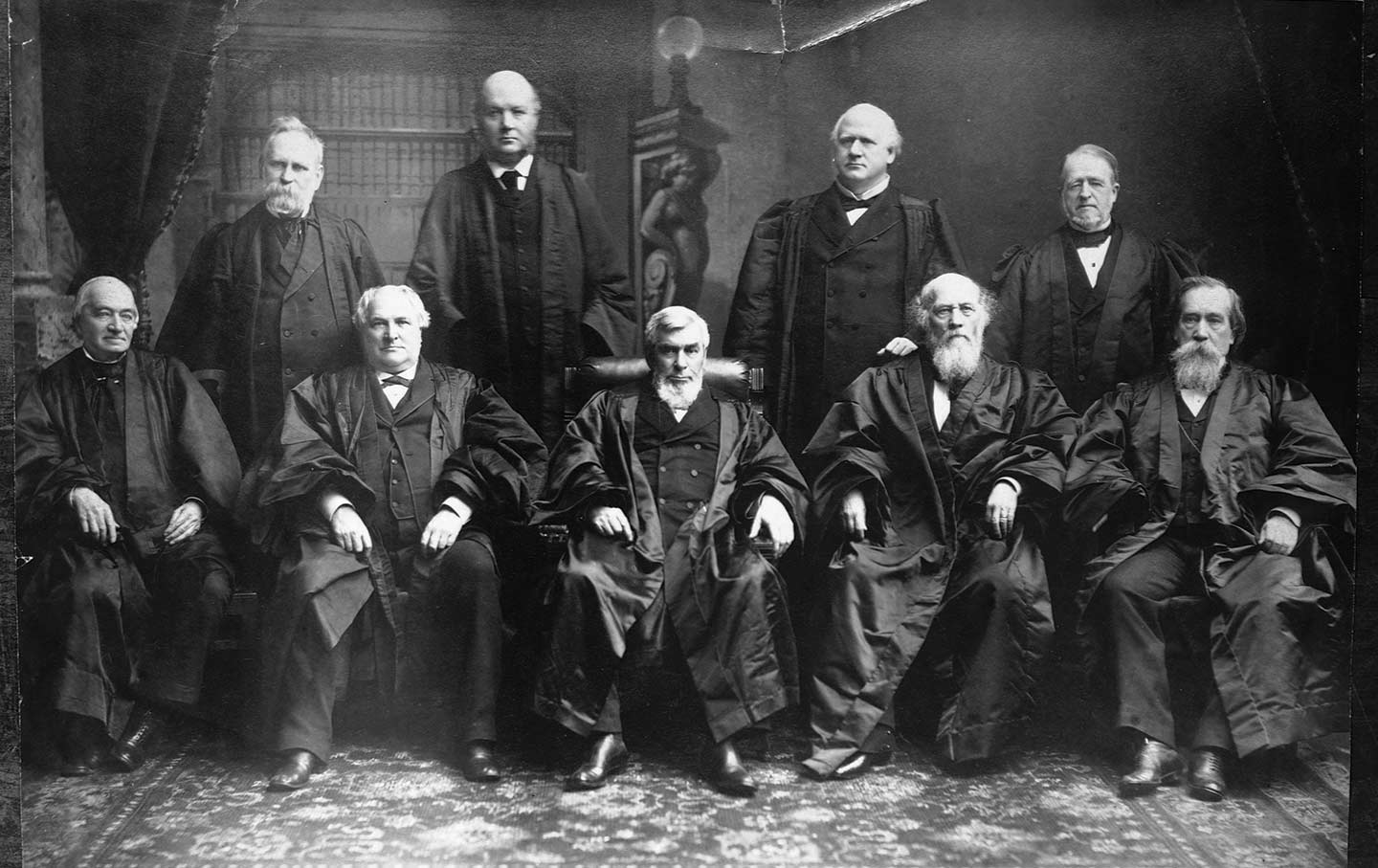
The Supreme Court in 1888.
(C.M. Bell / Library of Congress)
The Supreme Court’s dismantling of the last vestiges of the 1965 Voting Rights Act this spring in Louisiana v. Callais marked the end of an era—a retreat from the core civil rights commitment to draw electoral-district lines in a way that would ensure representation for racial minorities. More immediately, the decision in Callais set off a pell-mell process of new gerrymanders that carved up majority-minority districts into fragments designed to dilute Democratic votes. This fall, Democrats will likely lose three seats in the House of Representatives as a result of the decision. The number of Black representatives will likely drop too.
Books in review
Supremacy: How Rule by the Court Replaced Government by the People
Buy this bookFor many Democrats, Callais also reignited a long-smoldering fury with the court. Days after the decision, House minority leader Hakeem Jeffries of New York insisted that the time had come for “massive judicial reform”; the court, he insisted, was a “disgrace.” Representative Ro Khanna of California demanded term limits for the justices. Longtime Democratic strategist and professional intemperate James Carville charged that the “sons-of-bitches” on the court were “irredeemably corrupt” hacks and called for the addition of no fewer than four new justices once the Democrats retake control of Congress and the White House. Likely 2028 presidential contender Kamala Harris, who has recently echoed Carville’s proposal, signaled a new openness to such formerly off-limits steps. And in a widely read piece in The New York Times, prominent Harvard scholars Nikolas Bowie and Daphna Renan opined that the court was endangering the ability of the American people to govern themselves.
Now, in an energizing new book brimming with intelligence and passion, Bowie and Renan offer a full-dress critique of the court’s role in the nation’s history. Years in the making, and striking for its ambition and creativity, Supremacy: How Rule by the Court Replaced Government by the People represents a culmination of sorts of the years of liberal and left-wing discontent with the court. In it, Bowie and Renan argue that the Supreme Court has undermined American democracy throughout its 236-year existence—and never more so than in the present. Ranging from the court’s infamous endorsement of slavery in the Dred Scott case to the grim rollback of Reconstruction’s fleeting civil rights triumphs, they tell the story of the nation’s highest court working time and again to smother democratic possibilities and institutions. The authors recount the court’s dagger to the heart of the first peacetime federal income tax in 1895, its knife to the throat of the New Deal in the mid-1930s, and its slow carving-up of the Voting Rights Act in the decades leading up to Callais. They track the court’s undermining of civil rights laws, child-labor protections, labor regulations, domestic-violence laws, and firearms restrictions. They document its damage to campaign-finance laws, to consumer-protection laws, and to laws constraining overreach, crime, and corruption in the White House. In stark terms, Bowie and Renan describe a Supreme Court made up of latter-day monarchs who have disabled American self-government and rendered the United States “a nation that is a democracy mostly in name.”
In liberal-left legal circles, the critique of a “juristocracy” run rampant is growing in influence by leaps and bounds. Viewed favorably by liberals during the nearly 16 years that Earl Warren served as chief justice, the court has since become one of the principal sites of progressive disillusionment with American institutions. The stakes for our democracy could not be higher.
But is the diagnosis right?
Observers of the Supreme Court today have a name for the aggressive assertion of judicial power. They call it “judicial supremacy”: the claim that the court has the exclusive power to interpret the Constitution’s meaning and to require the elected branches of government to follow its interpretations.
In theory, it would be simple enough for progressives of all stripes to reject this idea of judicial supremacy outright—after all, plenty of democratic countries have managed without the judicial power to decide on the constitutionality of laws passed by the legislative branch, the United Kingdom and New Zealand chief among them. But American liberals face a special problem when it comes to doing so: In the second half of the 20th century, especially during the Warren years, judicial supremacy was associated not with conservative rulings but with liberal ones, such as the 1958 case of Cooper v. Aaron, in which Chief Justice Warren and a unanimous court ruled that Governor Orval Faubus and the state government of Arkansas were bound by the court’s decision in the epoch-making desegregation case Brown v. Board of Education. “The federal judiciary,” the court declared in Cooper, “is supreme in the exposition of the law of the Constitution.” The court’s judgment in Brown was thus “the supreme law of the land,” to be followed by state and federal officials alike.
Bowie and Renan’s creative solution is to distinguish between the judicial review of state laws on the one hand and of federal laws on the other, thereby offering a way for 21st-century liberals to celebrate the righteousness of the decisions in Brown, Cooper, and the now-overturned Roe v. Wade while still expressing frustration with the Supreme Court’s outsize power. The authors of Supremacy thread this needle by applauding the court for applying the federal Constitution to overturn state laws—for applying the Constitution “vertically,” as they put it—while remaining steadfast that the court should not apply the Constitution “horizontally”: that is, to block the federal laws passed by Congress.
Bowie and Renan note that judicial review in the horizontal sense has always been the more controversial form of review, all the way back to the earliest days of the republic. Founding-era critics worried that it would allow the courts to seize a dangerous amount of legislative power for themselves—such a practice, North Carolina’s Richard Spaight stated in 1787, “would be more despotic than the Roman Decemvirate, and equally as insufferable.” Such was the opposition to horizontal judicial review that in 1792, a few members of Congress threatened to impeach those justices who raised separation-of-powers objections to a law that gave the court’s members the task of reviewing pension claims by veterans of the War of Independence. A decade later, after a watershed election swept Thomas Jefferson into office, the new president’s partisans in Congress effectively abolished the Supreme Court’s 1802 session in order to block judicial review of their new laws. In a pair of decisions the next year, the court asserted its authority to decide on the constitutionality of congressional laws while meekly allowing such new Jeffersonian attacks on the judiciary to stand. In Marbury v. Madison, Chief Justice John Marshall gave voice to the court’s judicial-review authority, but did so in service of Jefferson’s efforts. In Stuart v. Laird, by contrast, the court declined to exercise that same authority when it would have produced a direct conflict with the new president.
Bowie and Renan adopt the conventional wisdom that after Marbury, judicial supremacy remained mostly dormant until 1857. In that year, in the infamous Dred Scott case, Marshall’s successor, Chief Justice Roger Taney, ruled that Dred and Harriet Scott were slaves even though they had lived in a territory where slavery was illegal because, among other things, Congress had exceeded its power when its Missouri Compromise banned slavery in the territories north of the 36°30’parallel while admitting Missouri as a slave state. A ban on slavery, Taney held, would violate the Fifth Amendment rights of enslavers to be free from government deprivations of their property without due process of law. Reactions to the decision in the North were fierce, but mostly not because of Taney’s ruling that Black people could not be citizens. Chief Justice John Roberts’s opinion this past summer in the birthright-citizenship case suggested otherwise, but most white northerners were indifferent on that score. The main source of the anger over the Dred Scott case was that the decision opened the Western territories to slavery and thereby threatened to deprive white families of the economic opportunities of free soil and free labor. Such was the animus toward this dimension of the ruling that three years later, Abraham Lincoln would win the White House on a Republican Party platform that challenged the scope of the court’s power over the Constitution. The court, Lincoln announced, lacked the authority to resolve the public’s disagreements over the great question of slavery and freedom in the West.
From Dred Scott and Lincoln’s election, Bowie and Renan turn to Reconstruction, the pivotal decade in which the Republican-controlled Congress enacted laws to protect and defend freed people in the South, only to see the Supreme Court overturn or distort them. In the final months of the war, Congress established the Freedmen’s Bureau, which W.E.B. Du Bois later called “a full-fledged government of men,” as an administrative agency charged with distributing abandoned lands, setting up schools, and adjudicating disputes between whites and Blacks. It also passed the Enforcement Act of 1870 and the Ku Klux Klan Act of 1871, which among other things made it unlawful to violate the constitutional rights guaranteed in the 13th, 14th, and 15th amendments. And in early 1875, as Democrats were prepared to take over the House of Representatives for the first time since before the war, the lame-duck Republican majority in Congress passed a civil rights act prohibiting discrimination in public accommodations and authorizing the victims of such discrimination to sue in the federal courts.
Here was Congress building on the transformative moral triumphs of the Civil War, the Emancipation Proclamation, and the Reconstruction amendments and enacting substantive laws with an eye toward making the United States a more just and equal nation. But in each instance, the Supreme Court intervened horizontally to snuff out the promise of these laws. Before the war’s violence had fully come to an end, the court ruled (in the famous case of Lambdin Milligan) that the Freedmen’s Bureau courts were an unconstitutional violation of white defendants’ trial-by-jury rights. The court then truncated the reach of Reconstruction legislation in cases like in United States v. Reese and United States v. Cruikshank, ruling that the 14th and 15th amendments prohibited action by states, not discriminatory violence by private persons. In 1883, the court siphoned away the last energies of congressional Reconstruction by striking down the Civil Rights Act of 1875. The perversely titled Civil Rights Cases followed the line laid down in Reese and Cruikshank, holding that the discriminatory behavior of railroads, hotels, and theaters—like the murderous terror of the Klan—was not state action and thus not subject to constitutional constraints.
After betraying Congress’s Reconstruction statutes, the court began striking down a new generation of congressional attempts to rein in industrial capitalism. In 1895, the court’s decision in United States v. E.C. Knight Company blocked Congress from dismantling giant monopolies in manufacturing. Three months later, the court struck down the new progressive federal income tax, deeming it (in Justice Stephen Field’s words) an “assault upon capital.” In quick succession, the court struck down Congress’s 1906 protections of railroad workers injured on the job and its 1898 attempt to prohibit workers from being fired for joining a union. Federal laws to end child labor fell under the court’s scythe in 1918 and 1922, as did Congress’s efforts to check the executive branch in 1926.
During the presidency of Franklin Roosevelt, the court emerged as a reactionary obstacle to New Deal efforts to address the Great Depression, striking down federal laws like the National Industrial Recovery Act, the Agricultural Adjustment Act, and the Railroad Retirement Act. Although Roosevelt’s star-crossed court-packing plan was defeated in Congress, his appointment of eight new justices over the course of his presidency effectively cleared away the obstacles to New Deal programs by other means.
Bowie and Renan argue that this compositional shift in the court also augured a movement away from horizontal review to vertical review. In their telling, civil rights lawyers like Charles Hamilton Houston saw the enduring promise of the Klan Act and made it the central vehicle for the famous litigation campaign that led to Brown v. Board of Education. The NAACP’s campaign for Black freedom, in Bowie and Renan’s creative revisionist telling, relied not on an idea of the courts as a “judicial angel” offering escape from politics, but on a strategy of using Congress and the Klan Act to deliver on an existing democratic commitment to constitutional rights for all. In this account of the ruling, the key moment in Brown v. Board of Education came when the justices asked Thurgood Marshall whether they should wait for Congress to act before declaring segregation unconstitutional. Marshall’s reply, which drew on the strategy of his colleague Constance Baker Motley, is the climactic juncture of Bowie and Renan’s argument. “Congress,” Marshall told the justices, “has already acted” by passing the Klan Act. The court’s job in Brown, he continued, was to vindicate Congress’s democratic mandate.
Put this way, Brown stood for what Bowie and Renan call “democratic constitutionalism”—the egalitarian expression of a multiracial democratic majority breathing new life into the Constitution. Yet the Warren court, in their view, lost the plot. Its opinion in Brown made no mention of the Klan Act, and so the breakthrough of Brown has been attributed ever since to judicial action instead of to Congress. The effect, Bowie and Renan argue, has been politically catastrophic. Liberals adopted a self-defeating embrace of the same antidemocratic juristocracy that historically has dealt death blows to progressive policies. Name-checking the lions of liberal jurisprudence—Akhil Reed Amar, Ruth Marcus, Laurence Tribe, and Ronald Dworkin among them—Bowie and Renan accuse liberals of supporting the court’s authority even though its imperial ambitions have usurped the democratic potential of the people acting through Congress. The authors concede that the judicial review of federal laws has yielded progressive victories from time to time. The court blunted anti-communist legislation that violated free-speech principles. It overturned sex discrimination in both military benefits and Social Security pensions in the 1970s. It averted some of the worst excesses of the congressionally endorsed detention policy at Guantánamo Bay after 9/11, and it overturned the discriminatory Defense of Marriage Act in 2013. But such victories, they contend, are “dwarfed in their overall significance” by the “vastly larger set of cases” in which the court has harmed vulnerable minorities.
The Bowie and Renan argument will be tonic to the flagging spirits of liberals estranged from today’s court. But like previous critiques of judicial review over the past century and a half (many of which they feature in their book), its impact is likely to be fleeting. Parts of it may even be counterproductive, because in crucial respects, their forceful narrative rides roughshod over the political dynamics of judicial review in America.
As a starting point, the judicial review of federal statutes is more deeply embedded in American history than the thesis of Supremacy contemplates. The pension cases of the 1790s may have occasioned loose talk of impeachment by a handful of politicians, but the controversy also showed that judicial review had widespread support from the start. Between 1792 and 1794, all six of the Supreme Court’s justices indicated that they would not give effect to a law that unconstitutionally turned them into claims administrators. The first US attorney general, Edmund Randolph, agreed that the justices had the authority not to give effect to unconstitutional laws. In short order, Congress amended the law to remove the offending provisions. And in the five decades between Marbury and Dred Scott, the Supreme Court set aside at least 10 laws passed by Congress without much objection either from Congress or We the People.
Some of these early decisions turn the Bowie and Renan argument on its head. Consider the 1842 decision in Prigg v. Pennsylvania, which arose out of Pennsylvania’s effort to prosecute a Maryland slave catcher, Edward Prigg, for kidnapping Margaret Morgan and her children and trafficking them back to the slave states. The court overturned Prigg’s kidnapping conviction on the ground that federal law on fugitive slaves preempted the personal-liberty laws of the free states. The case’s result was a travesty—an early sign that neither the Supreme Court nor the Constitution would be able to contain the growing schism over slavery in American politics. But Prigg is also at odds with the Bowie and Renan thesis. Supremacy treats the opinion in Prigg as though the court made fugitive-slave renditions a national duty. Yet as Justice Joseph Story’s opinion in the case noted, Congress had beaten the court to the punch by nearly a half-century with the Fugitive Slave Act of 1793, which breathed life into the Constitution’s fugitive-slave clause and made kidnapping a national business. In its time, the antislavery critique of Prigg held that the court should have rejected Congress’s authority to pass laws about fugitive slaves, a power nowhere specifically enumerated in the Constitution. The egalitarian move was therefore for the court to act horizontally and overturn the law. Instead, the Supreme Court in Prigg did as Bowie and Renan urge. It deferred to an act of Congress, only here that meant acceding to evil. Even worse for their argument, Justice Story did suggest that the Fugitive Slave Act was invalid in one respect. The law conscripted free-state officials into participating in the federal slave-catching system, but Story deemed this beyond Congress’s constitutional power. Horizontal judicial review in Prigg effectively incapacitated Congress’s slave-catching apparatus—at least until Congress established federal commissioners to do its dirty work in a new Fugitive Slave Act in 1850.
On a more systemic level, the paradox of horizontal judicial review in the run-up to the Civil War is that it was nurtured and encouraged by elected officials as much as it was advanced by the Supreme Court. No one wanted Dred Scott to take the slavery question off the table more than President-elect James Buchanan. Indeed, both Democrats and Whigs in Congress were desperate for judicial solutions that would allow the parties to punt on the slavery questions that threatened to tear them asunder. Elected officials wanted most of all for the Supreme Court to solve the problem of slavery in the Western territories—and leading antislavery politicians wanted this nearly as much as proslavery ones. Bowie and Renan dismiss Salmon Chase, the US senator from Ohio who was widely expected to become the first antislavery president, as a judicial supremacist. They aren’t entirely wrong. Chase insisted that the Constitution did not permit slavery in the Western territories and demanded that the courts say so. But Chase was among the most successful and influential members of Congress in his day. If democracy and Congress are the relevant measures, the popular Chase was far more significant than the radical abolitionists who loom large in the Bowie and Renan story but who seldom tried to win elections and rarely won when they did.
Racial egalitarians turned to the courts both before and after the Civil War because Congress was a natural agent of majoritarian-rule white supremacy. It was Congress, after all, that passed the law in 1790 limiting naturalized citizenship to white persons, enacted the Fugitive Slave Act of 1793, and updated that act in 1850. It was Congress, not the courts, that authorized Indian removal in 1830, that enacted Chinese-exclusion legislation beginning in 1882, and that passed the Dawes Act dismantling Native tribes in 1887. Congress failed to enact simple voter-protection legislation in the 1890s and let anti-lynching legislation languish even as the annual toll of lynchings reached the triple digits. Congress’s immigration laws in 1921 and 1924 famously codified a virulent conception of Anglo-Saxon supremacy into law. Southern Democrats, as Ira Katznelson has shown in When Affirmative Action Was White, systematically turned the New Deal’s legislative program against the interests of Black people.
Meanwhile, as Dylan Penningroth details in Before the Movement, many Black families in the late 19th and early 20th centuries expressed a “wary faith” in the courts, at least relative to electoral politics in Congress. Kate Masur’s Until Justice Be Done demonstrates that advocates for Black freedom pressed their cause via constitutional litigation in the courts long before the Civil War. And even in the dismal “separate but equal” era of Plessy v. Ferguson, the court prohibited race discrimination in jury selection and sided with Chinese laundry owners victimized by San Francisco’s discriminatory administration of its health and safety codes. In 1917, the Supreme Court barred racial zoning by state and local governments. In 1923, scarcely two months after Congress tabled a crucial anti-lynching bill, the court reversed the lawless criminal convictions of Black men sentenced to death in Arkansas. In 1927, the court decided the first in a series of so-called “white primary” cases, ruling that various Southern schemes to prevent Black voting in the Democratic Party’s primary elections were unconstitutional. The court twice sided with the young Black men convicted of rape in lynch-mob proceedings in Scottsboro, Alabama, first in 1932 and then again in 1935. And in 1938, it decided the first of its school-segregation cases on the way to Brown v. Board of Education, ruling that the University of Missouri’s law school had to admit a Black applicant named Lloyd Gaines. These were vertical-review cases, to be sure. They overturned state laws. But they were victories that the various Congresses of the long Jim Crow era could not deliver—and that even the Reconstruction Congresses might not have been able to muster. The Supreme Court could and did.
Other questions emerge when one looks more closely into Congress’s delegation of power to the federal courts. Ever since the Judiciary Act of 1789, as the constitutional lawyer Charles Black once observed, Congress has repeatedly authorized and reauthorized the Supreme Court (and, beginning in 1875, the federal courts more generally) to engage in precisely the kind of horizontal review of its own laws that Bowie and Renan decry as democratically illegitimate. Such long-standing grants of power to the courts look an awful lot like the congressional authorization that Bowie and Renan celebrate in the Klan Act. Congress, in other words, has literally ordered the Supreme Court to review its own enactments. Congress could withdraw that authorization tomorrow, though whether the court would acquiesce in such jurisdiction-stripping is a hotly contested question. But until Congress takes such steps, it’s hard to see the court’s compliance as illegitimate.
If federal courts lacked the authority to review federal legislation, the results could be bizarre. The supremacy clause of the US Constitution requires state courts to enforce the federal constitution. The Wisconsin Supreme Court did just that when it ruled the Fugitive Slave Act unconstitutional in 1854. Could it possibly be that federal courts don’t have the authority to do what their state counterparts must? Could the Affordable Care Act’s Medicaid expansion be constitutional in blue states, where liberal courts uphold it, but unconstitutional in red states, where conservative courts do not? Could federal firearm regulations be unconstitutional in red states but permissible in blue ones? Even if Bowie and Renan might contemplate such a world, Congress obviously does not and has not since 1789.
The difficulty with Bowie and Renan’s argument runs deeper than the technical law of judicial review. There’s a reason that civil rights lawyers in the mid-20th century did not object when their courtroom victories were premised on their clients’ constitutional rights instead of on Congress’s dictates. They were thrilled, and not because they were making a tragic strategic blunder. Political questions become judicial ones in the United States because the interests of advocates and institutions alike make appeals to the courts a powerful and alluring move. The Supreme Court is a strategic resource in American politics: It allows advocates to entrench their claims, at least temporarily, against the risk of shifting political winds. Congress uses the court for its own ends as well. Just as it did in the run-up to the Civil War, it delegates constitutional questions to the court all the time—the better to resolve difficult negotiations on the floor, or to duck hard questions that Congress has no desire or capacity to answer. Political scientists call the phenomenon “legislative deferral.” Think of it as passing the buck.
None of this is to gainsay, even for a moment, that some of the cases Bowie and Renan decry are awfully hard to describe as ceded by Congress—or to deny that Supremacy is a book of creativity and passion, an impressive bid to make sense of our age of dysfunctional judicial review. Cases like INS v. Chadha in 1983 and Trump v. Slaughter this past summer, in which the court struck down Congress’s efforts to check executive-branch overreach, have swollen the power of the executive branch. The court’s decisions in Citizens United and similar cases have given money breathtaking power over our elections, despite Congress’s efforts to control it. The Trump v. United States presidential-immunity decision in 2024, which is one of the worst decisions in the court’s history, has freed irresponsible presidents from accountability. Decisions like these have made American democracy immeasurably worse and have greased our slide into the current crisis. But the problem with these decisions is not the underlying authority of the court. The problem is with their merits as interpretations of the US Constitution.
What makes today’s court so anomalous is not its claim to authority: That is age-old, routine, and constitutionally grounded. The distinctiveness of our current dilemma is that in many of the court’s most politically charged cases, such as Louisiana v. Callais, the votes of six justices routinely deal losses to a political party that represents about half the country.
Since Lyndon Johnson’s failed nomination of Abe Fortas to be chief justice in 1968, Republican presidents have named 15 justices to the bench, while Democrats have named five. It would be one thing if that disparity had arisen during an age of one-party domination. Republicans dominated the White House and the court during and after Reconstruction; Democrats controlled politics and the court after the New Deal. But our era’s imbalance has come as a result of historical accident and partisan tactics during six decades of closely divided government, with increasingly razor-thin partisan margins in Congress and alternating control of the presidency. The legal scholars Dan Epps and Ganesh Sitaraman note that a majority of the current justices were nominated by presidents who lost the popular vote. Four were confirmed by senators representing a minority of the US population. Democrats have won five of the last 10 presidential elections, yet according to one prominent study, the GOP’s current supermajority of appointees is likely to retain control over the court until 2065.
The resulting imbalance makes it entirely understandable that left-liberal critics of the court have become increasingly furious. Even so, these critics offer their own fateful misunderstanding of the court’s power, one that is likely to have dismal consequences for progressive politics. The court’s authority is widely popular in the United States and has been for a long time. A best-selling book by the centrist conservative Sarah Isgur proposes plausibly that the court is the “last branch standing” in a political landscape of executive aggrandizement and congressional abdication. Even as the court’s approval ratings have plummeted in recent years, some 87 percent of Americans still support the principle of judicial review of laws passed by Congress, a figure that is more or less constant across the political parties.
Bowie and Renan’s book is an attempt to change this math. They believe that history shows judicial review to be an obstacle to the real multiracial democracy that America so badly needs, and so they mean to build a popular groundswell against it. In the past, however, the great challenges to the court’s authority—Jefferson’s, Lincoln’s, and Roosevelt’s principal among them—have followed popular mobilizations and landslide elections, not preceded them. As political strategy goes, mobilizing against judicial review is a little like being baited into an unforced error instead of setting an agenda for success.
What Bowie and Renan are really on to here is that a Supreme Court in such unusually sharp conflict with one of the two major parties is a court that we have never seen except in moments of great political upheaval. The paralyzing difference now is that we still await the transformative political realignment or movement that could sweep the field and reset the relationship between the Supreme Court and the elected branches. Our political crisis would be much simpler if Bowie and Renan were right and the court had disabled our democratic politics. The harder truth is that our democratic politics have built and enabled the court.
More from The Nation
New Mexico’s Grand Experiment New Mexico’s Grand Experiment
Last November, the state made childcare free for children of all ages, for all families. The impact has already been profound. “I feel like I can breathe," one mother said.

The Many Lives of Janet Malcolm The Many Lives of Janet Malcolm
A new biography tells the story of one of America’s great masters of reportage.

How I Fell Through the Cracks at Facebook How I Fell Through the Cracks at Facebook
A chronic illness forced me out of my software engineering job. What would have helped me most was a workplace union.

“I Had to Get My Mind Right”: The Challenges to Loving Relationships After Being Laid Off by DOGE “I Had to Get My Mind Right”: The Challenges to Loving Relationships After Being Laid Off by DOGE
After the federal firings, Black women felt betrayed and disillusioned. One longtime federal worker learned from experience the importance of community.

The Violent, Militaristic Ideology that Undergirds Fraternities The Violent, Militaristic Ideology that Undergirds Fraternities
The first major hazing scandal in American history occurred at West Point in 1900. There are eerie parallels to what happened at Cornell’s Chi Phi.

Northeastern’s Lack of Transparency Undermines Student Journalists Northeastern’s Lack of Transparency Undermines Student Journalists
The lack of access to university administration makes it hard for student reporters to report fully on campus affairs.

