
The Architecture of Campus Assault
College sexual assault is predictable. Here’s how to change that.
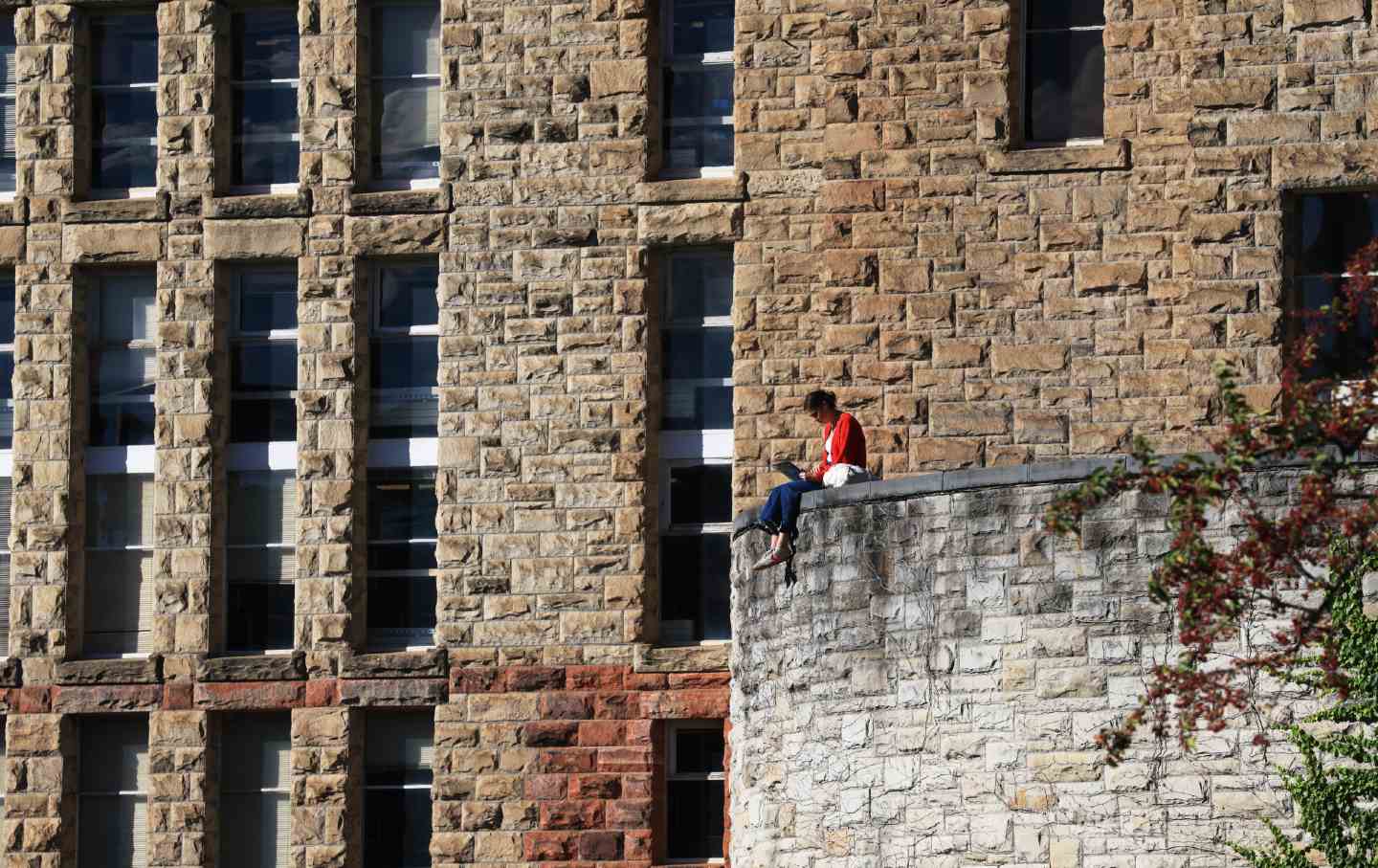
A student sits on Cornell’s campus before a protest against the university’s actions following Jane Doe’s alleged sexual assault at a campus fraternity in 2024.
(Spencer Platt / Getty Images)What would it take for this to be the last Jane Doe?
In September, a former Cornell student sued her university for failing to protect her from seven members of the Chi Phi fraternity who she alleges gang raped her in 2024. The public has fixated on her accused assailants, and on the perceived impunity they’ve enjoyed from the university. But Jane Doe’s lawsuit should make us consider not only her school’s lax response to the alleged assault but also how Cornell, and institutions everywhere, enable the kind of violence she endured.
We live in an “assaultogenic” society. How did we get here? Why are we still here? And what do we do to move forward?
Few people have thought as deeply about the answers to these questions as Jennifer S. Hirsch and Shamus Khan, authors of Sexual Citizens: A Landmark Study of Sex, Power, and Assault on Campus. Hirsch, a professor of sociomedical sciences at Columbia, and Khan, the Willard Thorp Professor of Sociology at Princeton, draw on years of interviews, ethnographic observation, and survey data at Columbia to expose the “social ecosystem” that makes sexual assault a predictable feature of college life.
Asking readers to consider more than just predation and punishment, the authors treat sexual violence as the consequence of power imbalances between students of different genders, ages, races, sexualities, and class backgrounds. Meanwhile, institutions render these dynamics more dangerous by funneling the vulnerable into physical spaces controlled by the powerful. Students arrive at college severely underprepared to navigate this landscape, having never been taught how to articulate their own desires and boundaries—let alone those of their peers.
“It takes a lot of work to teach kids to move their bodies safely through the world,” the authors write. “We know this about everything except, it seems, sex.”
—Lily Seltz and Lara-Nour Walton
Lily Seltz & Lara-Nour Walton: Part of what’s so striking about Jane Doe’s story is how many people are alleged to have been complicit in her assault—not only the seven named in the lawsuit, but also the more than 50 men who were part of the Snapchat group where one person advertised “free pussy.” The loyalty between these fraternity members seems to have overridden any sense of obligation to Jane Doe herself.
In Sexual Citizens, you have a chapter called “The Power of the Group,” where you argue that groups frequently enable sexual situations, including assaults. How do groups fit into the campus sexual landscape?
Shamus Khan: Groups are very involved in creating sexual opportunities. We already have language for this. We talk about “wingmen” and “matchmakers.” An individual can be “cockblocked” by someone. Sex is not just an interaction between two people.
This is important to recognize for a whole host of reasons. One is that consent understands sex on a very contractual basis: individuals consenting to individuals. But that’s an inadequate framework, because sexual experiences are often totally enmeshed within group dynamics.
The second thing is that groups often reflect societal power structures. Different groups are more powerful than others, and within the fraternity and sorority system, alcohol is given to men [sororities are not allowed to possess or serve alcohol by official Panhellenic rules]. There’s a reason why Jane Doe walked into a fraternity and not a sorority: Fraternities are the places that can have parties.
Also, if we look at national statistics, men drink more than women. Fraternities are disproportionately white, and white people drink, on average, more than other racial and ethnic groups. So schools have designed things such that a specific group on campus that drinks more also controls the spaces of socialization.
Jennifer S. Hirsch: When we think about the power of the group, we should also think about the power of groups that have fundamentally failed so many Jane Does. In our research, we show that women who’ve experienced comprehensive sexuality education with skills-based components are half as likely to be raped in college. Yet the New York State Legislature has not passed a requirement that schools provide such education.
The Legislature is a powerful group that, for some reason, has refused to use its power in ways that we know would work. It’s like if we had a vaccine that was going to prevent half of the deaths from a disease and lawmakers decided not to give it to people. Either we need new policies or we need new policymakers.
LS & LNW: You just mentioned comprehensive sexual education and the limitations of a consent-only framework. What is comprehensive sexual education? What sets it apart from basic consent education?
JSH: Comprehensive sex ed includes the full range of things that people need to know to move their bodies through the world as sexual individuals in a way that helps them get where they want to go without hurting themselves or others. Students learn human development and healthy relationships, develop communication skills, get age-appropriate information about sexuality and sexual health, and learn to think critically about how the social world shapes sexuality. It needs to start in kindergarten. Respect for other people’s bodies—“sit criss-cross applesauce and keep your hands on your own body”—is a fundamental part of kindergarten. Also, there’s a ton of evidence that starting early with age-appropriate sex ed is highly protective against child sexual abuse.
Age-appropriate strategies help students learn to “communicate personal boundaries and show respect for someone else’s personal space.” Teaching young people about sexual citizenship —the right to choose one’s own sexual experiences, and the idea that other people have the same right—starts with teaching that other people are people, not furniture.
Consent education could be an important booster, communicating to students that an institution of higher education values sexual citizenship. But for students who have never had sex ed, it’s like teaching about driving by only telling people to stop at stop signs, when they don’t know how the brakes work, or how to switch lanes, or even how their turn signals work. If all you know about driving is to stop at stop signs, you don’t belong on the road.
Consent is a concept, but sex is a social act, and comprehensive sex ed helps people develop the self-understanding to think critically about what they are doing, to value the equivalent humanity of others and their right to sexual self-determination, and the communication skills to safely navigate complex interpersonal situations.
LS & LNW: Are there any current initiatives to implement comprehensive sex ed?
JSH: There is actually a bill sponsored by New York State Senator Julia Salazar that would create these standards for sex ed. At the moment, all that’s required in the state of New York is that students get education on HIV and AIDS. Of course, that is important—HIV infection rates have ticked up in NYC in recent years, and young people are disproportionately affected by sexually transmitted infections. But it’s totally insufficient. The Healthy and Safe Students Act would make up for the many deficiencies in the sex ed being provided to youth in New York State, making sure that they all learn about healthy relationships, consent, boundaries, and bullying prevention.
LS & LNW: Could you describe the “sexual geography” framework that you use in Sexual Citizens? How could considering the layout of our built environment help us better understand campus assaults?
JSH: Spatial choices at the institutional level amplify the power of already powerful groups on campus. First-year students are in small dorm rooms. They can’t host parties. Alcohol is more severely policed in those spaces, because most students are underage. If you want to go to a party, your options are: go to a bar if you have a good fake ID and you have money to buy drinks, or go to a space controlled by older men. And the power disparity between a fourth-year man and a first-year woman is very substantial. It’s a disparity of age. It’s a disparity of comfort in the college environment. It’s typically a disparity of experience with alcohol and with sex.
Many policy choices have created a system that essentially funnels first-year women into spaces controlled by older men. There are things that could be modified about campus sexual geography. How do we provide less advantaged groups of students—first-year students, or first-generation students, or racial or ethnic minority students—with access to party spaces? And we should think about housing, too. We’ve naturalized the idea that the older you are, the better your living spaces. But it’s incoming students who really need that good space.
The sexual geographies that set the context, both for sexual encounters and for sexual violence, are modifiable at the social and the institutional level. But that requires people who may not see themselves as sexual assault prevention stakeholders to step up.
LS & LNW: What do you make of the role of substance use in Jane Doe’s case, and in the college sexual landscape more generally?
SK: One of the things we show in the book is that people don’t get drunk and then happen to have sex. They get drunk in order to have sex, and we understand that as socially produced. Sex ed that counters, rather than reinforces, shame around sex is part of our prevention strategy. If you don’t feel like you need to be ashamed to have sexual desires, it doesn’t require you to get drunk out of your mind to have sex.
There’s a lot of focus on Jane Doe’s substance use, but being under the influence also makes people more likely to commit harm. When we teach about drunk driving, we don’t say, “Don’t get drunk and drive, because if there’s another drunk driver on the road, they’re likely to hit you.” What we say is, “Don’t get drunk and drive because you could hurt someone, including yourself.”
LS & LNW: People on the Internet have zeroed in on the now-public text exchanges between Jane Doe and her alleged assailants following the assault. A lot of the messages are friendly or conspiratorial, and people may view them as exculpatory evidence. Why do some victims stay in touch with their assailants after the fact? And why might it be misguided to try to disprove allegations based on post-assault behavior?
JSH: In our research, Shamus and I found that that there’s no right way to be a sexual assault survivor. Most people are assaulted by someone they know—frequently a friend, sometimes someone they found attractive, someone they care about. So students do a lot of interpretive work to try to figure out how to square what happened to them with the whole fabric of their life. This is not just a campus phenomenon; people remain in domestic marital situations with people who are abusing them and threatening their lives. It’s not unusual that people who are enmeshed in relationships in which they experience harm continue to be in those relationships.
This also serves as a reminder that the sexual assaults that are reported to administrators or police, let alone reported in the media, are only a fraction of the total assaults on college campuses. It is much easier to report an assault by a stranger than a friend. When somebody is deeply knit into a friendship group, and they experience a betrayal from someone in that group, what’s at stake is the whole architecture of their college project. That’s a very hard kind of assault to report.
The assaults that people report are also the ones that they, at some point label, as assault. Some people are unwilling to say that what happened to them was a violation, that “what happened to me was wrong.”
LS & LNW: You brought up the need for states to mandate comprehensive sex ed. What else can policymakers do beyond education? And what can institutions of higher education do to prevent sexual violence on campus?
JSH: We can use the collective rage we feel to push for institutional and legal change, like revising intoxication laws. [New York state law holds that voluntary intoxication does not preclude a person from consenting to sex unless they are completely incapacitated].
SK: In the US, we frequently fall back on, “let’s give some trainings to people and hope that they’re going to act better the next time.” But we know that doesn’t work.
We think about sexual violence as a manifestation of systemic harm and inequality within a society. There are other manifestations of that: the mental health crisis and substance use. We think about these as three legs of a stool. What we’re asking for isn’t just a policy agenda that goes to sexual violence, but really thinks critically about how much of what we do creates systemic power inequalities. We need a big tent agenda to take this on, and it needs to be policy driven and institutionally oriented, rather than a therapeutic politics of individual transformation.
We lay out some of the strategies that institutions can use in our Sexual Assault Prevention and Community Equity toolkit, which encourages universities to “leverage the organization of residential and social space on campus” to advance equity and prevent violence. No one thing is going to be the cure-all. But the small steps we can take are as simple as ensuring students have spaces other than dorm rooms to socialize after parties end and bars close. One great example of this is keeping a dining hall open all night, as Columbia has opted to do.
LS & LNW: Since Jane Doe’s civil complaint became public, Doe’s supporters have homed in on the lenient treatment of her alleged assailants, and attempted to take some form of justice into their own hands—circulating the names and faces of the seven men to encourage social censure. Where does accountability and punishment fit into your vision of how we respond to sexual violence right now?
SK: There is a place for punishment—accountability will have consequences that are positive and will reduce harms after they happen. But, we might reflect for a moment on America’s proclivity for mass incarceration, and ask ourselves whether our exuberance to imprison tons of people was actually as transformative as we thought it would be. We can’t punish our way out of problems. We have to focus on preventing them.
Popular
“swipe left below to view more authors”Swipe →In our work, we saw so many people who described textbook examples of committing assaults, and didn’t realize that they were in the wrong. When people commit assaults and don’t think they’re doing the thing, the punishment for that crime is not really going to affect their behavior.
JSH: Shamus and I are not comfortable telling people to not be so angry. Those feelings are real and justified. But to keep this from happening in the future, we have to think audaciously about what it looks like to promote sexual citizenship. At the heart of the Cornell story is the failure to see a classmate as an equivalent human being. So it doesn’t matter if people have one class on consent or 100 classes on consent, if you don’t actually get to the underlying values question.
SK: A punishment-focused response also risks making people very fearful about sex, which can actually make it more difficult for them to do the work of recognizing their partners’ sexual citizenship, and their own.
LS & LNW: What do you make of the current call to ban Greek life ?
SK: If we ban Greek life without fundamentally restructuring the dynamics of campus life, we’re still going to see cases like Jane Doe’s. Places that don’t have Greek life also have high rates of sexual assault, because they still funnel younger people into spaces disproportionately controlled by more powerful people on campus.
JSH: In the calls for banning Greek life, part of what I hear is just a level of intolerable rage. People are saying: “This cannot stand.” We agree that we need to do a big, hard thing. But the big hard thing that we would like to see is the leaders of every institution of higher education in the country getting together to say: “The kids that you’re sending us are dangerous because they’re not being taught anything about sex.”
Remedial sex ed in college is not enough. It has to happen from kindergarten to 12th grade, in part because so many people experience sexual trauma before they even get to college, but also because so many people don’t go to college.
LS & LNW: There is so much emotional power and potential in this moment. How do we make it possible for people who are feeling so angry right now, and so eager for justice and accountability, to channel this energy into the preventative policy interventions that you’re advocating for?
SK: The activists’ responsibility is rage, and the administrators’ job is to do the bureaucratic work.
JSH: Right. The first step to solving a public problem is to drive widespread agreement that it’s a problem, that it’s an intolerable situation, that it’s something that needs a solution. For that, as Shamus said, you need the rage. And, until we are really sure that this is not going to be forgotten in six months, the rage is our fuel. Let’s keep going with that.
More from The Nation
What Role Should the Supreme Court Play in American Politics? What Role Should the Supreme Court Play in American Politics?
A wide-ranging new book by Nikolas Bowie and Daphna Renan examines how America’s highest court often gets in the way of democratic politics.
Monstrous Merger Monstrous Merger
Allowing Paramount to buy Warner Bros. is a capitulation to corporate power and a threat to press freedom.
How Congress Is Cashing In on the AI Boom How Congress Is Cashing In on the AI Boom
Roughly one in five members of Congress has household investments in the industry.

Rebecca Solnit's (Mis)Adventures in the Manosphere Rebecca Solnit's (Mis)Adventures in the Manosphere
Rebecca Solnit explores an America where the right has turned hatred of women into an ever-expanding, multi-platform Internet grift.
Wendell Berry’s Unrelenting Vision Wendell Berry’s Unrelenting Vision
The poet wrote for The Nation for decades, always demonstrating conscience and prescience.

Anthropic Wants You to Be Kind to Claude Anthropic Wants You to Be Kind to Claude
…even as AI courts serial real-world disasters, defaces the environment with data centers, and is not about to return your empathy in kind.

