This Election, Black Women Showed How Much They Love This Country. Will It Ever Love Them Back?
We overwhelmingly cast our votes for the unfinished dream of democracy. Guess we’re mostly alone in that commitment.
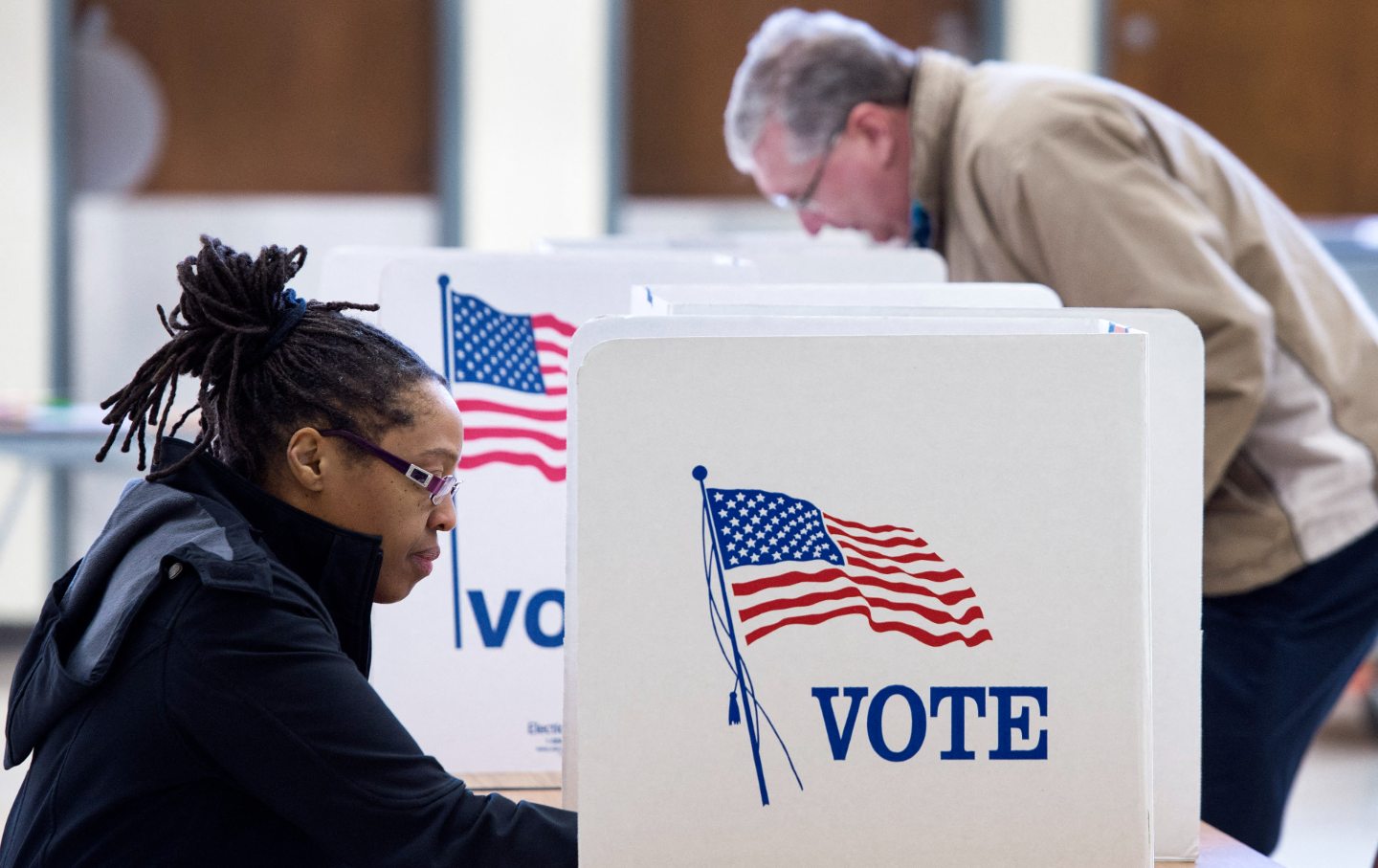
Part of me thinks that I have only myself to blame for being even nervously optimistic about Kamala Harris’s chances this election. I know this country—and the racism and misogyny inherent in its founding that stretches into the present—and I am well aware of how, time and again, it has fought back, often violently, against multiracial democracy.
And so I really had no justifiable reason for entertaining the idea that America would elect a woman—much less a Black and South Asian woman—as president. Maybe I loved this country so much I believed it might try to be better. That’s on me, I guess.
Related Articles
I was never naïve enough to think that white women, a nearly consistent Republican bloc since 1952, would vote for Harris. In Arizona, Missouri, and Nevada, Trump-voting women likely contributed to wins for abortion rights initiatives while helping to hand Harris a loss—an on-brand move from a group that has, collectively, stepped over Black women since the days of the suffragettes. Trump also made inroads with numerous groups of color. Are there “legitimate” reasons for that? Well, registered voters who were blind-tested on policy proposals without knowing which candidate backed them overwhelmingly preferred Harris’s stances, including professed Trump supporters. Her policies on crime, foreign policy, and the economy were more popular than Trump’s, while her immigration policies were equally popular yet less polarizing. The minutiae of Harris’s platform was, arguably, unknown to most voters (notably, in the aforementioned blind poll, respondents often falsely attributed her policies to Trump). But even the lowest-information voters knew that Trump had no policy proposals at all, save for mass deportations and tariffs.
Perhaps they didn’t believe Trump would follow through on the horrors he promised, giving the benefit of the doubt to an adjudicated rapist (as the judge overseeing the trial described the verdict) and felon while assuming the worst of a self-made prosecutor and career public servant. Please—convince me that race and gender didn’t shape those assumptions. We know that at least 77 million people voted for Trump, giving him the popular vote. That means those of us who voted for Harris weren’t betrayed by the archaic, undemocratic Electoral College but by our neighbors, our coworkers, and the strangers we pass on the street.
This must have come as great news for the MAGA movement, which has obsessed over what will happen when white Americans cease being a majority of the population. Apparently, all that a lot of us need, in order to vote for our own marginalization, is for a demagogue to promise better prices on eggs.
I realize there are those who cast votes for Trump, explicitly or by third-party default, to protest the Biden administration’s policies on Israel and Gaza. That’s different from voting for Trump to lower the price of groceries. But I fear that he will help bring devastation to Gaza even beyond what we’ve seen. After all, Trump has alluded to his vision for a flattened Gaza to be remade into a waterfront playground for the rich; used “Palestinian” as a slur against his rival; and instituted a Muslim ban in all but name during his first term. Though he made repeated (yet policy-empty) promises to bring peace, he remains a well-known pathological liar. In any case, I don’t think the majority of Trump voters are among those objectors. Instead, I suspect most—including those who belong to historically marginalized groups—believe there’s safety in aligning with power instead of opposing it: that if you join the MAGA cheering section, you might avoid finding yourself in its crosshairs. But that outlook, most Black folks recognize, is foolhardy. Accordingly, there’s one demographic that still isn’t buying Trump’s bullshit: Black women, who voted for Harris by more than 90 percent. That’s not because they are a monolith. It’s just that, with so much on the line, they saw a need to be both principled and pragmatic.
It’s hard to feel anything less than betrayed and hopeless right now. As always, Black women showed unfailing, unrequited love for this country and an unmatched belief in the politics of solidarity. They didn’t cozy up to the bully, hoping to be spared when he turned on everyone else. They didn’t mistake his gaudy wealth for the promise of shared prosperity. Instead, they cast their votes for the unfinished dream of democracy—for the belief that, given time and struggle, we might work toward something that serves and protects us all. Guess we’re mostly alone in that belief. (Though shout out to Black male voters, nearly 80 percent of whom voted for Harris.)
This wasn’t just an election—it was a reveal. It showed how many of us are willing not only to stand idly by, but to actively vote for harm against others for the possibility of a come-up. In my worst post-election moments, I’ve caught myself, fleetingly, hoping that Trump supporters experience no less than exactly what they voted for. But that’s neither my politics nor who I really am. It’s probably just the tiredness talking.
In recent weeks, Trump supporters have celebrated by indulging in characteristic displays of racist and sexist intimidation and harassment. The white nationalist Nick Fuentes coined the right’s new misogynist taunt: “Your body, my choice.” In at least 30 states, Black students received anonymous texts telling them they had been “selected to pick cotton at the nearest plantation.” Fascists shouted “Heil Hitler and Heil Trump” outside a community theater’s staging of The Diary of Anne Frank in rural Michigan; on the streets of Columbus, Ohio, neo-Nazis waved swastikas and yelled racial slurs.
As Trump returns to power, some of these threats will turn into successful incitements to violence. But the most consequential harms will be inflicted by his legislative and policy agenda. Many folks who could always be counted on to fight back are exhausted. They’re focused on taking care of their own. Can’t blame them for adopting that most American ethos of selfishness. Hopefully, it’s temporary.