The Jewish Justice Movement Is Being Reborn
At the Jewish Voice for Peace rally, thousands of protesters made clear that they will no longer allow the suffering of the Jewish people to be weaponized against others.
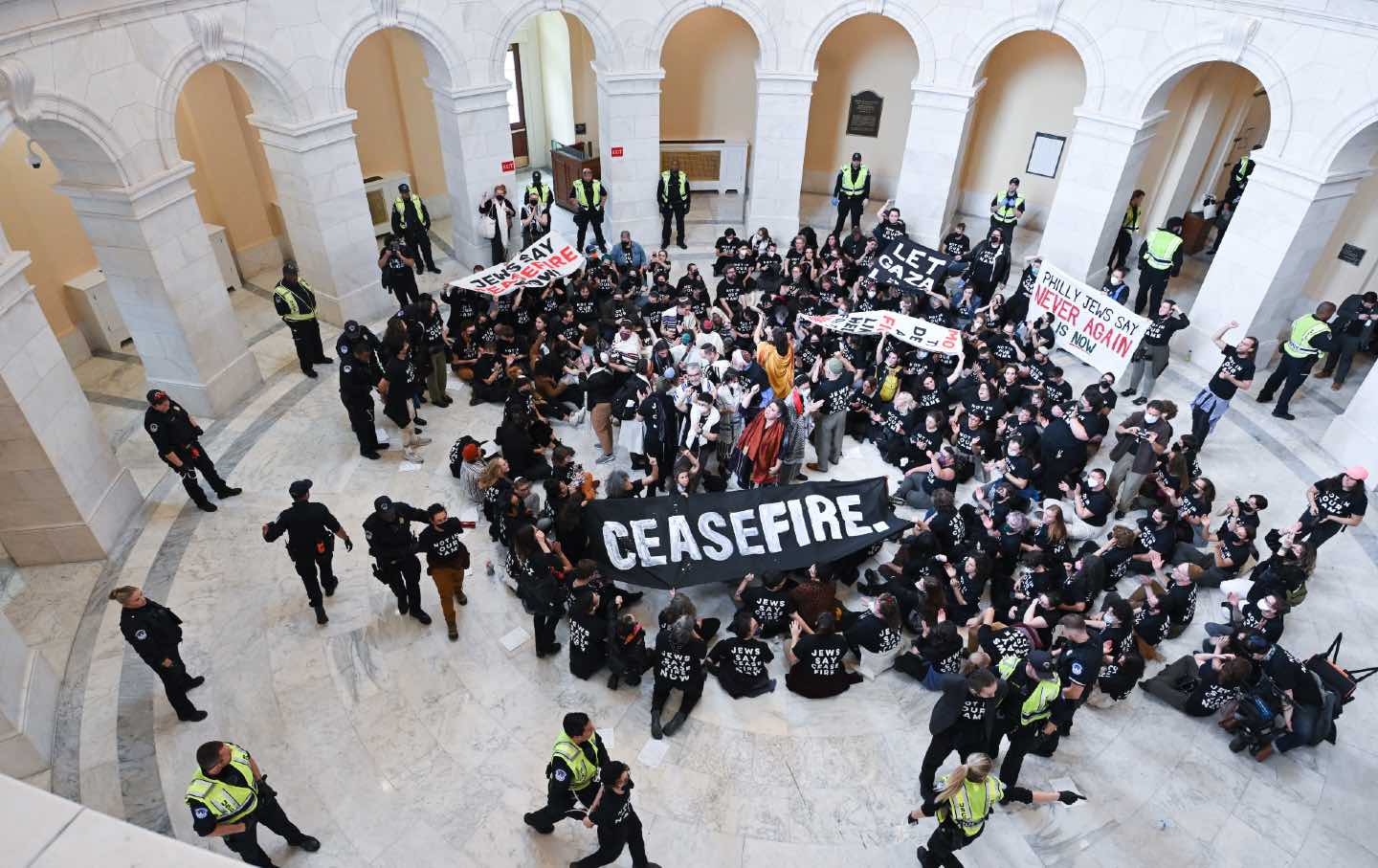
Jewish Voice for Peace demonstrators demand a cease-fire in the Israel and Gaza conflict on October 18, 2023, in the Cannon House Office Building in Washington, D.C.
(Matt McClain / Getty)On October 18, several hundred US Jews—along with a few allies—were arrested for sitting in the rotunda of the Capitol building. We chanted, we sang, we dropped banners, and we spoke with a clear message: Stop the war on Gaza; cease the bombing; and end Israel’s war on the Palestinian people, which must no longer be waged in the name of Jews. When we occupied the space, we shed our jackets to reveal identical black T-shirts that read “Not In Our Name” on the front and “Jews Say Cease Fire Now” on the back.
Aided by a melodious shofar, two dozen rabbis spoke about the moral urgency of the moment while thousands of fellow Jews chanted “Cease-fire now!” outside the building. Together, it created a cacophony of righteous trouble in the best tradition of our people. It recalled our ancestors who stood with the oppressed, who helped build the labor movement, and who devoted their lives to anti-racist struggle. For decades, that history often seemed distant. On Wednesday, it felt reborn.
Jewish Voice for Peace organized the rally on just a few days notice, and protesters came ready to be heard. The arresting officers kept asking people if they were going to give up their right to remain silent, and it was as if everyone shouted back, “Hell yeah!”
In many places, Jewish silence on the oppression of Palestinians has reigned for too long. But at this moment of crisis, protesters said what perhaps had gone unspoken at family gatherings or in places of worship: that we have had enough, that we will no longer allow the suffering of our people—the pogroms, the Holocaust, or the Hamas killings—to be weaponized against others. Our history gives us an extra responsibility to speak out for those facing the specter of genocide.
For Israeli Prime Minister Benjamin Netanyahu and President Joe Biden “never again” is a slogan, a bumper sticker, a rallying cry for more carnage. But for those inside and outside the Capitol, “never again” means exactly what it’s supposed to: “Never again” will we allow masses of people to be massacred. If the rest of the world turns a blind eye, the Jewish people will raise up and bear witness. David Friedman, the ambassador to Israel under Donald Trump, took to Twitter to say, “Any American Jew attending this rally is not a Jew—yes I said it!” Suffice it to say, Friedman, who spent years as a hack for the openly anti-Semitic Trump, is not in charge of who gets to be Jewish.
Almost certainly to Friedman’s chagrin, protesters made plain that there is nothing anti-Semitic about criticizing the Israeli state and there is nothing bigoted about standing up to US aid and support for Israel’s war on the Palestinian people. The gaslighting and gatekeeping of powerful officials like Friedman have made people of all backgrounds afraid to speak out, lest they be called anti-Semites. Jewish Voice for Peace is saying that people need to stand up against the slaughter nonetheless and that this fear and silence has deadly consequences.
This week in D.C. has felt historic: An emergent Jewish resistance has been a part of daily protests across the city. A thousand people on Monday blocked the entrances and exits to the White House. Nightly demonstrations have been taking place in front of the corridors of power. As I write this, Jewish people are being arrested at the Israeli embassy. But while Wednesday, October 18, will be remembered, it was also too small. The hundreds of Jews in the rotunda should have been thousands. The thousands outside the Capitol building should have been tens of thousands. This moment demands a Jewish revolt against the false messiahs of Netanyahu’s war cabinet, of the evangelical mega churches, and of too many politicians on both sides of the aisle. This isn’t about choosing “teams,” as Biden said. It’s about stopping a slaughter.
Jewish folks are not the center of this struggle. We’re part of a global resistance movement. But as Jews, we have a moral and political obligation to try to end the violence being inflicted in our name. It is time, at long last, to give up our right to remain silent.